


The 2026 Guide to Building Real Equity in Metro Detroit Rentals
After a rollercoaster year of political uncertainty and disruptive market forces, many rental investors are focusing on the fundamentals–like building equity.
The recent government shutdown underscored why smart systems and mathematical discipline are non-negotiable for anyone serious about growth.
So if you want to build equity for your rental portfolio in 2026, what’s the best formula?
We’ll break down the equity-building strategy we think works best right now, using the Metro Detroit market as an example.
Let’s run the numbers.
How Strong Is Metro Detroit’s Rental Market?
According to the latest CoreLogic data, Detroit clocked an 8.7% year-over-year gain in home prices, recently overtaking Miami as the fastest-appreciating housing market in the US.
While coastal markets face affordability crunches and investor slowdowns, Metro Detroit is seeing steady rental growth and equity gains:
- Rental Snapshot:
Detroit’s average rent in late 2025 holds steady near $1,200, but in suburbs like Oak Park, you’ll routinely see three-bedroom homes bringing in $1,350–$1,600 per month.
Demand is persistent—low vacancies and practical rent levels keep cash flow consistent.
- Current Mortgage Rates:
With 30-year fixed rates around 5.99% and 15-year loans at 5.375%, borrowing costs are higher than pandemic lows, but Detroit’s affordability changes the equation.
Here, median home prices under $200,000 mean investors can still secure strong yields without over-leveraging.
- Annual Appreciation:
Most forecasts track 3–6% appreciation rates for Detroit homes in 2026.
But with 8.7% annual appreciation in 2024, we can see just how much headroom remains for both equity growth and future rent bumps.
Detroit’s secret sauce?
Accessibility.
As Dr. Selma Hepp, CoreLogic’s chief economist, pointed out, Detroit remains one of the few metro areas where typical families aren’t priced out the day they start shopping. For investors, that means the pool of quality tenants—and buyers down the line—is deeper than ever.
Pair that with multibillion-dollar investment from Detroit’s automakers and ongoing city revitalization, and it’s clear: this is a market built for durable, compounding returns.
What Makes Equity the Real Prize for Detroit Landlords?
Think of equity as quietly compounding wealth—your ownership share in the property, growing every time a tenant pays rent, and every time Detroit posts another year of appreciation.
It’s not just “phantom money”—it’s future leverage for expansion, an emergency reserve, and the fastest on-ramp to true financial independence for rental owners in affordable Midwestern markets.
Case Study: Single-Family, Condo, or Duplex?
Now let’s look under the microscope and see how three different investment paths stack up right now—using real price and rent ranges from Oak Park, Michigan– a highly sought-after inner-ring suburb of Detroit.
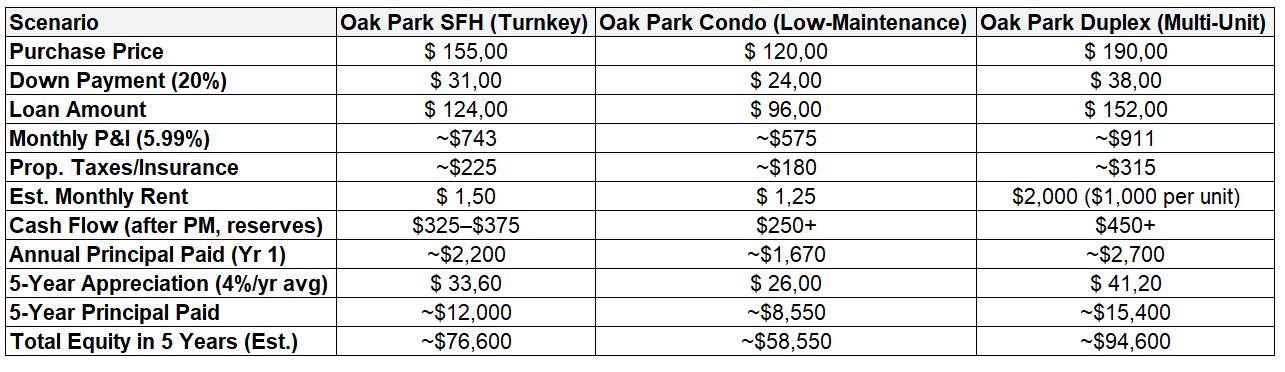
Numbers shown include standard property management, basic vacancy/maintenance reserves, and average local taxes/insurance. Always plug your own figures into the equation.
What Do These Scenarios Tell Us?
- Boring Wins: A basic, well-renovated Oak Park single-family is a steady equity engine, producing both cash flow and above-average appreciation with minimal drama.
- Low-Fuss, Slower Growth: The condo keeps things simple and offers predictable returns, but the ROI curve is gentler—great for newer or out-of-state investors.
- Doubling Up: A duplex jacks up cash flow and equity growth, but comes with more active management and risk (especially if you self-manage versus using a pro PM).
New-Generation Equity-Building Strategies That Actually Work
1. Embrace Principal Prepay—But Only If Cash Flow Allows
Extra principal payments in Year 1-5 have an outsized impact when rates are near 6%. Even $150–$200/month above your regular mortgage speeds up your equity gains dramatically—just make sure your reserves aren’t being starved to fund them.
2. Focus Renovations on “Tenant-Proof” Upgrades
Forget over-improving. In Oak Park, curb appeal, leak-resistant roofs, and modern, efficient HVAC rank far above granite counters. These boost value, minimize headaches, and support higher rents year after year.
3. Joint Venture or Partner for Multi-Unit Scale
Want bigger equity jumps? Partner up for a duplex or two. In a diverse, high-demand suburb like Oak Park, a properly managed multi-unit can protect against vacancy shocks and accelerate principal reduction as both units work together to pay down your mortgage.
4. Equity Is for Offense and Defense
Post-shutdown, Metro Detroit investors know: equity is your safety net and your springboard. Use it wisely—either to weather storms, fund your next purchase via a cash-out refi or HELOC, or simply sleep better at night knowing your portfolio has margin for error.
If you’re looking for a guide who can crunch the numbers, spot the overlooked deals, and help you scale smart in Oak Park or anywhere in Metro Detroit, reach out now. Let’s put your equity to work—without the gimmicks, just disciplined, data-backed strategy.
Unlock exclusive off-market Detroit-area opportunities— and start building the kind of equity that pays off for a lifetime.


Comments