


How To Avoid Paying Capital Gains Tax? With Eric Brotman
“The most rewarding part of what I do is seeing the positive outcomes and positive outcomes for us and our clients aren't necessarily investment returns or something quantitative, their life moments they're being able to retire with dignity and to be able to be financially independent and to be able to see their kids or grandkids or great-grandkids get an education and not be buried in debt or issues, it's buying the dream home, or the vacation home, or the, or being able to help the charity that makes the most, that means the most of them.”
Eric Brotman is a CFP and PCP who is the Chief Executive Officer of BFG. Financial based out of Baltimore, Maryland. It's an independent firm assisting clients with wealth creation, preservation, and distribution. He has over 25 years of experience in financial planning. And he is here to share some knowledge. In fact, recovering the four ways to pay less in taxes. He is also the host of don't retire Graduates, a podcast dedicated to teaching listeners how to advance into retirement in a more efficient way that helps them financially as well.
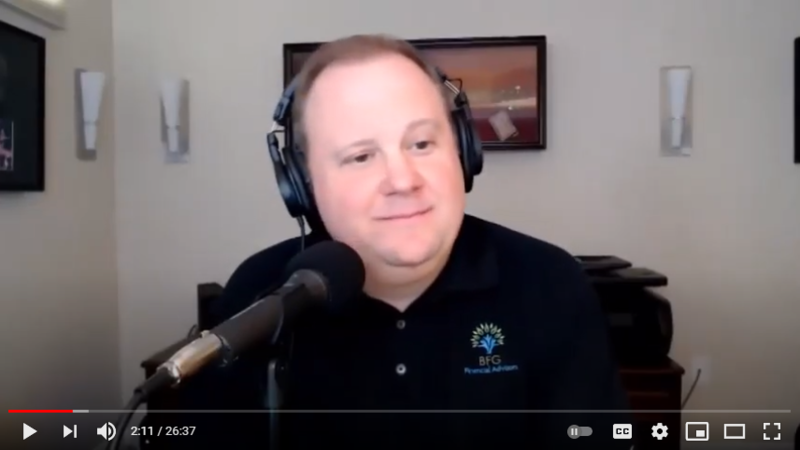
Click on the video below:
Brett:
My next guest is a financial expert. In fact, he is a CFP and PCP who is the Chief Executive Officer of BFG. Financial based out of Baltimore, Maryland. It's an independent firm assisting clients with wealth creation, preservation, and distribution. He has over 25 years of experience in financial planning. And he is here to share some knowledge, in fact, recovering the four ways to pay less in taxes. He is also the host of Don't Retire, Graduate, a podcast dedicated to teaching listeners how to advance into retirement in a more efficient way that helps them financially as well. Hey, welcome to the show, Eric Brotman. Eric, how are you doing?
Eric:
Sure, the story is that I started financial planning and wealth management back in the 90s, and created an independent firm in 2003. And have grown it to now an organization with 21, folks, eight financial advisors, we work as a team as an ensemble. We have clients in 30 states, and manage money for multi-generational families. And so we're not looking to do corporate work or employee benefits or executive benefits necessarily, what we want to do is work with, with high net worth families, upwardly mobile families, and families that are trying to grow wealth, preserve wealth, and ultimately make sure that most of it stays within their family after they go as well.
Brett:
Excellent. And Eric, I'm curious, you know, I think our listeners are with our guests who have been so successful and have so much experience before we dive into some of the strategies that you use to help folks with what you do. Who was Eric growing up? In other words, I think we've all been given superpowers, right, a superpower, I call it a gift from God. And maybe it's one or two or three, some of us have more, but maybe what's that one gift that you were given? Eric? And how does that help how you help people today?
Eric:
You know, even at a very young age, I think I was a connector, I was the one most likely to put together a game on the playground or to put together a group for the prom. And so just from all ages, I still consider myself a connector. Now it's more social media sometimes than it is physically. But at the end of the day, I love connecting problems and solutions and people who can help one another. So I think my superpower is just that.
Brett:
Excellent. And did you play any sports growing up or do anything like that? Where maybe you're the captain of the team and helping lead the squad forward?
Eric:
I played lots of sports and none of them well. So I was never the team captain. Although I was frequently the one who worked the hardest in practice because my Super Bowl was practice. I was not much of an athlete. You know, at the end of the day, I look back on that and think, man, I really tried.
Brett:
Absolutely. Well, thanks for sharing that. And I think that it's so good to have the connector, right? Because otherwise, you know, a people's communities aren't built as much and, and, and leadership isn't advanced unless we're all working together as a team, right. And so to have that gift is a great gift to have. And so thank you for sharing that. So Eric, what's the most rewarding part of what you do?
Eric:
The most rewarding part of what I do is seeing the positive outcomes and positive outcomes for us and our clients aren't necessarily investment returns or something quantitative, their life moments they're being able to retire with dignity and to be able to be financially independent and to be able to see their kids or grandkids or great-grandkids get an education and not be buried in debt or issues, it's buying the dream home, or the vacation home, or the, or being able to help the charity that makes the most, that means the most of them. So I think it's all about outcomes. It's all about the whys. The hows are in a textbook, and the whats we can figure out and the who's we can meet, but ultimately, the whys are what matters. That's why we do what we do.
Brett:
I love that I read the book by Simon Sinek Start With Why maybe you have to, but it truly is, I think, why we do what we do, and the inspirations behind it. And again, all of the gifts that we've been given to make a difference in people's outcomes, whether it be with us, you know, the services we provide, and or the financial legacy that folks can leave, right, which leads into the opportunity to take advantage of legal tax loopholes, right, and finding ways to pay less in tax. Let's be honest. Right. So with that being said, I'm curious, you know, four ways to pay less in tax, maybe do you have a couple you want to share with us?
Eric:
Sure, there, there are four strategies available to almost every American family, where you can park money, where it will never be taxed again, legally, of course. And some of those are obvious. So when I say hey, here's a place where you can invest money, and it'll never be taxed. Again, what a lot of people immediately think of is the Roth IRA or the Roth 401k. And that's absolutely true. That is certainly one of the options. The other ones that maybe get a lot less exposure, but you get a lot more. One of them is the Health Savings Account. HSA 's are amazing. They're a tax accident, as far as I'm concerned, because they are the perfect vehicle where you can get a deduction for your deposits, you can grow tax-free. And you can make tax-free withdrawals as long as it's for health care. And quite frankly, I don't know anybody who's going necessarily at any couple, who's going to be fortunate enough to never have medical expenses at some point in their lives. So a lot of people think HSA has to be used immediately, and you have to park money and then spend it on deductibles or coinsurance or all this other nonsense. The fact is you don't you can, you can save that for decades and let it grow and never pay capital gains tax, which is wonderful. Another strategy is a 529 plan. Yes, it's for education. So there are strings attached to it. However, it's a spot where you can put money away, you can get it out of your estate, which is very significant, particularly in certain parts of the country, you can get it out of your estate by naming your children or grandchildren or someone else, your next-door neighbor, as a beneficiary, you're never gifting the money, you're not giving it to them, it's still yours. But it's outside of your taxable estate. It grows with no taxation. And as long as it's used for a qualified educational purpose, which in a limited way can be for private school can also be for college or grad school, or you could even go back for your Ph.D. bread. If you were thinking about doing that. It's always an option. But at the end of the day, there will be someone in your family or in your community at some point that's going to want educational funds, and you could put money away for decades and never pay tax again. And the last is whole life insurance, which people absolutely don't understand. It's incredibly powerful to sort of be your own bank and have your own collateral and be in a position to utilize that. And so these four strategies between the whole life insurance, the HSA, the 529 plan, and the Roth IRA, I wrote an e-book that's available for free download, it can be found at low tax book.com. And anyone who's interested in it can read that I go through examples, I go through the details. And I also tell my personal story. Because quite frankly, there's a fair amount of money of mine that is in those four strategies, and it's working my tax bill. It's only gruesome because of earned income. It's not gruesome because of my money at work.


Comments