


Strategy for great Return on Investment on undervalued multifamily pro
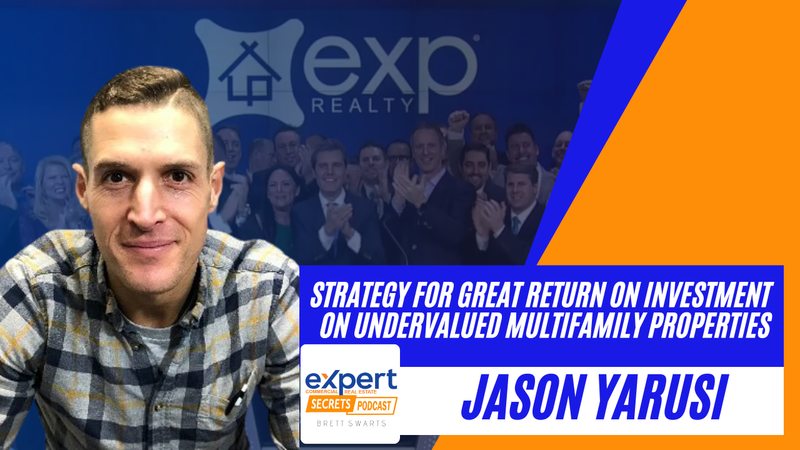
"I call myself passive-aggressive in our search for opportunities, is that we're out there looking, we know our game plan for work, we're not forcing ourselves to find a deal. So the deals will come with our plan. But we don't want to just take on any deal just for the sake of a deal. That's not our game plan. So just always committing to do the work to make sure that we'll be on the right spot when opportunity provides."
Jason Yarusi is an active real estate syndicator and investor. In 2016, he founded along with his wife, Yarusi Holdings, a multifamily investment firm and where they have general partners in over 800 units and with 450 units under management. The firm repositions properties through operational efficiencies, moderate to extensive renovations, and complete re-branding. He is also the host of the Multifamily Live Podcast.
Watch the episode here
Brett:
I'm excited about our next guest. He's a repeat guest from a year ago, he was on the show, and we have a lot to catch up on. But as an introduction, he's an active real estate syndicator and investor. In 2016, he founded along with his wife, Yarusi Holdings, a multifamily investment firm and where they have general partners in over 800 units and with 450 units under management. The firm repositions properties through operational efficiencies, moderate to extensive renovations, and complete re-branding. He is also the host of the Multifamily Live Podcast, please welcome to the show with me, Jason Yarusi. How are you doing, sir?
Jason:
I'm doing great. Thanks for having me back.
Brett:
Excited to dive in and catch up. For our listeners that are just getting to know you for the first time. Would you give us a little bit more about your story and your current focus?
Jason:
Yes, sure. So currently, since the last time we spoke I've actually moved down just south of Nashville into Murfreesboro, Tennessee from New Jersey. My wife and I have Yarusi Holdings and a multifamily syndication firm with about 150 plus units spread across four markets. We came from a different world of restaurants and, and breweries back in our day, that's where we met. When we moved out to New Jersey, we jumped into the family construction business, to help really propel them forward. There's a time Hurricane Sandy happened and there was a lot happening, where we really just wanted to help my dad just take his business to the next level. We knew that wasn't our long-term goal of trying to find something that was going to give us our time and allow us to dictate our lives. And as Pili was pregnant with our first child, and we were really growing a family we found real estate and real estate was something that really helped us propel forward. But we quickly found out that the active side wasn't where we wanted to be, flipping into wholesaling. And we found commercial real estate, investing into large apartment buildings that allowed us to really scale up and take the action that's gotten to us where we are today.
Brett:
Amazing. We're gonna dive right into today's topic, five ways to raise money without asking for it. Jason, let's be honest, there's a lot of money these days, a lot of capital chasing fewer and fewer deals, especially deals that make a lot of sense on the cap rate and cash on cash returns the value-added type of stuff. You went to Tennessee, you relocated out there, perhaps you're finding more stuff out there. I'm curious. Let's touch on the five ways to raise money without asking for it.
Jason:
Yes, sure. So we had a move in implant, but no, that could happen. we were just having so many inconsistencies with these kids going to school and all the other things that were happening in New Jersey, so it just really accelerated some of the rate at our timeline we had on the docket, whether it be Denver or Nashville, and it came down to if we moved out to Denver, we'd kind of be on the opposite side of where we're investing just like where we were in New Jersey being 1000 miles away from really the assets that we're going after. So we found Nashville, we have a lot of friends living in this area. So we found a great market, we actually just had purchased a property in Murfreesboro, Tennessee, and 93 units back in November. And we honed in and said, let's make the move. So we jumped down here, it's been great getting to know the area, it's been good for us really just diving into more investments in these.
Brett:
Excellent. So let's start with the number one way and the secret to raising money without asking for it. What's the first one?
Jason:
So most times in life we go and we ask without really just setting the narrative of what we're trying to do. And so it puts us in a position where we need right. And that's not a great place for you to put your investors because then you need them to help you. But we always want to come from a part of helping them. And so when we look at this, we go through five steps to understand how can we help investors so we can all get to the common goal. And what I found is that when you're put in a position of need, it's after you find a deal. And even in the beginning, if you haven't had a deal before, you have to get in front of investors to let them know who you are. So the first step is getting in front of people and talking to them about you, your track record, what you've done in the past and whether or not it's been in multifamily real estate, but if this is going to be your first deal, you have to talk about who you are how you've shown up into your prior life or what you're doing currently, whether it be in your current job or in other businesses, they get asked to set the narrative for who you are.
Brett:
Excellent. So the first thing is who right not showing up in a sense of need right? Establishing that relationship, and even prior to finding the deals that a fair summary?
Jason:
Correct. That's an absolutely great summary. And so number two would be learning who that investor is, how you can help them and what they're looking for. Because we all think we have the best deal that's ever been created. However, if we have a long-term sales even or 10 year holds deal and the investors looking for short-term projects, right, it's not gonna be the right fit, regardless of how great we think it is. So how can we help them? Are you looking for cash flow? Are they looking for appreciation, depreciation, tax advantages, or portfolio diversification? What is it that the investor is looking for? What is going to be important to them? Because if you're just looking at me, you're missing the point here, we're coming to provide value for our investors, we're coming to provide opportunities, so we can take away capital raiser and putting the other context opportunity provider now gives us a leg up because now we're looking to help instead of seeking to need.
Brett:
That makes perfect sense. I think another way to put it, I actually think it's, we're on the business of buying real estate, we're in the business of solving problems and or providing you solutions or life changes. So understanding who the investor is and what their goals are, and what's important to them, tax advantages, capital preservation, cash flow, perhaps replacing income so they can retire from their day job or spend more time with their family. So understanding who they are, what their goals are, is that a fair summary?
Jason:
Absolutely fair summary. So that leads us into number three, then we start talking about why multifamily real estate, why is this the space that we are dealing with because remember, we'd like to have this conversation before we have a project. Because if you have a project and just imagine a person has not invested in this space before, or it's going to be a new space where maybe they have just on a small side, but they've never done syndication before. You're now slamming them with all their information, right? All this information all at once. So we'd like to do this beforehand. So we can give the investors the opportunities to make good decisions, not be forced into the decision. Because like we've all known we feel like we're being sold, or we feel like it's too much information overload. It's going to trend us to say no more. So the next part is explaining why do we like the multifamily space? Why do we like specifically, what we're going to do? What is important about this space? What have been the drivers? How is it performed traditionally, against other asset classes? What has been a reason that we are now moving from what we're currently doing into multifamily? So number three is talking about the space overall.
Brett:
Excellent. So why multifamily? Just the intrinsic investment itself, what it provides depreciation, cash flow appreciation, the ability to get great financing the ability to syndicate, a lot of different ways of doing that to lower your risk, and of course, just housing parts. So I hear you so instead of hitting everyone all at once again, under the need thing, right where time and pressure can create uncertainty and caution. Let's spread it out. Let's educate. Let's tell him the way of the real estate before the project. Is there Is that a fair summary?
Jason:
That's an absolutely fair summary. And so that would lead us into number four. Remember, we're doing this all before the project, right? So now we're talking specifically about the projects we're looking for. So space, we're going to deal with the markets, the size of the property, the age property, the returns rights, were given opportunities and digest. But this also allows us to now get a temperature on whether or not this is a space, that's going to be interesting for them. And concurrently, whether or not this would be a space that is looking to invest for because now remember, we don't have the pressure off here's our deal, we need to find capital within a month or close within two months, we're now giving them the opportunity to understand the space we're in. But we're also understanding whether or not this is a great space for them. And really, are they looking to commit capital. So we may leave number four, understanding that this investor may want to put $50,000 and $100,000 in. Now, where this is massively important is that for a lot of people, the first time raising money, what's one of the big uncertainties is you find his magical deals the perfect deal right now you're so excited about this deal. Now you have to go raise $500,000, $3 million, $5 million, you've never done it and you haven't had these conversations before. So now you've committed to a deal that you might potentially hopefully you'll be able to get the capitals across but you don't know. So now we're taking the lack of clarity out because you have had conversations before this 1, 2, 3, and four of the steps. And potentially you've now found 30 investors who each want to invest that say easy math $50,000. So you can now potentially raise softly $1.5 million, which potentially you can find a four to $5 million deal with that type of capital. So now it gives you so much clarity because you can back yourself into the type of projects you can find and now ultimately feel comfortable that when you do find that project, you're not going to be out there on an island-hopping that you can raise capital because of those conversations that had.
Brett:
Excellent. See, I'm thinking micro-commitments here. interest gauge even viability in liquid cash available that they're comfortable with potentially putting into an investment. Would it be 50? Would it be 100? Or would it be 250? It's more of a soft raise, and I think of the elephant, right? One bite at a time, Jason? Like, how do you raise $5 million, but one bite at a time, and one step at a time 1, 2, 3, 4. You've already had that soft commitment, which probably leads into step number 5.
Jason:
You actually find a deal, right. So now imagine this, you actually find the deal. In step 5, you have to go back now to do 1, 2, 3, and 4 for the first time. So everything we just covered, you would now have to go deal with the investor, have you found the deal without doing any steps, it will put you in a position now, you've asked for capital right now, just imagine all that information just gone through all at the moment, we need the capital, or you can eliminate all those steps and be all the way through having those conversations to the day of finding the deal. And then going back to those investors. And now when you do it's allowed us to raise capital on a day to days because we've already had the conversations prior, we already know who's interested. So we just go back and say, Hey, we found that deal. And the deal is done. Because you've already made the commitments early and you haven't put the pressure on them that they need to make a decision now, because it's helping you at that time, it's now you are giving them the opportunities to make great choices is going to help them along the way.
READ AND LISTEN TO OUR FULL EPISODE


Comments