

Landlord Insurance Is Actually Three Different Contracts

Ask ten property owners what they carry on a rental and almost every single one says landlord insurance. Here's the thing. That phrase doesn't appear anywhere in the actual contract. What's actually printed in there is a form number, and it's one of three. DP 00 01, DP 00 02, or DP 00 03.
DP stands for dwelling property. These forms exist in the first place because a standard homeowners policy assumes you live in the house, and a rental blows that assumption apart. What most owners don't realize is these three forms look almost identical sitting side by side on a quote sheet, and then behave completely differently the day you actually file a claim.
What you get no matter which one you pick
All three forms share the same basic structure. Coverage A is the dwelling itself. Coverage B is other structures, so your detached garage, a shed, maybe a dock. Coverage C is personal property. Coverage D is fair rental value. Coverage E is additional living expense, which honestly matters a lot less on a rental than most people assume it will.
Here's the part that catches people off guard every time. Liability isn't in the base form. A dwelling policy is a property contract, full stop. Liability comes in through an endorsement, or through a completely separate policy written alongside it. I've talked to owners who found this out for the first time after someone actually got hurt on their property, which is about the worst possible moment to learn it.
What actually changes between the three forms is which causes of loss the policy responds to, and how the claim gets valued once something happens.
DP-1, the basic form
This one has the shortest list of covered perils out of the three. In its base version, it only covers fire, lightning, and internal explosion. Everything else has to come in through an extended coverage endorsement, which tacks on wind, hail, explosion, riot, aircraft, vehicles, smoke, and volcanic eruption. Vandalism gets added separately on top of all that.
The valuation piece is actually the bigger issue here. DP-1 is frequently written on actual cash value, which means depreciation comes straight out of your check.
Let me put real numbers on this. Say hail damages a roof that costs $24,000 to replace. The roof is sixteen years old with a twenty year expected life. On an actual cash value settlement, the carrier depreciates roughly 80 percent of that value and cuts you a check for about $4,800. Subtract a $2,500 deductible and you're holding around $2,300 against a $24,000 job.
On a replacement cost form, that same exact loss pays out around $21,500 after the deductible, usually released in two pieces, with the depreciation portion coming back to you once the work is actually done.
That's a $19,000 swing, and nothing caused it except the form number sitting on page two of your policy.
Owners end up on DP-1 for reasons that make sense in the moment. It's the cheapest quote on the table. It's also sometimes the only offer available at all on an older roof, a rural property, or a non-owner-occupied house in a market where carriers are actively pulling back.
DP-2, the broad form
Still named perils, but the list gets longer. This one adds damage from burglars, falling objects, the weight of ice and snow, accidental discharge of water or steam, freezing of plumbing systems, sudden electrical damage, and sudden cracking or tearing of a heating or air conditioning system. The dwelling itself is usually valued on a replacement cost basis here.
The water and freezing perils are the ones that actually earn their keep anywhere with a real winter. Picture a supply line letting go upstairs in February and running for two full days before anyone notices. On a DP-1, that turns into an argument about whether anything on the covered perils list even applies. On a DP-2, it's a straightforwardly covered loss, as long as you met the condition requiring you to keep the heat on, or shut off the water and drain the system, while the property sits unoccupied.
If you own anything seasonal, go read that condition before winter hits. Not after you've already got water damage.
DP-3, the special form
This one flips the entire logic around. The dwelling and other structures move over to open perils, meaning the policy covers any cause of loss it doesn't specifically exclude. The burden of proof shifts too. You're no longer stuck proving the cause of loss shows up on some list. The carrier now has to point to a specific exclusion to deny you.
That single reversal is worth more than any individual peril you could bolt onto a named perils form.
One thing stays the same across all three though. Personal property under Coverage C remains on named perils even on a DP-3. The building gets the broad treatment. What's inside it does not.
If you're going to be on a dwelling policy at all, DP-3 is the one you actually want.
Where all three still come up short for a short term rental
Picking DP-3 solves the peril problem. It does absolutely nothing for the occupancy problem, and that shows up in three specific places.
Contents. Coverage C on a dwelling form was built for the small amount of property an owner keeps on site to maintain the place, think a lawnmower or some tools. The default limits are small, often just a few thousand dollars, and it runs on named perils. A furnished rental sitting on $40,000 worth of beds, sofas, televisions, and kitchen gear is carrying exposure this form was simply never sized to handle. Theft is also excluded or sharply limited on dwelling forms unless somebody specifically adds it back in.
Income. Fair rental value is typically calculated as a percentage of Coverage A, and it's based on what the property would rent for on a standard lease. A cabin pulling in $4,200 during a strong August gets valued as though it rents for $1,400 a month. If a fire takes that property out of service for six months, that shortfall isn't some rounding error you can shrug off.
Occupancy. The form assumes a tenant, a lease, and stable long term occupancy. Nightly guests are an entirely different risk profile, and carriers absolutely know it. Most of them now ask about short term rental use directly on the application, and again at renewal. Getting that answer wrong, even completely by accident, creates a misrepresentation problem that outlives the entire policy term.
How to check which one you actually have
Pull your declarations page and find the forms and endorsements schedule on it. Look for DP 00 01, DP 00 02, or DP 00 03, followed by a four digit edition date.
If the number isn't obvious, read the actual policy text. A numbered list of specific covered causes of loss means you're on DP-1 or DP-2. A section that instead lists exclusions, with the dwelling covered for risks of direct physical loss, means you're on DP-3.
Then check the valuation language sitting right next to Coverage A. You're looking for the words replacement cost or actual cash value. And check the roof separately too, because roof settlement schedules are increasingly showing up as their own endorsement now, even on otherwise solid replacement cost policies.
What I'd actually ask my agent
Ask which DP form your policy actually uses, and whether a DP-3 is even available for your specific property. If the answer comes back no, ask why. It usually traces back to roof age, protection class, or prior losses, and two of those three are things you can actually do something about.
Ask exactly how the roof is valued, and get it in writing. Replacement cost on the dwelling paired with a separate depreciation schedule on the roof is a common structure now, and it changes the math on the single most likely claim you'll ever actually file.
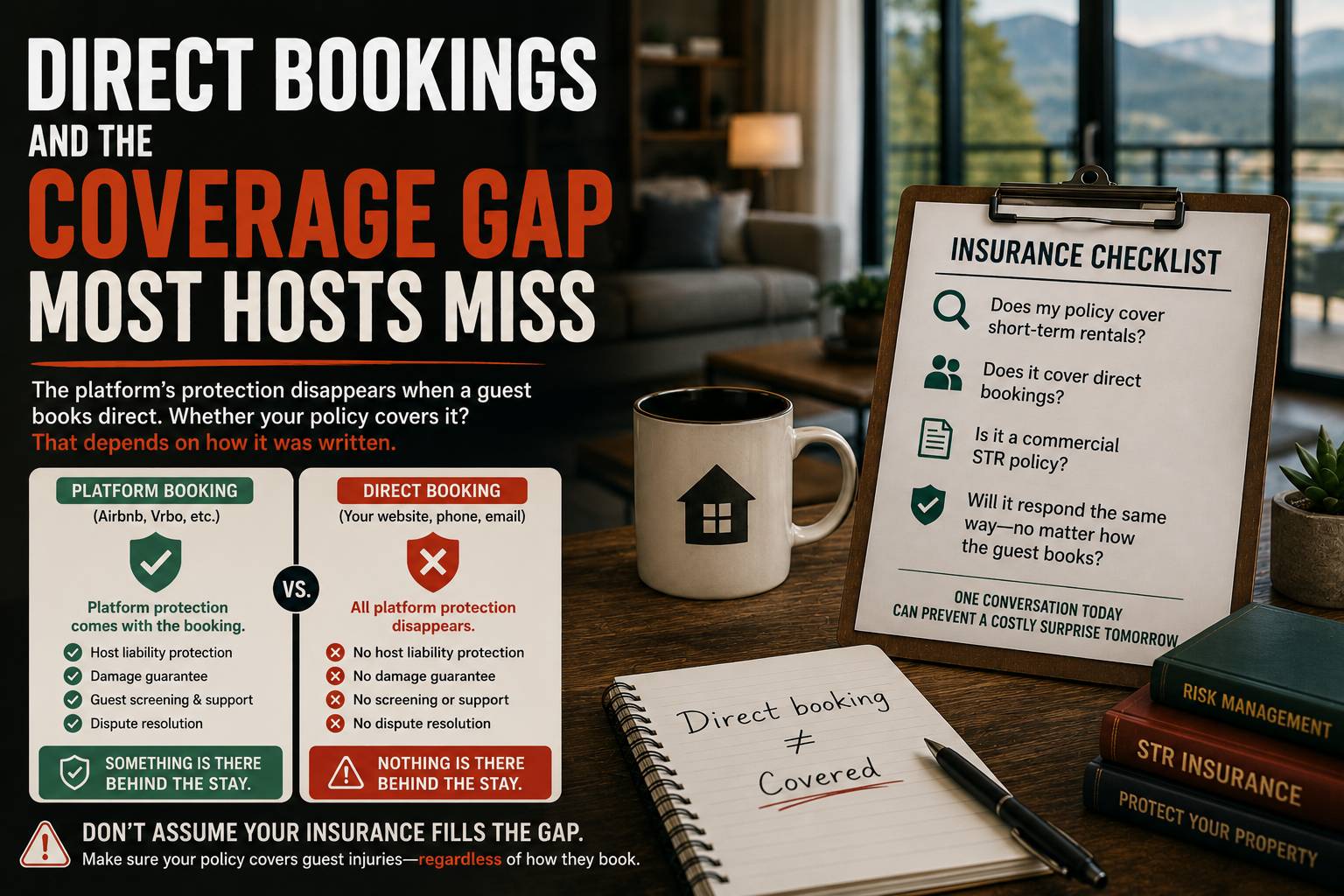
Ask whether the carrier itself knows the property gets rented out nightly, and ask where that's documented in your file. Not whether your agent personally knows this. Whether it's actually on record with the company that's supposed to pay you when something goes wrong.


Comments