

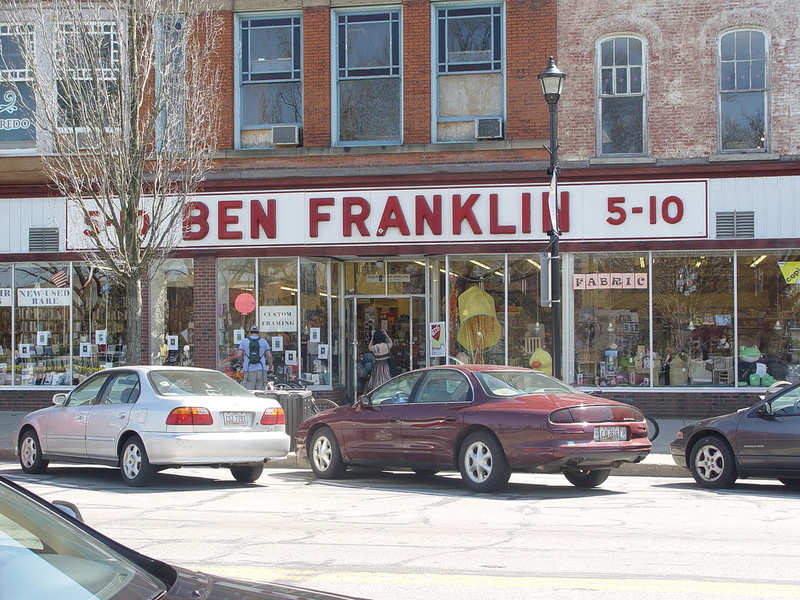
Remember the local Five and Dime Store?
I read an article this morning about how the success of Kohl’s department stores is a combination of their ability to adapt to the new retail landscape of the Amazon Shopper and the i ability of its competition JC Penney and Sears for example to do the same.
As I read articles about the changing landscape of retail over the past 40 to 50 years, my lifetime, I can’t help but see the writing on the wall for the real estate investing industry. For those of us in the real estate industry: Realtors, Landlords, Home Flippers, if we can learn and adapt to the changing landscape, we will thrive and if we can’t we will go away.
Who wins, those who thrive and who loses, the consumer who used to be served by our industry.
Let’s take a look at retail and make some analogies.
I remember growing up in small-town Kansas with the local square. We could go to town and visit the local Five and Dime Drug store that sold a little bit of everything that we might need, offered our prescriptions that we might nee,d and we could also get a soda or a malt or maybe even a sandwich. There were also small boutique clothing stores, a hardware store, all specialty. Some of you reading this may not have a memory of these stores unless you have gone to a destination spot that caters to tourists or weekend visitors. Here in Kansas City, you might think of Weston, a small town that has reinvented itself as a destination for Kansas Citians to go for a weekend outing and has brought back stores like this. Or if you have gone on vacation to a destination like Telluride Colorado you may have seen these.
Then in the late 1960s and early 1970s, Wal-Mart and the big box stores came to town. They sold everything you could possibly want at a fraction of the cost and the local Five and Dime Drug Store and small-town Hardware stores disappeared overnight, I would guess it was actually about 10 years before all of these stores in my home town were gone. All those storefronts now are offices, antique stores and a few boutiques that are trying to make small-town America into a weekend getaway.
Then in the 1980s Wal-Mart and the big box stores said, you know what we can sell groceries too and the local grocery chains were hugely disrupted. Those that were able to expand their footprint and service a larger area with big distribution or became the boutique grocery store survived, the local mom and pop with one or two stores, went away. So now you can buy groceries at Wal-Mart or the hyper-expensive boutique grocery stores of today, like Hen House that not only has groceries, but they will cook it for you.
Fast forward to the 2000s and along came Amazon, and stores across America everywhere are going out of business because everyone shops online now. Wal-Mart has the distribution system to compete with Amazon as it sells everything, but none of the other retailers do. Only those that are reinventing how they do business and partnering with Amazon or being bought by Amazon are going to survive.
So what does all this retail stuff have to do with Real Estate? Well, the first part of my life I was a Retail person and went to seminars and training about Retail and what we were learning about the future was playing out. Then about 20 years ago I made the jump to real estate and I see all of this retail decline and disruption being played out in real estate.
Let’s look at the typical real estate investment that has made countless people rich and been the fodder for books, blogs, and podcasts forever. Acquire a house, rent it out, let the tenants rent pay you some cash flow, maintain the house and pay off the mortgage. Once you are free and clear on a few of these properties, maybe about 10, you have the needed income to retire should you want to.
The Mom and Pop landlord of my childhood acquired their first property by way of inheriting mom and dad’s house and then renting it out. Or moving out of their first home they purchased and moving up while renting out the old house. These were the Mom and Pop landlords who worked hard to maintain a very low-cost rental property that their friends and neighbors rented at an affordable price. These mom and pop empires were often passed on to the children who grew them a bit more.
There were some Mom and Pops that focused on the lower end houses in the older neighborhoods and then their children moved to better neighborhoods newer and pricier house with higher rents. But it was all about building equity, not so much cash flow now and it was a local investment.
These Mom and Pops were the local Five and Dime Stores and like the local Five and Dime stores, they are being disrupted.
The Professional Landlord came along, that wanted cash flow now on the property while building equity, with a tenant that was not friends and family and neighbors. They bought up houses in the older neighborhoods and fixed them up with new everything, they charged more in rent and they made money now. And if they could not do this in their own big city where they lived, they looked at doing it in other big cities, where houses were affordable. These are the landlords of my age.
Here in KC we bought houses, fixed them up and commanded premium rents. As real estate investors, we bought houses, we fixed them up and sold them to the out of state investors. Turn Key Investor Companies and Property Management companies popped up to cater to these professional landlords.
This type of investor, I would equate to the Big Box Store. The Big Box Professional Landlord thrived, starting in the older neighborhoods of the 1920s to 1950s, but started buy homes in newer neighborhoods of the 1960s and 1970s. They owned 20 to 50 units and run it as a business, often with the help of a property manager and sometimes in addition to their day job working in the factory, as the local dentist, or teaching in our kid’s schools.
This was a great model and then the Great Recession came along and totally disrupted everything.
You see the Professional Investor didn’t inherit his parents or grandparent’s home. They didn’t buy their rental property from the neighbor with seller financing. No, they went to the bank or a mortgage broker and got a loan for 70% of the value. Then the lenders said, hey why not get one at 80% or 90% and they just got stupid.
Then when the great recession came along, it created the Amazon of our industry and it changed things, FOREVER.
First up, those professional landlords rented to tenants with nice jobs, that made good money . . . until they didn’t have jobs anymore and could not pay rent. Some landlords lost all tenants and all properties to foreclosure and others, well, others strategically shifted their portfolios. They took a look at the harder to maintain homes that were costing them money, that rented for lower rents, where good paying tenants were harder to come by. They strategically sold off these low-end rentals or lost them to foreclosure.
Sometimes they lost them to foreclosure, even though their tenants were paying rent and they never missed a mortgage payment. These professional landlords had small, local hometown bank loans that covered multiple properties. And when the recession happened, the banking commission stepped in and audited banks and told them that when term loans on real estate came due, to not renew and to not make loans. So, the professional landlord with 50 units, never missed a payment, had a loan come due on 10 or so of those properties, could not refinance, to the bank foreclosed.
At the same time, Banks were foreclosing on homeowners and we glutted the system with foreclosed homes. And the big giant money on Wall Street that had been buying up packages of mortgages saw an opportunity and they took it. They started buying up all of these foreclosed homes on the market and renting them out. Back in 2009, 2010 and 2011, the number one buyer of homes for the average real estate investor was a hedge fund.
The Wall Street Landlord was born, the Amazon of the real estate industry.
Who is this Wall Street Landlord? It’s a smart business person who pools together money from investors, pension funds, other wealthy people and invests it in businesses and now in rental property portfolios. They own and manage 100’s of single-family rental units across our country.
And you know what, they are cleaning up their portfolios and getting rid of the older homes that are harder to maintain, rent out, and just are not profitable and focusing on the newer homes.
Now, we see in the media that there is a severe shortage of affordable rental housing. That tenants are organizing and demanding affordable rental housing, it’s their “right”. Elected officials and those running for office are supporting these tenant groups by creating rental registration so they know who the landlords are, inspections to keep those rental units maintained, and talking about creating rental regulations to limit how much rents can increase over a given time.
What’s happening out there?
As I talk to real estate investors, landlords and industry people I see the following happening.
The Mom and Pop landlords, that offered affordable housing to their friends, family and neighbors, well those that are left see that their way of doing business is dying. While it paid the bills and gave them a good life over the years, its just not a profitable model. Working for minimal equity and very small cash flows does not keep homes maintained and something has to give. They don’t offer brand new everything in their homes, and they offer rental rates that are affordable, but because things are old and break often, they do have maintenance issues and they see all this rental regulation as just more costs and fees that are finally going to put them out of business.
No more five and dime stores in the rental industry unless they can reinvent through the revitalization of older neighborhoods or as boutique Airbnb rentals.
Next, we have a professional landlord, the Big Box Stores. Some are going to go out of business along with the Mom and Pop Stores, think Brands Mart or BlockBuster. And some are going to change with the times, like Kohls. They are putting more of their money into newer or even brand new housing to offer as rentals because these rentals command top rents, attract the more professional tenant who can afford top rents and are just all around easier to manage.
Then we have the Amazons of our industry who are out there creating new funds of BILLIONS of DOLLARS to acquire more rental property. They are all about the bottom line. If it does not make money, they are not going to do it. So, the low end, 50 to a 100-year-old house, is just not going to cut it. Affordable rental housing, whatever that might be is not going to cut it.
The Amazon Landlords of the world, well they don’t really care about more rules and regulation, they are big enough and have enough units in an area that they will just pass the cost along to the consumer. Not hard to do when your units set the curve on pricing.
And who is going to lose? Well, that’s going to be the tenants out there picketing and demanding rental registration, rental inspections, regulations making it harder to screen or evict a tenant. Those costs are going to be passed on to the rental consumer or if the rental unit just is not profitable, it’s going to be closed and the affordable rentals of the mom and pop era, well they are going to be gone.
In summary – the Mom and Pop (Five and Dime) Landlord that offers Affordable Housing is a dying breed. They will either sell out, be forced out, or work to become professional landlords. Or maybe they will convert to some other industry, sellers who seller finance perhaps.
The Professional (Big Box) Landlords will grow and adapt so they can survive in the Amazon Landscape of the Wall Street Landlord. Guessing here that the BRRRRers of the world will be Professional Landlords
And those folks crying for Affordable Housing, I warn you greatly, be careful what you wish for. All these rules and regulations you are demanding, is just speeding up the demise of the small time Five and Dime Landlord and pushing the Big Box Landlord to be more like the Amazon Landlord.
Which by the way is not far off, I hear Amazon and all the other tech giants are now exploring ways to create affordable housing . . . take us back 100 years to the company owned town that offered the jobs, the housing, and the support, we shall see how that fits into the grand scheme of things.


Comments