Advantage Property Management

Advantage Property Management

Investor · San Francisco, CA · Member since 2017 · 303 posts · 327 votes

I am a Tennessee property investor reviewing my past management relationship with Advantage Property Management of Cordova (Memphis) (APM) and trying to determine whether other owners had similar experiences regarding repair billing and related disclosures.

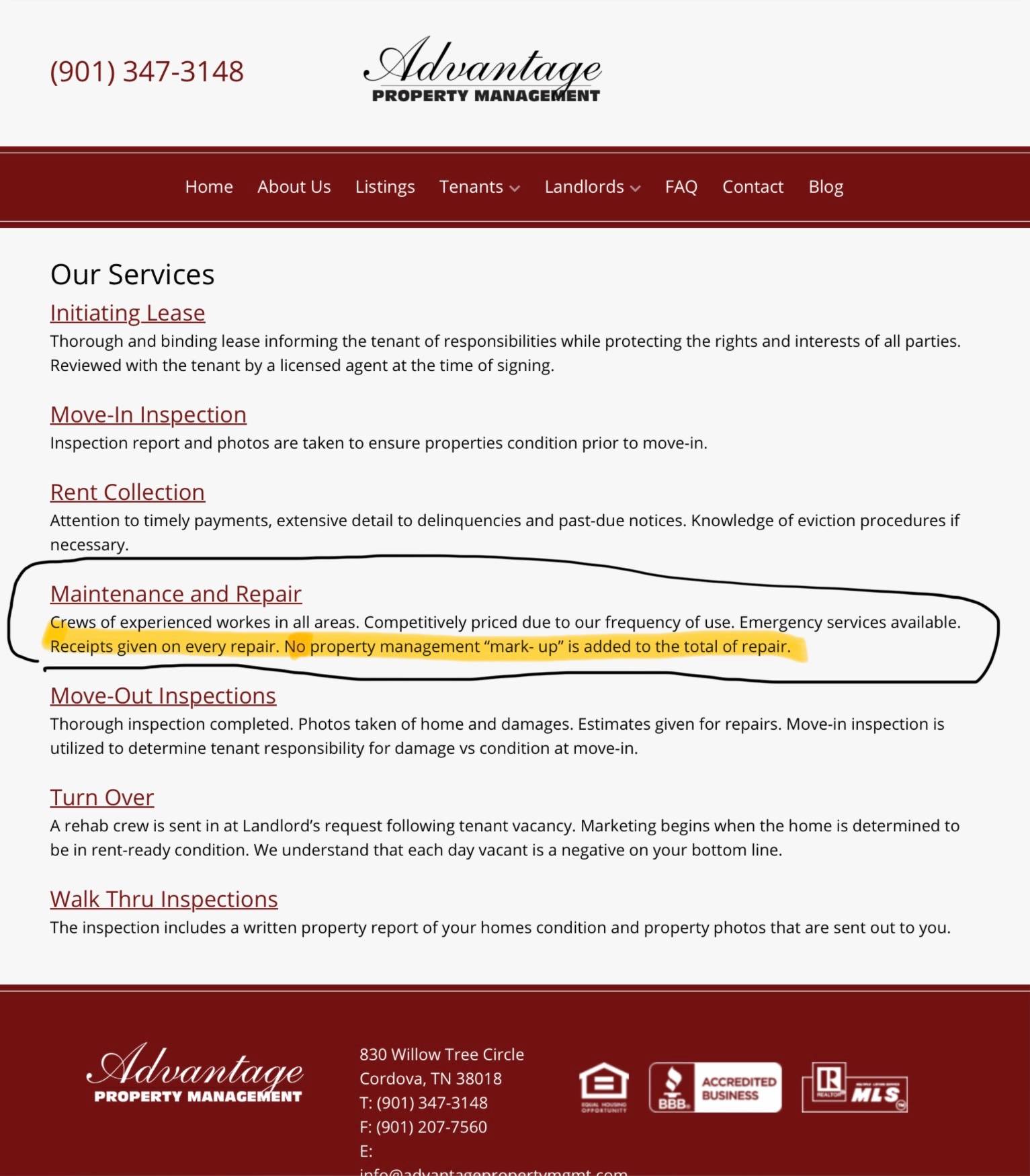
Before I contracted with APM, its website stated: "Receipts given on every repair. No property management 'mark-up' is added to the total of repair." (I'll try to attach a screenshot, circa 2019.)  I also received other communications from APM that were consistent with that statement.  The management agreement itself did not specifically address repair markups.

During the relationship, in its annual cash flow statements to me, APM identified some repair-related charges as "vendor discounts,” and explained them this way: “What is a Vendor Discount? This is a advancement/draw paid to the vendor on projects. It is part of your repair/rehab expenses.”

If you are or were an owner client of APM, in Tennessee or Mississippi, and received similar statements, disclosures, explanations, or billing practices, I would appreciate a private message.

I am only attempting to compare information from current or former owner clients. Please do not post accusations, speculation, or statements about matters outside your own personal experience.

0Reply
280 views

Most Popular Reply

Drew SygitBusiness Member
Property Manager · Royal Oak, MI · Member since 2012 · 12k+ posts · 9k+ votes
2mo
Quote from @Al D.:

@Drew Sygit 

I am not really sure if we are arguing about something here. I don’t think we are. But you are raising some points that may need addressing, if only for the banter. :)

I will not get into any details in this forum beyond what I posted in the OP.

As far as “markup” or “kickback” being very different by legal definition: I am not aware of whether either of these terms is legally defined in any jurisdiction or in common law. What matters is whether a particular set of actions meets the definition of a violation in a statute. If *any* one element is missing where the statute may use “and,” rather than “or,” then the act is not a violation… at least of that statute.

As I stated previously, TN 62-13-312(b)(17) prohibits a licensee from, “Paying or accepting, giving or charging any undisclosed commission, rebate, compensation or profit or expenditures for a principal or in violation of this chapter.”


I used a specific hypothetical example, after which I stated the applicable elements (using the words from the statute) in my reply to David… I believe the hypothetical I gave is an example of undisclosed(!) markups, while “markups” is not specifically legally defined anywhere I’ve seen.  It is my assumption, not being a lawyer, that - as long as disclosed - markups or kickbacks are not otherwise prohibited by this statute.

What is the argument for which you provided the four examples? That consumers are expected to know when something sounds too good to be true, even in a fiduciary relationship and even if having done additional due diligence that I stated in my hypothetical? Where would you draw the line? What if you went another step and insisted to see the invoices? And once they furnished them, would you contact any number of the vendors to verify the charges? But what of the (suspected) fraud went deeper to further conceal itself? What if the PM gave you invoices for all kinds of jobs performed by their contractor “ABC123 Where We Do It All” self proprietorship, that - unbeknownst to you - they made up and are ready to answer calls for? Where would you draw the line?.. Luckily, the law/system only expects so much of consumers.

If it’s about the regulators’ failure, sure, you have a very strong point. Btw, of the four examples, only madoff had a direct fiduciary relationship with his clients - toward the end of his reign - and specifically because the SEC (a regulator) forced him to. And while the bulk of the recovery came from private actions, the DOJ did play a huge role. Given his professional bona fides before his crash, what was too good to be true about him/his alleged returns?

We do not live in a perfect world: Just because government regulators failed to prevent something - or even in making victims whole after the fact - does not mean that they shouldn’t exist/shouldn’t be complained to. I’d hate a world without them. (I know you are not arguing for that.)


 I enjoy debating, not arguing:)

See this reply in the discussion

9 Replies

Jump to latestLatest
  • Member since 2026 · 10 posts · 3 votes
    3mo

    Following this thread with interest.

    I’m actively learning the Tennessee investment market and one thing I’ve been trying to understand better is what experienced investors look for in a property manager... especially around repair transparency, markups, vendor relationships, and reporting.

    For Memphis investors here: what are the biggest green flags and red flags you watch for when evaluating a PM company?

    Appreciate anyone willing to share lessons learned.

  • Jordan RayBusiness Member
    Real Estate Agent · Memphis, TN · Member since 2023 · 623 posts · 321 votes
    3mo
  • David SeharPro Member
    Member since 2026 · 2 posts · 2 votes
    2mo

    When I see "vendor discounts" with out actually seeing your statement, I assume it is a backdoor to getting the maintenance mark-up a management company claims to not charge. What a lot of PM companies will do is advertise "No Maintenance Markup", and then they will have a 10% "discount model" in place with their vendors where the vendor will invoice them and provide an under the table discount. example: You are quoted $1,000 for a job, you approve and pay for said job, vendor does work, invoices $1,000, PM company then only pays the vendor $900, and keeps the $100 surplus as revenue, all while you still have a $1000 invoice from the vendor for what was quoted.

  • Investor · San Francisco, CA · Member since 2017 · 303 posts · 327 votes
    2mo

    @David Sehar 

    There are certainly various ways of cheating consumers (clients, in case of PMs) out of their money. Luckily, there are laws to deal with some of that. Specifically in TN, 62-13-312(b)(17) prohibits a licensee from, “Paying or accepting, giving or charging any undisclosed commission, rebate, compensation or profit or expenditures for a principal or in violation of this chapter.”

    The example you provided has the elements of (1) “accepting,” (2) “undisclosed” (because you said “under the table,”) and (3) “rebate.” So, to any person who has the mental capacity to obtain/retain a TREC license - especially by the time one qualifies as a broker - this section should be a no-brainer to understand. You clearly do.  And you are not alone.

    But your example involves knowing participation in the scheme by a third party, and at a possible detriment to their own income tax obligations, since they invoice for the full amount charged to the property owner, before (presumably) officially deducting the “rebate” to the PM firm as a business expense. Even if the vendor may not be familiar with …312(b)(17) - which wouldn’t apply to them anyway - they would be an additional participant in the scheme. Or, as people with my background like to call them: “state’s evidence” - if we have evidence of conspiracy between the parties, and can charge both in a criminal case, but may only be interested in making a stronger case against the other party(ies)… It’s just not good “business” to have witnesses. Or leave them alive. :)  But, seriously, as a logistical thing, the PM has to arrange this with all/most/as many as possible vendors.

    Let’s, instead, imagine a scenario, just off the top of my head, about an imaginary TN/MS PM firm who specifically advertised “no repair markups,” or similar language, to prospective clients, which at least one imaginary client, albeit a seasoned investor, comes to rely on in contracting with that imaginary PM.

    Being a seasoned investor, seeing “vendor discounts” on his licensed PM’s annual cash flow statement begs the question of what that means. But - likely having foreseen the question - the PM tells him (and presumably also their other clients) what it means in the very CF Statement delivery email: “What is a Vendor Discount? This is an advancement/draw paid to the vendor on projects. It is part of your repair/rehab expenses.” Right there in black and white - no need to even wonder. But the investor still wonders.

    Yet, at first, he chooses to believe what he is being told - because if they lied…. License.

    At second, tho, he decides to ask the PM directly: “What exactly is it? It looks to me like an upcharge on certain repairs.” And the PM promptly replies: “It’s draws and advancements we pay to vendors on their Reno (sic) draws or work orders when needed by the contractor.”  Plausible.

    He also asks the PM why the PM doesn’t produce vendor invoices for his review. The PM tells him that they, “(S)topped providing the vendors information and invoices due to owners outsourcing a few of our vendors then our work was not prioritized.” Also plausible.

    So, now the client has come to rely on the initial advertisement that the PM charges no markups, as well as the PM’s statement that what he suspected could be (undisclosed) markups are actually not. And, for years after, the client continues to rely on that, in good faith, because he has looked up the law, and knows that disclosure of such practice would have been required.

    But, if perhaps the PM innocently forgot to disclose, then certainly, if engaging in the practice without disclosure could have been a mere oversight, then (1) concealing it and providing the preemptive answer to the possible question the way it was provided, and (2) denying it when asked directly, would be a whole other set of elements beyond TREC.  Of course, there’d need to be evidence…

    Then, one day, the client learns who a particular vendor was - for a number of invoices - reaches out to the vendor directly, and gets copies of the invoices addressed/billed to his PM with his investment property address and description of work exactly as his owner’s portal showed (without the vendor name) for around same respective dates. One problem, tho: Each of those invoices the client obtained directly from the vendor was for less than what the PM charged him in each instance.

    At least in this case, the vendor wasn’t a participant in the undisclosed markup.  Smart.

    In the above - imagined, of course - scenario, we have: (1) “charging,” (2) “undisclosed,” (3) “compensation or profit.” As in your example, these elements would also make up the same TREC violation, per se. So, expectedly, then, once our imaginary client tells the imaginary PM that he now has evidence of undisclosed markups, he (still, in his bottomless well of good faith) “suggests” to the PM that perhaps this was an innocent oversight limited only to his account.

    The PM finally does come clean on the markups - hooray! - but also with an accompanying “justification” that the practice is not in violation of anything because, wait for it: the client was always provided the full price before agreeing to it…

    I see that you are a local broker. And, from your comment, you seem to know the related law well. Would you “buy” that broker’s “justification” as presented? I trust not. And if not, if such a PM firm was operating as your local competitor, how fair would their conduct be to you, never mind to the consumer? Hypothetically, of course.

    Of course, this imagined story could never happen in real life, because… the law.
    • Drew SygitBusiness Member
      Property Manager · Royal Oak, MI · Member since 2012 · 12k+ posts · 9k+ votes
      2mo
      Quote from @Al D.:

      @David Sehar 

      There are certainly various ways of cheating consumers (clients, in case of PMs) out of their money. Luckily, there are laws to deal with some of that. Specifically in TN, 62-13-312(b)(17) prohibits a licensee from, “Paying or accepting, giving or charging any undisclosed commission, rebate, compensation or profit or expenditures for a principal or in violation of this chapter.”

      The example you provided has the elements of (1) “accepting,” (2) “undisclosed” (because you said “under the table,”) and (3) “rebate.” So, to any person who has the mental capacity to obtain/retain a TREC license - especially by the time one qualifies as a broker - this section should be a no-brainer to understand. You clearly do.  And you are not alone.

      But your example involves knowing participation in the scheme by a third party, and at a possible detriment to their own income tax obligations, since they invoice for the full amount charged to the property owner, before (presumably) officially deducting the “rebate” to the PM firm as a business expense. Even if the vendor may not be familiar with …312(b)(17) - which wouldn’t apply to them anyway - they would be an additional participant in the scheme. Or, as people with my background like to call them: “state’s evidence” - if we have evidence of conspiracy between the parties, and can charge both in a criminal case, but may only be interested in making a stronger case against the other party(ies)… It’s just not good “business” to have witnesses. Or leave them alive. :)  But, seriously, as a logistical thing, the PM has to arrange this with all/most/as many as possible vendors.

      Let’s, instead, imagine a scenario, just off the top of my head, about an imaginary TN/MS PM firm who specifically advertised “no repair markups,” or similar language, to prospective clients, which at least one imaginary client, albeit a seasoned investor, comes to rely on in contracting with that imaginary PM.

      Being a seasoned investor, seeing “vendor discounts” on his licensed PM’s annual cash flow statement begs the question of what that means. But - likely having foreseen the question - the PM tells him (and presumably also their other clients) what it means in the very CF Statement delivery email: “What is a Vendor Discount? This is an advancement/draw paid to the vendor on projects. It is part of your repair/rehab expenses.” Right there in black and white - no need to even wonder. But the investor still wonders.

      Yet, at first, he chooses to believe what he is being told - because if they lied…. License.

      At second, tho, he decides to ask the PM directly: “What exactly is it? It looks to me like an upcharge on certain repairs.” And the PM promptly replies: “It’s draws and advancements we pay to vendors on their Reno (sic) draws or work orders when needed by the contractor.”  Plausible.

      He also asks the PM why the PM doesn’t produce vendor invoices for his review. The PM tells him that they, “(S)topped providing the vendors information and invoices due to owners outsourcing a few of our vendors then our work was not prioritized.” Also plausible.

      So, now the client has come to rely on the initial advertisement that the PM charges no markups, as well as the PM’s statement that what he suspected could be (undisclosed) markups are actually not. And, for years after, the client continues to rely on that, in good faith, because he has looked up the law, and knows that disclosure of such practice would have been required.

      But, if perhaps the PM innocently forgot to disclose, then certainly, if engaging in the practice without disclosure could have been a mere oversight, then (1) concealing it and providing the preemptive answer to the possible question the way it was provided, and (2) denying it when asked directly, would be a whole other set of elements beyond TREC.  Of course, there’d need to be evidence…

      Then, one day, the client learns who a particular vendor was - for a number of invoices - reaches out to the vendor directly, and gets copies of the invoices addressed/billed to his PM with his investment property address and description of work exactly as his owner’s portal showed (without the vendor name) for around same respective dates. One problem, tho: Each of those invoices the client obtained directly from the vendor was for less than what the PM charged him in each instance.

      At least in this case, the vendor wasn’t a participant in the undisclosed markup.  Smart.

      In the above - imagined, of course - scenario, we have: (1) “charging,” (2) “undisclosed,” (3) “compensation or profit.” As in your example, these elements would also make up the same TREC violation, per se. So, expectedly, then, once our imaginary client tells the imaginary PM that he now has evidence of undisclosed markups, he (still, in his bottomless well of good faith) “suggests” to the PM that perhaps this was an innocent oversight limited only to his account.

      The PM finally does come clean on the markups - hooray! - but also with an accompanying “justification” that the practice is not in violation of anything because, wait for it: the client was always provided the full price before agreeing to it…

      I see that you are a local broker. And, from your comment, you seem to know the related law well. Would you “buy” that broker’s “justification” as presented? I trust not. And if not, if such a PM firm was operating as your local competitor, how fair would their conduct be to you, never mind to the consumer? Hypothetically, of course.

      Of course, this imagined story could never happen in real life, because… the law.


      This all typically starts with a naive and "cheap" investor who doesn't take the time to really understand how the business world works.

      Only a fool works for free.

      PMCs need to make money off of maintenance or they go out of business, or provide poor service (cause they can't afford to do it right).

      Caveat emptor - if it sounds too good to be true, it usually is.

      You may actually have a legal case if your PMC hid any vendor kickback from you, their client. Much less likely of a case based on false advertising for their claims of "no markup". 

      Your bigger challenge will be, how much to spend to win in court, but then the PMC files bankruptcy and you collect little, if not zero?

    • Investor · San Francisco, CA · Member since 2017 · 303 posts · 327 votes
      2mo
      Quote from @Drew Sygit:
      Quote from @Al D.:

      @David Sehar 

      There are certainly various ways of cheating consumers (clients, in case of PMs) out of their money. Luckily, there are laws to deal with some of that. Specifically in TN, 62-13-312(b)(17) prohibits a licensee from, “Paying or accepting, giving or charging any undisclosed commission, rebate, compensation or profit or expenditures for a principal or in violation of this chapter.”

      The example you provided has the elements of (1) “accepting,” (2) “undisclosed” (because you said “under the table,”) and (3) “rebate.” So, to any person who has the mental capacity to obtain/retain a TREC license - especially by the time one qualifies as a broker - this section should be a no-brainer to understand. You clearly do.  And you are not alone.

      But your example involves knowing participation in the scheme by a third party, and at a possible detriment to their own income tax obligations, since they invoice for the full amount charged to the property owner, before (presumably) officially deducting the “rebate” to the PM firm as a business expense. Even if the vendor may not be familiar with …312(b)(17) - which wouldn’t apply to them anyway - they would be an additional participant in the scheme. Or, as people with my background like to call them: “state’s evidence” - if we have evidence of conspiracy between the parties, and can charge both in a criminal case, but may only be interested in making a stronger case against the other party(ies)… It’s just not good “business” to have witnesses. Or leave them alive. :)  But, seriously, as a logistical thing, the PM has to arrange this with all/most/as many as possible vendors.

      Let’s, instead, imagine a scenario, just off the top of my head, about an imaginary TN/MS PM firm who specifically advertised “no repair markups,” or similar language, to prospective clients, which at least one imaginary client, albeit a seasoned investor, comes to rely on in contracting with that imaginary PM.

      Being a seasoned investor, seeing “vendor discounts” on his licensed PM’s annual cash flow statement begs the question of what that means. But - likely having foreseen the question - the PM tells him (and presumably also their other clients) what it means in the very CF Statement delivery email: “What is a Vendor Discount? This is an advancement/draw paid to the vendor on projects. It is part of your repair/rehab expenses.” Right there in black and white - no need to even wonder. But the investor still wonders.

      Yet, at first, he chooses to believe what he is being told - because if they lied…. License.

      At second, tho, he decides to ask the PM directly: “What exactly is it? It looks to me like an upcharge on certain repairs.” And the PM promptly replies: “It’s draws and advancements we pay to vendors on their Reno (sic) draws or work orders when needed by the contractor.”  Plausible.

      He also asks the PM why the PM doesn’t produce vendor invoices for his review. The PM tells him that they, “(S)topped providing the vendors information and invoices due to owners outsourcing a few of our vendors then our work was not prioritized.” Also plausible.

      So, now the client has come to rely on the initial advertisement that the PM charges no markups, as well as the PM’s statement that what he suspected could be (undisclosed) markups are actually not. And, for years after, the client continues to rely on that, in good faith, because he has looked up the law, and knows that disclosure of such practice would have been required.

      But, if perhaps the PM innocently forgot to disclose, then certainly, if engaging in the practice without disclosure could have been a mere oversight, then (1) concealing it and providing the preemptive answer to the possible question the way it was provided, and (2) denying it when asked directly, would be a whole other set of elements beyond TREC.  Of course, there’d need to be evidence…

      Then, one day, the client learns who a particular vendor was - for a number of invoices - reaches out to the vendor directly, and gets copies of the invoices addressed/billed to his PM with his investment property address and description of work exactly as his owner’s portal showed (without the vendor name) for around same respective dates. One problem, tho: Each of those invoices the client obtained directly from the vendor was for less than what the PM charged him in each instance.

      At least in this case, the vendor wasn’t a participant in the undisclosed markup.  Smart.

      In the above - imagined, of course - scenario, we have: (1) “charging,” (2) “undisclosed,” (3) “compensation or profit.” As in your example, these elements would also make up the same TREC violation, per se. So, expectedly, then, once our imaginary client tells the imaginary PM that he now has evidence of undisclosed markups, he (still, in his bottomless well of good faith) “suggests” to the PM that perhaps this was an innocent oversight limited only to his account.

      The PM finally does come clean on the markups - hooray! - but also with an accompanying “justification” that the practice is not in violation of anything because, wait for it: the client was always provided the full price before agreeing to it…

      I see that you are a local broker. And, from your comment, you seem to know the related law well. Would you “buy” that broker’s “justification” as presented? I trust not. And if not, if such a PM firm was operating as your local competitor, how fair would their conduct be to you, never mind to the consumer? Hypothetically, of course.

      Of course, this imagined story could never happen in real life, because… the law.


      This all typically starts with a naive and "cheap" investor who doesn't take the time to really understand how the business world works.

      Only a fool works for free.

      PMCs need to make money off of maintenance or they go out of business, or provide poor service (cause they can't afford to do it right).

      Caveat emptor - if it sounds too good to be true, it usually is.

      You may actually have a legal case if your PMC hid any vendor kickback from you, their client. Much less likely of a case based on false advertising for their claims of "no markup". 

      Your bigger challenge will be, how much to spend to win in court, but then the PMC files bankruptcy and you collect little, if not zero?

       @Drew Sygit 

      I am not sure what typically starts with a naive and cheap investor. False advertising to such an investor by a licensee who is held to a higher standard by the state than, for example, some “contractor” on Thumbtack? (I am presuming that you are not blaming the investor, however naive and cheap he may be. More on this point below.)

      While I agree with you on the aphorism, I am not sure what “only a fool works for free” is doing in this thread. However a given PM wants to make money from their clients in the course of their business is their business - and they absolutely need to be profitable to stay in business. Whether the formula for profit is based on the % of rent alone, or on % of rent and on vendor markups/in-house crew, should not be a concern to the investor-client. (Unless he is an investor in the PM firm.) The hypothetical scenario I presented involves the (statutory) requirement for the licensee to disclose certain facts to their client, if present. The law I presented for the scenario is not hypothetical. And that law does not prohibit profit.

      How is any consumer expected to know what “sounds too good to be true” - especially if in clear-meaning written English in certain consumer-facing locations - from an entity the consumer knows is regulated? Saying “caveat emptor” in this thread is ignoring the foundation of the relationship in question - there are fiduciary duty and statutory compliance at the foundation of a licensee-principal relationship, not to mention terms of the contract. This is absolutely not a case of caveat emptor.

      This is not a forum for litigating specifics. But, as far as general false advertising is concerned in Tennessee, 47-18-104(b) addresses various examples.

      For some victims, it may not be about being made whole through a private legal action.

    • Drew SygitBusiness Member
      Property Manager · Royal Oak, MI · Member since 2012 · 12k+ posts · 9k+ votes
      2mo
      Quote from @Al D.:
      Quote from @Drew Sygit:
      Quote from @Al D.:

      @David Sehar 

      There are certainly various ways of cheating consumers (clients, in case of PMs) out of their money. Luckily, there are laws to deal with some of that. Specifically in TN, 62-13-312(b)(17) prohibits a licensee from, “Paying or accepting, giving or charging any undisclosed commission, rebate, compensation or profit or expenditures for a principal or in violation of this chapter.”

      The example you provided has the elements of (1) “accepting,” (2) “undisclosed” (because you said “under the table,”) and (3) “rebate.” So, to any person who has the mental capacity to obtain/retain a TREC license - especially by the time one qualifies as a broker - this section should be a no-brainer to understand. You clearly do.  And you are not alone.

      But your example involves knowing participation in the scheme by a third party, and at a possible detriment to their own income tax obligations, since they invoice for the full amount charged to the property owner, before (presumably) officially deducting the “rebate” to the PM firm as a business expense. Even if the vendor may not be familiar with …312(b)(17) - which wouldn’t apply to them anyway - they would be an additional participant in the scheme. Or, as people with my background like to call them: “state’s evidence” - if we have evidence of conspiracy between the parties, and can charge both in a criminal case, but may only be interested in making a stronger case against the other party(ies)… It’s just not good “business” to have witnesses. Or leave them alive. :)  But, seriously, as a logistical thing, the PM has to arrange this with all/most/as many as possible vendors.

      Let’s, instead, imagine a scenario, just off the top of my head, about an imaginary TN/MS PM firm who specifically advertised “no repair markups,” or similar language, to prospective clients, which at least one imaginary client, albeit a seasoned investor, comes to rely on in contracting with that imaginary PM.

      Being a seasoned investor, seeing “vendor discounts” on his licensed PM’s annual cash flow statement begs the question of what that means. But - likely having foreseen the question - the PM tells him (and presumably also their other clients) what it means in the very CF Statement delivery email: “What is a Vendor Discount? This is an advancement/draw paid to the vendor on projects. It is part of your repair/rehab expenses.” Right there in black and white - no need to even wonder. But the investor still wonders.

      Yet, at first, he chooses to believe what he is being told - because if they lied…. License.

      At second, tho, he decides to ask the PM directly: “What exactly is it? It looks to me like an upcharge on certain repairs.” And the PM promptly replies: “It’s draws and advancements we pay to vendors on their Reno (sic) draws or work orders when needed by the contractor.”  Plausible.

      He also asks the PM why the PM doesn’t produce vendor invoices for his review. The PM tells him that they, “(S)topped providing the vendors information and invoices due to owners outsourcing a few of our vendors then our work was not prioritized.” Also plausible.

      So, now the client has come to rely on the initial advertisement that the PM charges no markups, as well as the PM’s statement that what he suspected could be (undisclosed) markups are actually not. And, for years after, the client continues to rely on that, in good faith, because he has looked up the law, and knows that disclosure of such practice would have been required.

      But, if perhaps the PM innocently forgot to disclose, then certainly, if engaging in the practice without disclosure could have been a mere oversight, then (1) concealing it and providing the preemptive answer to the possible question the way it was provided, and (2) denying it when asked directly, would be a whole other set of elements beyond TREC.  Of course, there’d need to be evidence…

      Then, one day, the client learns who a particular vendor was - for a number of invoices - reaches out to the vendor directly, and gets copies of the invoices addressed/billed to his PM with his investment property address and description of work exactly as his owner’s portal showed (without the vendor name) for around same respective dates. One problem, tho: Each of those invoices the client obtained directly from the vendor was for less than what the PM charged him in each instance.

      At least in this case, the vendor wasn’t a participant in the undisclosed markup.  Smart.

      In the above - imagined, of course - scenario, we have: (1) “charging,” (2) “undisclosed,” (3) “compensation or profit.” As in your example, these elements would also make up the same TREC violation, per se. So, expectedly, then, once our imaginary client tells the imaginary PM that he now has evidence of undisclosed markups, he (still, in his bottomless well of good faith) “suggests” to the PM that perhaps this was an innocent oversight limited only to his account.

      The PM finally does come clean on the markups - hooray! - but also with an accompanying “justification” that the practice is not in violation of anything because, wait for it: the client was always provided the full price before agreeing to it…

      I see that you are a local broker. And, from your comment, you seem to know the related law well. Would you “buy” that broker’s “justification” as presented? I trust not. And if not, if such a PM firm was operating as your local competitor, how fair would their conduct be to you, never mind to the consumer? Hypothetically, of course.

      Of course, this imagined story could never happen in real life, because… the law.


      This all typically starts with a naive and "cheap" investor who doesn't take the time to really understand how the business world works.

      Only a fool works for free.

      PMCs need to make money off of maintenance or they go out of business, or provide poor service (cause they can't afford to do it right).

      Caveat emptor - if it sounds too good to be true, it usually is.

      You may actually have a legal case if your PMC hid any vendor kickback from you, their client. Much less likely of a case based on false advertising for their claims of "no markup". 

      Your bigger challenge will be, how much to spend to win in court, but then the PMC files bankruptcy and you collect little, if not zero?

       @Drew Sygit 

      I am not sure what typically starts with a naive and cheap investor. False advertising to such an investor by a licensee who is held to a higher standard by the state than, for example, some “contractor” on Thumbtack? (I am presuming that you are not blaming the investor, however naive and cheap he may be. More on this point below.)

      While I agree with you on the aphorism, I am not sure what “only a fool works for free” is doing in this thread. However a given PM wants to make money from their clients in the course of their business is their business - and they absolutely need to be profitable to stay in business. Whether the formula for profit is based on the % of rent alone, or on % of rent and on vendor markups/in-house crew, should not be a concern to the investor-client. (Unless he is an investor in the PM firm.) The hypothetical scenario I presented involves the (statutory) requirement for the licensee to disclose certain facts to their client, if present. The law I presented for the scenario is not hypothetical. And that law does not prohibit profit.

      How is any consumer expected to know what “sounds too good to be true” - especially if in clear-meaning written English in certain consumer-facing locations - from an entity the consumer knows is regulated? Saying “caveat emptor” in this thread is ignoring the foundation of the relationship in question - there are fiduciary duty and statutory compliance at the foundation of a licensee-principal relationship, not to mention terms of the contract. This is absolutely not a case of caveat emptor.

      This is not a forum for litigating specifics. But, as far as general false advertising is concerned in Tennessee, 47-18-104(b) addresses various examples.

      For some victims, it may not be about being made whole through a private legal action.


      Again, I agreed you may have a case regarding undisclosed kickbacks - which are NOT illegal if properly disclosed. 

      It is only my opinion that you will have a difficult time proving false advertising. 
      How exactly did they charge a "markup"?

      NOTE: I believe the legal definitions of a "markup" and "kickback" are very different, with no connection between them.


      "How is any consumer expected to know what “sounds too good to be true” - especially if in clear-meaning written English in certain consumer-facing locations - from an entity the consumer knows is regulated?"
      - How many examples are needed to prove the fallacy of this argument?
      1) The Great Depression
      2) The Savings & Loan Crisis of the 1980s
      3) The Great Recession and bank bailout
      4) Bernie Madoff

      How did the regulated entities involved in all these examples protect consumers?

  • Investor · San Francisco, CA · Member since 2017 · 303 posts · 327 votes
    2mo

    @Drew Sygit 

    I am not really sure if we are arguing about something here. I don’t think we are. But you are raising some points that may need addressing, if only for the banter. :)

    I will not get into any details in this forum beyond what I posted in the OP.

    As far as “markup” or “kickback” being very different by legal definition: I am not aware of whether either of these terms is legally defined in any jurisdiction or in common law. What matters is whether a particular set of actions meets the definition of a violation in a statute. If *any* one element is missing where the statute may use “and,” rather than “or,” then the act is not a violation… at least of that statute.

    As I stated previously, TN 62-13-312(b)(17) prohibits a licensee from, “Paying or accepting, giving or charging any undisclosed commission, rebate, compensation or profit or expenditures for a principal or in violation of this chapter.”


    I used a specific hypothetical example, after which I stated the applicable elements (using the words from the statute) in my reply to David… I believe the hypothetical I gave is an example of undisclosed(!) markups, while “markups” is not specifically legally defined anywhere I’ve seen.  It is my assumption, not being a lawyer, that - as long as disclosed - markups or kickbacks are not otherwise prohibited by this statute.

    What is the argument for which you provided the four examples? That consumers are expected to know when something sounds too good to be true, even in a fiduciary relationship and even if having done additional due diligence that I stated in my hypothetical? Where would you draw the line? What if you went another step and insisted to see the invoices? And once they furnished them, would you contact any number of the vendors to verify the charges? But what of the (suspected) fraud went deeper to further conceal itself? What if the PM gave you invoices for all kinds of jobs performed by their contractor “ABC123 Where We Do It All” self proprietorship, that - unbeknownst to you - they made up and are ready to answer calls for? Where would you draw the line?.. Luckily, the law/system only expects so much of consumers.

    If it’s about the regulators’ failure, sure, you have a very strong point. Btw, of the four examples, only madoff had a direct fiduciary relationship with his clients - toward the end of his reign - and specifically because the SEC (a regulator) forced him to. And while the bulk of the recovery came from private actions, the DOJ did play a huge role. Given his professional bona fides before his crash, what was too good to be true about him/his alleged returns?

    We do not live in a perfect world: Just because government regulators failed to prevent something - or even in making victims whole after the fact - does not mean that they shouldn’t exist/shouldn’t be complained to. I’d hate a world without them. (I know you are not arguing for that.)

    • Drew SygitBusiness Member
      Property Manager · Royal Oak, MI · Member since 2012 · 12k+ posts · 9k+ votes
      2mo
      Quote from @Al D.:

      @Drew Sygit 

      I am not really sure if we are arguing about something here. I don’t think we are. But you are raising some points that may need addressing, if only for the banter. :)

      I will not get into any details in this forum beyond what I posted in the OP.

      As far as “markup” or “kickback” being very different by legal definition: I am not aware of whether either of these terms is legally defined in any jurisdiction or in common law. What matters is whether a particular set of actions meets the definition of a violation in a statute. If *any* one element is missing where the statute may use “and,” rather than “or,” then the act is not a violation… at least of that statute.

      As I stated previously, TN 62-13-312(b)(17) prohibits a licensee from, “Paying or accepting, giving or charging any undisclosed commission, rebate, compensation or profit or expenditures for a principal or in violation of this chapter.”


      I used a specific hypothetical example, after which I stated the applicable elements (using the words from the statute) in my reply to David… I believe the hypothetical I gave is an example of undisclosed(!) markups, while “markups” is not specifically legally defined anywhere I’ve seen.  It is my assumption, not being a lawyer, that - as long as disclosed - markups or kickbacks are not otherwise prohibited by this statute.

      What is the argument for which you provided the four examples? That consumers are expected to know when something sounds too good to be true, even in a fiduciary relationship and even if having done additional due diligence that I stated in my hypothetical? Where would you draw the line? What if you went another step and insisted to see the invoices? And once they furnished them, would you contact any number of the vendors to verify the charges? But what of the (suspected) fraud went deeper to further conceal itself? What if the PM gave you invoices for all kinds of jobs performed by their contractor “ABC123 Where We Do It All” self proprietorship, that - unbeknownst to you - they made up and are ready to answer calls for? Where would you draw the line?.. Luckily, the law/system only expects so much of consumers.

      If it’s about the regulators’ failure, sure, you have a very strong point. Btw, of the four examples, only madoff had a direct fiduciary relationship with his clients - toward the end of his reign - and specifically because the SEC (a regulator) forced him to. And while the bulk of the recovery came from private actions, the DOJ did play a huge role. Given his professional bona fides before his crash, what was too good to be true about him/his alleged returns?

      We do not live in a perfect world: Just because government regulators failed to prevent something - or even in making victims whole after the fact - does not mean that they shouldn’t exist/shouldn’t be complained to. I’d hate a world without them. (I know you are not arguing for that.)


       I enjoy debating, not arguing:)

Join the conversationCreate a free account to reply, vote on answers and follow this thread.