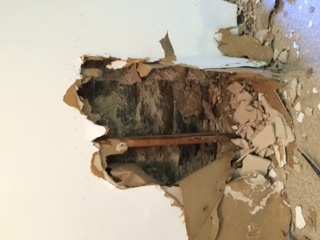
HELP - Basement Rental Flooding - Course of action

HELP - Basement Rental Flooding - Course of action

Logan, UT · Member since 2016 · 35 posts · 13 votes

I am in need of some guidance on how to handle a situation. I am posting this in behalf of my in-laws who are the landlord of a rental affected.

The landlord was notified last night of flooding in the basement unit in a duplex (upstairs, downstairs configuration) (older home). Upon arrival we found at least 4 inches of water throughout the basement. The water was coming in from the storm drain in the stair well of the front door. With all the rain, and snow melt locally, the storm drains, and sewers are backed up. Many other homes in the valley are affected.

I went out to assist removing the water using a shop vac. With two shop vacs going, and and several industrial fans drying the ground, we were able to lower the water levels to fine puddles. I was able to cap off the storm drain, and slow down the water flow from the street (but I didn't stop it). However, when we went inside, we saw that there was water coming in from the walls. I believe it's just coming straight through the foundation into the house.

We've relocated the tenant to a hotel for the night, and it's looking like we will house him there for the next while. We determined that we can't stop the water from coming in, so we have determined that this is too much for us to handle until the rain / snow / snowmelt / saturated ground is over with.

I'm sure there is someone in the BP community that has faced a situation like this before, and I'm counting on you to help us out. What steps should we take? 

These factors we do know:

  • The tenant cannot return to this place and will probably need to relocate.
  • We will need to get a professional cleaning service / GC to come in and fix and prevent this from happening again.
  • We have to contact insurance to determine what is covered in the home-owners.
0Reply
136 views

Most Popular Reply

Real Estate Investor · Audubon, PA · Member since 2009 · 13k+ posts · 8k+ votes
9y

@Sid Leibowitz suggested that if drywall is present that the lower portion be removed; I would suggest that you measure up about 48 inches to snap a chalk line and take out whatever drywall lies below that, so that you can use full sheets of drywall to replace the wet sections. The edge of the full drywall sheet is tapered, so that lets you have a cleaner (less bulging) joint where new meets old in the middle of the wall - so less noticeable.

See this reply in the discussion

29 Replies

Jump to latestLatest
  • Contractor · Atlanta, GA · Member since 2015 · 236 posts · 91 votes
    9y
    It is difficult to assess situations like this without seeing it, would you be able to post pics or the drain along with the terrain of the yard?
  • Logan, UT · Member since 2016 · 35 posts · 13 votes
    9y

    I will be able to in the morning. 

    To paint a picture for you, all the land around the home (including driveway) is sloped toward the home. There are no rain gutters.  It's not a pretty picture, or situation. But I will get pictures in the morning of the damage.

    We're thinking that we'll need to gut the basement and seal the foundation, and walls to prevent this from happening again. @Adam Abdel-Hafez, would you recommend any contractors in northern Utah? I know it's a little bit of a drive from Georgia...

    Edit: We talked to the neighbors and every house on the block / street is experiencing similar issues.

  • Jerry W.Pro Member
    Moderator
    Investor · Thermopolis, WY · Member since 2012 · 4k+ posts · 4k+ votes
    9y

    @Account Closed, this is not my area of expertise, but here goes.  You will have to reshape the lay of the land so water runs away from the house.  Water will continue to seep in somehow if it in effect sits at the bottom of a pool.  In my personal house there were water issues.  Sump pumps were installed in 2 locations in metal culvert tubes in gravel, with holes for water to drain into.  The sump pumps pumps the water outside to an area where it drains away from the house.One sump pump was outside one was inside the house.  Sealing the concrete will not totally work, you need to reroute the water as well.

  • Contractor · Atlanta, GA · Member since 2015 · 236 posts · 91 votes
    9y
    I don't know any contractors in Utah, but I would recommend adding gutters with drain pipes about 5-10ft away from the home. I would also backfill dirt around the foundation so that it doesn't slope down to the house. On rentals, I always try to rule out the simply solutions before I get to the more difficult ones.
  • Flipper · Louisville, KY · Member since 2017 · 65 posts · 28 votes
    9y
    You might also contact your sewer company. A backup as a result of inadequate clogged or damage on their end might be covered by them.
  • JD MartinBusiness Member
    Moderator
    Rock Star Extraordinaire · Northeast, TN · Member since 2015 · 10k+ posts · 16k+ votes
    9y

    Unfortunately, you are trying to deal with a situation that should have been fixed before there were any people in the house. Sealing the walls will do little to nothing - the hydraulic pressure of water that wants to get in is going to exceed anything you put on the walls. If every house on the street is experiencing similar issues, they also all have grading issues. As long as water can be relocated to a point lower than the basement, no matter where the house is, flooding and water intrusion can be prevented.

    Step 1 here is going to be installing proper roof gutters and figuring out where you are going to route this water. If it is impossible to route downhill by gravity, it can all be routed into a catchment system with a pump that can then send the water wherever it needs to go. 

    Step 2 is regrading the house. You don't necessarily have to regrade the entire property, just create a swale all the way around the house a few feet from the foundation that can route the water where it needs to go. If there's nowhere to route it, see the catchment system & pump mentioned above. As far as the driveway, you saw-cut a drainage tile into the driveway and route the water into said swale. You can also bury a perforated pipe under the swale to move even more water, faster. 

    Skyline Properties
    View Page
  • Developer/Broker · Spanish Fork, UT · Member since 2016 · 73 posts · 41 votes
    9y
    Jerry W. and Jd Martin are right. The system they're describing is know as a French drain system. It usually includes installing drains around the home surrounded by gravel. As the water percolates into the ground, it hits the gravel and goes into the perforated pipe. Then travels to a catch basin where a sump pump can pump it away from the home. We've dealt with this a lot. Good luck!
  • Investor · Columbus, MT · Member since 2013 · 1k+ posts · 1k+ votes
    9y

    @Account Closed said, it did absolutely nothing.  Get the water away from the walls.  

  • Member since 2016 · 13k+ posts · 12k+ votes
    9y

    Sealing the walls from the inside is a useless endeavor. I have had a similar situation and permanent fixes require numerous solutions

    Re-grade the lot, install gutters and get the water away from the foundation, Dig around foundation and install drains leading to a sump, pump the water away from the foundation.

    Adding new drain lines around the foundation can be done by digging around the outside of the entire foundation or by cutting the concrete floor around the interior parameter and adding the lines leading to a sump.

    None of this will prevent the storm drain from backing up as that is caused by exterior issues related to the city storm system. Insurance coverage is your only avenue in that regard although you could install a one way trap on the line under the floor.

  • Contractor · Atlanta, GA · Member since 2015 · 236 posts · 91 votes
    9y
    You need gutters for sure no matter what. 90% of water intrusion problems can be solved with fully functioning gutters that move water away from the home with simple corrugated pipes. Shoveling in dirt around the foundation will assist in having puddles of water slopes towards the foundation. I cannot stress how many times people suggest wrapping a foundation and/or French drain system when it is not necessary. On rental properties, rule out the simple solutions before you get to the difficult/expensive solutions. Out of 100 situations, I've had to do a French drain maybe once or twice to solve the problem.
  • Contractor · Glen Cove, NY · Member since 2016 · 209 posts · 89 votes
    9y

    I just flipped a house that had the same problem. The house was brick and concrete basement, The gutters were clogged with the silt coming from the roof shingles that were installed over a year ago. There was a drain at the bottom of the stairs and there was a pipe running from the back of the house to the street sewer two drains in the pipe line in the basement. Over time this silt went down the rear drain and worked itself the length of the house and whenever there was a rain the pipe was insufficient to drain the water the the sewer. Eventually backing up the water into the basement and sucked up water like a sponge.  We had to first get a good drain cleaning service (plumber with a big auger on their machine. and they cleaned the sand out of the pipe. There was a lot of sand. It took some tile to unclog the pipe. Then we had to cut the sheet rock at  24" from the floor as it was all wet and install new sheet after the studs dried a a bit. Then on the outside there was a i/" gap between the concrete driveway and the house that we had to back fill with foam and fill with type "S"concrete. and then seal all windows that may be on the side of the house and there are gaps with urethane and not silicon. the urethane comes in colors. Check any exposed brick for signs of requiring pointing and re-point.  I have before and after pictures of our mess if you need. 

  • Broker · Logan, UT · Member since 2013 · 1k+ posts · 1k+ votes
    9y

    @Account Closed

    Where is this property (approximately)?  The reason that I ask is that there are different issues in different parts of town.  Some of it's bad engineering from the 1980's before storm drains were required in new subdivisions.  In other areas like the west side of town you have water table issues, etc.  Your solution will differ depending on the topography and source.

    I'm hearing about lots of these issues all over the valley.  This has been a tricky winter up here with frozen pipes in January and now flooded basements in February.  I actually spoke to a friend this morning who does flood mitigation (and therefore had to cancel a lunch appointment).  She told me that all they can do right now is remove water.  Trying to fix any problems is useless until the snow and rain subside.

    So, unfortunately, you should probably plan on helping the tenant find new housing as it may be a month or two before it makes any sense to address the problem.

    Figure out what their insurance says.  My guess is that it won't be good news.  If insurance will pay anything on this, they will have recommendations/requirements.

    Let us know.

  • Real Estate Investor · Audubon, PA · Member since 2009 · 13k+ posts · 8k+ votes
    9y

    There is something called a "check valve" that is installed in drain piping so that water is only allowed to flow in one direction.

    If I understand correctly, you have a set of exterior steps, and at the bottom of those steps there is a drain inlet opening that is intended to capture water from the stairwell and feed it into the drain system; but due to excess water in the drain system from other sources, water is flowing out of that drain inlet. So the check valve would have to be in the section of pipe that exits from that drain inlet, so that no further back flow occurs.

    And a French drain system with sump pump will be needed to deal with the water seepage through the walls due to hydrostatic pressure.

    Although proper grading and gutters are a good idea, the hydrostatic pressure would not be cured by either of those.

  • Residential Real Estate Broker · Chicago Suburbs, IL · Member since 2013 · 1k+ posts · 594 votes
    9y

    One of our rentals has a check valve on the sewer line. That way when to much storm water gets into the city sewer system and overflows it, it prevents the sewer water flow from going back into the basement of the home. That happens to be an issue with that town that they don't have the funds or interest to fix.

  • Broker · Logan, UT · Member since 2013 · 1k+ posts · 1k+ votes
    9y

    We are not allowed to put storm water or (irrigation water) in the sewer system.

    The vast majority of these storm drains at the bottoms of exterior stair wells are simply holes into a gravel bed. 

    Moreover, the city has been asking residents to consume less water so the waste water ponds don't flood.  It seems like that would be bad.

    So back-flow preventers probably aren't the solution to many of the flooding issues in northern Utah.

  • Logan, UT · Member since 2016 · 35 posts · 13 votes
    9y

    Thank you to all that have replied. @William Hochstedler, @Kimberly H., @Steve Babiak, @Sid Leibowitz, @Adam Abdel-Hafez, @Thomas S.
    The fiasco is not over, but the we have survived. We ended up dramatically slowing down the water flow into the house by placing sand bags, and digging trenches around the house, and moving the water out into the street which helped mitigate the issue where the water that was coming through the walls. As for the water that was coming from the storm drain, we couldn't stop that, so we sandbagged as much as we could to slow the water down, and just let it flood, occasionally checking on the home to ensure water levels were low / not going to come in contact with electrical (outlets, appliances). A few days later the water had stopped flowing into the home, and we went and shop-vac'd all the water that remained in the house. We dried everything we could reach, and left fans on for almost a week to continue to dry it out. The tenant found a place with a friend, and the unit is locked down, and cleaned out. The plan is, once the weather clears up, to install more permanent drains, gutters, and put systems in place to move the water away from the house. There is also a plumber coming out to check the storm drain to make sure that no debris is blocking our connection to the street, and we are also investigating if there is a option to have a float valve to be installed to prevent this from happening in the future.

  • Minneapolis, MN · Member since 2013 · 2k+ posts · 1k+ votes
    9y

    Keep a dehumidifier running..and maybe a fan to circulate the air.  good luck. 

  • Investor · Pueblo West, CO · Member since 2014 · 310 posts · 213 votes
    9y

    I had a similar situation with water coming into the basement from the foundation walls from lots of rain. It was heavy rain for about 3 days and the dirt surrounding the house was saturated.

    The house was built in 1967 and I noticed that the dirt around the house had a small pitch toward the house. It appears that the house sunk or settled over the years. I got one dump truck load of fill dirt delivered to the house and wheel barreled it around the house. Now the water is less likely to collect near the foundation. It would take a 100 year flood for water to get into the basement, but it can still happen.

    Are you 100% positive that water is coming out of the drain? I had two separate plumbers come to my house and tell me that this was the case. However, I later found out that water was coming in through the foundation and going into the drain. The carpet was wet near the drain so the plumbers assumed water was coming out of the drain.

  • Investor · Philadelphia, PA · Member since 2015 · 3k+ posts · 3k+ votes
    9y

    others have mentioned a backflow prevention valve. It will allow water to go out, but not in, through the sewer line. 

  • Contractor · Glen Cove, NY · Member since 2016 · 209 posts · 89 votes
    9y

      While you are sitting and waiting, the water has sucked up into sheet rock and studs behind creating an environment for mold to grow. You should measure up from the floor and strike a line to where it is dry and then sawzall out all the wet sheet rock exposing the wet stud. Dispose of the wet sheet rock out of the house. This will allow for the stud to dry out and you may be able to save the stud. Otherwise you may have a secondary condition of carpenter ants in the spring and summer.  These are like termites and make nests in  wet wood and can travel throughout the studs behind the walls and destroy all wood in the house. Best, Sid

    1. Contractor · Glen Cove, NY · Member since 2016 · 209 posts · 89 votes
      9y

      I forgot to mention removing all the wet insulation also. This will only capture water like a sponge and may never dry out if encapsulated in the wall. 

    2. Logan, UT · Member since 2016 · 35 posts · 13 votes
      9y

      @Sid Leibowitz That is the plan for the basement. Once the the gutters and drainage lines are in place (The schedule is for beginning of April), then the landlord is going to have their contractors come in and fix up the unit (there is a lot more to fix than just the bottom foot or two of the drywall, like electrical runs, etc. It's turning into a full unit rehab).

      @Deanna McCormick That is a great idea! I'll go grab a dehumidifier and drop that off this week and move it around the unit every few days. Hopefully that can help. Thankfully, the flooring and walls (visible sides) have been dry. We are not eager to open the walls to inspect the damage.

      @Adam Christopher Zaleski Water was coming in from the foundation, AND the the storm drain. I was able to put a storm drain plug (See below image. I highly recommend these things) and it stopped the water flow from the drain into the house. After doing this, we realized the water was now flowing out of the house over toward the drain (thank heavens the basement is sloped, that's about the only thing going for this house). Upon investigation, we noticed that there was water coming from under the baseboards in the bedroom, and the living room walls on the far side of the home.

    3. Real Estate Investor · Audubon, PA · Member since 2009 · 13k+ posts · 8k+ votes
      9y

      @Sid Leibowitz suggested that if drywall is present that the lower portion be removed; I would suggest that you measure up about 48 inches to snap a chalk line and take out whatever drywall lies below that, so that you can use full sheets of drywall to replace the wet sections. The edge of the full drywall sheet is tapered, so that lets you have a cleaner (less bulging) joint where new meets old in the middle of the wall - so less noticeable.

    4. Minneapolis, MN · Member since 2013 · 2k+ posts · 1k+ votes
      9y

      Yup open up the drywall for at least the first foot,  and test see how the insulation and drywall is in several spots.. you gotta get it figured out early because mold will start and once that sets in your talking issues.. 

      We usually don't go up the entire 48 " as post above but 2 feet is pretty standard. If your good at taping the lines won't show and measure and cut a straight line to start.. 

    5. Investor · Pueblo West, CO · Member since 2014 · 310 posts · 213 votes
      9y

      It's nice of you to put the tenant in a hotel. How many nights did you pay? What did it cost you? Is it in your lease? Since you are paying for a hotel are they still paying rent during the same time?

      My lease states that if flood or fire prevents the house from habitable, I stop charging rent. However, I don't pay for a hotel. It seems like a hotel could get really expensive really fast.

    Join the conversationCreate a free account to reply, vote on answers and follow this thread.