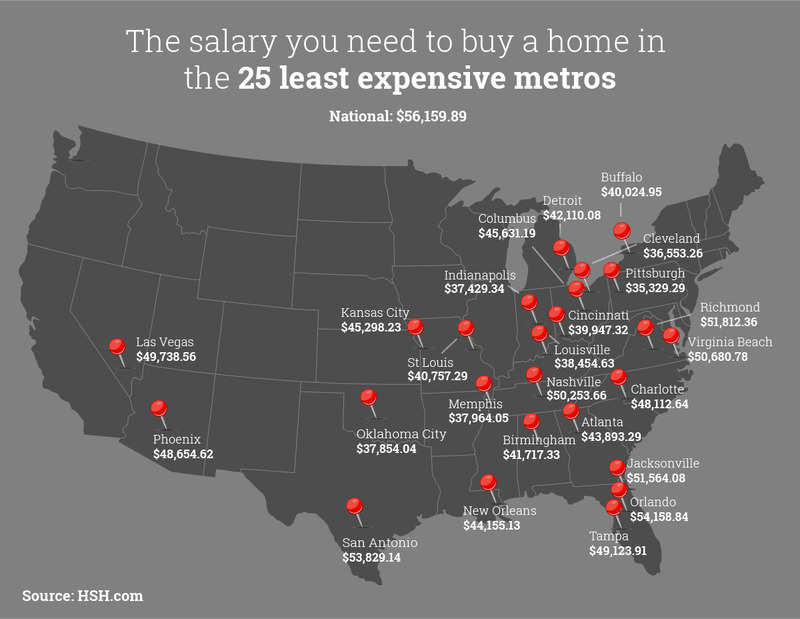
CBS News reported Monday that a study from the COVID-19 Eviction Defense Project estimates between 19 million and 23 million renting families nationwide could be at risk of losing their homes by September 30.
"There are already 12,000 eviction cases pending in Virginia and another
10,000 cases prepared in North Carolina, two states that saw their
eviction moratoriums end in June."
Rep. Ilhan Omar's solution: She’s called for lawmakers to cancel rent and mortgage payments entirely
*******************************************************************
It all seems sensationalized to me. It's an election year and it will get crazier the closer we get to the election.
You really want to discount appreciation, one of the three main wealth drivers in real estate, as a "feel good" argument just because what goes up can also come down? Well, there is no guarantee that the other wealth drivers will continue either.
And there most certainly are things you can do with appreciation. It's not some mythical thing that is stuck there. You can borrow against it. You can refinance and take the cash out. You can sell the place. You can use it to buy more places. You can retire on it.
As for the argument that you pay a lot of it to an agent when you go to sell, I love that. I'm sorry, but that sounds like the old Jewish housewife joke. Husband says to wife: We just won the lottery! Wife screams: OH. MY. GOD. THE TAXES!!!!
eviction moratoriums are NOT ENDING anytime soon in SoCal. I can see the light at the end of the tunnel towards the end of 2021 being realistic with Rent forgiveness and NO help for landlords. It’s a democratic state to buy out votes. I agree it will get really ugly before it gets better.
Any idea why people still invest in CA?
I saw the writing on the wall a while back and friends thought I was nuts to not invest in California. I looked around and saw nearby landlord friendly AZ and TX. Seems people are the proverbial frog in the pot. They don't notice it is getting increasing bad but seem to take No action to make it change.
Did that writing on the wall mention all the appreciation that you missed out on? What about the like clockwork annual rent increases?
There is no doubt that investing in CA is a minefield, but with risk comes reward. Those that are smart, know the rules, have reserves, screen well, and stay on top of their properties will do fine. Practically every renewal there is the opportunity to do a rent increase. People say that CA doesn't cash flow. However, with the way rent keep increasing, you can cash flow after a few years. The weak can't afford this, but the strong can.
There is always demand for units here. Every day there is a post about a unit being vacant for 1-2 months and the landlord doesn't know what to do. These people are never in CA. I pick from a pool of qualified tenants.
Yes, our government is stupid and liberal. The more risk they throw on landlords, the higher the rent goes. The more laws they put in place, the more mom & pop landlords exit the business and the less supply there is on the market. Landlord friendly is only one piece of the puzzle. The friendliest place can have low demand, zero appreciation, and stagnant rents... but it is landlord friendly should you ever need it.
I saw the writing on the wall a while back and friends thought I was nuts to not invest in California. I looked around and saw nearby landlord friendly AZ and TX. Seems people are the proverbial frog in the pot. They don't notice it is getting increasing bad but seem to take No action to make it change.
Did that writing on the wall mention all the appreciation that you missed out on? What about the like clockwork annual rent increases?
There is no doubt that investing in CA is a minefield, but with risk comes reward. Those that are smart, know the rules, have reserves, screen well, and stay on top of their properties will do fine. Practically every renewal there is the opportunity to do a rent increase. People say that CA doesn't cash flow. However, with the way rent keep increasing, you can cash flow after a few years. The weak can't afford this, but the strong can.
There is always demand for units here. Every day there is a post about a unit being vacant for 1-2 months and the landlord doesn't know what to do. These people are never in CA. I pick from a pool of qualified tenants.
Yes, our government is stupid and liberal. The more risk they throw on landlords, the higher the rent goes. The more laws they put in place, the more mom & pop landlords exit the business and the less supply there is on the market. Landlord friendly is only one piece of the puzzle. The friendliest place can have low demand, zero appreciation, and stagnant rents... but it is landlord friendly should you ever need it.
Appreciation is a "feel good" argument. That isn't anything you can guarantee will always be there or be there when you retire. There isn't anything you can do with it. And, they can always raise taxes on property sales, plus you pay a lot of that equity to a real estate agent when you go to sale.
But, I know, "properties always go up in value" . . .until they crash.

eviction moratoriums are NOT ENDING anytime soon in SoCal. I can see the light at the end of the tunnel towards the end of 2021 being realistic with Rent forgiveness and NO help for landlords. It’s a democratic state to buy out votes. I agree it will get really ugly before it gets better.
Any idea why people still invest in CA?
I saw the writing on the wall a while back and friends thought I was nuts to not invest in California. I looked around and saw nearby landlord friendly AZ and TX. Seems people are the proverbial frog in the pot. They don't notice it is getting increasing bad but seem to take No action to make it change.
Because properties trade at a 3.5% cap rate and get financed on 4.0%-4.5% cap rates. So every dollar of NOI increase can increase the property value by $25
You really want to discount appreciation, one of the three main wealth drivers in real estate, as a "feel good" argument just because what goes up can also come down? Well, there is no guarantee that the other wealth drivers will continue either.
And there most certainly are things you can do with appreciation. It's not some mythical thing that is stuck there. You can borrow against it. You can refinance and take the cash out. You can sell the place. You can use it to buy more places. You can retire on it.
As for the argument that you pay a lot of it to an agent when you go to sell, I love that. I'm sorry, but that sounds like the old Jewish housewife joke. Husband says to wife: We just won the lottery! Wife screams: OH. MY. GOD. THE TAXES!!!!
Bought a duplex in southern california 2016, cash flows 600$/month, appreciated 200k. That's why I invested in California. Crashes haven't hurt California compared to everywhere else.
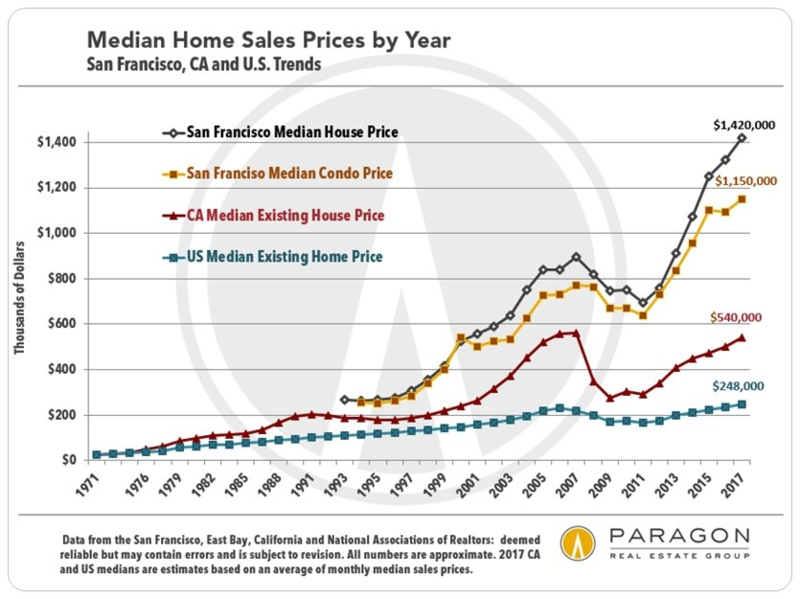
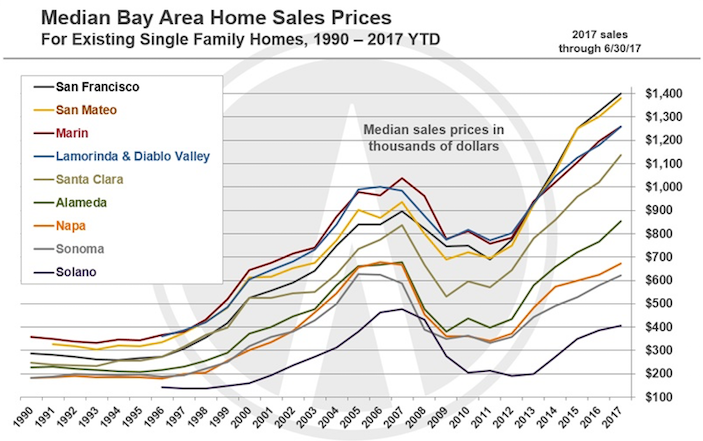
If you don't believe in appreciation, check bay area prices for the last 20 years
Bought a duplex in southern california 2016, cash flows 600$/month, appreciated 200k. That's why I invested in California. Crashes haven't hurt California compared to everywhere else.
If you don't believe in appreciation, check bay area prices for the last 20 years
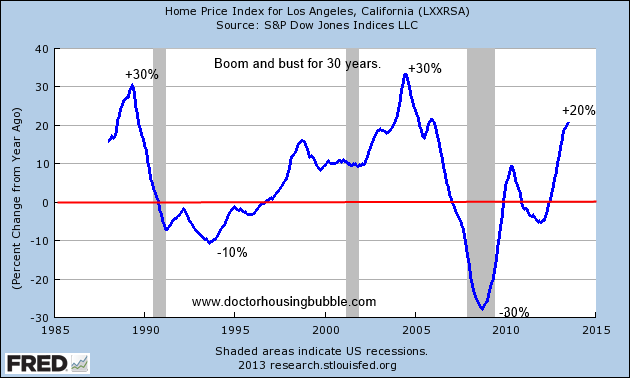
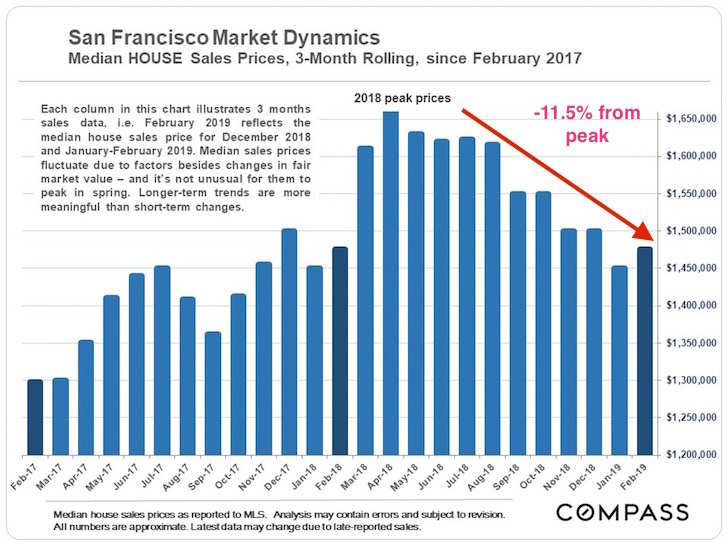
You are right! Appreciation in the area has only gone up over the last 30 years, never went down, never corrected.
Opps, wrong slide. Ignore the chart below. It doesn't fit your narrative. ;-)
You really want to discount appreciation, one of the three main wealth drivers in real estate, as a "feel good" argument just because what goes up can also come down? Well, there is no guarantee that the other wealth drivers will continue either.
And there most certainly are things you can do with appreciation. It's not some mythical thing that is stuck there. You can borrow against it. You can refinance and take the cash out. You can sell the place. You can use it to buy more places. You can retire on it.
As for the argument that you pay a lot of it to an agent when you go to sell, I love that. I'm sorry, but that sounds like the old Jewish housewife joke. Husband says to wife: We just won the lottery! Wife screams: OH. MY. GOD. THE TAXES!!!!
It was Your argument for appreciation, not mine. There are lots of ways to get depreciation in investments. I'm glad you are happy to pay taxes on unrealized profit. Clever investing. ;-) Do you believe property taxes and wealth taxes in CA are not going to rise in the future? Seems to be a faulty line of thinking, but Chacun Son Goût
You've confused me.
Your comment: "If you don't believe in appreciation, check bay area prices for the last 20 year" and used the same chart I used.
My comment was that real estate has it ups and downs and doesn't always go up. Please note 2007 - 2011.
It's doesn't really matter though.
Think of it this way, say you have a rental property that has a Negative Cash Flow but it's gone up 20% in value. A nice healthy increase. So, your $900,000 rental house is now valued at $1,080,000 for a $180,000 increase. Not bad. So, you go to refinance to take out all of that equity and the bank will do a 70% LTV on $1,080,000 value for a loan of $756,000. Oops, that's not even enough to pay off the underlying loan, let alone give you any cash out. How is that helpful? It's all math, and Not Everybody is good at math. That's all.
It could go up 30% in value and you still wouldn't be able to refinance without bringing money to close.
Plus all that time you are paying property taxes, replacing the roof, replacing flooring, updating kitchens and bathrooms, painting, managing the property, having vacancies and so on. And the tax laws could change and hurt your position at any time.There could be a major earthquake, Pandemic, fire, riots, and nut cases at city hall. All of which affect your equity position and/or your risk factor and/or "quiet enjoyment" of the property.
You guys are posting the Case Shiller index... it's an APPRECIATION chart. So it showing year over year increases for four years of a whopping 13% appreciation in Seattle, a respectable 6ish% appreciation in LA and then dropping to about 1% appreciation for the final Jan 19 tally. Let's look at LA, since that's the most modest. That means in LA houses went up 5-6% between Jan 2015 and Jan 2016, another 5% from 1/2016 to 1/2017, another 7% or more in '17-18 and 1% or so from '18-'19. My way of looking is that you got compounded interest for all these years (the Jan value is higher than the year before). If we don't compound it and take the very lowest numbers for Los Angeles, it's still impressive, just add 5%+5%+7%+1%=18% in 5 years. That's about right... 20% or so in 5 years in LA. And in Seattle, they're smiling even more. And in SF, the numbers were so high to begin with that they've been smiling for years.

@Account Closed
^JJ should have cleared it up for you a bit there. Your chart shows strong appreciation year over year on average. Does it have dips? sure, like everything. For the most part it's up and up and away.
I work in the Bay and my colleagues here who have bought houses 15 years ago don't have a 30% increase in value, they have 300% increase in value.
I'll use your example anways, 1,000,000 home, take out a HELOC and buy whatever cash flowing properties I would want. Leverage is the name of the game. Give me access to more $ and I'll invest it and beat out the 4% interest rate (that is tax deductible). In addition to claiming the mortgage interest tax deduction, you can deduct depreciation on the 1,000,000$ property. All of the issues you mentioned are tax deductible and insurance takes care of 3/4 of them as well.
I have 5 out of state properties, one in California. The one in California I leveraged and bought the other 5 BECAUSE of the appreciation. It cash flows the most, it appreciated the most, it gives me the most tax deductions BY FAR.
Investing in California has worked out well for me, if it goes down, that's fine. I'll take the cash flow and 5 properties it provided me. To each their own.
So I pay more in property taxes as the value of my property rises. So what? This is a good thing. The value of the property rises because demand is rising. Demand continues to outpace supply. My rents increase. My rent increases far outpace the property tax increases. This is a business. If you run it properly, rent increases will always outpace expenses.
The good news for you is that your approach of investing in stagnant assets to avoid higher property taxes probably doesn't have a lot of competition. 👍
It could go up 30% in value and you still wouldn't be able to refinance without bringing money to close.
You're damn right that not everyone is good at math. You forgot to take into account that you had to put 30% down on that $900,000 property, so your mortgage is $630,000 minus the principal reduction since day one. Now that property is worth $1,080,000, and a 70% LTV is $756,000, meaning you can refinance the ~$630,000 owed and take out $126,000. Not Everybody is good at math. That's all.
@Account Closed
^JJ should have cleared it up for you a bit there. Your chart shows strong appreciation year over year on average. Does it have dips? sure, like everything. For the most part it's up and up and away.
I work in the Bay and my colleagues here who have bought houses 15 years ago don't have a 30% increase in value, they have 300% increase in value.
I'll use your example anways, 1,000,000 home, take out a HELOC and buy whatever cash flowing properties I would want. Leverage is the name of the game. Give me access to more $ and I'll invest it and beat out the 4% interest rate (that is tax deductible). In addition to claiming the mortgage interest tax deduction, you can deduct depreciation on the 1,000,000$ property. All of the issues you mentioned are tax deductible and insurance takes care of 3/4 of them as well.
I have 5 out of state properties, one in California. The one in California I leveraged and bought the other 5 BECAUSE of the appreciation. It cash flows the most, it appreciated the most, it gives me the most tax deductions BY FAR.
Investing in California has worked out well for me, if it goes down, that's fine. I'll take the cash flow and 5 properties it provided me. To each their own.
You were smart. You took your profits and went to another state with your money.
It could go up 30% in value and you still wouldn't be able to refinance without bringing money to close.
You're damn right that not everyone is good at math. You forgot to take into account that you had to put 30% down on that $900,000 property, so your mortgage is $630,000 minus the principal reduction since day one. Now that property is worth $1,080,000, and a 70% LTV is $756,000, meaning you can refinance the ~$630,000 owed and take out $126,000. Not Everybody is good at math. That's all.
You forgot the costs of doing the refinance. ;-) And now, you have more of a delta between income and outgo. The 30% you put down and then you took out, you already had, it isn't "new money".
Anyway, I don't put 30% down on properties (I put down far, far less) and I'm able to buy far more properties that actually cash flow and are going up a measly 10% to 15% and are very unlikely to crash. California, I'm not so sure about.
@Greg M.
Haha his math is laughable. He says he puts even less down. Say 10% down ok 90k equity 810k loan. Now it goes to 1.08M. Now he’s got 270k equity and a 810k loan. Somehow he can’t get ahead on the extra 180k of equity he got because his lender is eating up all of that in fees...
@John Farady You do know that lower money in the deal AMPLIFIES your return from appreciation (or cash flow for that matter). Just thought you should be aware. Also I’m not sure if you are reading any of the graphs other than maybe a location in the heading and the slope of the line, but that very first table you posted is a good argument for why CA real estate is so impressive. I’m on mobile and wasn’t able to see the whole graph but the Y-Axis is percent change from prior year. See how the peaks are at 30% and the line spends a significant amount of time between 20% and 30%? That is year after year after year of 20-30% appreciation. Yes it drops negative periodically. You may lose 10% in a bad crash. But you make up for it when you’re in the upper part of the graph. Can you find a graph showing the same for Phoenix? I would love to compare the two.
@Greg M.
Haha his math is laughable. He says he puts even less down. Say 10% down ok 90k equity 810k loan. Now it goes to 1.08M. Now he’s got 270k equity and a 810k loan. Somehow he can’t get ahead on the extra 180k of equity he got because his lender is eating up all of that in fees...
@John Farady You do know that lower money in the deal AMPLIFIES your return from appreciation (or cash flow for that matter). Just thought you should be aware. Also I’m not sure if you are reading any of the graphs other than maybe a location in the heading and the slope of the line, but that very first table you posted is a good argument for why CA real estate is so impressive. I’m on mobile and wasn’t able to see the whole graph but the Y-Axis is percent change from prior year. See how the peaks are at 30% and the line spends a significant amount of time between 20% and 30%? That is year after year after year of 20-30% appreciation. Yes it drops negative periodically. You may lose 10% in a bad crash. But you make up for it when you’re in the upper part of the graph. Can you find a graph showing the same for Phoenix? I would love to compare the two.
Why do you assume I am putting 30% ($300,000) down and buying $900,000 houses? I am not. That's bad investing. That's for people that are bad at math.
I average putting $7,000 down on $250,000 properties (0.03%) that I take over in PHX AZ, I have some carrying costs naturally, and the existing loans are in the $180,000 range.
The properties have an average ARV of $250,000, but I buy at $180,000 which requires about $7,000 of my own money.
All of this is documented with HUD statements and cashiers checks and wire transfers. Yep, I buy equity AND cash flow.
I use Subject To, then I sell to Tenant Buyers who give me between $20,000 and $25,000 as an option fee. That's my return, up front. The average cash flow I get on the properties I buy, is about $700. The Tenant Buyers do all of the maintenance and repairs per our agreement. No management company or fees. No CapEx. So, for 30% of $900,000 ($270,000) instead of buying 1 house, I am for sure buying 18 houses (conservatively) getting an average of $500 each for $9,000 a month income on the same amount. I've lost track actually. Plus I get the appreciation of those properties, whatever it may be, I don't really track it.
All of this in the cities of Phoenix, Mesa, Scottsdale, Peoria, Gilbert where they appreciate my business, are landlord friendly, taxes are low and rents are skyrocketing. But, please continue investing in California if that's what floats your boat. I don't really need more competition in my target area.
I look for profit, not ego. I work with high income earners (accredited investors) who think like I think, so I'm perfectly happy to be the dumb rich guy on Bigger Pockets. ;-)
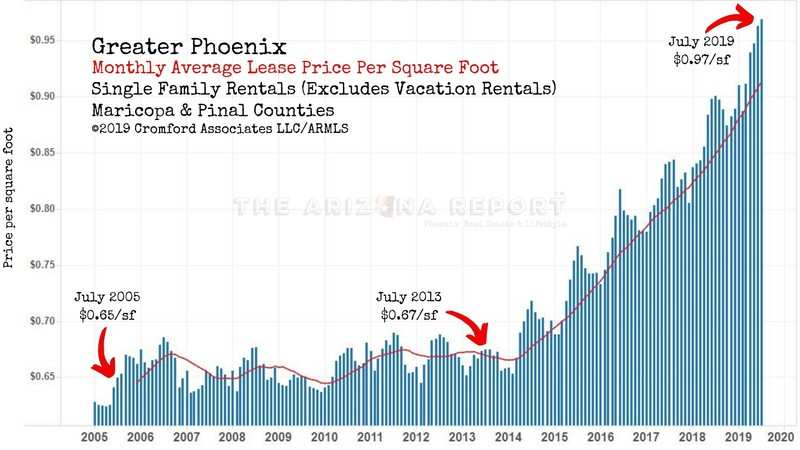
Let's all agree that time-slicing data over short periods do not serve much value in understanding long-term investment considerations.
Investment returns are commensurate to risk, reward, effort and barriers to entry. These factors are dynamic and change over time, but efficient markets will find new equilibrium points. Until fundamental value drivers (i.e. weather, diverse economy, foreign investment interest) change, CA investments will likely remain sound over time.
I do not buy the argument that you cannot monetize appreciation before asset disposition or refi - cash flow from appreciation is realized through rent increases. The real question is whether the NPV impact of 0 cash flow in the first few years after acquisition can overcome later-year high cash flow or capital gains upon sale. Since most folks on this forum do not calculate IRRs, most find it difficult to compare investment strategies that are not cash flow based.
While wealth does not necessarily equate to intelligence, there is still a logical explanation for why CA real estate prices are high - all these people cannot simply be gambling, right? Speaking of efficient markets, what made Arizona an attractive market 5 years ago has quickly diminished. All the folks who cannot afford CA are crowding the AZ market, so at some point the factors that make CA an attractive appreciation play will also adversely affect AZ as well.
For the sake of constructive discussion, let's all agree that both CA and AZ are good markets to invest in. Whether CA or AZ fits your personal interest is up to a number of factors that only you can answer based on individual constraints and preferences.
If you think CA real estate prices are high, you haven't seen many markets outside of the US. Global money will chase yield, and CA still looks plenty attractive to international investors. The international investors will buoy the CA market, CA investors will buoy AZ market, AZ investors will buoy TX market... and so forth...
@John Farady
Yes, it’s so sad!
Nyc will start evictions soon
They’re starting illegally I’m sure already
California is a whole other animal. SoCal alone has more housing value than Texas and Florida combined. The amount of wealth created via RE can be substantial enough that many will risk whatever the extra hurdles. It is common a single property's total profit is measured in the multiple 6 figures over time. A couple hundred a month cashflow is just not comparable in many cases.
Good luck with your search!