Would you purchase strictly for cash flow?

Would you purchase strictly for cash flow?

Member since 2022 · 19 posts · 4 votes

Hi all,

I've been finding really good deals for cash flow in some of the smaller towns. However I'm a bit nervous about purchasing in a town where there's not much going on.

We are foreign investors, strictly purchasing for cash flow - however there's always that lingering thought of non paying tenants, etc. etc. 

Does anyone purchase strictly for cash flow? Knowing that the property itself likely won't appreciate much or at all over time?

4Reply
55 views

Most Popular Reply

Real Estate Agent · Columbus, OH · Member since 2019 · 82 posts · 133 votes
4y

I liken the cash flow approach in real estate to the value approach in stocks. To me, as Bill Ackman says, free cash flow is the most important thing in business. When purchasing a property I imagine I am purchasing a business or a farm. You wouldn't purchase a business that didn't have any returns without a path to profitability. But you also wouldn't purchase a business that is in a dying industry. My rule of thumb for analyzing markets is population growth. The economic basis of growth is supply and demand, if you buy in a place where the population is trending down it's likely that you will not see any intrinsic growth in that area. If you can find an area like some cities in the midwest like Indianapolis, Dayton, Cincinnati, etc where the population is increasing and you can still get good cash flow then in my opinion it makes for a sound investment. 

See this reply in the discussion

61 Replies

Jump to latestLatest
  • Eric FernwoodBusiness Member
    Realtor · Las Vegas, NV · Member since 2014 · 995 posts · 1k+ votes
    4y

    Hello @Erika Geoffrey,

    What you should buy depends on your goals. If your goal is a dependable passive income, then no. There are multiple reasons I do not recommend small towns and buying just for cash flow, but the biggest reason is inflation.

    Inflation continuously erodes the buying power of the dollar. Every time you go to the grocery store, buying the same basket of goods takes more and more dollars. If your rent is not rising as fast or faster than inflation, you will not have the additional dollars to maintain your standard of living.

    For example, if inflation continues at 8%, how many dollars will you need to buy the same basket of goods in five or ten years? See the table below. The table shows how many dollars you will need each year to have the same buying power as $100 today.

    I talked to someone who was not concerned about inflation because their rents rose on average 2% per year. What is happening to their buying power over time? See the table below.

    So, even if the rent increases 2% annually, when inflation is 8%, at the end of year 5, your buying power declined by 32%.

    Jobs are another factor to consider. A rental property is no better than the jobs around it. Small towns tend to be too dependent on a single business sector or company. And, it is not just the jobs the tenant has today. The average life of a company is ten years. The average life of an S&P 500 company is only 18 years. Every job your tenant pool has today will likely go away over the next 10 to 15 years. Unless new employers are moving into the location and creating similar paying jobs requiring similar skills, the only jobs available will be lower-paying service-sector jobs. If your tenant pool's income declines, so will your rent.

    Also, cities derive most of their operating income from property and sales taxes. Property prices and sales tax revenue decline if the median income declines. When the city's revenue falls, they have no option but to reduce spending on schools, public safety, road repair, etc. As city services decline, crime follows. No one wants to live in a high-crime location with declining services. Those with sufficient income will move to a more desirable location. The people remaining will, on average, have lower incomes. Thus, the city receives less revenue and cuts more services. This is a financial death spiral from which few declining cities have recovered.

    My Recommendations

    Only buy in cities with a population of at least 1 million. Real estate investing is a long-term business. Smaller towns are unlikely to attract new employers and have limited ability to weather financial storms. Long term, few small cities will do well. Also, only buy where appreciation and rents increase faster than the inflation rate. If not, your first month's rent will be the highest amount you will ever receive.

    FERNWOOD Team, KW VIP Realty520 Reviews
  • Member since 2022 · 19 posts · 4 votes
    4y

    @Eric Fernwood Interesting take. I agree smaller towns are more risky, for many reasons.

    Wouldn't going for a population of over a million take out a ton of opportunities? Canada only has, I believe, 6 cities with over 1 mil population, and of course prices are much higher in these locations (they would likely gain more appreciation over time, but with a higher purchase price the overall return would likely be the same as say, a city with 300,000 population).


    When it comes to inflation, it seems most jobs don't keep up with inflation raises. So whether the income comes from rental properties or a 9-5, your buying power would decrease over time, regardless. No?

  • Rental Property Investor · Boston, Massachusetts (MA) · Member since 2016 · 2k+ posts · 2k+ votes
    4y

    @Eric Fernwood slightly pedantic on my end but  the 2% escalations should be added to the previous years rent, not the base. At least thats how we structured ours.

    But definitely agree with the concerns. One HUGE advantage of real estate is its potential to hold its value against inflation both in cash flow and appreciation. This holding value is intimately tied up with the health of the local market. A purely cash flow place in a lower end market that doesn't appreciate could be losing money even at positive cash flow.

    I would part ways with you on the 1M mark but only in that its the satellite towns of such cities that can have winners. Towns with riverwalks, coffeeshops, wifi, schools and greenery that can host professionals based nearby.

  • Rental Property Investor · Honolulu, HAWAII (HI) · Member since 2011 · 4k+ posts · 2k+ votes
    4y

    When I first started investing I did with turnkey rentals for cashflow. That is a great way to get started but once you get more experienced value add is better.

  • Eric FernwoodBusiness Member
    Realtor · Las Vegas, NV · Member since 2014 · 995 posts · 1k+ votes
    4y

    Hello @Erika Geoffrey,

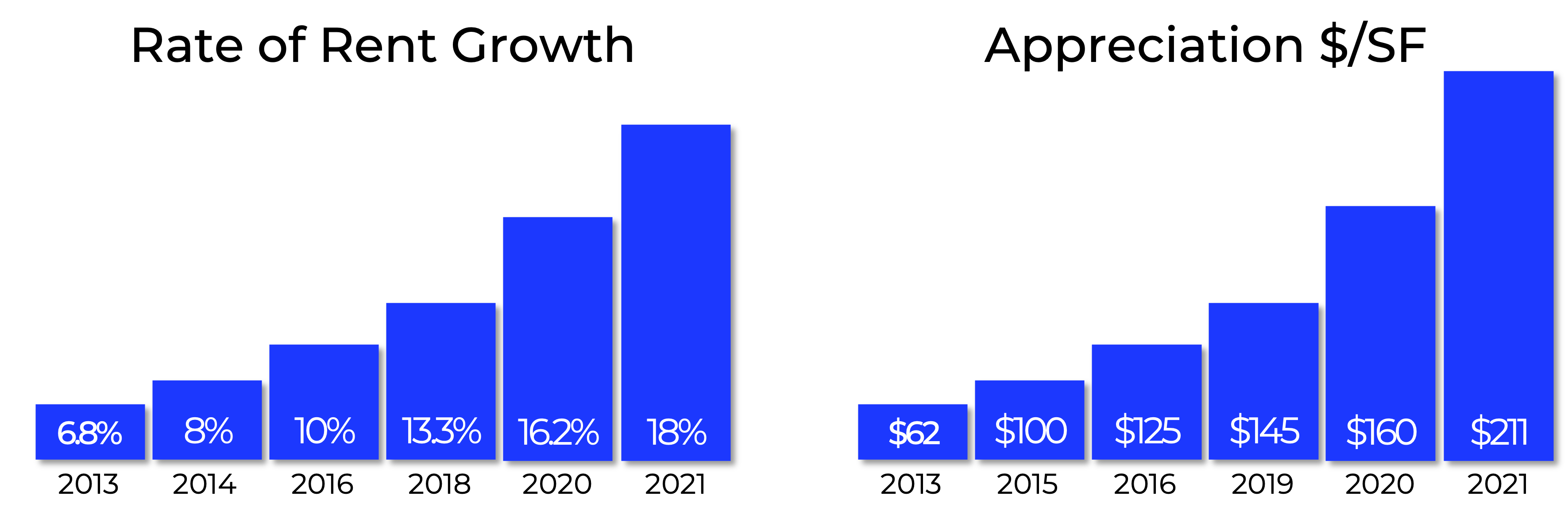
    It depends on the location. We are in Las Vegas, and below are the stats for our target tenant pool and the properties they rent.
    https://www.lasvegasrealestateinvestmentgroup.com/nwassets/images/propertyPerformance20220609.png

    The stats are only for the properties we target, not the overall Las Vegas market. Our client's rental incomes continue to increase in buying power, even considering inflation.

    Rent growth in 2021 (for our target segment) was 18%. However, you can not increase a tenant's rent by 18% in one year. I did a study, and most rent increases ranged between 8% and 12% per year.

    Las Vegas is a unique city for several reasons.
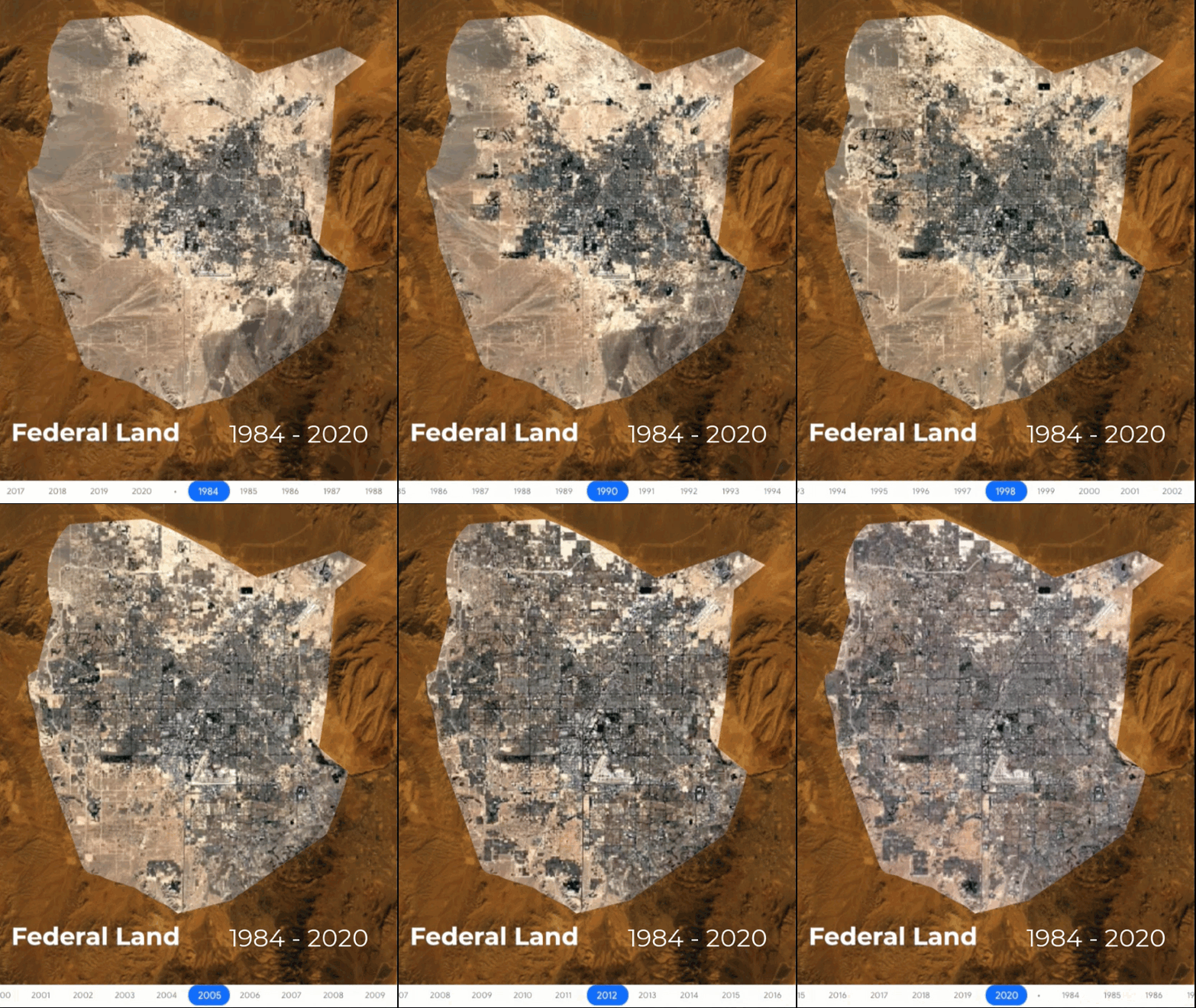
    • Las Vegas is a small island of privately owned land in an ocean of federally owned land. See the time-lapse below. People come to Las Vegas and see the vast open desert around Las Vegas and assume that there is infinite land for expansion. Not true. 85% of the entire state of Nevada is federally owned. Clark County (the Las Vegas metro area) is 87.5% federally owned. So, there is little land left for development. The land is expensive. In good areas, raw land costs over $1M/Acre or $1M/hectare.
    https://www.lasvegasrealestateinvestmentgroup.com/nwassets/images/landUsage20220126.gif
    • Rapid economic growth - Today, there are over 26,000 open jobs. And, there are $22B projects under construction, which will create thousands of additional jobs.
    • A population growing at a sustainable rate (2.5% to 3%), limited land for expansion, and good-paying jobs will keep Las Vegas rents and prices increasing for the foreseeable future.
    • Other factors will continue Las Vegas’ growth for the foreseeable future that I will not go into here.

    A question I frequently get concerns income reliability - the connection between jobs and tourism. I was living in New York City when I decided to move to Las Vegas and to build a business focused on investors and dependable passive income streams. Once I selected Las Vegas, I spent almost three months studying tenant pool demographics. The result of my studies was selecting a narrow tenant pool segment. This tenant pool has performed exceptionally well in good times and bad. Below are our 15-year results.

    • 2008 crash - Zero decline in rent and zero vacancies.
    • COVID - Almost no impact
    • Eviction moratorium - No impact
    • Our average tenant stay is over five years.
    • We’ve had only five evictions in the last 15 years.
    • 2022 YoY (July) result: rent increase 11%, appreciation 26%

    My point is that location is your most important investment decision, not the property. As long as you buy in a location where rents and prices increase faster than the inflation rate, appreciation and rent increases will correct all but the worst mistakes. However, if you buy in a location where prices and rents increase below the inflation rate, you can do nothing to turn the situation around after the fact.

    I assume you are from Canada. Based on a quick Wikipedia search, you might need to look at metro areas of 800,000 or more. There are things to be considered when you buy in a high-appreciation location.

    • Property prices in high-appreciation locations are more expensive than in areas with low appreciation rates.

    • Just because you buy in a high-appreciation location does not guarantee that the property you select will perform. You must choose a tenant pool with a high concentration of “good” tenants. I define a good tenant as someone who:

      • Has stable employment in a market segment that is very likely to be stable or improve over time
      • Has a credit history with which you can evaluate the likelihood that they will perform
      • Pays all the rent on schedule
      • Takes care of the property
      • Does not cause problems with neighbors
      • Does not engage in illegal activities while on the property
      • Stays for many years

      Good tenants are the exception, not the norm. Good tenants are the result of:

      • Targeting the right tenant pool.
      • Select properties that your target tenant pool is willing and able to rent.
      • A skilled property manager.

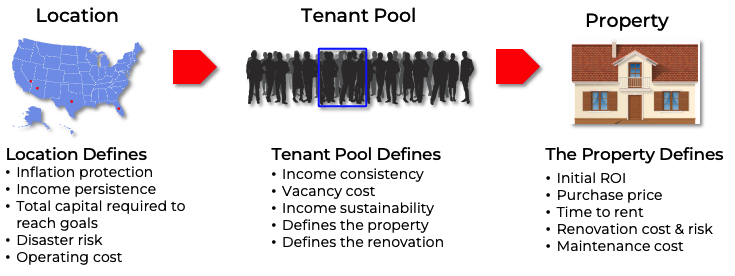
    Your target tenant pool defines everything. The property type, location, configuration, and rent range. The tenant pool also defines the renovation items. Below is the process I followed.
    https://www.lasvegasrealestateinvestmentgroup.com/nwassets/images/20220706-381.png

    If there are any questions about the above process, please feel free to ask.

    I should have clarified that my 1M mark refers to the metro area, not just a city jurisdiction. @Erika Geoffrey @Jonathan R McLaughlin

    FERNWOOD Team, KW VIP Realty520 Reviews
  • Eric FernwoodBusiness Member
    Realtor · Las Vegas, NV · Member since 2014 · 995 posts · 1k+ votes
    4y

    Hello @Lane Kawaoka,

    You brought up a great topic, turnkey. I am occasionally asked about turnkey vs. working with an investment team.

    Turnkey is a purchase method and nothing more. Buying turnkey does not reduce your due diligence. The most important decision you will make is the location, not the property. Select the investment location based on factors including:

    • Rent growth and appreciation rate vs. the inflation rate.
    • Population size
    • Population growth
    • Crime
    • Disaster risk
    • Operational costs

    Once you’ve selected the location, the next decision is which tenant pool to target. Every property is only desirable to a narrow tenant pool segment. Choose a tenant pool segment that will provide a reliable income stream (in good times and bad) and only buy properties that the tenant pool segment is willing and able to rent. Once you select your tenant pool segment, all decisions about the property characteristics are defined. Your target tenant pool defines the location, property type, configuration, rent range, and more.

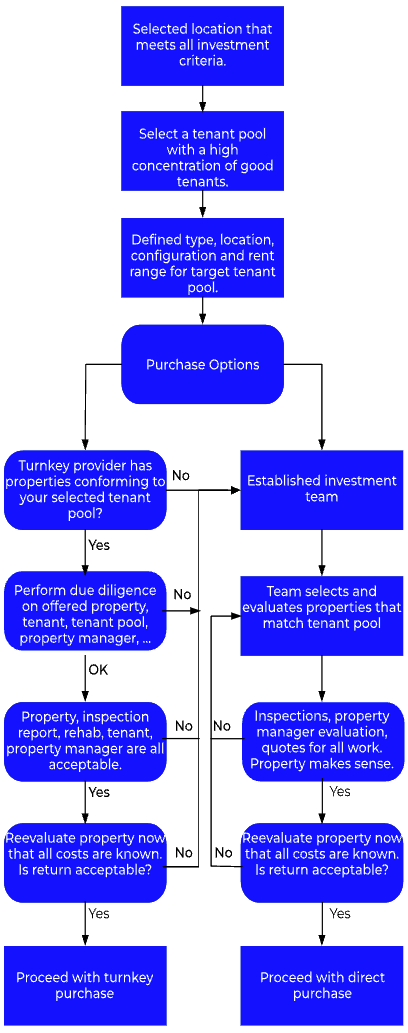
    Once you know the characteristics of the properties you want, the next step is deciding how to purchase the property. Two options are direct or turnkey. As an engineer, I believe in processes, not feelings and guesses. So, I put together the following decision tree to help decide which purchase method was best for meeting your goals.
    https://www.lasvegasrealestateinvestmentgroup.com/nwassets/images/20220706-383.png

    Other considerations

    Turnkey Convenience Fee

    Turnkey properties will always be more expensive than direct purchases, resulting in a lower return. Turnkey providers must charge enough to cover a renovation, carrying costs, marketing expenses, tenant acquisition, and profit. These costs are in addition to the actual property cost. Below is a diagram illustrating the cost difference between direct vs. turnkey. The difference between a direct purchase and buying turnkey is the "convenience fee.”
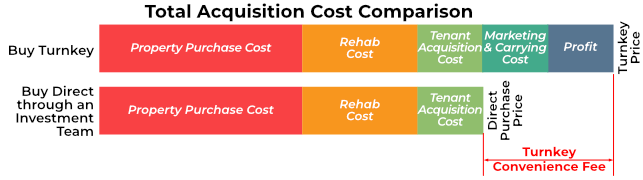
    https://www.lasvegasrealestateinvestmentgroup.com/nwassets/images/cbpp_turnkeyCostComparison-05.png

    Note that while you pay more with turnkey, you will save time. That is the main advantage of buying turnkey.

    Property Condition

    Most turnkey providers put their money into cosmetics, not systems. Painting, carpet, and light fixtures are low-cost items compared to termites, roof, plumbing, wood rot, electrical, HVAC, and foundation issues. For example, during the inspection of a flipped property, we learned that the plumbing system needed replacement; the flipper just patched over the leaks. A typical cost to re-plumb a house is $10,000 to $20,000. The paint, carpet, and everything else probably cost under $5,000.

    I have also heard that some turnkeys do not allow independent property inspectors. Unless I know the actual property condition, how do I know the actual cost? Never buy a property without an independent inspection.

    Property Management

    One of the selling points for turnkeys is that they manage the property after the sale. The flip side is that you cannot use a different property manager, even if you are dissatisfied with their property manager's performance. While Yelp (and similar) reviews are problematic, read the turnkey's property manager's reviews. One large turnkey property manager has a 1.5 stars rating. Such a poor-performing property manager will result in more frequent tenant turns, which generates more income for the property manager (lease-up fees).

    Another claimed advantage of the property manager is their internal maintenance staff. Internal maintenance staffs are an inherent conflict of interest. Property managers make more money on repairs than they do on rent collections. I do not want my maintenance costs to be the property manager's profit center.

    If You Decide on Turnkey

    I recommend the following as a condition of purchase.

    • The right to have an inspection by an independent licensed property inspector.
    • A list of all repairs made by the turnkey. You need to know which items (from the inspection report) still need to be corrected. Get a quote for all these repairs, so you know how much the property will cost you, including repairs.
    • Get independent rental and sales comps for the property. Compare this to what the turnkey states.
    • Get copies of their management and leasing agreement and read them. For example, I've seen terms requiring you to sell the property through the turnkey at a very high commission rate.
    • You must have the right to choose the property manager. You want a property manager that works for you, not the turnkey. I have heard that you do not have that option with most turnkeys. Property management is a significant residual income for the turnkey.
    • Results from any code inspections. In some locations, the house must pass specific codes to get a certificate of occupancy.
    • All disclosures that the property's prior owner provided to the turnkey.
    • A written statement from the property manager with specifics on the time and cost to evict a non-paying tenant.

    If you obtain all the above, buying turnkey or direct becomes a simple time vs. return decision.

    FERNWOOD Team, KW VIP Realty520 Reviews
  • Rental Property Investor · Centreville, VA · Member since 2019 · 1k+ posts · 799 votes
    4y

    I would definitely recommend exploring turnkey investing out of state in cash flowing markets. Let me know if you want to connect

  • Real Estate Broker · Cleveland Dayton Cincinnati Toledo Columbus & Akron, OH · Member since 2013 · 30k+ posts · 20k+ votes
    4y
    Quote from @Erika Geoffrey:

    Hi all,

    I've been finding really good deals for cash flow in some of the smaller towns. However I'm a bit nervous about purchasing in a town where there's not much going on.

    We are foreign investors, strictly purchasing for cash flow - however there's always that lingering thought of non paying tenants, etc. etc. 

    Does anyone purchase strictly for cash flow? Knowing that the property itself likely won't appreciate much or at all over time?


     You should also be looking at the comps as well. Never forget about the comps.

  • Rental Property Investor · Honolulu, HAWAII (HI) · Member since 2011 · 4k+ posts · 2k+ votes
    4y

    For those who are able to save more than $30k a year or have substantial liquidity (over 200k), being a landlord and especially flipping is a lot of work. If you like it cool/good for you... but just remember why we got into this... To be free from a JOB...Focus on being an Investor not a Landlord.

    Do the math here… with 300 dollars per property (2 months of work to buy a turnkey rental) you are going to need 20-40 of these to replace your income. I had 11 of these and good systems in place but still had 1-2 evictions a year and 3-4 big things that were normal annoyances like plumbing leaks, damages from hurricanes, or some vandalism. Image if I had 30, just 3 x those numbers.

    Directly investing in a turnkey rental or small MFH is a good way to start to learn and build up the war chest to go into my scaleable investments such as private placement syndications. 

    If your net worth (income minus expenses) is under $200,000 or barely save $30,000, syndications are not for you. Stick with these Turnkey rentals.

  • Real Estate Consultant · Cleveland · Member since 2020 · 6k+ posts · 3k+ votes
    4y
    Quote from @Erika Geoffrey:

    Hi all,

    I've been finding really good deals for cash flow in some of the smaller towns. However I'm a bit nervous about purchasing in a town where there's not much going on.

    We are foreign investors, strictly purchasing for cash flow - however there's always that lingering thought of non paying tenants, etc. etc. 

    Does anyone purchase strictly for cash flow? Knowing that the property itself likely won't appreciate much or at all over time?


     OF  course, if your getting 20% net caps, and understand there will be little to no appreciation, why not. However in my market we have been fortunate to get a lot of appreciation, more then double or triple plus double digit net caps.  

    Good Luck 

  • Investor · Buffalo, NY · Member since 2012 · 39 posts · 10 votes
    4y
    Quote from @Erika Geoffrey:

    Correct. However I’d also like to get some cash flow as well. Not just appreciated value that I won’t see until I sell 30 years from now

    do a cash out refi to get a little money now  tax free also 

Join the conversationCreate a free account to reply, vote on answers and follow this thread.