Using Creative Financing To Buy "Off Market" with "Subject To" and "Wraps"

Using Creative Financing To Buy "Off Market" with "Subject To" and "Wraps"

Investor · Get yourself trained before doing something inadvisable. · Member since 2024 · 3k+ posts · 1k+ votes

Are you new? Buying an "Off Market" property with "Subject To" and "Wraps" & Selling "Lease / Option"

When buying a property to cash flow, you need to know what your expenses are. The following is one I actually purchased in Phoenix that was a pre-foreclosure. The seller and I negotiated the terms. I did not offer a number to him, he told me what he needed. This first portion is the end result. The following portions are how we got there. Click on images to enlarge.
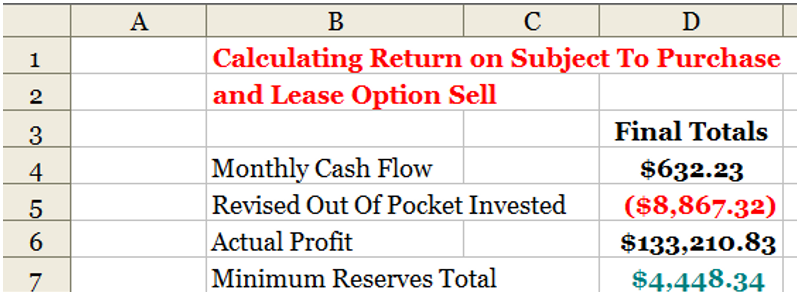
The house was not suitable for the MLS. The seller had waited too long to fix the problem and just wanted out. He said he needed $10,000 so he could move back to his home state. So, this is how we put the deal together.

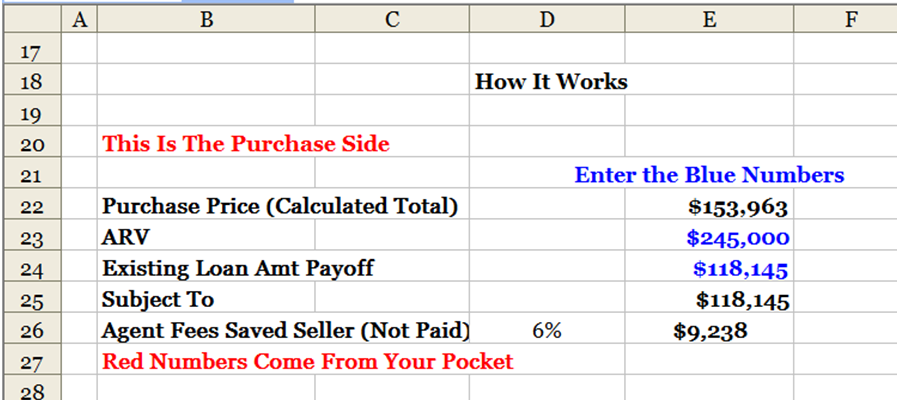
First, you determine ARV (After Repair Value) so you can see if this one is actually worth buying. In this case it’s worth $245,00 fixed up.,(ARV).

You enter the Blue Numbers only, the rest are calculated. Enter the ARV (it's MLS value after it's all fixed up) on line 23, you get that number from looking at "comps". On line 24 you enter the payoff amount. We’ll take care of the arrears in a minute.
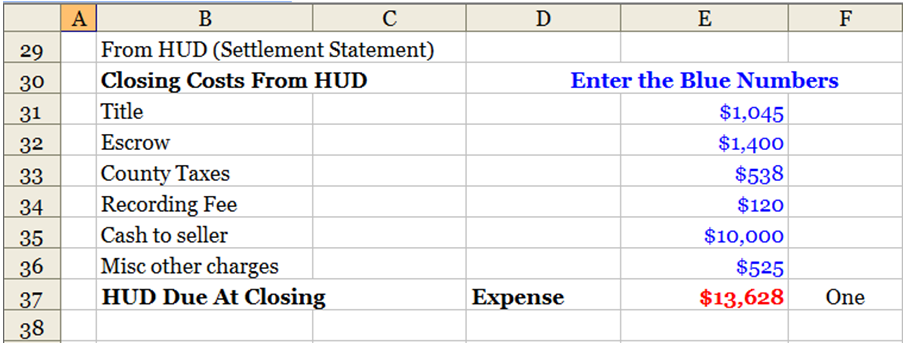
We always go through Escrow and Record, so we need to account for those costs. We Record because it’s the right thing to do and we want to know about any actions that come up against the property. Some people say don’t Record because of the Due On Sale clause, or to use a Land Trust to defeat the DOS which is bad information. If a lender wants to enforce a Due On Sale, a Land Trust violates the DOS anyway so it is ineffective in stopping the Due On Sale call.

Line 35 is always negotiable, but the seller needs enough to rent an apartment and move their belongs or they will become squatters which causes serious problems. There will be closing costs.
And of course, since this is a pre-foreclosure, the arrears have to be brought current.

Sometimes, a property will have a second loan or lien. Usually those can stay in place, but sometimes you have to pay those to buy the property. You can get the payoff amount from the lender. There is a specific process for doing that properly. If you are new, I would have someone help you with the process.

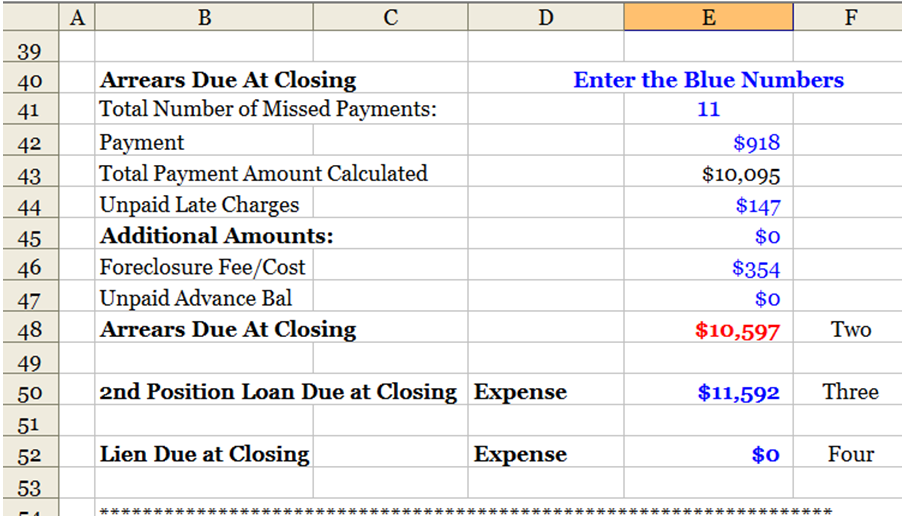
So, on this property, I paid line 37 $13,628 (which included $10,000 to the seller & closing costs $3,628), brought the loan current $10,597 line 48, took over the 2nd loan of $11,592 and took over the main mortgage of $118,145. I paid $153,862 and got a $245,000 property. But, I didn't need all $153,862, I only needed $24,225 to do so.

When you are new, looking for lenders & considering Fix & Flip, BRRRR, or rental, as a buyer, learn to ask the owner/seller to be one of your private lenders with creative financing. This works in Southern California (CA), AZ, WA, and GA & TX. Slight variations work elsewhere.

0Reply
334 views

3 Replies

Jump to latestLatest
  • Investor · Get yourself trained before doing something inadvisable. · Member since 2024 · 3k+ posts · 1k+ votes
    1y
    Quote from @Ken M.:
    @nathanm177

    Are you new? Buying an "Off Market" property with "Subject To" and "Wraps" & Selling "Lease / Option"

    When buying a property to cash flow, you need to know what your expenses are. The following is one I actually purchased in Phoenix that was a pre-foreclosure. The seller and I negotiated the terms. I did not offer a number to him, he told me what he needed. This first portion is the end result. The following portions are how we got there. Click on images to enlarge.

    The house was not suitable for the MLS. The seller had waited too long to fix the problem and just wanted out. He said he needed $10,000 so he could move back to his home state. So, this is how we put the deal together.

    First, you determine ARV (After Repair Value) so you can see if this one is actually worth buying. In this case it’s worth $245,00 fixed up.,(ARV).

    You enter the Blue Numbers only, the rest are calculated. Enter the ARV (it's MLS value after it's all fixed up) on line 23, you get that number from looking at "comps". On line 24 you enter the payoff amount. We’ll take care of the arrears in a minute.

    We always go through Escrow and Record, so we need to account for those costs. We Record because it’s the right thing to do and we want to know about any actions that come up against the property. Some people say don’t Record because of the Due On Sale clause, or to use a Land Trust to defeat the DOS which is bad information. If a lender wants to enforce a Due On Sale, a Land Trust violates the DOS anyway so it is ineffective in stopping the Due On Sale call.

    Line 35 is always negotiable, but the seller needs enough to rent an apartment and move their belongs or they will become squatters which causes serious problems. There will be closing costs.

    And of course, since this is a pre-foreclosure, the arrears have to be brought current.

    Sometimes, a property will have a second loan or lien. Usually those can stay in place, but sometimes you have to pay those to buy the property. You can get the payoff amount from the lender. There is a specific process for doing that properly. If you are new, I would have someone help you with the process.

    So, on this property, I paid line 37 $13,628 (which included $10,000 to the seller & closing costs $3,628), brought the loan current $10,597 line 48, took over the 2nd loan of $11,592 and took over the main mortgage of $118,145. I paid $153,862 and got a $245,000 property. But, I didn't need all $153,862, I only needed $24,225 to do so.

    When you are new, looking for lenders & considering Fix & Flip, BRRRR, or rental, as a buyer, learn to ask the owner/seller to be one of your private lenders with creative financing. This works in Southern California (CA), AZ, WA, and GA & TX. Slight variations work elsewhere.

    Accredited investors, there even more ways. This is just one.

  • Investor · Pacific Northwest · Member since 2026 · 65 posts · 16 votes
    7mo

    Off-market sub-to is where the deal math actually makes sense right now.

    On-market properties are priced for conventional buyers. Off-market motivated sellers don't care about your rate — they care about speed and certainty.

    The tracking piece is what kills most people on this strategy. You can close 1 sub-to deal in a spreadsheet. At 3, it starts breaking. At 5+, you need a real system for existing rate, wraparound rate, payment dates, equity position per deal.

  • Bo SmithPro Member
    Hinton, WV · Member since 2026 · 1k+ posts · 373 votes
    7mo

    Ken's laid out the mechanics well here. The subject-to and wrap strategy really does work, but I want to flag something I see beginners get wrong: the legal side matters more than most people think.

    The due-on-sale clause is real. Some lenders will enforce it, some won't. You can't ignore it by using a land trust (that's just legal theater). What actually protects you is that many lenders won't enforce DOS on subject-to deals if you're paying on time and the property is being maintained. But "probably won't" isn't the same as "won't."

    The better approach is recording it right, like Ken mentioned. You need title insurance, escrow, and clear documentation so when you eventually sell or exit the property, there's no ambiguity. The small cost upfront saves you from getting sued or losing the deal later. Plus, if the lender does call the note, you want to know immediately, not in year three.

    The real power of subject-to deals is that you control a property with minimal down payment and take over existing financing at terms that might be better than current market rates. But you're inheriting the seller's problem (they need out), which means the profit comes from either fixing the issue (rehab, rent it) or from the spread in what the existing loan is versus what you can rent it for.

    Are you looking at subject-to deals mostly for cash flow, equity position, or are you rehabbing and reselling?

Join the conversationCreate a free account to reply, vote on answers and follow this thread.