Belmont, NC · Member since 2013 · 139 posts · 21 votes
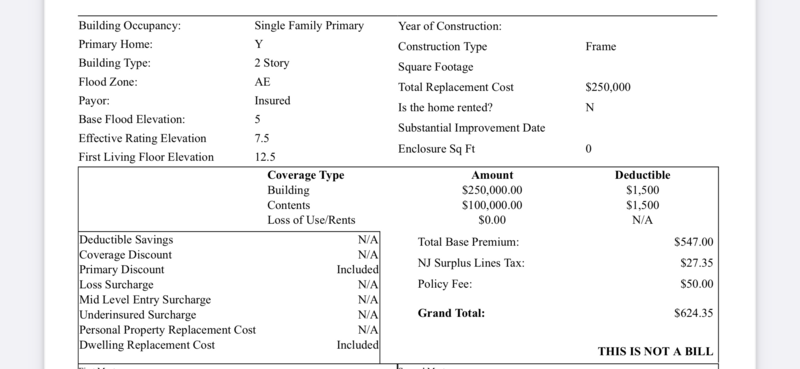
I'm curious if anyone has any experience with building a spec house in AE floodplain, especially in Charlotte, NC within Mecklenburg County. It's my understanding that I can build the lowest level of the first floor a few feet above the base flood elevation and the insurance premium would be less than $1,000 per year. If that's the case, we will pay the first 8 years of premiums or something like that when we go to sell. Any advice or experience would be great! Thanks,
Troy Knight
No experience in Charlotte, however with my AE zones we are also given a Base Flood Elevation. BFE. The BFE is the lowest elevation new construction or extensive renovations can be built at. When we build new construction we will set the floor at one foot or more above BFE, as that is where substantial discounts begin to occur (25-40% in my market).
Pier and beam construction is most common here, so we might only spend $2-3000 above bare minimum in construction costs to achieve a $600-1000 yearly discount in flood policy for the buyer. (Is this where you were headed with pre-pay)?
Attached garages can be one of the biggest issues I've faced, as different surveyors and insurance agents view FEMA's guidance differently. I've done carports in lieu of garages to avoid the issue in the past.
Knowledgeable insurance agents can navigate this issue pretty easily, and should be able to provide pricing based upon several different elevations to help determine what would be most beneficial for you.
FEMA sent a letter last year stating flood policy's WILL rise 5-18% per year for the next several years until they reach actuarial soundness. So, if it's a hot area, and your house has cheap flood insurance there should be some positive correlation to sales price.
I do not think you can prepay insurance. I wanted to prepay liabilty insurance for a few years for an HOA I developed, and the agent wouldn't allow it. I have built in flood plains, but not sure what you mean by "AE"
The problem with floodplains is that they are subject to re-evaluation every few years, so I doubt there is any way to pre-pay for that long. I did buy a rental home in a flood zone. Once it was determined that it would require flood insurance, we renegotiated a lower price and the seller paid the loan down enough to cover that current year's monthly escrow payments for flood insurance. The premium has, however, doubled due to the new rules and surcharges on investor property. It is my understanding, though, that an owner-occupied can keep the current rating even if it changes to a worse one as long as they maintain flood insurance on the property. If they stop coverage and start again, they'd be subject to the worse rating.
Troy Knight
No experience in Charlotte, however with my AE zones we are also given a Base Flood Elevation. BFE. The BFE is the lowest elevation new construction or extensive renovations can be built at. When we build new construction we will set the floor at one foot or more above BFE, as that is where substantial discounts begin to occur (25-40% in my market).
Pier and beam construction is most common here, so we might only spend $2-3000 above bare minimum in construction costs to achieve a $600-1000 yearly discount in flood policy for the buyer. (Is this where you were headed with pre-pay)?
Attached garages can be one of the biggest issues I've faced, as different surveyors and insurance agents view FEMA's guidance differently. I've done carports in lieu of garages to avoid the issue in the past.
Knowledgeable insurance agents can navigate this issue pretty easily, and should be able to provide pricing based upon several different elevations to help determine what would be most beneficial for you.
FEMA sent a letter last year stating flood policy's WILL rise 5-18% per year for the next several years until they reach actuarial soundness. So, if it's a hot area, and your house has cheap flood insurance there should be some positive correlation to sales price.
The National Flood Insurance Program (NFIP) is badly in debt, so Congress has decided to stop subsidizing flood insurance. Rates will go up each year by approx 18% per year until a structure's policy reaches the acturial rate. Talk to your local Building Commissioner's Office, determine the BFE and build above it (don't forget the utilities need to be above the BFE also).
A good insurance agent should be a help you estimate the costs of future insurance
What do you mean by utilities being above the BFE? I see how electric would be easy by going overhead. Sewer and gas though run underground to the front of the lot deeper in to the floodplain I believe on this house.
Troy Knight the utilities can be underground, the the panels, meters, water heaters etc have to be above BFE. On a FEMA elevation certificate they document the finished floor elevations, and the lowest elevation of mechanical and electrical equipment.
I have just bought land in an AE zone (Camp Verde, AZ) and I am trying to learn what my restrictions on building will be. Anyone have tips for learning that? I know the technical/code-type things but I am wondering what is deemed do-able and what is not (both the town and the flood people have not gotten back to me and I'm in my due diligence period!). I know that is pretty general- but I have to start somewhere... Thanks!
FEMA sets flood plains and zones, so check their site to understand what it means. At the end of the day it's a way to say that this area is more prone to flooding compared to other areas. So building in flood zones aren't an issue, you just have to build your base floor level above that flood plain. Your survey company is supposed to give a topographic survey telling you what the current elevation of the ground is, and then an engineer is to test your soil to tell you what you're building on. What the soil is will determine what kind of foundation you're able to have, because you have to build the foundation up high, the soil will determine what technique you're going to use. Your architect will then design the house to make sense. Here in Florida, stem walls and popular, but in Louisiana where the soil is much softer, they use building piles. If it's in Arizona, I'd make the assumption it's going to be a stem wall.
What you have to consider is what trees are on the property. Are those trees protected, or are they able to be taken down? Trees will affect where you can put your footers.
Other than that, you should be fine. Stem walls are just another couple courses of blocks, and extra backfill and compaction. But nothing detrimental.
AE is more commonly referred to as the 100 year floodplain. You can build in this with certain restrictions. Your community will likely have a floodplain technical guideline. In that will be what's called a "freeboard". This is the height in which the first finished floor, electrical, and mechanical equipment must be. Our local code dictates that this height is 3' above the established elevation of the floodplain. You can go on FEMA's site and download the map for your address. Look for the black squiggly line in the body of water and it will have an elevation; that's your floodplain elevation.
You can also fill the site and have a portion or all of the site removed from the floodplain by applying for a Letter of Map Revision based on fill (LOMR-F). The process is; get surveyor to do survey, draw the fill area, submit to your community floodplain admin with their application, Fill the area and compact, get new topo survey, fill out the LOMRF application and submit with the $800 fee. It takes about 90 days to get the letter back from FEMA. You can do this simultaneously with the structure to save time.
I just stumbled on this thread. There is some incorrect info here, and just wanted to clarify a couple of things.
The "AE" refers to a Special Flood Hazard Area (SFHA), or "floodplain, where FEMA has computed the Base Flood Elevation (BFE), the elevation that floodwaters rise as a result of a "100 Year" storm. An "A" zone has not had the elevations computed, but is still a regulated SFHA. In MOST states, all finished floor elevations and ALL mechanicals (electrical components including switches and outlets, HVAC, water heaters, appliance, etc.) must be a minimum of 2 feet ABOVE the BFE. Buried utilities, i.e. public water and sewer are fine. But septic fields typically must be raised above the BFE, as do well heads.
FEMA can be approached for amendments to flood maps and the status of a structure being in a SFHA on a case-by-case review. What they decided for your neighbor's home means NOTHING regarding your home.
Your local Floodplain Administrator can guide you as to what your options are on a site (without engineering it for you).