I got the inspection report for a turnkey property I am considering buying. There was one item listed in the 'Major Item' section. See language below along with pictures:
"Horizontal cracking on East side of basement. This type of movement indicates wall is being pushed
in by soil pressure. Repairs made, but incomplete and unreliable. This is still a structural concern.
Recommend hiring professional structural engineer to evaluate and advise to avoid continued
movement and possible structural damages to home. None visible during time of inspection."
The TK provider's perspective is that they fixed the cracks, but they also recommend a structural engineer take a look. Should I get it checked out before putting it under contract? I know this is not uncommon, but I dont want any potential return wiped out because of a major foundational issue in a few years. Has this come up with anyone before? What would you do? I can't believe I am the first person to encounter this with a TK property....
@Jesse S. You'll definitely want to have someone take a look. Looks like the beginning of the wall slowly coming in. It may take another decade, but the wall will continue to bow out, eventually falling in if nothing is done (possibly). Hard to say without seeing the outside and different factors that contribute to this, but have someone look for sure. Better safe than sorry.
@Jason D. @Grant Rothenburger Thanks for your input, very helpful. My gut was saying better safe than sorry as well. I'll get it checked out. Thanks again!
@Jesse S. Happy to help
Installing a series of upright columns against the wall that is bowing inward is the most common way to address this situation Jesse. The bottoms of the columns are inserted into the openings made into the concrete slab and the tops of the columns are secured to the ends of the floor joists. This is indeed a serious issue that will show it's ugly head in any future transaction unless it is addressed properly by a foundation repair company. I suggest you have a local, highly recommended, and experienced foundation repair contractor look it over instead of a structural engineer unless the seller will pay for the S.E.'s visit and report. Best of luck going forward.
@Daniel Cullen thanks so much for your reply. Given your experience, I appreciate your perspective! I can't tell from the pictures how much (if at all) the wall is bowing in, but I am going to get it checked out.
The turnkey construction manager said "they are settlement cracks with no lateral movement" I am going to get it checked out regardless.
Hey Jesse, here are before and after of cracks on one of my recent purchases in Little Rock.
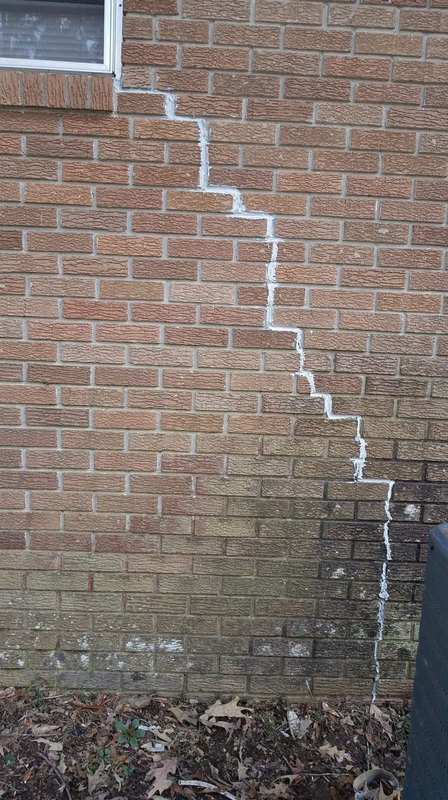
My inspection report didn't indicate anything major with this finding. The TK's feedback was "The inspector did not note any foundation issues on this one. Because it is on a pier and beam system the crack is due to some minor shifting and not structural. If it were on a slab, the cracks would indicate an issue with the foundation/slab." Because my inspection report did not call this out as a major finding , I have taken my TK's feedback at face value. Does your property have a slab foundation?
@Warren A. good to hear from you! Thanks for sharing your experience in LR. I have no idea if my property has a slab foundation, but the cracks are in the basement and the inspector called it a major item. My TK did a similar 'filling' of the cracks as a solution, but the inspector recommended an expert opinion. In looking at the pictures, there are actually cracks on at least 3 walls which is a little more concerning. They've offered to add a "Repair Under Consideration" to the contract, which I am considering, only if they agree to all of the recommended repairs!
Property is in Kansas City btw.
Hey Jesse, here are before and after of cracks on one of my recent purchases in Little Rock.
My inspection report didn't indicate anything major with this finding. The TK's feedback was "The inspector did not note any foundation issues on this one. Because it is on a pier and beam system the crack is due to some minor shifting and not structural. If it were on a slab, the cracks would indicate an issue with the foundation/slab." Because my inspection report did not call this out as a major finding , I have taken my TK's feedback at face value. Does your property have a slab foundation?
@Jesse S. I have a property in KC that has similar/worse cracks as your photo and I did what @Daniel Cullen did and got beams all the way around the foundation. That was what my structural engineer recommended at my house. It wasn't a cheap repair but I got the house ( fixer upper) at such a great deal it didn't matter.
Is that house in Waldo? I ask cause my house is in Waldo and alot of the houses in that area have the same cinderblock foundations & have common foundation issues. I was told (about mine) that it probably wouldn't effect the resale value too much as alot of those houses are in similar shape. That being said I would get a structural engineer to have a look at it to be on the safe side and try to negotiate the price down if they recommend work being done. Cause if you sell it to someone else in the future they'll be having the same feelings about it you are and could be instant negative equity if you have to do an expensive fix whenever you go to sell it.
Warren....the crack in your photo is almost certainly 'structural' since it starts out narrow and becomes wider toward it's upper termination. That is the hallmark of a crack caused by underlying foundation movement. Did your inspector dig away some soil at the base of the crack in order to see if there was a corresponding crack at its bottom terminus? Did you or he/she look for a 'mirror crack' on the opposite wall? Be careful of wishful thinking!
@Laura Williams thanks for sharing your experience.... sounds expensive! Given that I would be buying this property turnkey, I would never complete the sale if I had to pay for it! Any issues since you had the beams installed?
The house is in Independence (not Waldo) but I've heard from someone else that many houses in KC have this issue. I don't know how true that is, but I guess it's something to keep in mind.
@Jesse S. it’s been 3 years and I don’t see any more cracks or movement at all. I had the brackets put ALL the way around the perimeter of the whole basement. But I will still need to make sure the gutters are always clean and water flowing away from the foundation & soil graded to be safe. I bought this house at an auction and I wasn’t able to do a proper inspection. It had a finished basement so I didn’t even know how bad the foundation was until we ripped the Sheetrock off. Fortunately I bought it so cheap it didn’t matter but one lesson for someone to learn if you buy a house that has a finished basement and cinderblock foundation. Beware of what’s under the Sheetrock that you can’t take off until after you buy it!! Lol.
From what I’ve learned about the foundations ...so far.... the stone foundations are the best ...like in the older 100 year old homes. Most of the time they aren’t going anywhere anytime soon although you don’t want to put in sump pumps &/or French drains with these foundations as it’s not good for stone foundations.
The cinderblock like what we have in these houses is crap ...they can get problems very easily. And the newer slab foundations as well. I’ve been told that with the newer foundations once they go bad it’s a lot more difficult to fix them properly than the older stone foundations.
When I look for new properties to buy if I see a house and notice the land is sloping inwards towards the house ..I know it’s a very good chance that house is going to have foundation issues. Seen it a lot now. I stay away now from those and usually won’t even waist my time to look inside if the landscape isn’t right. In KC can get heavy rains and all that water running towards the foundation can eventually ruin it over time and or flood the basement every time it rains hard.
@Daniel Cullen thank you both for your feedback. I will look into getting foundation inspection.
@Jesse S. Sounds like you made a smart move on your decision.
@Jesse S. I have to agree with @Jason D. and others. Obviously this wasn't actually fixed, and if you're buying turnkey, everything should be as-new or as close as possible. I also agree that the sort of blase attitude about this inspection item raises some alarm bells re: what other things did they patch over or cut corners on? Is this indicative of how they will approach other issues with maintenance/repairs/tenants in the future?
Looks like you've gotten some good advice on what should be done to remedy this situation structurally, but the question is whether the company will be footing that bill or lowering the price to compensate. This is an issue that will become a bigger/pricier problem down the line, so I would make sure you are protecting the future of your investment by dealing with it now if you're really sold on this property.
Good luck!
A local foundation contractor is more practical. I had to let go a structure PE who explained the mechanics which I already know. He was the Sr Structure on train stations in CA. The local foundation contractor ready the report took one look and said it was a go. Fixed it for a $500 with 1 year warranty.
@Clayton Mobley thanks for your comment. I agree that the BP community has given me good advice! I'm not 100% sold on this property so I am going to pass on it, but to the TK's credit, they are willing to get the structural report and are not pushing a quick close.
All,I don't want to mean to hijack Jesse's thread but I wanted to update on my situation that will hopefully be of benefit to not just me but others as well. I reached out to the original home inspector (not structural engineer) to get his feedback and he acknowledged that he inadvertently left out details about the cracks in his original report so he went back to the property to re-examine today and his reply along with new photos,
"I went back to (the property) this afternoon and photographed the brick veneer cracks. They have mostly been sealed with a caulk or other form of sealant. They could have used a different color that would blend better, but cracks are mostly sealed. The Brick on this house is not a supporting or structural component. It is a veneer or form of an exterior cladding, like siding or decorative stone. This home is supported by 8x12" concrete foundation blocks. I crawled under the house and took photos of the foundation in the areas that the brick had cracked. The foundation has no cracking and appears to be in good condition. We just recently had a 4-6" rain(last Thursday & Friday) and I cannot find any defects in the foundation in these areas. I have attached the photos below. The first are an example of the sealed brick cracks and then photos of the foundation block behind the brick cracks. The last are examples of brick being laid in front of foundation block. I do not think that you need a foundation contractor. However, I understand your concern and am not attempting to dissuade you from obtaining additional opinions. I personally do not know any foundation contractors that I trust. I have in the past, seen contractors try to sell jobs that may have not been needed. You may be better served by hiring a structural engineer who will give you an unbiased opinion."
Based on the third photo, I now see the brick does look like decorative and subsequent photos of the foundation look ok? Anyone disagree ? I did call a structural engineer today and he quoted $400 . What do you guys think? Do these new photos and explanation suggest the foundation looks ok or would you still suggest a structural engineer to come out? If I should still get a structural engineer evaluation, I wonder if he could leverage these photos and give me a reduced cost. I don't mind mind paying for a professional's time but at the same time, if it's just going to be a quick 15-20 minute evaluation, $400 seems expensive.
@Jessica S. You can always put it under contract with an inspection contingency however, you should have a structural engineer/foundation contractor inspect it and give a report. Cracks in foundations are not unusual at all and are often nothing more than settling in older homes. Vertical cracks are more typical of settling however, so I would be more concerned with horizontal cracking. That could be an indication of something more serious. In any case, get it checked out.
All,I don't want to mean to hijack Jesse's thread but I wanted to update on my situation that will hopefully be of benefit to not just me but others as well. I reached out to the original home inspector (not structural engineer) to get his feedback and he acknowledged that he inadvertently left out details about the cracks in his original report so he went back to the property to re-examine today and his reply along with new photos,
"I went back to (the property) this afternoon and photographed the brick veneer cracks. They have mostly been sealed with a caulk or other form of sealant. They could have used a different color that would blend better, but cracks are mostly sealed. The Brick on this house is not a supporting or structural component. It is a veneer or form of an exterior cladding, like siding or decorative stone. This home is supported by 8x12" concrete foundation blocks. I crawled under the house and took photos of the foundation in the areas that the brick had cracked. The foundation has no cracking and appears to be in good condition. We just recently had a 4-6" rain(last Thursday & Friday) and I cannot find any defects in the foundation in these areas. I have attached the photos below. The first are an example of the sealed brick cracks and then photos of the foundation block behind the brick cracks. The last are examples of brick being laid in front of foundation block. I do not think that you need a foundation contractor. However, I understand your concern and am not attempting to dissuade you from obtaining additional opinions. I personally do not know any foundation contractors that I trust. I have in the past, seen contractors try to sell jobs that may have not been needed. You may be better served by hiring a structural engineer who will give you an unbiased opinion."
Based on the third photo, I now see the brick does look like decorative and subsequent photos of the foundation look ok? Anyone disagree ? I did call a structural engineer today and he quoted $400 . What do you guys think? Do these new photos and explanation suggest the foundation looks ok or would you still suggest a structural engineer to come out? If I should still get a structural engineer evaluation, I wonder if he could leverage these photos and give me a reduced cost. I don't mind mind paying for a professional's time but at the same time, if it's just going to be a quick 15-20 minute evaluation, $400 seems expensive.
Warren, is $400 going to break your bank? I think it's a solid investment for a piece of mind. Alternatively, you could try looking for somebody with that experience on bigger pockets. They probably wouldn't be able to give you a full blown report based on pics, but at least make some suggestions. Yet another option is just to monitor that these cracks don't open up again or get worse, if you are tight on funds currently. I didn't mean to induce any anxiety with my original response to you, but seeing how this is a long-term hold, just looking out for the structural longevity of your investment (you don't want to be shelling out even more money down the road, if this can be fixed relatively cheap right now).
@Victor S. Agree . I don't want to be penny saved pound foolish. I asked a structural engineer to come out and I will update on the findings. He lowered his price to $375. If there is repair needed, I can get the TK to cover under their warranty since it was just recently closed.
An update to our house with the cracks in the walls ... the TLDR is that after inspection by structural engineer, the foundation is OK.
"Structural:
Perimeter cracking in bricks/interior walls along perimeter:
The back left corner of the house has settled slightly (see pictures) causing cracks in the
bricks and also between the mortar and bricks. There is another minor crack on the rear
wall. The settlement has not damaged or compromised the footer or foundation, and has
not caused any interior cracking or out‐of‐square doors in the area of cracking. As the
supporting foundation moves differently, stresses are induced into the rigid veneer as the
framing can flex. The propensity of the subgrade soils to shrink/swell in response to
moisture fluctuations typically causes these issues. Moisture variations cause clays to
expand and contract more than other types of soils. Clays shrink as they dry, so in effect the
soil outside the footing settles faster than the soil around the home. Clays will also swell
when they are wet and the reverse will occur. Unfortunately clay soils are very prominent in
these areas.
After thorough evaluation, it has been determined that the house is safe and no repair is
needed. Further cracking is possible but unlikely, however in the unlikely event of further
cracking, the structure of the home will still not be compromised. The soils in this corner of
the home were most likely disturbed from construction of the home (ie removal of a tree,
etc) and those soils have now compacted enough to limit future cracking. Sometimes soils
can become overly dry in the summer season and shrink under the footing. Footings in Arkansas are typically only 18‐24” deep so moisture cycles (extremely wet to dry and repeat) can cause this movement if both extremes occur close together.
No repairs or modifications are suggested or necessary."