We are 2 teachers with smaller bank accounts, but with 2 homes in Denver with huge equity. Would like to really start getting into investment properties. We have 4 years left on our old house to pay it off. We should net about $1700+ (depending on taxes, insurance, rental rates) in 4 years when it is all paid out. Do we get a HELOC on our current home, and then use that as the 25% down payments and then use regular mortgages loans for investments properties, so we can get multiple properties over the years? Or do we get a HELOC and just pay in cash for a house because "cash" is better in this competitive market (not Denver, a cheaper area), but then we probably only get one property? Or do we do a cash-out refinance on the house about to be paid off and use that money, but then miss the perks of just getting a bunch of cash each month? Someone recommended that and said it might be good for tax purposes, but it doesn't seem like a good idea to me.
Hi @Kitty Horeis!Definitely a great place to be in and good on you for starting to think creatively on how to utilize that equity! I would first ask you what your primary goal is, and when you want to reach it? Then on top of that it will simply come down to where your money goes the furthest. You have the most security with a paid off home. But if refinancing it, or taking out a HELOC will get you into a couple more properties and in total over your portfolio you are now creating more cashflow, then your money is working harder for you, and you have multiple properties that are appreciating, and gaining equity. That's typically how I work with my clients to look at their portfolios, and how to best utilize them.
As for whether doing a HELOC or Refinance, there are arguments for both. A refinance you would get better rates, and possibly pull out a bit more capital, but you'll be paying for it for the next 30 years even if you don't use all of it. A HELOC you would have worse rates, but you would only pay for what you use, on a interest only basis, and if you pay it off (through a BRRRR or otherwise) you can then reuse it, and recycle capital. I would get with a mortgage broker and explore the different options in detail!
Happy to help further! Also, where are you looking to invest?
I would refinance since interest rates are low and use your equity to buy as many rental units as you can by only putting 25% down on each. The key is to find the right properties that will cash flow enough to pay the payments and give you some extra cash each month. At the same time you will be gaining more equity on all your properties. If you have any questions on how to do this please let me know.
Interest rates are low. If you have the ability to borrow, use someone else's money (ie a bank's). The tenants will be paying for that mortgage, not you. You will still benefit from having a paid off house (aside from the HELOC). It really comes down to what you are comfortable with. I don't do the refinancing as I plan on retiring in less than 10 years and want some of my places paid off, so they have higher cash flow. Plus I don't see myself buying anymore properties anytime soon as I am close to my max borrowing amount.
Hi @Kitty Horeis!Definitely a great place to be in and good on you for starting to think creatively on how to utilize that equity! I would first ask you what your primary goal is, and when you want to reach it? Then on top of that it will simply come down to where your money goes the furthest. You have the most security with a paid off home. But if refinancing it, or taking out a HELOC will get you into a couple more properties and in total over your portfolio you are now creating more cashflow, then your money is working harder for you, and you have multiple properties that are appreciating, and gaining equity. That's typically how I work with my clients to look at their portfolios, and how to best utilize them.
As for whether doing a HELOC or Refinance, there are arguments for both. A refinance you would get better rates, and possibly pull out a bit more capital, but you'll be paying for it for the next 30 years even if you don't use all of it. A HELOC you would have worse rates, but you would only pay for what you use, on a interest only basis, and if you pay it off (through a BRRRR or otherwise) you can then reuse it, and recycle capital. I would get with a mortgage broker and explore the different options in detail!
Happy to help further! Also, where are you looking to invest?
I like the idea of using a HELOC to buy properties in cash and then fix them up and refinance them to pay off the HELOC.
My philosophy is that HELOCs are better when you want to put out the money and pull it back regularly, whereas more traditional financing is better for long-term investments. If you use HELOCs to pay for downpayments and leave it invested for a while, that could get pretty pricey and hurt your cash flow.
Kitty, I'm also a teacher--very conservative as we start out here. I appreciate your question and am following. Our circumstance is similar.
Theresa Harris, question for you:
On our first rental, we're sitting on @ $130K cash/equity after refinancing in October this year to capture a 2.89% on a 30 year conventional--and we took out cash up to 70% LTV. It's not a good feeling leaving equity sitting there, but it *is* producing a decent cash flow, which makes us comfortable. We're considering a HELOC @ 80% LTV and to use that for a down payment on a property, then using the cash flow from the property to pay down the HELOC. What's our downside if the cash flow works to make the payments and adds value to the cash flow? We're relatively new to this and seeking our first STR property in about the $500K range using one of those 10% down loans and the cash from the original refi we did at 70% LTV. Thanks in advance.
@Kitty Horeis I'm a big fan of Helocs, because you're not signing yourself up for 30 more years of higher, interest-first payments on day one. Helocs also allow your funds to be much more dynamic, as your money is always working for you. My wife and I have a very specialized 1st position Heloc on our property that's tied to a zero-balance-sweep checking account. All of our normal banking deposits/savings sit on our balance, saving us a great deal of interest. Whenever an opportunity arises, we simply write a check or ACH transfer out and put that equity to work. Being designed to sit in 1st position, it has the staying power more similar to that of a traditional mortgage. I always recommend it to anyone who's good with their money, it's been an awesome tool for us.
Thanks everyone for all this good information. I think the plan will be to go a HELOC (flexible money and I can make the payback shorter) and just let that one house be paid off in 4 years and enjoy that cash flow when it happens.
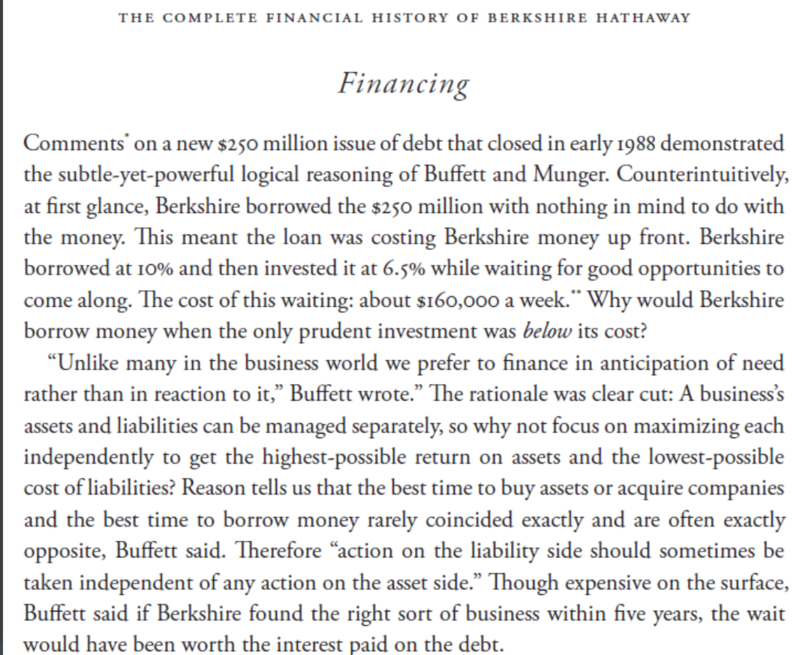
Your question reminded me of a Warren Buffet quote:
"Action on the liability side should sometimes be taken independent of any action on the asset side."
If RE is part of your long term investing/ wealth buldings strategy than it could be a good idea to get a large amount of cash out of your homes via refinancing, NOT a HELOC, even if you don't have a deal lined up right now.
The only downsides of this are 1] if your existing income can't cover the new, higher, payment, you will have to eat some of your see corn every month, but with rates the way they are today that's a relatively low cost. 2] A more pressing risk is that all that cash in the bank will burn a hole in your pocket and you'll feel pressure to buy a sub par rental just to get your money in the game.
To counter #2, I'd lay out my criteria before I got the loan and only buy something that met that.
The picture below explains the quote I opened with a bit more.