How to overcome economical downturn as landlord
Most Popular Reply
Eric FernwoodBusiness Member
Realtor · Las Vegas, NV · Member since 2014 · 997 posts · 1k+ votesHello @Nick Liu,
Great question. I will attempt to answer it from going through the 2008 crash in the Las Vegas market.
Buy the Right Properties to Start Off
During every market crash, some locations are hurt far worse than others. For example, the current drop in oil prices has hit North Dakota hard but has had little impact on Nevada. The same is true of business sectors within a metro area. Some sectors are hit far worse than others. However, it is hard to determine which are the affected by looking at the gross numbers provided by the news sources.
If you only looked at the unemployment rate and number of foreclosures in Las Vegas during the 2008 through 2014 period, you would expect all Las Vegas investors took a terrible beating. However, our clients reported that rents and time to rent did not change for class A and B properties. When one of our clients asked for specifics we dug into the data. In order to answer her question we analyzed MLS sales and rental data during the period from 2008 to 2014. One of the problems with most data is that it is too "averaged" to be truly useful. We decided to narrow our focus as follows:
• Single family
• 3 bedrooms
• 2 car garage
• 1,200 to 1,500 SqFt
We also restricted the geographical area to the region marked in green below.
Restricting the data to this property profile and area matched the majority of our investor's properties at that time, which are A or B class properties.
We started by exporting data from the MLS for conforming properties that sold or leased between 2008 and 2014. We then computed the average $/SqFt by month and plotted the results as shown in the graph below.
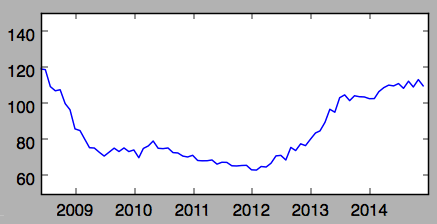
As you can see, the average $/SqFt sales price plunged by almost 50%. What happened to the average $/SqFt rental price? As you can see below, rental rates remained virtually unchanged.
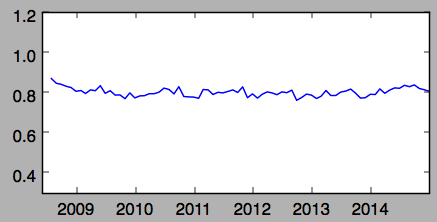
The data showed what our clients were experiencing; A & B class investment properties saw little or no change in cash flow or time to rent during the 2008 to 2014 period. However, C class properties fared badly with vacancy rates exceeding 20% in some areas. We believe that the reason C class properties were disproportionately impacted by the crash has to do with the job sectors in which the different tenant pools worked.
Class C properties in Las Vegas generally rented in the range of $450/Mo. to $700/Mo. and were largely occupied by construction workers and hourly service workers. When construction virtually stopped in 2008, a great many of these people became unemployed and thus the high vacancy rate and falling rents. However, the tenant pool for Class A and B properties (largely casino workers), which generally rented in the range of $1000/Mo. to $1400/Mo., suffered income reductions but comparatively few became unemployed. Even those who lost their homes through foreclosure or short sales still needed a place to live and desired to stay in the same general areas so they became renters.
It is important to consider how the industry/business sectors which employ your target tenant pool are likely to perform during a downturn. We feel this is far more important than observing various purchase "rules" because it does not matter how little you paid for the property if there is no tenant paying the rent. Rental properties are only as good as the jobs in which the tenant pool works.
There is another factor that contributed to the class A and B rental stability in Las Vegas: eviction laws.
Eviction Laws
Incentives are strong determiners of how people will behave. A great example from history is the survival rate of prisoners transported to Australia during the 1860's. Originally, ship captains were paid a fee for every prisoner that walked onto a ship bound for Australia. Under this incentive program, only about 40% survived the transit. When the incentive changed to being paid for every prisoner that walked off the ship in Australia, the survival rate increased to about 98%.
In some states like California it can take up to one year to evict a non-paying tenant. So, if a tenant is undergoing financial stress, there is little incentive to pay the rent. As one client put it, "In California, tenants pay their bills in the following order: car payment, credit cards and, if they have leftover funds, the rent."
In Las Vegas, a typical eviction takes less than 30 days and costs less than $500. Tenants have a strong incentive to pay the full rent on time or they will be out on the street in less than 30 days. Due to Las Vegas eviction laws we believe that tenants in Las Vegas pay their bills in the following order: car payment, rent and, if they have leftover funds, credit cards.
What about the class C tenant pool? We feel that two factors made the crash very hard for class C property owners. First, if the tenant does not have a job, they can't pay the rent. When construction virtually ended in 2008, so did the related jobs. Second, in our experience, class C tenants tend to be cash based (class A and B tend to be credit based). Cash based tenants have little to fear from evictions and judgements because they carry no financial "history"; what they did in the past has little impact on their present or future. Such cash based tenants have little incentive to pay the full rent on schedule; they can always move to another property.
In Summary
• You need to buy properties where the tenant pool is credit based and their job pool is likely to be stable even in turbulent economic times.
• Tenants constantly pay rent only when there is a strong incentive to do so. Do local eviction laws incentivize paying the rent or do they have the opposite effect?

FERNWOOD Team, KW VIP Realty520 Reviews
20 Replies
- Investor · Cleveland, OH · Member since 2015 · 6k+ posts · 2k+ votes10y
- 10yJoe VilleneuvePro MemberPlymouth, MI · Member since 2013 · 13k+ posts · 19k+ votes
- 10yJay HinrichsBusiness MemberReal Estate Consultant · Summerlin, NV · Member since 2014 · 45k+ posts · 66k+ votes
- 10yJoe VilleneuvePro MemberPlymouth, MI · Member since 2013 · 13k+ posts · 19k+ votes
- 10yJay HinrichsBusiness MemberReal Estate Consultant · Summerlin, NV · Member since 2014 · 45k+ posts · 66k+ votes
- 10yJoe VilleneuvePro MemberPlymouth, MI · Member since 2013 · 13k+ posts · 19k+ votes
- 10yJoe VilleneuvePro MemberPlymouth, MI · Member since 2013 · 13k+ posts · 19k+ votes
- Investor · Cleveland, OH · Member since 2015 · 6k+ posts · 2k+ votes10y
- Real Estate Broker & Investor · Indianapolis, IN · Member since 2012 · 218 posts · 83 votes10y
- Investor · Cathedral City, CA · Member since 2014 · 481 posts · 170 votes10y
- 10yEric FernwoodBusiness MemberRealtor · Las Vegas, NV · Member since 2014 · 997 posts · 1k+ votes
Hello @Nick Liu,
Great question. I will attempt to answer it from going through the 2008 crash in the Las Vegas market.
Buy the Right Properties to Start Off
During every market crash, some locations are hurt far worse than others. For example, the current drop in oil prices has hit North Dakota hard but has had little impact on Nevada. The same is true of business sectors within a metro area. Some sectors are hit far worse than others. However, it is hard to determine which are the affected by looking at the gross numbers provided by the news sources.
If you only looked at the unemployment rate and number of foreclosures in Las Vegas during the 2008 through 2014 period, you would expect all Las Vegas investors took a terrible beating. However, our clients reported that rents and time to rent did not change for class A and B properties. When one of our clients asked for specifics we dug into the data. In order to answer her question we analyzed MLS sales and rental data during the period from 2008 to 2014. One of the problems with most data is that it is too "averaged" to be truly useful. We decided to narrow our focus as follows:
• Single family
• 3 bedrooms
• 2 car garage
• 1,200 to 1,500 SqFtWe also restricted the geographical area to the region marked in green below.
Restricting the data to this property profile and area matched the majority of our investor's properties at that time, which are A or B class properties.We started by exporting data from the MLS for conforming properties that sold or leased between 2008 and 2014. We then computed the average $/SqFt by month and plotted the results as shown in the graph below.
As you can see, the average $/SqFt sales price plunged by almost 50%. What happened to the average $/SqFt rental price? As you can see below, rental rates remained virtually unchanged.
The data showed what our clients were experiencing; A & B class investment properties saw little or no change in cash flow or time to rent during the 2008 to 2014 period. However, C class properties fared badly with vacancy rates exceeding 20% in some areas. We believe that the reason C class properties were disproportionately impacted by the crash has to do with the job sectors in which the different tenant pools worked.Class C properties in Las Vegas generally rented in the range of $450/Mo. to $700/Mo. and were largely occupied by construction workers and hourly service workers. When construction virtually stopped in 2008, a great many of these people became unemployed and thus the high vacancy rate and falling rents. However, the tenant pool for Class A and B properties (largely casino workers), which generally rented in the range of $1000/Mo. to $1400/Mo., suffered income reductions but comparatively few became unemployed. Even those who lost their homes through foreclosure or short sales still needed a place to live and desired to stay in the same general areas so they became renters.
It is important to consider how the industry/business sectors which employ your target tenant pool are likely to perform during a downturn. We feel this is far more important than observing various purchase "rules" because it does not matter how little you paid for the property if there is no tenant paying the rent. Rental properties are only as good as the jobs in which the tenant pool works.
There is another factor that contributed to the class A and B rental stability in Las Vegas: eviction laws.
Eviction Laws
Incentives are strong determiners of how people will behave. A great example from history is the survival rate of prisoners transported to Australia during the 1860's. Originally, ship captains were paid a fee for every prisoner that walked onto a ship bound for Australia. Under this incentive program, only about 40% survived the transit. When the incentive changed to being paid for every prisoner that walked off the ship in Australia, the survival rate increased to about 98%.
In some states like California it can take up to one year to evict a non-paying tenant. So, if a tenant is undergoing financial stress, there is little incentive to pay the rent. As one client put it, "In California, tenants pay their bills in the following order: car payment, credit cards and, if they have leftover funds, the rent."
In Las Vegas, a typical eviction takes less than 30 days and costs less than $500. Tenants have a strong incentive to pay the full rent on time or they will be out on the street in less than 30 days. Due to Las Vegas eviction laws we believe that tenants in Las Vegas pay their bills in the following order: car payment, rent and, if they have leftover funds, credit cards.
What about the class C tenant pool? We feel that two factors made the crash very hard for class C property owners. First, if the tenant does not have a job, they can't pay the rent. When construction virtually ended in 2008, so did the related jobs. Second, in our experience, class C tenants tend to be cash based (class A and B tend to be credit based). Cash based tenants have little to fear from evictions and judgements because they carry no financial "history"; what they did in the past has little impact on their present or future. Such cash based tenants have little incentive to pay the full rent on schedule; they can always move to another property.
In Summary
• You need to buy properties where the tenant pool is credit based and their job pool is likely to be stable even in turbulent economic times.
• Tenants constantly pay rent only when there is a strong incentive to do so. Do local eviction laws incentivize paying the rent or do they have the opposite effect?FERNWOOD Team, KW VIP Realty520 Reviews - 10yJay HinrichsBusiness MemberReal Estate Consultant · Summerlin, NV · Member since 2014 · 45k+ posts · 66k+ votes
- Cedar Park, TX · Member since 2015 · 377 posts · 200 votes10y
- Investor · Newberg, OR · Member since 2016 · 90 posts · 19 votes10y
- 10yJay HinrichsBusiness MemberReal Estate Consultant · Summerlin, NV · Member since 2014 · 45k+ posts · 66k+ votes

Join the conversationCreate a free account to reply, vote on answers and follow this thread.