High Appreciation vs. High Cash Flow... What's your pick?

High Appreciation vs. High Cash Flow... What's your pick?

Rental Property Investor · Member since 2018 · 15 posts · 28 votes

Hi BP Community,

Need your input!

Save to afford a project in Austin, TX? - High appreciation potential

Start buying rentals in Killeen / Copperas Cove / Harker Heights, TX? - Positive Cashflow, guaranteed rent if military tenants.

21Reply
451 views

Most Popular Reply

Realtor · Los Angeles, CA · Member since 2018 · 952 posts · 1k+ votes
6y
Originally posted by @Matt Camilliere:

Hi BP Community,

Need your input!

Save to afford a project in Austin, TX? - High appreciation potential

Start buying rentals in Killeen / Copperas Cove / Harker Heights, TX? - Positive Cashflow, guaranteed rent if military tenants.

 Matt, I'm going to make the case for #1!

Over time, owning a good piece of property in a proven appreciating market will build more wealth than buying a cashflowing property with little hope of appreciation. Personally, I'd rather have 80% leverage on a good property in Austin that's appreciating reliably (given the facts on the ground in Austin) than a cashflower in Killeen.

I say "personally" because personal circumstances make the difference. I have a career outside of real estate that provides a healthy income. My wife also works, so we're dual-earners -- and we're both happy in our careers, too! We don't need cashflow right now, but we're excited about building wealth.

That's why we bought an expensive duplex in Los Angeles in an historical neighborhood just outside of Hollywood. If the property appreciates half as well as the longterm historical average, I'll be able to refi out my daughter's college tuition when she goes in 15 years. That's more important to me than $150/mo/door or replacing my W2 (because I own my business, so I cut my own W2, so I got no problems being a W2 employee!).

One other case to make for option #1: even if your goal is to replace your income, you might be better off letting your capital appreciate in an Austin property for a couple of years. Five or ten years from now, when you're ready to replace your income, sell the Austin assets and 1031 exchange them into a cashflowing portfolio in Killeen or anywhere else.

So, it really depends on your circumstances. What are your circumstances?

Also, I'm glad you're not somebody who equates appreciation with speculation. In Indianapolis or Cleveland, such may be the case. But in LA or Austin or Seattle, appreciation is real.

See this reply in the discussion

125 Replies

Jump to latestLatest
  • Rental Property Investor · Kansas City, KS · Member since 2015 · 45 posts · 29 votes
    6y
    Originally posted by @Jon Schwartz:
    Originally posted by @Matt Camilliere:

    Hi BP Community,

    Need your input!

    Save to afford a project in Austin, TX? - High appreciation potential

    Start buying rentals in Killeen / Copperas Cove / Harker Heights, TX? - Positive Cashflow, guaranteed rent if military tenants.

     Matt, I'm going to make the case for #1!

    Over time, owning a good piece of property in a proven appreciating market will build more wealth than buying a cashflowing property with little hope of appreciation. Personally, I'd rather have 80% leverage on a good property in Austin that's appreciating reliably (given the facts on the ground in Austin) than a cashflower in Killeen.

    I say "personally" because personal circumstances make the difference. I have a career outside of real estate that provides a healthy income. My wife also works, so we're dual-earners -- and we're both happy in our careers, too! We don't need cashflow right now, but we're excited about building wealth.

    That's why we bought an expensive duplex in Los Angeles in an historical neighborhood just outside of Hollywood. If the property appreciates half as well as the longterm historical average, I'll be able to refi out my daughter's college tuition when she goes in 15 years. That's more important to me than $150/mo/door or replacing my W2 (because I own my business, so I cut my own W2, so I got no problems being a W2 employee!).

    One other case to make for option #1: even if your goal is to replace your income, you might be better off letting your capital appreciate in an Austin property for a couple of years. Five or ten years from now, when you're ready to replace your income, sell the Austin assets and 1031 exchange them into a cashflowing portfolio in Killeen or anywhere else.

    So, it really depends on your circumstances. What are your circumstances?

    Also, I'm glad you're not somebody who equates appreciation with speculation. In Indianapolis or Cleveland, such may be the case. But in LA or Austin or Seattle, appreciation is real.


    Best reply on this thread IMO. My hunch is most of the cashflow only crowd has never run the ROI numbers - and retiring your day job on Killeen property...that's a pipe dream unless you can get to like 50 of them.

  • Member since 2020 · 1 post · 0 votes
    6y

    cash flow

  • Property Manager · FL · Member since 2018 · 104 posts · 36 votes
    6y

    Cash flow first, appreciation second. Mr. Kyosaki once said "Invest for cash flow, not appreciation!"

  • Member since 2020 · 10 posts · 2 votes
    6y

    @Alexandre Marques dos Santos Newbie question so apologies in advance.

    How does having cash flow of around $100-200/mo help you purchase more properties faster? Is it as simple as I think it is—as in you have more money to save for future down payments or is there something to building equity and using that equity to apply for future mortgages on additional rental property? This is assuming you are using non-creative ways to finance your purchases (no outside investors, seller financed, etc.).

  • Rental Property Investor · Member since 2020 · 215 posts · 137 votes
    6y

    @Kunal Domakonda

    You nailed it. Either one or the other will drive you to same result. 200/mo if used to quickly build equity, will allow refinance and more cash to purchase a new one. Or you can just save it towards to a down payment. Also managing a portfolio, its more than 1 single property giving you CF.

    My properties are giving more than 200/mo so i can save quickly. Also having a short term financing (like a Heloc), i pay down the usage, so the cash goes towards to equity while i dont have the cost associated to a refinancing...

  • Specialist · Memphis, TN · Member since 2019 · 24 posts · 17 votes
    6y

    @Jon Schwartz

    Absolutely on point!

    The two most important metrics for a long-term successful market is population growth and job growth - which result in real estate growth.

    While appreciation does not directly increase your cash flow, the demand for real estate - which fuels appreciation - does directly impact your cash flow through annual rental income growth.

    In a high-growth market like Austin, or Dallas/Fort Worth, the ability to increase rent is higher than just about anywhere else on the country.

    Then, as you mentioned, if it does indeed appreciate, you have the option of Refinancing or taking advantage of a 1031 Exchange to pull the capital back out.

  • Realtor · Los Angeles, CA · Member since 2018 · 952 posts · 1k+ votes
    6y
    Originally posted by @Forest Skufca:

    @Jon Schwartz

    The two most important metrics for a long-term successful market is population growth and job growth - which result in real estate growth.

    Forest, FYI, I'm not sure the above is actually true.

    I'm a bit of an investment property nerd, so I did a correlation analysis to understand what actually drives up building values. Specifically, I looked at what metrics actually correlate to rising rents. I used data the Census Bureau's American Community Survey, which publishes excellent data annually on every MSA in the country.

    I limited the study to MSAs with populations above 100,000. I used annual data from 2005 through 2017 (I did the study in 2018), so it's a twelve-year window that includes one (Great) recession.

    I calculated the correlation between how much rents grew in each market against how much other metrics grew. Do rising rents correlate with rising population? Do rising rents correlate with a declining median age? Do rising rents correlate with an increasing number of college graduates? Here's what I found:

    Population growth matters, but not nearly as much as the three most correlated metrics, in order: median income growth, the population-per-unit ratio, and job creation.

    The first interesting point here is that income growth is more meaningful to rent growth than job creation. The quality of the job matters, I suppose. A new Amazon warehouse in town is great, but a couple tech startups downtown is better. Job creation made the top three, though, so we shouldn't discount low-paying jobs as not important!

    The second interesting point: population growth doesn't matter nearly as much as population growth relative to development of new units. If population is going up and new units are being built, you won't see much rent increase (ie, Rogers-Springdale-Fayetteville, AR). But if population is going up and unit count isn't, you get huge rental appreciation (ie, San Francisco and Manhattan).

    (This, of course, is why appreciation exists in some markets and not others: constraints on growth, usually physical.)

    Here's a slide I made for a presentation I gave about this:
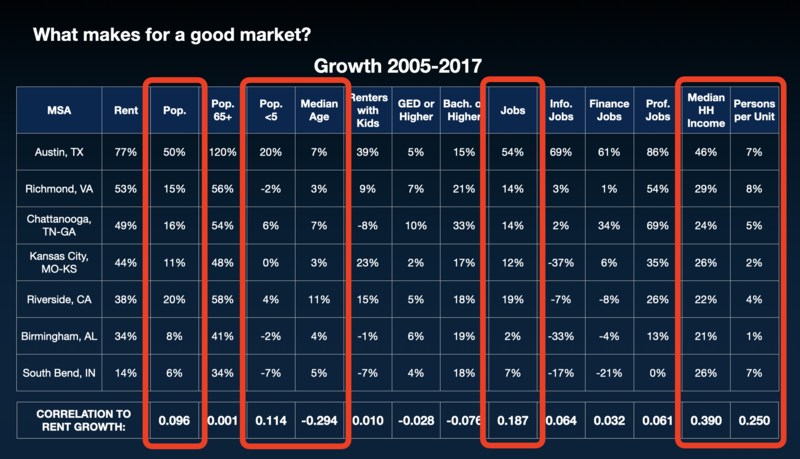
    These are the actual growth numbers and correlation coefficients for a random collection of markets. The most interesting metrics are outlined in red. As you can see, median household income growth is 4x more correlated to rent growth than population growth. And there's a strong inverse correction between rent growth and median age: rents go up as median age goes down.

    Sorry for this long-winded ranted. This is what happens when I have Coke in the afternoon.

    Conclusion: I guess the correct thing to say is, "The two most important metrics for a longterm successful market, according to a correlation analysis of Census data, are rising median household income and the ratio of population growth to new unit development."

  • Accountant · Temple, TX · Member since 2018 · 28 posts · 20 votes
    6y

    You’ve gotten a lot of feedback, but I haven’t seen any from Bell County. I currently live in Temple and have 3 properties there. The one I purchased in 2018 has appreciated about 20%, the one I purchased in 2019 has appreciated 15%. My 3rd property closed in June and I had a tenant lined up before closing. I only had a 7 day vacancy in May during the shut down. Cash flow is great, which is why I bought them but I found great deals and they’ve already appreciated like gangbusters!

    In addition, I’ve helped family members look for rental properties in Temple. If a vacancy sits on the market for more than 2 weeks, there is something wrong with it. We get tenants from Ft. Hood, from Scott & White teaching hospital, and commuters to Austin. 

    Rents are pretty high IMO at ~$1/sq ft/month. Taxes are just shy of 3%, so not bad for Texas. 

    Military makes for great tenants...you can report them to their CO if they don’t pay or take care of your property. Sure, you run the risk of turnover, but Ft. Hood seems to be a pretty steady 2 year commitment. I have one tenant with a 4 year assignment. Scott & White Interns come every spring and stay for 2 years. In both cases, these tenants usually don’t want to move at the end of the lease, so it’s not unusual to see them renew. 

    Temple is also growing like mad so you can find a turnkey new home and move tenants in with zero work. It’s getting hard to find anything to flip. 

    Hope something of this is helpful. Feel free to reach out if you want neighborhood specifics. 

  • Realtor · Boulder, CO · Member since 2016 · 3k+ posts · 5k+ votes
    6y

    The obvious answer is 1.5: Both! 

    What I like best about where I invest is it's possible to achieve both cash flow and appreciation (Denver market, so probably more similar to Austin than Killeen). 

    If I had to pick one, I'd look at the numbers. Cash flow for me is about $350/month per unit, while my appreciation breaks down to $350 PER DAY. So I will take appreciation, as $350 per day is much preferable to me over $350/mo. 

    If cash flow were the only option, I'd probably just invest in blue chip dividend stocks instead and save myself the headache of owning rentals. For me the ability to force appreciation quickly in a high appreciation market is the whole point of owning real estate instead of other truly passive, lower risk investment vehicles. 

    As far as appreciation being called speculation... I know that's probably the consensus here on BP, but I don't see it that way personally. It's more of an educated guess. If one knows their market well, it should be pretty easy to spot which neighborhoods are most likely to have increased property values over time. 

    Cash flow is just an educated guess as well: nobody can predict exactly how well a property will perform over time or when a major Capex expense or terrible nightmare tenant will rear their ugly head and devour several years worth of cash flow in one big gulp. It's very common for both experienced and especially new investors to be completely off with cash flow projections, so there aren't any guaranteed returns in this game, not from cash flow, not from appreciation.

    One thing I've learned is cash flow can provide a little extra side money which is nice, but appreciation is the real wealth builder of the two. 

    I wouldn't recommend buying solely for one or the other, but look at the overall quality of the property and calculate your IRR by looking at all the ways money is made in real estate: positive free cash flow (both initial and through rent increases over time), appreciation, gained equity through principle pay down, and depreciation tax benefits. Probably Austin is going to be the clear winner with all these factors accounted for, which is part of the reason why property is a lot more desirable and expensive there than it is in Killeen.

  • Rental Property Investor · boca raton, FL · Member since 2015 · 43 posts · 20 votes
    6y

    well it depends on your goals and current status.


    If you have a high paying job now and not planning to leave your job soon.

    I would prefer to have lower cashflow but higher appreciation.

    As Ill be taxed on my cashflow with the same brackets of my income.

    Appreciation I can refinance and take out money without being taxed

  • Real Estate Agent · Santa Barbara, CA · Member since 2016 · 518 posts · 283 votes
    6y
    Originally posted by @Steve Morris:
    Originally posted by @Storm S.:

    @Steve Morris my vote is number 1, number 1 is where you make the real money. Any property will cash flow depends on your capital structure. I’m looking for the highest possible total return.

    Sorry, in Portland proper, I've got a lot of guys from LAX that overpaid in 2017/18.  Some are trying to sell these and taking a hit on price.

    A lot of the properties are break-even deals, so the worst of both worlds.

    I'll paraphrase Warren Buffett and say that you make your best return when you buy.  You buy based on returns today.  If you have great returns today, the price will adjust in your favor.

     I don't think losing money is exclusive to chasing apprecation, I know california investors who bought out of state for "the cashflow" who also just broke even. The investors you mention probably either paid market value or overpaid also your timeframe is pretty short (3-4 Years), Warren Buffet look at 10 year timeframes or more. I have a client who bought a 15 unit apartment complex here in Santa Barbara for 1M with 300k down about 20 years ago, today its worth at least 4M. Thats over a 13X return on investment over 20 years just in apprecation, that doesn't even include the 20 years of cashflow. In the long run high appreciation markets outperform cashflow markets. Even if my client had overpaid for the property 20 years ago it has a negligible impact on his long term rate of return.

  • Seattle, WA · Member since 2017 · 5 posts · 1 vote
    6y

    Cash flow first. -Short term gain

    Appreciation -long term gain

  • Ian WalshBusiness Member
    Lender · Philadelphia, PA · Member since 2016 · 2k+ posts · 1k+ votes
    6y

    Personally, low leverage fits my goals

  • Rental Property Investor · Madison, WI · Member since 2019 · 32 posts · 28 votes
    6y

    @Matt Camilliere

    I shoot for 1.5 (blend of your choices).

    In the Midwest the highest cash flow ones usually have lowest appreciation potential and highest risk (less desirable, declining areas) I think of it like the difference between risky stocks vs blue chip stocks that pay a more predictable dividend with a little lower appreciation potential.

    I choose to invest where I live (expensive market) and there are very few #2s here so that's why I shoot for 1.5 and try to buy blue chip style properties (nice A- to B units in good neighborhoods/school districts) and am willing to take lower (but not zero or negative) cash flow in exchange for a safer bet in a great spot. That said I have a regular full time job that allows me to take on a little more risk/cover a shortage as I'm not depending on only my REI income to live.

  • Real Estate Agent · Baltimore, MD · Member since 2018 · 285 posts · 228 votes
    6y

    High cash flow! 

  • Real Estate Broker · Austin, TX · Member since 2019 · 32 posts · 18 votes
    6y

    @Matt Camilliere

    Cash flow. And if two projects are the same, the one with the greatest chance of appreciation. You can’t rely on an asset going up in value consistently and there are too many factors outside your control.

  • Eric FernwoodBusiness Member
    Realtor · Las Vegas, NV · Member since 2014 · 997 posts · 1k+ votes
    6y

    Hello @Matt Camilliere,

    An excellent question, one that more people should consider. Before I tell you my preference between cash flow and appreciation, I want to talk about what determines prices, and that is demand. Demand is a function of the imbalance between buyers and sellers. Where there are more buyers than sellers, prices rise until the number of buyers and sellers match. Where there are more sellers than buyers, prices fall until the number of buyers and sellers match. Demand is what makes the property on the left worth $80,000 and the property on the right $2,500,000.

    I've talked about demand and prices, but what about rent? There is a relationship between prices and rents. The studies I've read state that rents lag prices by 2 to 10 years. Market conditions like you mentioned are real world examples of rents lagging prices. See the image below.

    High Appreciation, Little or No Cash Flow

    With rising demand, the current rents reflect property prices from 2 to 10 years ago. The result is that prices are high and there is little or no cashflow, as you are seeing in Austin. However, if you hold the property long enough, rents should rise and eventually the property generates a positive cash flow. You just have to be willing to keep losing money every month until such time as rents rise sufficiently.

    When you buy an investment property in such a market, you are actually gambling that in the future, you will be able to sell the property for significantly more than you paid for it. Be certain to consider the cost to sell (7% to 8% of sales price) and long term capital gains taxes in your calculations. Also consider what you would do if it took many more years than you expected before rents rose enough to cover all your operating expenses. There is no guarantee that prices (and rents) will always rise.

    High Cash Flow, Little or No Appreciation

    With falling demand, the current rents also reflect prices from 2 to 10 years ago, when property prices were higher (in inflation adjusted dollars). The result is that property prices are low compared to the past so there is high cashflow. While such properties generate a high initial cash flow, if prices and rents are not rising at or above the rate of inflation, rents and prices are likely falling in inflation adjusted dollars. What does this mean to you?

    Dollar bills, by themselves, are worth nothing. The value of dollar bills is what you can exchange these dollars for. What complicates things is inflation. Inflation is continuously eroding the buying power of dollars. You see the effect of inflation when you go to the grocery store. Each year, it costs more dollars to buy the same basket of goods. To highlight the impact of inflation, I created the image below. The numbers are from the CPI Inflation Calculator by Bureau of Labor Statistics.

    As the chart shows, you need $103 in 2019 to buy the same basket of goods you bought for $50 in 1990. How does this apply to rent? If you rented a property in a high cash flow market (with little or no appreciation) in 2015 for $900/Mo., you would need to receive $993 in 2019 just to maintain the same buying power. If the 2019 rent is less than $993 , your rent actually declined in inflation adjusted dollars. However, by definition there is little or no appreciation in high cash flow markets (or they would not be high cash flow markets) so over time the inflation adjusted cash flow (buying power) will decline.

    My Preference

    There are markets where you can get a positive cash flow today and strong appreciation. This is my personal preference. I created the graphic below to illustrate the effect inflation has on (inflation adjusted) cash flow. If the appreciation rate is less than inflation, rent in buying power is declining. If appreciation is above the rate of inflation, buying power of the rent you will receive is increasing.

    Even though you start with a lower cash flow in a more balanced market, it does not take many years to have a higher real cash flow (buying power) than the high cash flow property. Since your major cost is fixed, as rents increase so does your return, as illustrated below.

    Matt, I hope this helps.

    FERNWOOD Team, KW VIP Realty520 Reviews
  • Realtor · Austin, TX · Member since 2016 · 52 posts · 18 votes
    5y

    I have properties in both Austin and Killeen. I think this depends on what your goals are. IMO If you're looking to buy and hold then appreciation doesn't matter as much. Also, you can buy a few properties for the price of one in Austin. 

  • Dan BurstainBusiness Member
    Real Estate Agent · Austin, TX · Member since 2014 · 361 posts · 331 votes
    5y

    This is the perfect thread to see what I have talked about for years now.   Those in consistently appreciating areas, where it is not icing on the cake but has been consistent for 40 years like Austin, will say #1 all day long.  Those in areas with roller coaster rides in appreciation will say #2 as they have seen investors get burned.  This is also the perfect thread to show the only real flaw in BP.  Whatever city you live in or invest in is DIFFERENT than other cities.  One approach that is super successful in your city might not be ideal in others.  So before you preach about #1 or #2 just caveat it with places you invest.  I love Austin and I and my investors have made a ton more money here vs. high cash flowing areas but I do realize those who believe #2 (cash flow) is the most important should probably look elsewhere.  Those who want to maximize return on investment should look at Austin and similar cities.

    Dan Burstain, Investment Realtor51 Review
  • Member since 2020 · 8 posts · 2 votes
    5y

    Forced cashflow, through value add, in a high appreciating market. You can have your cake and eat it too, you just need to find the right property/where to look.

  • Investor · Austin, TX · Member since 2013 · 680 posts · 1k+ votes
    5y

    @Jon Schwartz @Johnny Wolff hold on for just a moment shall we!  I alway enjoy a good debate, so let's bring it!  

    Here is my case for CASH FLOW over APPRECIATION!  My comments are not based on Research (as I can make research say anything I want) but from 18 years of doing!!!!  Top Three Reasons You Want CASH FlOW primary!

    1. Less Risk

    2.Build Confidence faster

    3. Can't eat appreciation on a long term basis

    Ok now I will go into depth.

    1. Less Risk: I like to put a stress test to my investments. Not interested in if the assumptions continue, what happens when the recession comes along and I either lose my job or my tenants lose their job and everyone else is in panic mode too. So you buy for appreciation but you can't make mortgage payment because you lost your job and your property is empty or bleeding by negative cash flow. OR you lose your job, but nothing negative happens to your rental but you are having to come up with $500 additional a month to make mortgage payment. I buy relative low income housing (duplexes) for cash flow. The other myth I have been told is don't buy duplexes buy SFH they appreciate better. Ha Ha, not in Austin the hottest property BAR NONE are duplexes!

    Buying for appreciation requires you to maximize your rents to limit as much as possible to limit negative cash flow.  The ONLY WAY YOU MAKE MONEY is the market HAS TO MOVE IN YOUR FAVOR!  NOT TRUE WITH A CASH FLOW POSITIVE INVESTMENT.  I have used the 1% rule to guide me over the last 18 years and that has allowed me to pay off my properties in 14-15 years with profits reinvested in the mortgage.  Investors that recommend appreciation as a strategy are normally from markets that cash flow strategies don't work........where did you say you're from Jon? 

    Lastly on Risk:  Positive cash flowing property will not cause you to sell your property in hard times.  The property itself will not be distressed but if it is an appreciation play it most certainly can cause you a lot of stress.  Property values can CRASH but RENTS DO NOT unless you're possibly in a High Appreciating area like San Fran and the high tech exit happens and workers move out in droves and the rents crash and all those recent buyers are selling or losing their properties if they don't have the resources AND CONFIDENCE (next item) to continue on.  

    2.  Confidence:  Investing successfully no matter what the strategy requires CONFIDENCE!  Yes.   The more you are in control the more your confidence grows.  Mike Tyson says:  They all have a plan (to beat me) until they get punched in the mouth!  It is when  some of your expectations don't happen and you are having to come up with MO MO MONEY to keep your investment from dying.  Even if the market rebounded and went up 10x after the down turn.......so how does that help you when you lost your CONFIDENCE and sold in the fire sale!  Can you lose confidence with a cash flow strategy, yes you can.  Usually it won't be because you're rents are declining.  It might be your management of the property that would also apply with an Appreciation play too.  I can anticipate the markets but I CAN"T CONTROL THEM.  

    3.  Can't eat appreciation on a long term basis:  Let's see, why do people get up every morning or night and go to work?  Would the number 1 reason be because they really enjoy their work?  Hey, they might enjoy their work, yes, or no, but the #1 reason they go to work is FOR THE CASH FLOW..........YES WE CAN ALL AGREE CAN WE NOT!!!!!!!!!  If you don't agree you are in the 1% of people or you just want to play devils advocate......no!   Would you go to work if pay was zero?  Most people on this website either invest in real estate or want to invest in real estate to become FINANCIALLY INDEPENDENT!  Our real estate is designed to REPLACE OUR PAYCHECKS!!!!!!!!  Think about that, if we could invest in a product that will replace our income AND GO UP WITH INFLATION, we could live for 1000 years and still not run out of money!!!!!   Cash flowing properties allow you to ACCURATELY predict when your property will be paid off or generate positive income.  Appreciating real estate not so much!

    These are my top 3 reasons but there are many more, next one up would be taxes but that is for another day.

    Lastly, I want to say there is absolutely many reasons to choose Cap Appreciation over cash flow.  But for most, inexperience investors just trying to secure financial independence cash flow strategy is the way to go.   If you're an experience investor and can afford to lose what you invest or you have deep reserves then a capital appreciation strategy could absolutely be good for you.  I just don't want an inexperienced investor get big eyes and not account for the risk and lose focus on what is the goal (make money in the short term or build cash flow for long term success).

    I posted this about Killeen 4 years ago:

    My two cents on the Killeen area. Someone said that homes are on the market longer than Austin, and price appreciation is not as strong as Austin. Well Austin is a strong market and is tough to compare against, however, I believe VA loans are holding the Killeen market back a bit. Why? VA requires no money down, and a lot of GIs are buying when they probably shouldn't and when they get transferred or get financially stress they sell causing a slow down in appreciation. Rents are not as strong due to a lot of housing forced into the rental sector on military transfers. Also Fort Hoot is huge and has a large capacity for soldiers, but as force levels change there are wide swings at times as to the number of soldiers stationed there. Just recently the post commander opened on post housing to civilians as they can not fill their housing on post with active duty soldiers. That action and the abundance of the VA loans has kept me from investing in Killeen.

    Now my idea of cash flow is not $100 a door and Killeen investing FOR ME is not a great investment location for cash flow.  Yes it can work but you do have to look at other factors.  

  • Rental Property Investor · Austin, TX · Member since 2020 · 10 posts · 9 votes
    5y

    If you're going to take the leap into negative cashflow hoping for appreciation be very careful with property taxes. They have been increasing 5-10% for a while for many people and will likely continue to do so as the city grows. A few years of that coupled with the fact that rents definitely aren't going up 5-10% every year consistently and you'll be digging yourself into an even deeper hole if you started out with negative cashflow.

  • Member since 2021 · 7 posts · 0 votes
    5y

    Anybody have any recent success stories in the Killeen area?

Join the conversationCreate a free account to reply, vote on answers and follow this thread.