"How Revenue-Generating WiFi Added $2.6M at Exit: The Ancillary Income Strategy"
Quick question for syndicators and value-add operators:
You're planning your capex budget 18-30 months before exit. Which investment delivers better ROI?
A) $10K/unit for kitchen/bath upgrades - might justify $50-100/month rent increase (if comps support it)
B) $1K/unit for revenue-generating WiFi infrastructure - generates $30-50/month in NEW ancillary income (guaranteed, not comp-dependent)
Most operators still pick A out of habit. The smart ones picking B are seeing $2-3M premiums at exit.
Here's why infrastructure wins.
The Problem with Traditional Value-Add:
We've all been trained on the same playbook: Buy Class B/C property → Renovate units → Raise rents → Flip in 3-5 years.
But the competitive landscape has shifted:
Market saturation: Granite countertops and stainless appliances have become table stakes in most major markets. When every comp property has the same finishes, cosmetic upgrades stop commanding rent premiums.
Rent growth normalization: Markets that experienced double-digit rent growth in 2021-2022 have returned to more sustainable single-digit (or flat) growth, making it harder to justify exit valuations based purely on rent increases.
Buyer due diligence evolution: Institutional acquirers are increasingly asking about documented ancillary income streams during due diligence. They want recurring revenue that travels with the asset, not just projections of future rent increases.
Industry evidence: In their Q4 2024 earnings call, Mid-America Apartment Communities (MAA) - a major REIT - highlighted ancillary fees as a key growth driver amid flat rent growth. Brad Hill, MAA's President and incoming CEO, specifically cited WiFi and bulk cable services as significant value-adding components: "Those are some of the larger components of the fees that we do have."
MAA's CFO added that "other revenue items primarily reimbursement and fee income [are expected] to grow at 2.5%" in 2025, while their effective rent growth projection sits at just 0.2%.
The message is clear: When rent growth stalls, smart operators diversify revenue through infrastructure.
The New Exit Strategy: Ancillary Income as a Value Driver
November 2025: The Haven at Chisholm Trail (Fort Worth, 328 units) sold to Valiant Residential.
The infrastructure decision seller made in 2019? Fiber-backed property-wide WiFi billed as a mandatory technology fee - residents couldn't opt out, it was part of living there (like paying for the baked-in pool maintenance even if you don't use the pool).
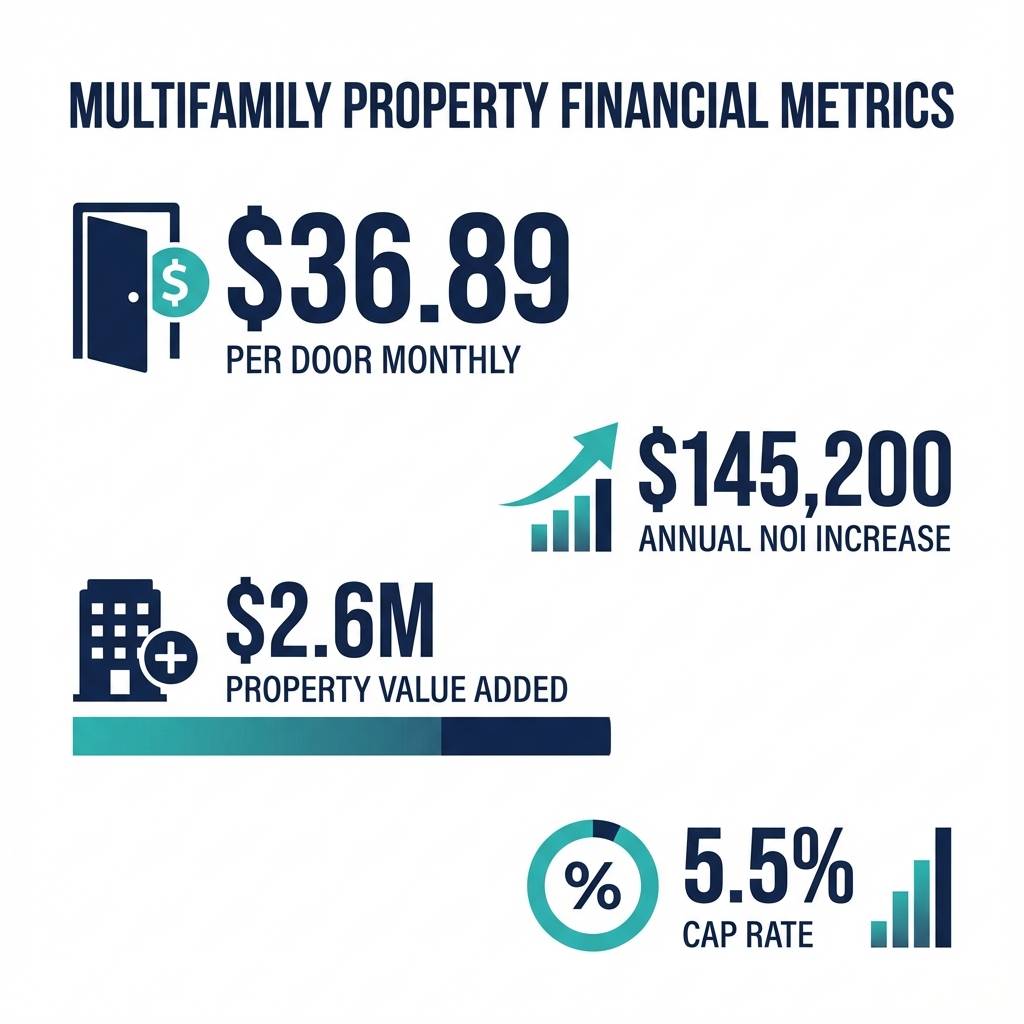
The numbers: • $145,000 annual WiFi revenue • 90+% resident adoption • $36.89/door/month • Zero property management burden (white-glove support model)
The exit math: $145K annual income ÷ 5.5% cap rate = $2.6M added to property value
Not a projection. Documented cash flow. Institutional buyers underwrote it at closing.
Why This Works (And Cosmetic Upgrades Don't):
1. Recurring revenue travels with the asset Unlike rent increases (which depend on comps), ancillary income is property infrastructure. The buyer gets the revenue stream day one.
2. Institutional buyers can underwrite it Show 12+ months of documented WiFi revenue at 90+% adoption = they'll include it in NOI calculations.
3. Premium exit valuations Properties with proven ancillary income are commanding 10-15% premiums in competitive markets (Dallas, Phoenix, Charlotte, Denver).
4. Solves a resident pain point Move-in ready WiFi = Day 1 connectivity. No "call Comcast and wait 2 weeks." Resident satisfaction goes up, complaints go to your vendor (not your office).
The Shift from Amenities to Infrastructure Revenue
At the IREM 2024 Global Summit, property management leaders emphasized innovative ancillary revenue streams as essential to boosting cash flow in saturated markets.
Jae Roe, Founder of SOVA Real Estate Solutions and VP of Property Management at Chicago Trend Corp., put it plainly: "You're really only constrained by your imagination" when it comes to ancillary income opportunities.
The differentiation game is moving from amenities (granite countertops, pool upgrades) to infrastructure that generates measurable, recurring cash flow (WiFi, smart building tech, charging stations).
The shift isn't about nickel-and-diming residents. It's about providing premium services they actually value while creating documented income streams that institutional buyers can underwrite.
The Timeline That Works:
If you're planning an exit, here's the proven roadmap:
Months 1-3: Infrastructure installation (fiber-backed WiFi deployment)
Months 4-12: Resident adoption ramp (marketing, onboarding, optimization)
Months 13-24+: NOI proof period (12+ months documented cash flow)
Month 24-30: Exit with institutional-grade proof
Total investment: ~$1,000/unit (e.g., $200K for 200-unit property, $300K for 300-unit) Annual revenue: $30-50/door = $72K-$120K annually (200 units) or $108K-$180K (300 units) Property value increase: $1.3M-$2.2M (200 units) or $2-3M (300 units) at 5-6% cap rate
ROI: 32% cash-on-cash return (Haven case study)
Why Fiber-Backed (Not Cable ISP WiFi):
Most bulk internet providers use cable ISP infrastructure (Comcast/Spectrum wholesale). Here's why that's a problem:
Cable ISPs: ❌ Asymmetrical speeds (300 Mbps down / 35 Mbps up) ❌ Shared bandwidth (congestion during peak hours) ❌ Upload bottleneck (kills Zoom, cloud backup, gaming) ❌ Resident complaints when it slows down
Fiber-backed WiFi: ✅ Symmetrical speeds (500 Mbps down / 500 Mbps up) ✅ Dedicated bandwidth (no congestion) ✅ Future-proof (AI, AR/VR, IoT ready) ✅ Premium positioning (residents see the difference)
Institutional buyers know this. They're specifically asking for fiber infrastructure in acquisition due diligence.
The Owner-Owned Infrastructure Model:
When you own the fiber/WiFi infrastructure (not a third-party ISP), you have full control over how to monetize or position it:
Option 1: RUBS Billing (What The Haven Did) • WiFi as line item on rent statement (technology fee or WiFi fee) • Residents see it clearly but can't opt out • You capture cost + margin • Simple, transparent, generates ancillary income
Option 2: Baked Into Rent • WiFi cost built into higher base rent • Invisible to residents (just "rent") • Simplified billing (no separate line items) • Positions property as premium/all-inclusive
Option 3: Free Amenity/Concession • "Free WiFi" as competitive differentiator • Used to justify rent premium vs competitors • No separate billing • Works great in high-competition markets or as move-in promotion
The key: YOU own the infrastructure in all three models. The billing method is just strategy—RUBS for documented ancillary income, baked-in for simplicity, or free for competitive positioning.
Most operators choose Option 1 (RUBS/technology fee) to maximize documented ancillary income at exit, which is what The Haven did.
The Three-Tier Ancillary Income Model:
This isn't just about WiFi. It's about layering revenue streams:
Tier 1 (Foundation): Owner-Owned WiFi Infrastructure • $30-50/door monthly • 80% of your ancillary income opportunity • Enables everything else
Tier 2 (Smart Building): IoT & Operational Tech • Smart thermostats (energy savings) • Water leak sensors (insurance/maintenance savings) • Smart locks (operational efficiency) • Requires WiFi infrastructure to function
Tier 3 (Resident Services): Premium Add-Ons • Streaming bundles • Premium bandwidth tiers • Smart home packages • Requires WiFi foundation
Most operators skip Tier 1 and wonder why Tier 2/3 don't work.
Who This Works For:
Syndicates (3-5 year holds): Install in Year 1-2 → Document 12+ months income → Exit in Year 3-5 with proven NOI boost
Value-add operators: Add to renovation playbook → Differentiate from cosmetic-only competitors → Command premium at exit
Brokers helping sellers/buyers: Position as pre-sale value-add strategy → Sellers with 18-30 months to exit get maximum benefit
Properties 60+ units: Economics work best at this scale (installation cost amortizes, per-door revenue adds up)
Common Objections (And Real Answers):
"Residents won't pay for WiFi - they want their own provider" Reality: 90+% adoption at The Haven. When WiFi is billed as a mandatory technology fee (can't opt out), residents get Day 1 connectivity without calling Comcast. Convenience beats choice.
"Installation costs are too high" Reality: $1,000/unit investment. For 200 units = $200K investment, $96K-$144K annual return = ROI in 16-25 months. At exit: $1.7M-$2.6M property value increase.
"What if technology changes?" Reality: Fiber infrastructure is future-proof. WiFi 6/7 upgrades are just equipment swaps (like replacing a router). The fiber backbone lasts 20+ years.
"Property management will hate the support burden" Reality: White-glove support model = vendor handles ALL resident issues. Zero calls to your office. Residents get 24/7 support, you get zero complaints.
"Institutional buyers won't value it" Reality: Valiant Residential (NMHC Top 50) underwrote The Haven's WiFi revenue at closing. They KEPT the revenue model post-acquisition. This is what they're looking for.
Resources:
I put together a full guide on this if anyone wants to dig deeper:
📊 Revenue-Generating WiFi & Ancillary Income Guide: https://gamma.app/docs/Guide-to-Revenue-Generating-Fiber-Backed-WiFi-Ancillary-Income-qojuk1ee9lbabbq
Covers: • The three-tier ancillary income model • Owner-owned billing options (RUBS, baked-in, free amenity) • Installation timelines and costs • Exit strategy optimization • Case studies with real numbers • Vendor selection criteria
Industry Sources Referenced: • MAA Q4 2024 Earnings Call: https://www.insidermonkey.com/blog/mid-america-apartment-communities-inc-nysemaa-q4-2024-earnings-call-transcript-1445988 • IREM 2024 Global Summit: https://www.multihousingnews.com/irem-2024-special-report-adapting-to-change-and-driving-revenue
Discussion Questions:
For operators in this forum:
- What's your current ancillary income as % of total revenue? Industry standard is 5%, but most properties are at 1-2%. Where are you?
- If you're planning an exit in 18-36 months, what's your value-add strategy? Still doing cosmetic upgrades, or moving to infrastructure?
- For those who've sold recently: Did buyers ask about ancillary income during due diligence? What did they want to see?
- Dallas/Phoenix/Charlotte/Denver operators: Are you seeing this trend in your markets? Institutional buyers prioritizing properties with documented ancillary income?
Would love to hear what's working in your markets. The playbook is changing fast in 2026.