How do you compare deals and know which one is actually “safer”?

How do you compare deals and know which one is actually “safer”?

Member since 2026 · 26 posts · 6 votes

Hi everyone — I’ve been learning a lot from this group, really appreciate all the insights here.

I’m a mobile developer exploring a simple tool for small landlords (1–20 units) to compare deals and quickly see which one actually survives bad scenarios (vacancy, repairs, rate changes, etc.).

here is rough version (not built yet):

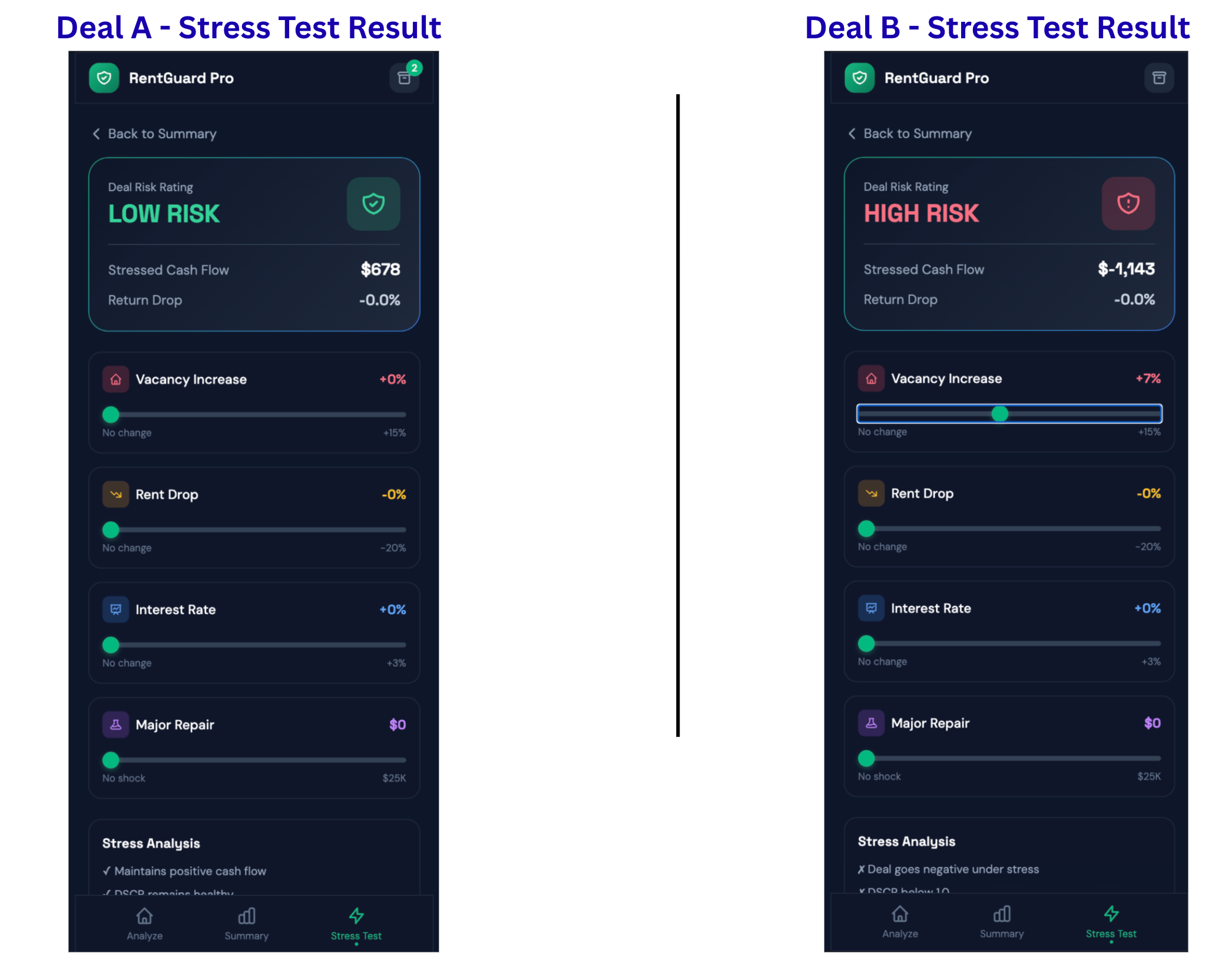
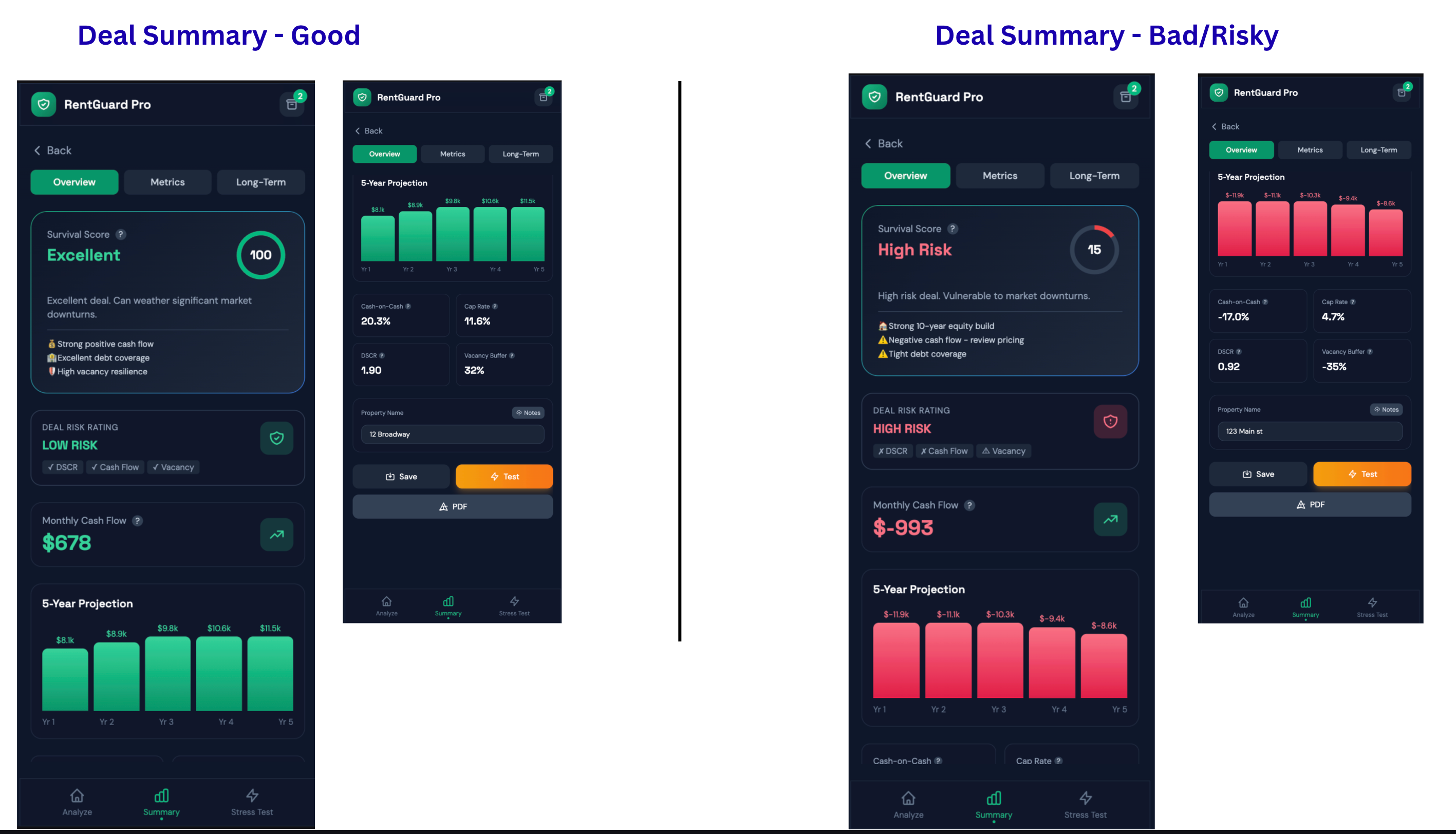
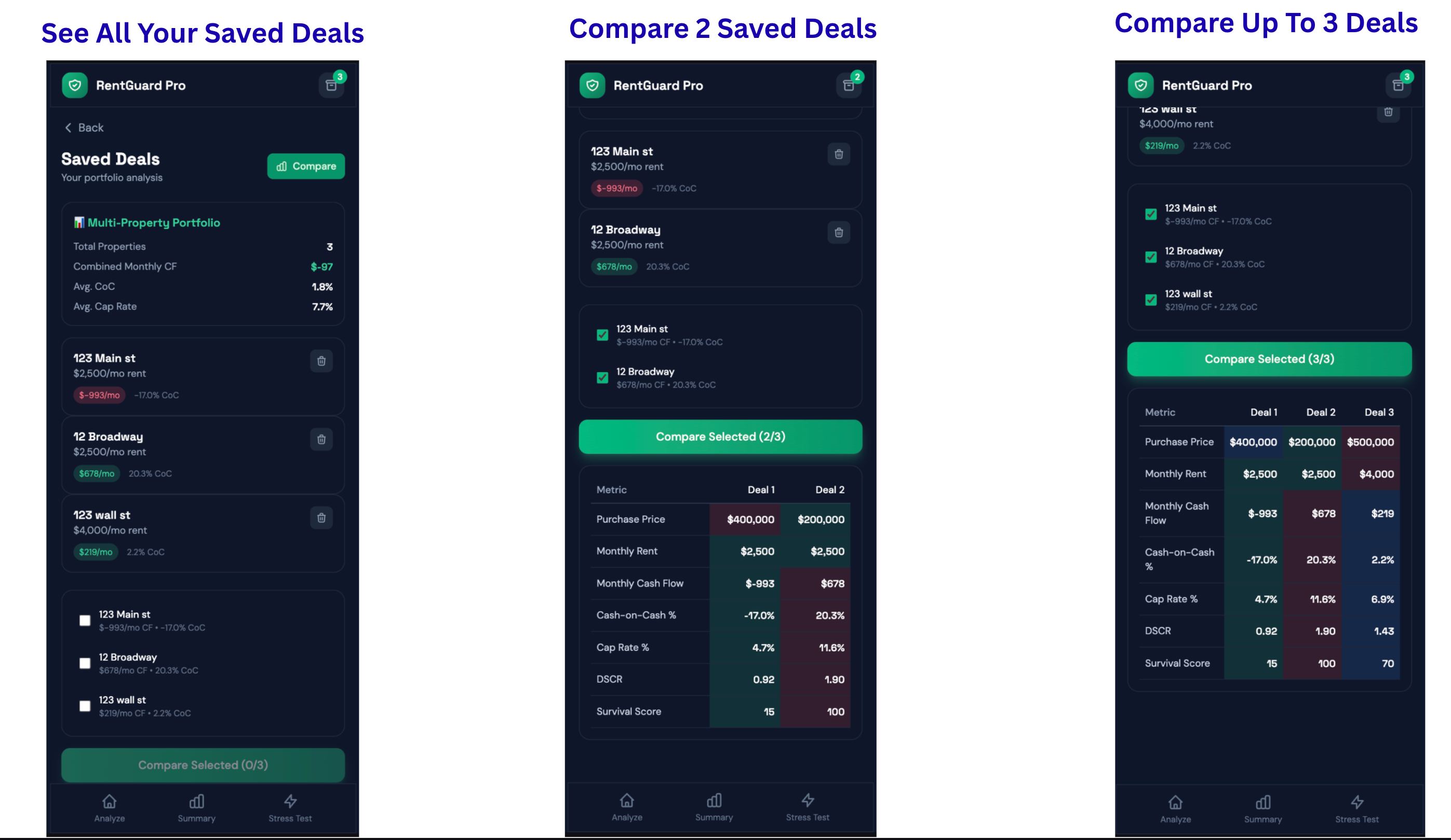
1774479988-compare.png.webp 1774479988-stress_test.png.webp 1774479988-summary.png.webp


The idea is to show things like:

  • Monthly cash flow
  • Side-by-side deal comparison
  • A “Survival Score” = how well the deal holds up under stress

I’m not selling anything — just trying to understand if this is actually useful.

Would love your honest feedback:

  1. Would this help you make decisions faster?
  2. What’s missing or unnecessary?

Thanks again — really appreciate it.
0Reply
168 views

12 Replies

Jump to latestLatest
  • Investor · Pacific Northwest · Member since 2026 · 65 posts · 16 votes
    6mo

    Hey AI Tounk, can you help explain your idea further and what it could do differently from how investors currently underwrite deals?

    • Member since 2026 · 26 posts · 6 votes
      6mo
      Quote from @Andrew Caranto:

      Hey AI Tounk, can you help explain your idea further and what it could do differently from how investors currently underwrite deals?

      Good question — that’s exactly what I’m trying to figure out.

      Most investors today either:

      • run a single scenario (rent, expenses, etc.), or
      • use spreadsheets/tools that show metrics like cash flow, cap rate, etc.

      What I’m trying to do differently is make the downside much more visible and intuitive.

      For example: instead of just showing “this deal makes $200/month,”

      it shows how that changes if:

      • vacancy increases
      • rent drops
      • a major repair hits
      • rates move

      And then summarizes that into something simple like a “Survival Score” — basically how well the deal holds up under stress.

      The goal is to answer: is this deal actually safe, or just looks good on paper?

      Curious if that’s something you already account for in your process, or if you mostly rely on base-case numbers?

      Here is few screenshots 

  • Property Manager · Calabasas, CA · Member since 2026 · 141 posts · 67 votes
    6mo

    The stress-testing angle is the right instinct. On the commercial side, the way I look at it is: does this deal still work if the tenant doesn't renew, rents come in 15% below ask, and I'm carrying it vacant for 8-12 months? If the answer is "no" or "barely," the deal is riskier than the cap rate suggests. For small commercial deals specifically, I'd add a few scenarios beyond what you're showing: (1) what happens if the anchor tenant leaves in a multi-tenant retail strip, (2) what does the debt service look like if you need to refi in 3 years at rates 150bps higher, and (3) how much deferred maintenance is baked into that NOI figure. The "survival score" concept makes sense, though I'd be careful about collapsing it to a single number — different investors have different tolerances for different risk types (vacancy risk vs. credit risk vs. capex risk are not the same). The most useful tool would let you see which specific assumption is actually killing the deal when you stress it. Happy to share how I think about this for NNN vs. modified gross leases if that's useful context.

    • Member since 2026 · 26 posts · 6 votes
      6mo
      Quote from @Ryan Stomel:

      The stress-testing angle is the right instinct. On the commercial side, the way I look at it is: does this deal still work if the tenant doesn't renew, rents come in 15% below ask, and I'm carrying it vacant for 8-12 months? If the answer is "no" or "barely," the deal is riskier than the cap rate suggests. For small commercial deals specifically, I'd add a few scenarios beyond what you're showing: (1) what happens if the anchor tenant leaves in a multi-tenant retail strip, (2) what does the debt service look like if you need to refi in 3 years at rates 150bps higher, and (3) how much deferred maintenance is baked into that NOI figure. The "survival score" concept makes sense, though I'd be careful about collapsing it to a single number — different investors have different tolerances for different risk types (vacancy risk vs. credit risk vs. capex risk are not the same). The most useful tool would let you see which specific assumption is actually killing the deal when you stress it. Happy to share how I think about this for NNN vs. modified gross leases if that's useful context.

      Ryan, this is extremely helpful — especially the way you’re framing vacancy and tenant risk. The idea of carrying a deal vacant for that long really puts the downside into perspective.

      Your point about not collapsing everything into a single score also makes a lot of sense. I’ve been thinking about how to keep things simple while still showing what’s actually driving the risk, not just the final number.

      Out of curiosity, when you stress a deal like that, do you typically have a clear sense of which variable (vacancy, rent, debt, etc.) is the main risk driver, or is that something you uncover through detailed analysis?

  • Property Manager · Calabasas, CA · Member since 2026 · 141 posts · 67 votes
    6mo

    Good question — and honestly it depends on the deal type, which is part of why a single score can be misleading.

    For commercial leases, the main risk driver is almost always clear from the lease structure before you run a single scenario. On a NNN deal with one tenant, vacancy risk dominates everything — if that tenant leaves, you have zero income and full carrying costs. On a multi-tenant retail strip, the risk is more distributed but you're really focused on the anchor. On modified gross leases, expense creep (especially insurance and taxes) is usually the one that surprises people.

    For small residential (1-20 units), I'd say vacancy and rent achievability are the two that matter most — and they're related. If your rent assumption is aggressive, you'll see it in higher vacancy when units don't lease at that number. The deals I've seen blow up at this size weren't killed by interest rates or repairs — they were killed by overestimating rent and not having a realistic vacancy buffer.

    The practical answer to your question: I usually know which variable is the killer before detailed analysis because I ask one thing up front — what has to be true for this deal to work? If the answer requires 98% occupancy at above-market rents with no major capex for 5 years, that's a deal where I already know what stress test is going to fail. Detailed analysis just confirms it.

    For your tool — one thing that would make the stress test more useful is showing not just what breaks the deal, but how far you have to push the assumption to break it. A deal that survives vacancy up to 25% is very different from one that breaks at 8%. That gap is the actual safety margin.

    • Member since 2026 · 26 posts · 6 votes
      6mo
      Quote from @Ryan Stomel:

      Good question — and honestly it depends on the deal type, which is part of why a single score can be misleading.

      For commercial leases, the main risk driver is almost always clear from the lease structure before you run a single scenario. On a NNN deal with one tenant, vacancy risk dominates everything — if that tenant leaves, you have zero income and full carrying costs. On a multi-tenant retail strip, the risk is more distributed but you're really focused on the anchor. On modified gross leases, expense creep (especially insurance and taxes) is usually the one that surprises people.

      For small residential (1-20 units), I'd say vacancy and rent achievability are the two that matter most — and they're related. If your rent assumption is aggressive, you'll see it in higher vacancy when units don't lease at that number. The deals I've seen blow up at this size weren't killed by interest rates or repairs — they were killed by overestimating rent and not having a realistic vacancy buffer.

      The practical answer to your question: I usually know which variable is the killer before detailed analysis because I ask one thing up front — what has to be true for this deal to work? If the answer requires 98% occupancy at above-market rents with no major capex for 5 years, that's a deal where I already know what stress test is going to fail. Detailed analysis just confirms it.

      For your tool — one thing that would make the stress test more useful is showing not just what breaks the deal, but how far you have to push the assumption to break it. A deal that survives vacancy up to 25% is very different from one that breaks at 8%. That gap is the actual safety margin.

      This is incredibly insightful — especially the way you framed it as “how far you have to push the assumption before it breaks.” That actually feels more useful than just knowing the break point itself.

      I’ve been showing where a deal breaks (like vacancy %), but your point about the gap between current assumptions and failure really clicks — that’s basically the real safety margin.

      For smaller residential deals, when you’re looking at that margin, what do you personally consider “comfortable”? For example, is there a vacancy buffer (in months or %) where you start feeling like a deal is solid vs too tight?

  • Property Manager · Calabasas, CA · Member since 2026 · 141 posts · 67 votes
    6mo

    Good question to pressure-test. For small residential (1-20 units), here's where I land personally:

    On vacancy buffer, I don't think in months — I think in percentages tied to the market. In a stable submarket with low vacancy rates (sub 5%), I'm comfortable underwriting 8-10% vacancy, which gives me a safety gap of 3-5 points. In a softer market or on a first-time stabilization, I'd want at least 15% modeled vacancy before I start feeling okay about the deal.

    The number that really matters for me though is months of negative cash flow I can carry before it becomes a problem. On a deal where 20% vacancy puts me $400/month negative, the question is: how long can I actually sustain that if leasing takes longer than expected? If the answer is 6+ months with comfortable reserves, I'm much less worried than if 3 months of higher vacancy would put me in a cash crunch.

    For your tool, one feature that would make the stress test more intuitive: show the vacancy % alongside the number of months at that vacancy rate before you hit a predefined reserve threshold. That's a more visceral risk signal than a percentage alone — especially for newer investors who think 15% vacancy sounds fine but haven't done the math on what that means to their reserves over 6 months.

    • Member since 2026 · 26 posts · 6 votes
      6mo
      Quote from @Ryan Stomel:

      Good question to pressure-test. For small residential (1-20 units), here's where I land personally:

      On vacancy buffer, I don't think in months — I think in percentages tied to the market. In a stable submarket with low vacancy rates (sub 5%), I'm comfortable underwriting 8-10% vacancy, which gives me a safety gap of 3-5 points. In a softer market or on a first-time stabilization, I'd want at least 15% modeled vacancy before I start feeling okay about the deal.

      The number that really matters for me though is months of negative cash flow I can carry before it becomes a problem. On a deal where 20% vacancy puts me $400/month negative, the question is: how long can I actually sustain that if leasing takes longer than expected? If the answer is 6+ months with comfortable reserves, I'm much less worried than if 3 months of higher vacancy would put me in a cash crunch.

      For your tool, one feature that would make the stress test more intuitive: show the vacancy % alongside the number of months at that vacancy rate before you hit a predefined reserve threshold. That's a more visceral risk signal than a percentage alone — especially for newer investors who think 15% vacancy sounds fine but haven't done the math on what that means to their reserves over 6 months.

      Ryan, This has been super helpful — I really appreciate how you think through deals, especially around reserves and downside scenarios.

      I’ve started putting a simple version of this together (focused on break points, buffer, and how long you can carry a deal under stress).

      Would you be open to trying a rough version once I have it ready and giving feedback? 

  • Property Manager · Calabasas, CA · Member since 2026 · 141 posts · 67 votes
    6mo

    Sure, happy to take a look when you have something rough to share. I'd focus your beta test on whether the "months of carry before reserve threshold" feature reads intuitively to someone who hasn't built it — that concept is the hardest to communicate clearly but the most valuable if it lands.

    • Member since 2026 · 26 posts · 6 votes
      6mo
      Quote from @Ryan Stomel:

      Sure, happy to take a look when you have something rough to share. I'd focus your beta test on whether the "months of carry before reserve threshold" feature reads intuitively to someone who hasn't built it — that concept is the hardest to communicate clearly but the most valuable if it lands.


       Hey Ryan, I just DM you with the link. Please let me know what you think.

  • Property Manager · Calabasas, CA · Member since 2026 · 141 posts · 67 votes
    6mo

    Got the DM — will take a look today. Excited to see how you built out the reserve carry feature. That's the one that's hardest to communicate but most useful when it lands right.

    • Member since 2026 · 26 posts · 6 votes
      6mo
      Quote from @Ryan Stomel:

      Got the DM — will take a look today. Excited to see how you built out the reserve carry feature. That's the one that's hardest to communicate but most useful when it lands right.


      Great, thanks a lot Ryan. Your feedbacks are definitely appreciated. Looking forward to it….
Join the conversationCreate a free account to reply, vote on answers and follow this thread.