The Supply Gap Nobody's Pricing In
The July numbers lined up in a way worth flagging for anyone underwriting deals right now!
Appreciation is slow, and that's the point
ICE's latest Home Price Index has prices up 0.21% month over month and 1.71% year over year. The six-month run rate puts us near 3% annualized. If you're used to the 2020-2022 environment, that feels like nothing.
But 3% on a leveraged asset is a different animal than 3% anywhere else. On a $500,000 property, that's roughly $15,000 in year one, $80,000 across five years, and $172,000 over a decade — before principal paydown, before rent growth, before depreciation. The returns aren't coming from appreciation alone right now, which means the deals have to underwrite on cash flow. That's a healthier discipline than the last cycle enforced.
Builders pulled back while household formation didn't
This is the piece I'd pay attention to. Housing starts fell 12.4% in July to a 1.24 million annual pace. Building permits went the other direction, up 5% to 1.44 million, but the builder sentiment index tells you how much conviction is behind those permits — NAHB's index rose a point to 35 in August, and anything under 50 means more builders see conditions as poor than good. High rates, affordability compression, and construction costs are all doing their work.
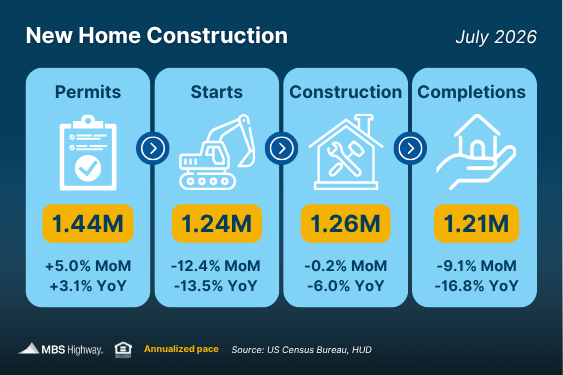
Meanwhile household formations are running around 1.4 million annually. We're forming households faster than we're breaking ground on homes, and that gap has been persistent rather than a one-month artifact.
The lag matters here. Permitting, construction, and completion take quarters, not weeks. Whatever supply response eventually shows up to meet returning demand, it isn't showing up quickly.
Demand is sidelined, not destroyed
Pending home sales fell 2.3% from June to July — second consecutive monthly drop, down 2.2% year over year, negative across all four regions. Lawrence Yun tied it directly to the summer's rate spike pulling back contract signings.
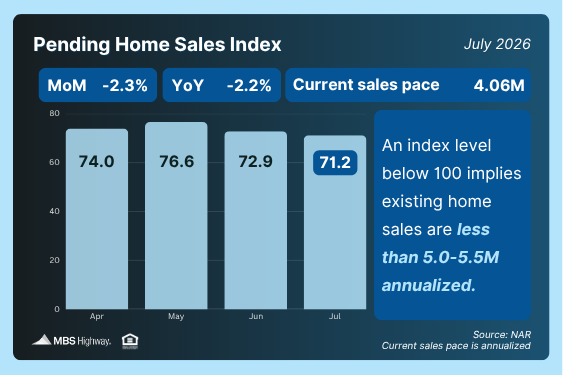
Sidelined buyers are a coiled spring, not a vanished cohort. When financing costs ease, they come back into a market where new supply hasn't caught up.
The rate picture is less one-directional than the consensus assumes
The July Fed minutes are worth reading carefully if you're modeling a rate-cut scenario. The Fed held, but three policymakers dissented in favor of a quarter-point hike, and the minutes noted "many participants" saw hikes as appropriate if inflation didn't decline.
Data since then has been friendlier — consumer and wholesale inflation both landed at or below expectations in July, and the July jobs report showed actual job losses. That combination argues for a hold in September. But if you're underwriting on the assumption that the next move is obviously down, the minutes suggest the committee is less settled than the market narrative implies.
Labor market read: initial claims dipped to 206,000, continuing claims stayed elevated at 1.799 million. Low initial claims look healthy, but they may undercount — displaced workers moving into contract or gig work often never file. Elevated continuing claims say the ones who do file are taking longer to land.
Investor takeaway
The setup right now is a market where competition is thin, sellers are negotiable, and the structural supply deficit hasn't been addressed. That's an acquisition window, not a reason to wait. If you're buying, underwrite conservatively — assume 3% appreciation, make the deal work on cash flow, and treat any rate relief as upside rather than a load-bearing assumption. The risk in waiting isn't that prices run away from you this quarter. It's that you end up bidding against the entire sidelined buyer pool for a supply that builders spent 2026 not building.
Watch PCE on Wednesday and Jackson Hole starting Thursday — those will move the rate narrative more than anything in the housing data.
