Warsh Kept a Rate Hike on the Table While Most of Us Are Modeling Cuts
Jackson Hole was the week's main event and it did not go the way most underwriting assumptions have been written.
The Fed Speech Nobody Was Positioned For
Fed Chair Kevin Warsh spoke Friday and made returning inflation to the 2% target his stated top priority. He acknowledged progress but said the underlying trend has not shown enough sustained improvement, and that there is still "work to do." He did not commit to a September hike. He also did not take one off the table.
This is worth flagging because it cuts against consensus. A lot of investors are still building models that assume the next Fed move is down and that debt gets cheaper on refinance in 12 to 18 months. Warsh spent his speech describing an economy that has strengthened, consumer demand that is healthy, and a labor market at full employment with 4.1% unemployment. That is not the setup for a cutting cycle. If your exit or refinance assumption requires a materially lower rate next year, stress test the version where it does not come.
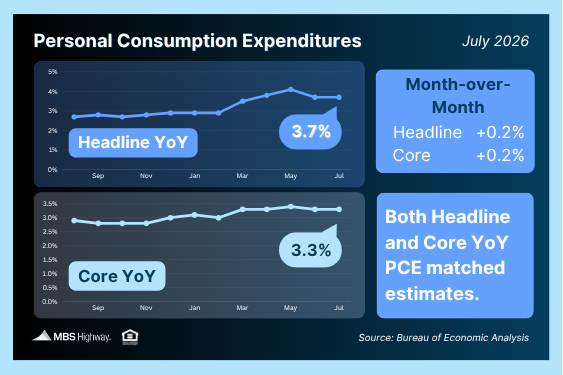
The inflation data underneath was mixed in a way that supports his caution. Headline PCE rose 0.2% in July with the annual rate at 3.7%, and core PCE also rose 0.2% with its annual rate at 3.3%. The friendlier read came from the Dallas Fed's Trimmed Mean measure, which strips out outlier price moves and showed underlying inflation at 2.3%. That is close to target. Warsh is choosing not to lean on it yet.
Read the New Home Sales Print Carefully
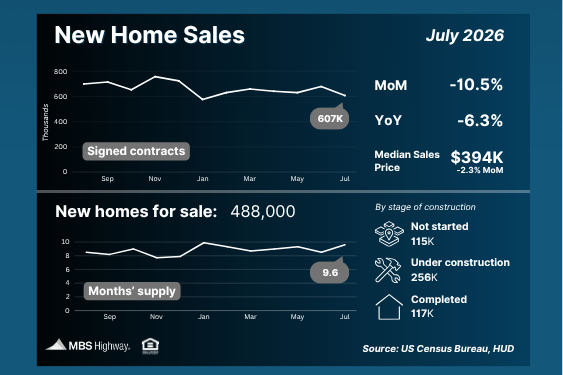
New home sales dropped 10.5% from June to July to a seasonally adjusted annual rate of 607,000, below expectations and down 6.3% year over year. June got revised up 50,000 to 678,000, which softens the drop a little.
The regional numbers are where this gets useful. Sales rose in the Northeast and West, fell 13% in the South, and fell 43% in the Midwest. A 43% regional swing in a single month is not a national trend, it is a market specific story. If you are buying in the Midwest, that is either a demand problem or a builder inventory problem depending on your submarket, and it is worth knowing which one before you underwrite absorption.
The Median Price Drop Is a Mix Shift, Not a Value Decline
The median new home price fell 2.3% month over month and generated a lot of "prices are falling" coverage. It is not that. The median tracks which homes sold, not what homes are worth. In July, sales in the $300,000 to $399,999 band increased notably, and more entry level product closing drags the median down mechanically.
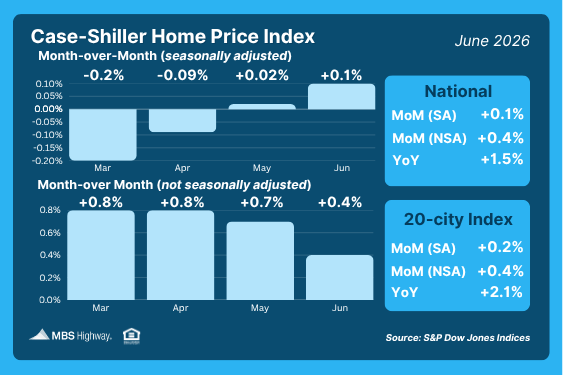
The repeat sales indices tell the real story because they track the same homes over time. Case-Shiller showed national prices up 0.4% in June, up 2.7% across the last four months, and up 1.5% year over year. FHFA showed prices flat for the month on a seasonally adjusted basis and up 2.3% annually for conventional financed homes. Values are still appreciating, just slowly.
What This Combination Means
You have transaction volume falling while values hold. That is a liquidity story, not a value story, and it is the environment where negotiating leverage shifts to whoever is still transacting. Sellers and builders sitting on inventory in a slow month are more flexible on price, concessions, and rate buydowns than the index level appreciation would suggest. The spread between what the comps say a property is worth and what a motivated seller will take is usually widest exactly here.
The economic backdrop supports that read without signaling distress. Q2 GDP came in at 1.5% annualized, down from 2.1% in Q1 but still positive, carried by consumer spending, business investment including the ongoing AI data center buildout, and exports. Initial jobless claims were 203,000, which is low. Continuing claims stayed elevated at 1.78 million, which says people who lose jobs are taking longer to find new ones. Slower, not breaking.
Investor Takeaway
Underwrite to today's rate, not to a cut. Warsh just told the market that inflation outranks rate relief on his priority list, and he left a hike live for September. Deals that only work if you refinance lower are speculation on Fed policy, and that speculation is currently pointing the wrong way. What the data does support is going after the liquidity gap: fewer buyers are transacting while values hold steady, so this is a window to negotiate on price and concessions rather than a window to wait for cheaper debt. Watch Friday's employment report closely, because Warsh built his case on labor market strength and a weak print is the one thing that changes his math.
