The Fed Hiked and Builders Cut Supply in the Same Week
The Fed hike got all the coverage last week but I think the construction data was the more important report and almost nobody paired the two.

The Hike Was Expected. The Posture Was Not.
The Fed raised the Federal Funds Rate 25 basis points, its first hike in three years. That much was priced in and should not have surprised anyone who was paying attention to the September odds.
The part worth updating your model on is everything around the decision. The vote was unanimous, which is notable after months of a divided committee. The statement led with elevated inflation. Chair Warsh said inflation "is too high and has been for too long." And the dot plot showed 16 of 18 officials expecting at least one more quarter-point hike this year.
I want to flag this directly because it cuts hard against how a lot of 2026 deal models were built. If your underwriting assumes a refinance at a lower rate in twelve to eighteen months, you are now betting against the stated expectation of nearly the entire committee. Not a slower path to cuts. Additional hikes. Run the higher-cost scenario and see if the deal still works, because a deal that only pencils at a rate the Fed is telling you it does not plan to deliver is not a conservative deal.
The Macro Data Will Not Bail You Out Either
Retail sales rose 1.2% in August, beating expectations, and 12 of 13 categories were up, so this was not just a gas price artifact. Initial jobless claims stayed low near 196,000, though that likely understates separations given how many displaced workers now move into gig and freelance income instead of filing. Continuing claims are elevated at 1.73 million, meaning people who do lose work are taking longer to get rehired.
A consumer who is still spending and a labor market that is soft but not cracking is the exact combination that lets the Fed keep hiking. If you were counting on economic weakness to force easing, this data does not get you there.
The Report That Actually Changes the Forecast
Housing starts fell 2.6% in August to a 1.28 million annual pace, below expectations. Permits fell 2.7% to a 1.39 million pace. NAHB builder confidence dropped three points to 32, well under the 50 line.
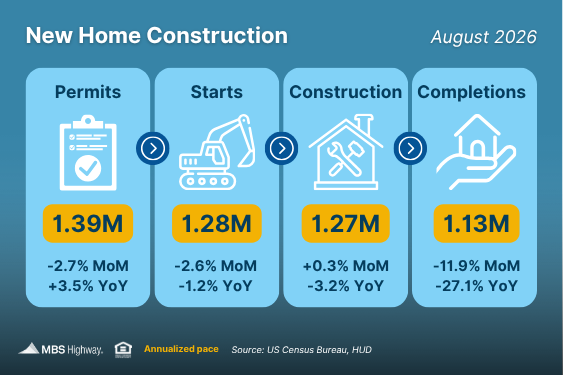
Set that against household formations running near 1.4 million annually as of June 30. Formation may have cooled some as rates rose, but the gap is still the whole point: the country is creating households at roughly the rate it is starting homes, and builders just decided to slow down.
Construction lead times mean this is a 2027 supply problem, not an October one. Permitting, building, and completion run in quarters. So the pullback you are reading about today shows up as missing inventory right around the time any rate relief would be pulling buyers back into the market. That is a squeeze setting up, and it is being telegraphed a year in advance.
Demand Is Bending, Not Breaking
Pending home sales rose 0.3% month over month and sit 4.7% below last year, with all four regions negative year over year. Yun's read was that buyers "steadily entered into contracts" even with rates climbing.
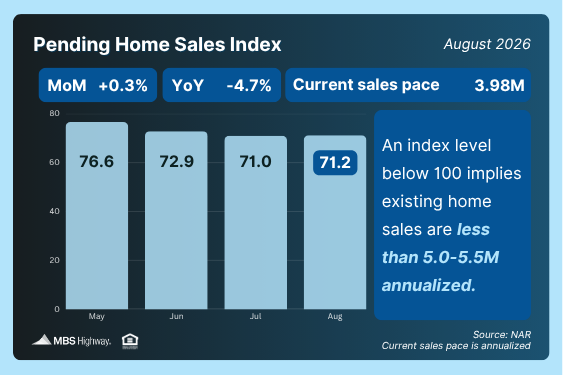
That is the useful signal. Demand is rate-sensitive at the margin but the core is intact. Households still form, people still relocate, and that floor does not move much.
Investor Takeaway
Two things are true at once and they point in opposite directions on timing. Near term, your cost of capital is probably going higher, not lower, and you should underwrite to today's rate or worse rather than penciling in a refinance the Fed is actively signaling against. Medium term, the supply picture just got tighter in a way that supports values and rents on anything you are already holding or acquiring now.
The practical move is to take your margin from terms rather than from rate. Sellers are carrying holding risk right now while absorption is soft, which is where concessions, buydowns, repair credits and price come from. That window is a function of a slowdown builders are already correcting for. Watch Thursday's New Home Sales to see whether the builder pullback is a read on real demand or an overcorrection, because that answer is worth more to your 2027 acquisitions than anything the Fed says next.
