Oil Wars Episode 6: Return of the Crude
This week, we're talkin' about the rate cut almost nobody is betting on. Central banks are still raising rates, yet the shock that forced their hand may already be unwinding, and what comes next could matter more for your mortgage rate than anything the Fed says in December. We'll also look at a study suggesting that the year you bought a building mattered far more than which building you bought, and at what Oracle's groundbreaking means for the land around it, which may be a very different story from the one in the headlines.
Let's get into it.
Today's Interest Rate:
(👆 .33% from this time last week, 30-yr mortgage)
The Weekly 3 in the News:
1) Tennessee's Supreme Court cut Nashville's Metro Council in half. The court upheld a 2023 state law shrinking the council from 40 members to 20, and the council must now redraw its districts, according to WSMV. For context, Los Angeles has 15 council members for about 3.9 million people, roughly 5.4 times Nashville's 721,000 (calculated); why the hell did Nashville ever have this 40-person jobs program?
2) Producer prices rose 6.5% from a year earlier, the fastest pace since 2022. Goods prices are up 10.2% year over year, though energy prices at the producer level edged down in October, the Bureau of Labor Statistics said. If you are budgeting a renovation for next spring, expect your bids to come in higher than your last ones.
3) Existing-home sales fell to their slowest pace since 2010. Sales dropped 5.5% in October to a 3.75 million annual rate, yet the median price still edged up 0.4% to $416,700, the National Association of Realtors reported. Volume collapsing while prices barely move means sellers are refusing to capitulate, and that stalemate is usually where patient buyers find their openings.
A Few Fun Things Happening in Nashville This Week
James Beard Foundation Taste America at Saint Elle, Thursday, Nov. 19. For the sybarites among you, more than a dozen chefs, including Arnold's Country Kitchen, Tailor and Lockeland Table, cook in one room at Saint Elle, 1420 3rd Ave. S. ($150 general admission at 7 p.m., $225 premier at 6 p.m.).
A bird sit and an autumn walk at Shelby Bottoms, Saturday, Nov. 21. Metro Parks hosts the Cornelia Fort Bird Sit from 9 to 11 a.m. and an Autumn Colors Walk from 2 to 3 p.m. on a former East Nashville airfield that has returned to grassland along the Cumberland.
When You Bought May Matter More Than What You Bought
Every investor has heard this adage: “a real estate investor makes their money on the buy.”
But is that always true?
Maybe not, especially in small multifamily. Let's take a closer look.
A St. Paul agent named Adam Tafel published a piece of research that suggests we may have been underweighting a simpler variable: the calendar. Tafel matched 4,829 resales of two- to four-unit buildings in Minneapolis and St. Paul by address in the NorthstarMLS data, kept only owners who held at least two years, and asked a plain question of each sale: did the owner get back more or less than they paid?
The answer depends overwhelmingly on when they bought.
Of the 957 buildings that resold for less than their purchase price, 822, or 86%, had been bought between 2004 and 2007. Among owners who bought in 2005, 76% eventually sold below what they paid. Among owners who bought in 2009 or 2010, the figure was 2%, and for every purchase year from 2011 through 2016 it ran between zero and 2%.

Source: , NorthstarMLS matched resales.
The Gap Between Vintages Is Enormous
The cohort summary is even more striking than the year-by-year chart. The median building bought between 2004 and 2007 resold at 0.61 times its purchase price, which is to say the typical peak-era owner got back 61 cents on the dollar before counting a single closing cost. Owners who bought from 2008 through 2011, in the depths of the bust, resold at a median of 2.27 times what they paid. The ratios are unannualized and the holding periods differ, so the comparison is not perfectly clean, but the direction is unmistakable: the same kinds of duplexes and fourplexes, on the same streets, produced opposite outcomes depending on which side of 2008 the deed was signed.
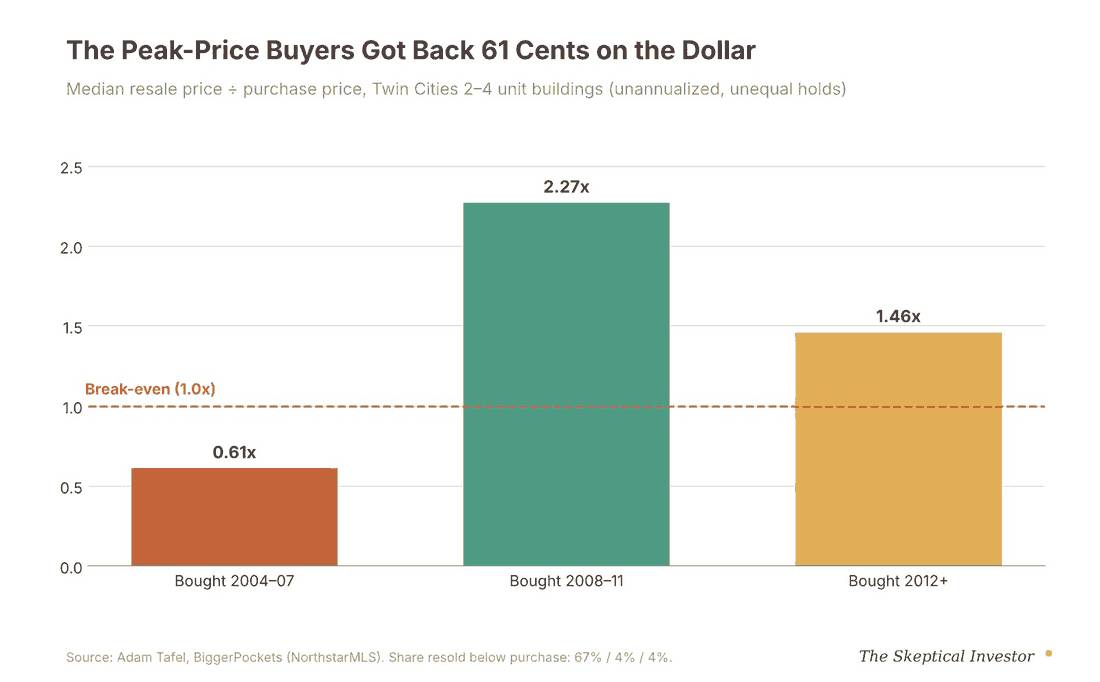
What I find most useful is the detail buried in the more recent data. Since 2012, only 89 buildings have resold for less than their purchase price, and those 89 had a median acquisition price of $320,000, against $230,000 for all qualifying resales from that period. Their median loss was a modest $21,000 over a median four-year hold, while the median loss across all below-purchase resales was $120,000. In other words, when the market is rising, a bad purchase costs you a little; when you buy at the top of a cycle, even an ordinary purchase can cost you a great deal. Timing appears to be the variable that turns a mistake into a catastrophe.
Which Vintage Are We Becoming?
The obvious question for anyone buying today is whether 2026 looks more like 2005 or more like 2010, and the truthful answer is that it looks like neither. Prices nationally are roughly flat, with the October median up just 0.4% from a year earlier, while volume has collapsed to its lowest level in a decade and a half. That is not the euphoria of 2005, when everyone was buying, and it is not the forced liquidation of 2010, when nobody could. It is a frozen market, and frozen markets tend to reward the buyer who negotiates hard and the owner who does not have to sell.
The more relevant lesson may be about the buyers of 2021 through 2024, who paid peak prices with cheap money and are now facing a refinance at 7.5%. If any cohort of today's owners resembles the 2005 vintage, it is likely to be the one that bought with thin equity and a short-term loan in those years, and it is the cohort from which I expect most of the motivated sellers of 2027 to come.
Steelman: The Study Flatters the Calendar
Obviously, and I know many of you are thinking it, the best case against reading too much into this comes from Tafel himself, who lists his own caveats at length. The data measure only nominal purchase and resale prices, so they ignore rent collected, expenses, improvements, financing and transaction costs; a 2005 buyer who collected fifteen years of rent and sold at 0.9 times purchase may still have made money. The study also captures only buildings that resold, which means owners who held through the trough and never sold are invisible, and the most recent cohorts simply have not been observed long enough to know how they will end. Finally, the higher purchase prices among the post-2012 losers do not prove overpayment, since building size, condition and rents could explain them. So the fair conclusion is narrower than the headline: buying at a cyclical peak raised the odds of a loss dramatically in this one market, but cash flow and holding power appear to have softened the blow for owners who could wait.
What to Do
If you are buying, underwrite the target property as though you might be the 2005 vintage, which means assuming flat prices for several years and requiring the deal to work on cash flow alone. If you own a building bought in 2021 through 2024, the study is an argument for holding rather than selling into a frozen market, provided your financing lets you. And if you want to run this exercise for your own market, any local broker can pull the same matched-resale data from an MLS export.
The Story of 2027: Oil in Oversupply
For most of this year, the single most important price in American real estate was a barrel of black, slimy crude oil.
When the war cut Gulf exports, gasoline soared, freight costs exploded, inflation re-accelerated, and central banks that had spent 2025 cutting rates reversed course and began raising them again. The Bank of England did so as recently as Nov. 4, lifting its policy rate to 4% and citing the effect of global energy prices on its inflation outlook, and the futures market expects the Fed to hike again in December. The consensus has settled on a world of expensive money for the foreseeable future. My argument this week is that the consensus may be fighting the last war. The inputs that drove this inflation, energy and the cost of moving goods across oceans, are now falling, and they may fall far enough in 2027 to let central banks pivot once more.
The Barrels Are Coming Back
World oil supply rose to 105.4 million barrels a day in October, the IEA reported on Nov. 13, an increase of 5.3 million barrels a day since August as Middle Eastern exports recovered. The agency now expects supply to grow by 6.6 million barrels a day next year to 108.1 million, while demand, which it estimates fell by 2.7 million barrels a day this year to 102.3 million, recovers by only about 2 million. Put those two forecasts side by side and the implied surplus for 2027 comes to roughly 3.8 million barrels a day (calculated), an enormous figure in a market where a surplus of 1 million is usually enough to push prices down sharply. It is a striking reversal from the agency's own October report, which had still projected a fourth-quarter deficit of 1.8 million barrels a day.
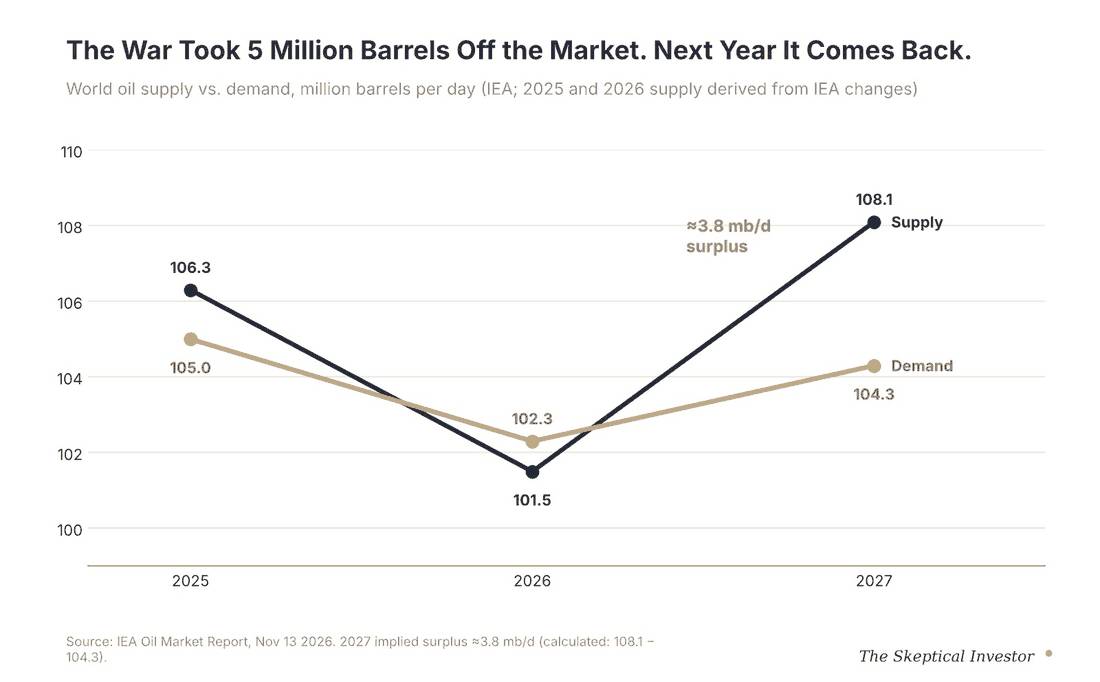
Source: . 2025 and 2026 supply derived from IEA-reported changes; 2027 balance calculated.
The recovery is real, but not complete. Gulf exports outside Oman are still running at about 18.4 million barrels a day, 26% below their prewar level, and on-land inventories have fallen to their lowest since 2016. Much of October's 52-million-barrel inventory build was flotsam of a sort, roughly 86 million barrels sitting on tankers at sea rather than in storage tanks on shore, which means the glut is still in transit more than it is in hand. Prices have already responded: Dated Brent, which touched $136 on Oct. 8, has fallen to about $93, though that is still roughly $22 above where it stood before the war.
Goldman Sachs reached a similar conclusion in its 2027 oil outlook, published Nov. 15 under the title "Adaptation." The bank's argument is that Mideast producers and oil consumers have adapted remarkably well to the shipping disruptions: ship-to-ship transfers and new pipeline capacity have let Gulf supply work around the danger, and Goldman expects Mideast output to rise above its 2025 average next year even as supply growth elsewhere stalls. In its base case, Brent averages $88 a barrel in 2027 and eases to $78 by the end of that year, as the return to surplus pulls the bank's estimate of fair value down from about $90 today (Goldman Sachs Research, "2027 Outlook: Adaptation," Nov. 15, 2026). The bank also made a claim I consider among the most consequential of the year for long-term investors: "we estimate that China's total oil demand peaked in 2025." If that is right, the world's largest marginal buyer of crude has stopped growing, and the structural floor under oil prices may be lower than most of us assume.
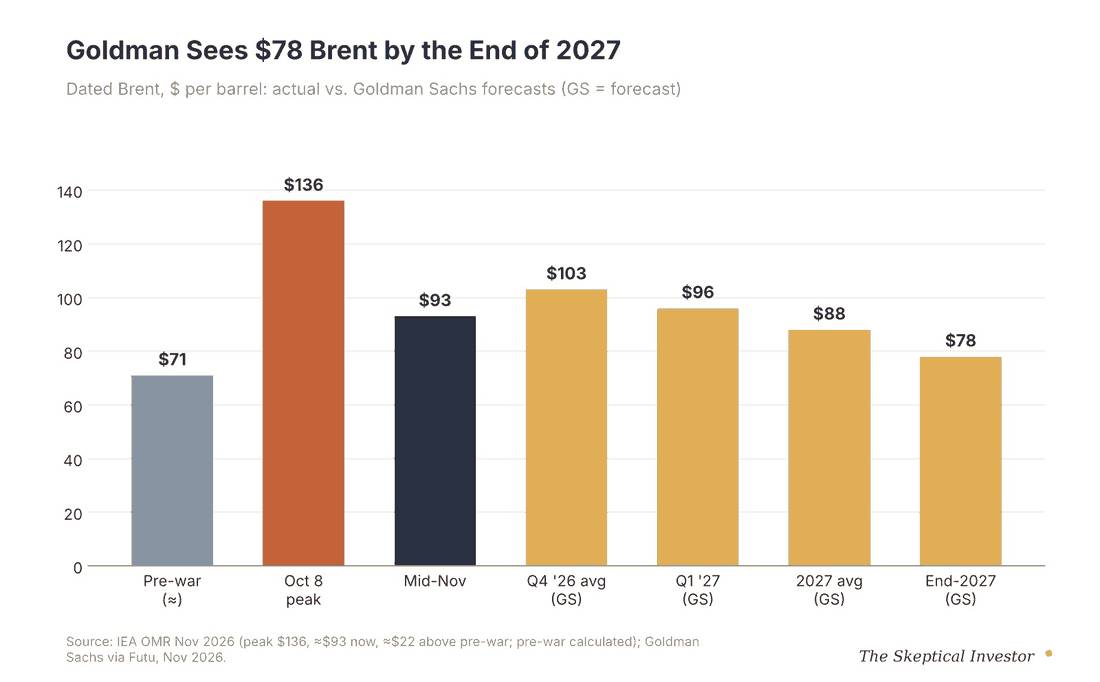
Sources: (peak, current and prewar gap; prewar level calculated); Goldman Sachs Research, "2027 Outlook: Adaptation" (Nov. 15, 2026), and for the quarterly figures. Goldman's fourth-quarter average includes the October spike.
2027: Cheaper Gas Will Pull Inflation Down
The path from the oil field to the consumer price index runs through the gas pump, and it is shorter than most people think. The October CPI rose 0.4%, with core prices up 0.3%, both a tenth above forecasts, and gasoline prices were up 37.4% from a year earlier, the only twelve-month figure the Bureau of Labor Statistics published for the month. Motor fuel carries a weight of about 3% of the CPI basket, which means it can move the headline number quickly in either direction. For much of this year the Fed has, in effect, been fighting a gas pump, and the gas pump is now losing.
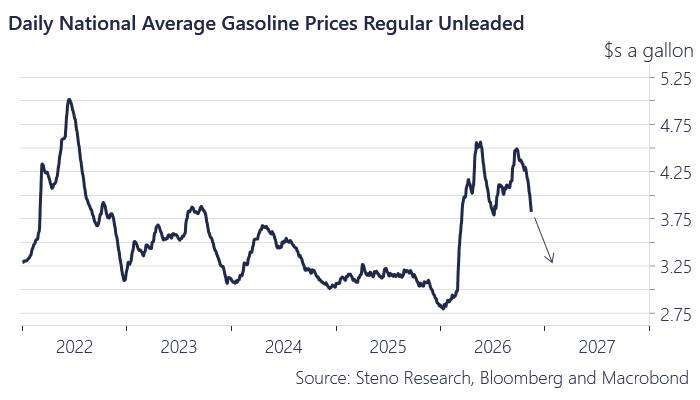
Source: Steno Research, Bloomberg and Macrobond.
Steno Research's chart shows the national average already rolling over from its autumn peak near $4.50 a gallon, and the arithmetic of what comes next is straightforward. A barrel holds 42 gallons, so every $10 drop in crude takes roughly 24 cents off a gallon of gasoline (calculated). If Brent falls from about $93 today to Goldman's $78 by the end of next year, a decline of about $15, that works out to roughly 36 cents a gallon, or about 9% off the $4.02 national average reported by AAA (calculated). Multiplied by gasoline's 3% weight, that would subtract roughly a quarter of a percentage point from headline inflation directly (calculated), before any knock-on effect on airfares, freight and the price of everything that travels by truck.
That knock-on channel runs through diesel, and it may prove the stickier of the two. Goldman expects crude to normalize while refined products stay expensive, with US wholesale diesel averaging $150 a barrel in 2027, or about $3.57 a gallon before taxes and retail margins (calculated), well above its historical average. The bank's reasoning is that refining capacity is growing slowly, the conflict continues to restrain product exports and keep freight rates high, and Russian product output remains constrained (Goldman Sachs Research, "2027 Outlook: Adaptation"). For landlords, that matters more than it sounds: diesel prices sit inside every contractor bid, every delivery of lumber and every truck roll from a plumber, so the relief in our operating costs may lag the relief at the gas pump by a good while.
Even with sticky diesel, the direction is unmistakable, and it removes the main justification for further hikes.
The Cost of Moving Goods Is Falling Too
Energy is only half of the supply shock that hit inflation this year; the other half was the price of moving cargo through a war zone. That price is now breaking. Kpler reported that tanker rates broadly fell in the first week of November as geopolitical premiums eased, with Aframax rates from the U.S. Gulf to northern Europe dropping from $20.75 to $11.71 in a single week, a decline of roughly 44% (calculated). Freight rates for Russian crude bound for Asia have also retreated from record highs amid what Reuters called a broader correction in the tanker market. Container shipping is turning more slowly: Drewry's World Container Index fell 3% to $4,429 per 40-foot container at the end of October and slipped another 1% in the first week of November. That is still more than double the $1,859 of a year earlier (calculated), which is precisely the point: there is a great deal of room for freight costs to fall if the shipping lanes keep calming down, and every dollar they fall eventually shows up in the price of furniture, appliances, lumber and the thousand other goods that cross an ocean before they reach a rental unit.
Central Banks Are Hiking Into a Disinflationary Wave
The underappreciated part of this story is the mismatch between what central banks are doing now and what the inputs suggest they will need to do a year from now. Futures traders still assign 100% odds to a December hike, and Morningstar's economists have noted that futures pricing pointed to a fed funds rate hiked in 2027 and then held, while they themselves expect cuts in 2027 and 2028 as inflation cools and growth slows. A handful of other forecasters have reached the same conclusion from the energy side. CaixaBank Research wrote on Nov. 11 that its baseline treats the energy shock as transitory, which would pave the way for the first rate cuts by the ECB and the Fed in late 2027. Capital Economics argues that investors are pricing too many European hikes, expecting euro zone inflation to peak near 4% in December and then fall sharply, with cuts returning in the second half of 2027. Even the ECB's chief economist, Philip Lane, has said inflation should decline toward target from the middle of 2027 onward, provided the energy shock does not intensify.
Central banks raise rates into supply shocks because they fear the shock will seep into wages and expectations. When the shock reverses instead, they tend to find themselves with policy far tighter than the economy needs, and history suggests they pivot faster than markets expect once the evidence turns. That is the setup I see for 2027: an energy and freight deflation arriving just as policy rates peak, with consumers already nervous about their jobs.
What the Bond Market Is Waiting For
If the pivot comes, the obvious question for real estate investors is how much of it reaches the 30-year mortgage, and here the bond market offers an instructive detail. The rise in long-term rates this year has had remarkably little to do with inflation expectations. The 10-year breakeven rate, the market's own forecast of inflation over the next decade, stood at 2.27% on Nov. 6, below the 2.35% of mid-October and below May's roughly 2.43%, when the Treasury sold 10-year inflation-protected bonds at a real yield of 2.169% against a 10-year yield near 4.6% (May breakeven calculated). In other words, investors already expect less inflation than they did six months ago, and yet the 10-year yield has climbed to 5.15%.

Sources: (May real yield); (Nov. 6 breakeven); (5.15%). November real yield calculated as 5.15 minus 2.27; the two readings are a week apart.
The difference is the real yield, the return investors demand above inflation, and it has risen to roughly 2.9%, up about seven-tenths of a point since May (both calculated). DoubleLine made the same observation about the longer end of the curve, finding that since the end of 2023 the 30-year Treasury yield rose 114 basis points while the real yield rose 107, leaving inflation expectations up just 7 basis points. Real yields reflect the price of money itself: the Fed's policy rate and the path investors expect it to take, the size of federal deficits, the volume of Treasury issuance and the premium investors want for lending to anyone for ten years.
This is why the pivot matters more than the oil price itself, and the logic is ineluctable once you see it. Cheaper oil cannot lower real yields directly, because investors are not demanding a high yield out of fear of inflation. A central bank that stops hiking and begins to cut, however, attacks the largest single input into real yields, which is the expected path of the policy rate. Oil and freight are the trigger; the pivot is the mechanism that carries the relief into the 10-year Treasury and, from there, into your mortgage rate.
The Arithmetic of an Oil Pivot
Mortgage rates sit on top of the 10-year Treasury, separated by a spread that compensates lenders and bond investors for prepayment risk and servicing costs. Today that spread is about 2.35 percentage points, the difference between the 7.50% MND rate and the 5.15% 10-year (calculated). In calmer years the spread has run closer to 1.7 to 2.0 points. To reach a 5.5% mortgage, then, the 10-year would need to fall to somewhere between about 3.5% and 3.8% (calculated), a decline of well over a full percentage point from here.
I sketched four plausible paths for the next twelve to eighteen months, and in each of them I assume oil keeps falling roughly as the IEA and Goldman expect. What separates them is how central banks and the bond market respond.
No pivot: the consensus. The Fed hikes in December as priced, then holds through 2027 because it fears declaring victory too early. Inflation expectations drift lower, the 10-year settles near 5.0% and, with a slightly narrower spread, mortgages land around 7.2% (calculated). This is roughly what the futures market is pricing today.
The pivot: cuts in 2027. Falling energy and freight costs pull headline inflation down quickly in the first half of the year, the labor market softens, and the Fed begins cutting in the second half, as CaixaBank and Capital Economics expect their respective central banks to do. Real yields ease by roughly half a point, the 10-year falls to about 4.55%, the spread narrows to about 2.0 points and mortgages reach roughly 6.55% (calculated).
The deep pivot. The disinflation proves larger than forecasters expect, the Fed cuts several times, and the mortgage spread returns toward its calmer-era range as rate volatility subsides. A 10-year near 4.0% with a 1.9-point spread puts the 30-year near 5.9% (calculated), within striking distance of 5.5%, and lower still if the spread narrows further.
The spoiler: deficits bite. Cheaper oil cuts inflation, but heavy Treasury issuance and a skittish bond market push real yields higher regardless of what the Fed does, the 10-year rises to about 5.55% and mortgages climb toward 7.95% (calculated).

Source: (7.50%, Nov. 13). Scenario rates are my own calculations, not forecasts from any agency.
The gap between the first and third bars is the opportunity. Under the consensus, the mortgage market barely moves; under a genuine pivot, rates could fall by roughly a full point within eighteen months, and by more in the deep pivot, and very few buyers, sellers or lenders are positioned for that outcome. The New York Fed's survey already shows households putting the odds of higher unemployment a year from now at 45%, the most since April 2020, which is the kind of reading that tends to precede a change of heart at the central bank. I would not bet the farm on the deep pivot, but I think the odds of some pivot in 2027 are considerably higher than a market pricing further hikes implies.
Steelman: Why the Pivot May Not Come
There are two serious arguments against this analysis, and both cut against the pivot. The first is that the glut may never fully arrive. Gulf exports remain a quarter below their prewar level and on-land inventories are at their thinnest in a decade, so the system has little cushion; another disruption to shipping could send Brent back toward triple digits within weeks, and much of the IEA's projected supply growth depends on that recovery continuing without interruption. Even Goldman, while forecasting lower prices, warns of significant near-term upside risk from intensified shipping attacks, damage to oil infrastructure and a rebuilding of the risk premium. Forecasters were projecting a fourth-quarter deficit only a month ago, which is a reminder of how quickly these projections can turn.
The second argument is that central banks may not cooperate even if energy does. Goldman expects refined products and freight for fuel cargoes to stay expensive through 2027, which would keep a floor under transport costs, and the ECB's own staff still project core inflation of 2.6% in 2027, above its target and above this year's level. Central bankers who were criticized for calling the 2021 inflation transitory may be slow to call this one transitory too, and a Fed that has just hiked will want several months of clean data before reversing. Finally, a pivot lowers short-term rates far more reliably than long-term ones: if investors keep demanding a high premium to finance federal deficits, the 10-year could stay stubborn even as the policy rate falls, and mortgage rates would follow the 10-year, not the Fed. The pivot scenario is underappreciated, in my view, but it is still a scenario, not a forecast.
If you are newer to this and wondering why rates matter so much, it comes down to how real estate pays you: cash flow, appreciation, loan paydown, tax benefits and leverage, and a high rate squeezes leverage and cash flow at the same moment while barely touching the other three. Brandon Turner's The Book on Rental Property Investing is still the best primer I know on how those pieces fit together. And if you want to understand how the war, the energy transition and the great powers are redrawing the oil map, Daniel Yergin's The New Map is the most readable guide I know.
Nashville: Oracle HQ Broke Ground. Finally.
On Nov. 10, more than five years after Oracle first announced its Nashville campus, the company finally put shovels in the ground on the East Bank. The ceremony drew Gov. Bill Lee, Mayor Freddie O'Connell and both of Oracle's chief executives, Clay Magouyrk and Mike Sicilia, and the numbers attached to it are the largest in the city's history: a $4.5 billion campus of 23 buildings on roughly 80 acres, about 8,500 workers, and completion planned for the end of 2031, according to WSMV. Oracle's own materials describe 78 acres, more than 1,900 trees and a Nobu hotel with 120 rooms, with the first buildings expected to open in 2030.

Rendering of Oracle's planned East Bank campus. Courtesy of Foster + Partners, via .
The site itself is a palimpsest of the city's industrial past, a former landfill and a stretch of riverfront warehouses and yards that, for most of my career, nobody outside the scrap business wanted. Under the 2021 deal, Oracle agreed to front $175 million for public infrastructure, including a pedestrian bridge to Germantown, a riverfront park and the cleanup of the old landfill, and the city will repay half of that cost out of the new property taxes the campus generates, for up to 25 years or until the money is repaid. The state added a $65 million grant. Oracle leaders also said the campus will include no data centers.

The planned pedestrian bridge to Germantown. Courtesy of Foster + Partners, via .
Don't Count on the Jobs Before 2030
The skeptic's first question about any corporate relocation is how many people will actually show up, and when. Oracle's 2021 incentives were tied to plans for 8,500 jobs, but the company's Nashville workforce remains a fraction of that. Bloomberg reported in January that only about 800 employees were assigned to Nashville, even as Oracle offered some cloud workers elsewhere tens of thousands of dollars to relocate, and a state filing cited by Axios showed 901 Nashville jobs for an earlier period, before the company's layoffs. Gov.-elect Marsha Blackburn's answer to the accountability question was blunt: "What you need to do is have clawback provisions."
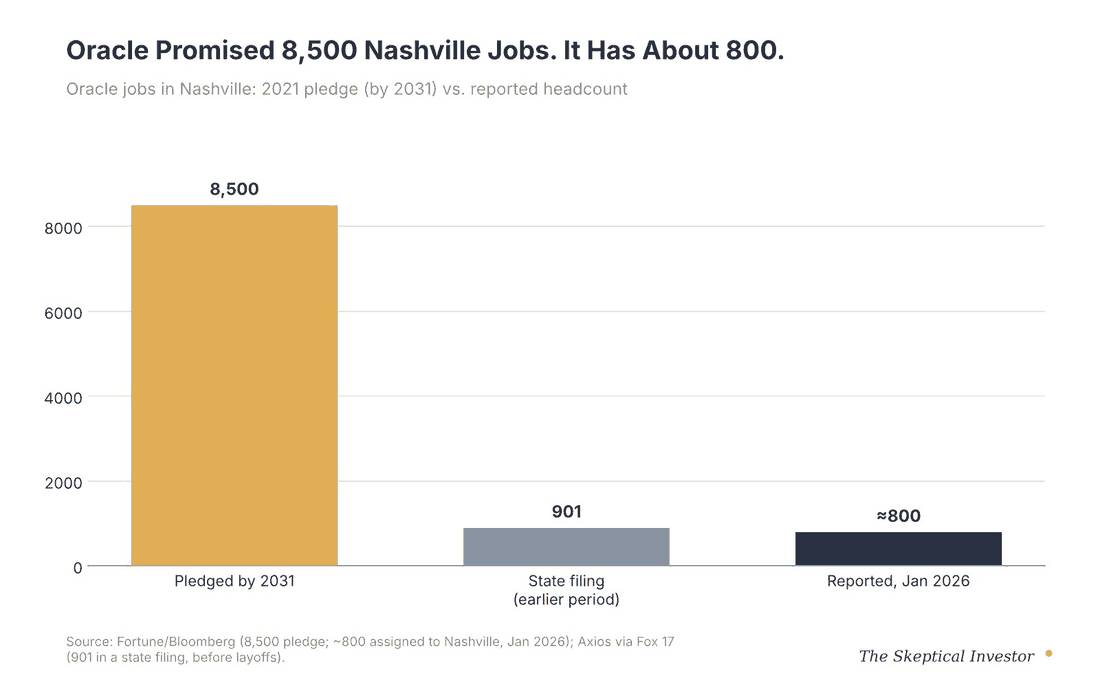
None of this means the jobs will not come. It means the demand they create for housing is a story for 2030 and beyond, and anyone underwriting a rental near River North on the assumption of thousands of new tenants next year is likely to be disappointed. Oracle is also among the largest spenders on AI data centers in the world, so the pace of hiring here may depend on how that bet pays off.
The Land Already Knows
The more interesting real estate story is that the land around the campus has repriced well ahead of the jobs. Oracle's original 2021 purchase cost $253.7 million, which The Real Deal put at about $3.09 million an acre. By 2025, the company was paying $42 million for a 2.73-acre parcel, almost $15.4 million an acre, and $60 million for a 3.7-acre site it bought from GBT Realty, or about $16.2 million an acre (calculated). Farther south, the 45-acre former scrapyard sold for $245 million, about $5.44 million an acre, and a 65-acre tract between the river and Trinity Lane that its owner assembled for $7.62 million, or $117,000 an acre, was listed for $200 million.

Sources: ; . The Ewing figure is an asking price, not a sale; per-acre figures for Ewing and GBT calculated.
Oracle's small 2025 parcels carry the premium of a buyer filling gaps in its own campus, so they overstate what an ordinary acre is worth. Still, the pattern is the one we saw in the Gulch and SoBro: land reprices on the promise of infrastructure years before anyone moves into an office. The $175 million bridge, park and greenway are what make the east side of the river walkable to downtown, and walkability, more than headcount, is what developers pay for. The groundbreaking adds certainty to that bet rather than new information. One caveat on timing: the bridge was still in permitting with the U.S. Army Corps of Engineers as of the latest check.
Steelman: The Groundbreaking Is Already in the Price
The strongest objection to calling this a buying signal is that it is not news. Oracle announced the campus in 2021, land values have already multiplied, and every serious developer on the East Bank has underwritten Oracle's arrival for years; a ceremony with gold shovels changes the probability only slightly. Meanwhile the jobs are years away and so far smaller than promised, the bridge is not yet permitted, and a pullback in AI spending or a broader recession could slow the build. A buyer paying today's East Bank prices may be paying for 2031 in 2026, with real carrying costs at 7.5% money in between.
What to Do
If you own land or small multifamily in East Nashville, River North or along Dickerson Pike, I would not sell on 2026 comparables, since the infrastructure that drives the next leg of value has not been built. If you are buying, recognize that the premium for proximity is being priced now while the tenants arrive later, and underwrite for a long, quiet carry. If you are a landlord, expect no Oracle-driven rent bump before 2030, and plan your leases accordingly.
My Take:
Markets have a habit of extrapolating the last shock long after its causes have begun to reverse. In 2021, investors assumed money would stay free forever; this year, they appear to assume it will stay expensive forever. The evidence this week argues otherwise. The barrels are returning, tanker rates are falling, container rates are rolling over, gasoline is sliding, and the quotidian pain at the pump that drove so much of this year's inflation is beginning to fade.
Central banks are still raising rates into that disinflation, and the futures market expects them to keep going. That leaves the pivot as the scenario few investors have priced. It will not arrive on a schedule, and the bond market may make us wait for it, but the investors who were ruined last cycle in the Twin Cities were ruined by assuming the conditions of their purchase year would last. The same mistake is available today in the opposite direction, and the investor who assumes 7.5% money is permanent may sell too cheaply, pass on too many deals, or refinance at exactly the wrong moment.
So here's how I'm operating:
If you own rentals: avoid locking in long prepayment penalties or long fixed-rate refinances at today's rates if you can help it; a pivot in 2027 would reward flexibility, while the consensus costs you little if you wait.
If you're buying: underwrite at 7% to 7.5% money so the deal works under the consensus, and treat a pivot as upside rather than a requirement. The frozen market is handing negotiating power to buyers now, before lower rates bring the competition back.
If you're selling: do not price as though 7.5% is the permanent condition of the market. If you can wait, a pivot could bring buyers back in 2027; if you cannot, price to the buyers who are active today, who have cash or conviction and will not pay for a rate cut that has not happened yet.
Everyone is braced for higher rates.
Almost no one is braced for the pivot.
Until next time. Stay Curious. Stay Skeptical.
Herzliche Grüße,
-The Skeptical Investor