There is no "Safe" in Investing
Today's Read Time: 25 minutes
This week, we're talkin' about what “safe” actually means in real estate (hint: nothing is safe), and who is left holding the bag when safetyism gets you in trouble. Plus, the equity market spent the last few weeks in a full-blown panic, the bond market grabbed the steering wheel from the Fed, mortgage rates plummeted. We'll finish on Nashville’s East Bank, where Oracle's new HQ renderings look spectacular. Nashville is a growin’.
Let's get into it.
Today's Interest Rate:
(👇 .17% from this time last week, 30-yr mortgage)
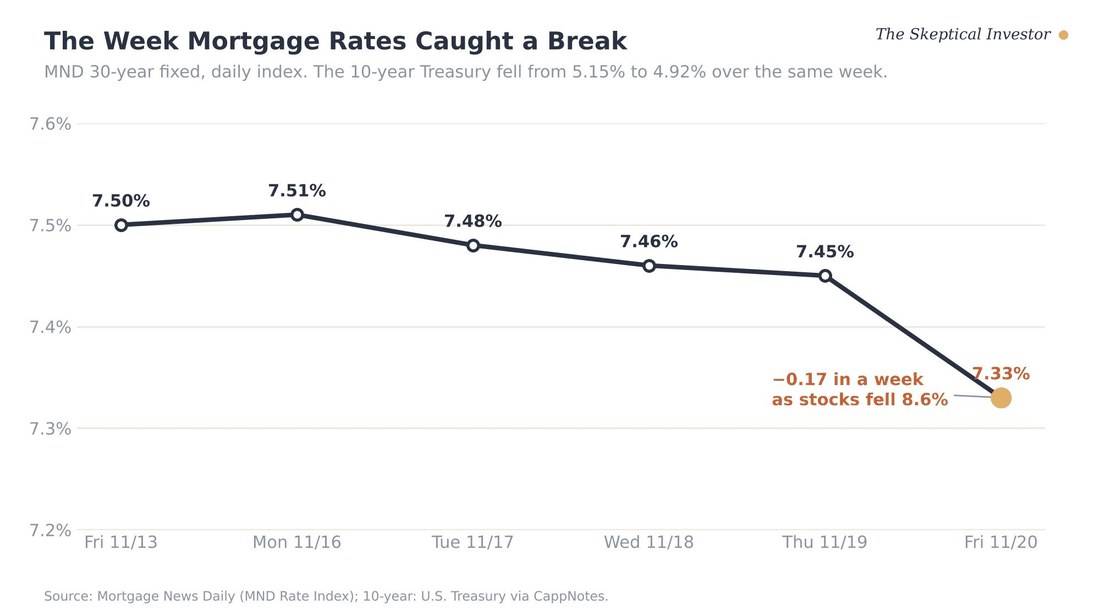
Source: , MND Rate Index, daily.
The Weekly 3 in the News:
1) Capitulation came, and then Jensen Huang came back. The bottom appears to be in. Nvidia's board voted unanimously on Monday to reinstate Huang as chief executive, a week after his departure helped drive the S&P 500 to its worst week since April 2025, and Nasdaq futures were up roughly 7% before the open, with Nvidia itself up about 34% in early trading. Why I think last week marked the bottom, and how the bond market lowered your mortgage rate along the way, is in the second section below.
2) Oil just posted the largest two-week drop in its history, and consumers noticed. Andreas Steno Larsen of Steno Research calls it “the LARGEST 2-week drop in the all-in pr barrel price of oil ever,” and his chart shows the all-in barrel falling about $36.90 in two weeks, past the $35.20 record set in October 2008. Within days, the University of Michigan reported that consumers' one-year inflation expectations fell from 4.7% to 3.7%, the kind of sharp reversal that tends to follow gasoline prices rather than lead them. The pattern is a familiar one: the shock that forced central banks' hands is unwinding faster than the central banks are.
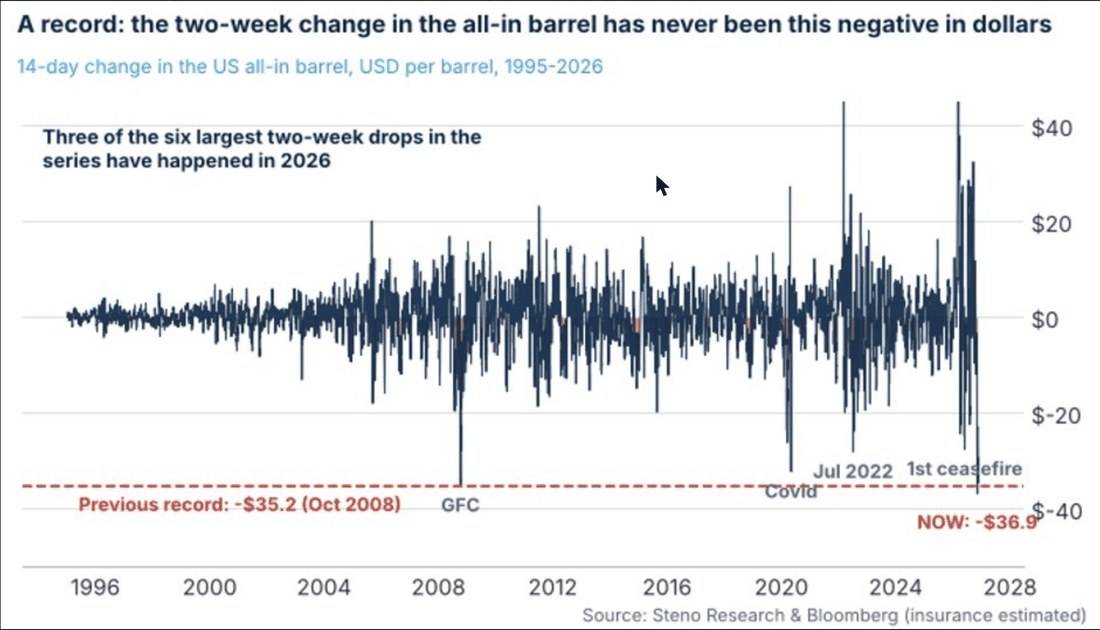
Source: , using Bloomberg data. Screenshot, Nov. 2026.
3) The Fed still looks set to raise rates in December, but the talk of a bigger hike has vanished. The minutes of the October meeting show that “almost all participants” expected further increases, and “a couple” floated going beyond a quarter point. Futures now put the odds of a hike at the Dec. 8–9 meeting at 97.6%, up from 88.6% on Friday and only slightly below the 100% of a week ago; what has disappeared is the 4.5% chance traders assigned a week ago to a half-point move. I still think they hike, and the market agrees, but the conviction behind a larger, more deleterious move is gone, and the November jobs report on Dec. 4 is the last major data release before the meeting (November CPI lands on Dec. 10, the day after the decision). If that report is weak, a pause becomes plausible.
A Few Fun Things Happening in Nashville This Week
The Boulevard Bolt, Thanksgiving morning, Thursday, Nov. 26. Nashville's Thanksgiving five-miler runs down Belle Meade Boulevard and raises money for homelessness services (register on Race Roster).
Christmas by Lamplight at Andrew Jackson's Hermitage, Friday and Saturday at 6 p.m. A lamplit tour of the mansion in its early-19th-century holiday dress, including the story of Rachel Jackson's death days before Christmas in 1828, runs Fridays and Saturdays through Dec. 19 (details from Visit Music City).
Triple Net May Not Be the ‘Safe’ Haven Investors Think
Lets get into our main story of the day: there is no such thing as a ‘safe’ investment.
Or “safe” anything, for that matter.
By the way, I absolutely keel over cringing when someone asks/says something is “safe.” Nothing is safe. And I would go a step further that one is making the world less safe by installing a culture of safetyism….
…But I digress….
Everything in life is a risk calculation. Thus, there are risks you have priced and risks you have not; the most dangerous assets are usually the ones sold as “safe.” In real estate, no asset wears that reputation more proudly than the triple-net building, and this month a bankruptcy court in Texas is testing it.
Triple Net is Not Without Risk
The question is, is the lower return worth it?
Ask a group of retiring landlords what they plan to buy with their 1031 exchange proceeds, and a striking number will describe the same thing: a fast-food building, on a long net lease, with a name on the sign their grandchildren would recognize. No toilets, no tenants calling at midnight, no turnover. The tenant pays the taxes, the insurance and the maintenance, and the owner collects what brokers like to call mailbox money.
It is a reasonable ambition. It also rests on an assumption that a growing number of investors have not examined: that the company named on the sign is the company paying the rent.
The calendar makes the assumption easy to skip. A 1031 exchange gives an investor 45 days to identify a replacement property and 180 days to close on it, and anyone who has sold a rental portfolio in the fall knows how quickly those 45 days evaporate. Under that kind of deadline, a listing that arrives with a famous logo, a 20-year lease and a broker's assurance that the tenant “has never missed a payment” is extraordinarily appealing. The offering memorandum will usually put the brand on the cover in full color. The name of the entity that actually signed the lease, and the strength of its balance sheet, tends to appear several pages later, in smaller type.
That is not a scandal; it is marketing, and every seller is entitled to lead with the most attractive feature of the property. But it does mean that the burden of reading past the logo falls entirely on the buyer, and the investor who buys the label of safety without reading the lease is precisely the one who gets hurt.
You Didn't Lend to KFC
On Nov. 16, a company called Tasty Chick'n filed for Chapter 11 bankruptcy protection in the Southern District of Texas. You have probably never heard of it, but you may have eaten at one of its restaurants. Tasty Chick'n is a franchisee: it operates 84 locations, 75 of them KFCs and nine combined KFC and Taco Bell stores, across 10 states including Tennessee, and employs more than 1,600 people (TNND via KMPH). Founded in 2021 and based in Plano, Texas, it is precisely the kind of peripatetic, acquisitive mid-size operator that has assembled franchised restaurants across the South over the past five years (TheStreet).
The numbers in its court filings describe a business that ran out of room. Restaurant-level earnings before interest, taxes, depreciation and amortization fell from $12.4 million to $7.1 million in a year, a 43% decline by my calculation (Bisnow, citing court records). According to the declaration of its chief executive, Thomas M. Scott, sales fell 11.4% in fiscal 2024, another 1.4% in fiscal 2025 and 2.8% so far in fiscal 2026, while the restaurant-level margin shrank from 11.8% to 4.0% (TheStreet). The company owes Yum Brands, KFC's parent, $15.6 million in unpaid royalties, and Yum sent a notice of intent to terminate its franchise agreements on Sept. 15.
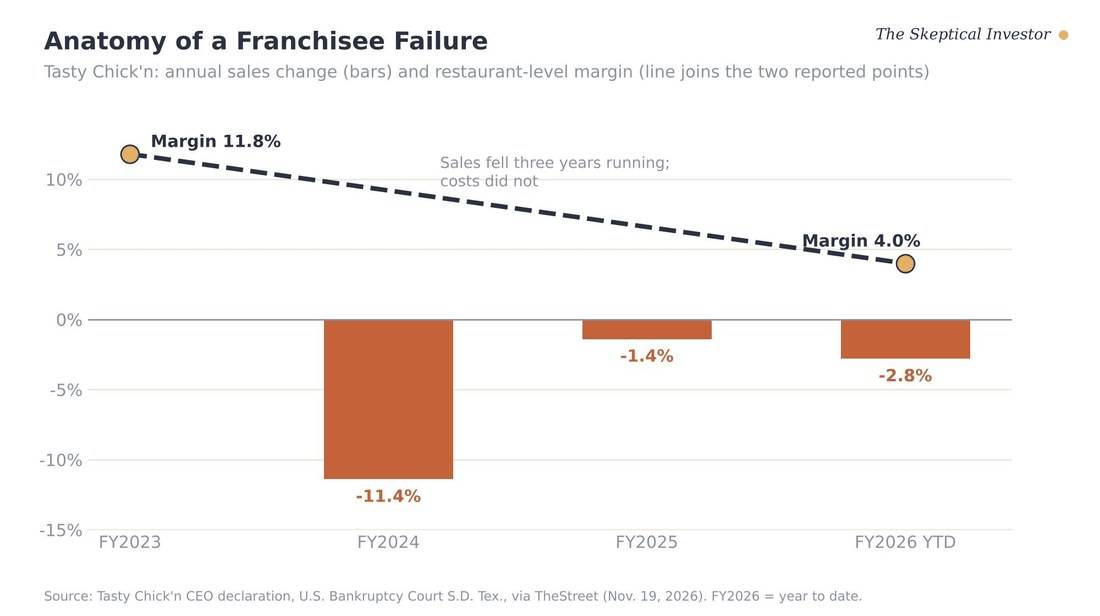
Source: , citing the Tasty Chick'n CEO declaration, U.S. Bankruptcy Court, S.D. Tex. Fiscal 2026 is year to date.
Here is the detail that matters for anyone who owns, or is thinking about buying, one of these buildings. In its first-day motions, Tasty Chick'n asked the court for permission to reject the leases on 73 of its 84 restaurants, or 87% of the portfolio by my calculation, including 13 locations in Memphis (TheStreet). A hearing on those rejections was scheduled for Nov. 23 before Judge Christopher M. Lopez. The landlords whose leases are rejected keep their buildings, and they keep a claim against a bankrupt company; what they lose is the rent.
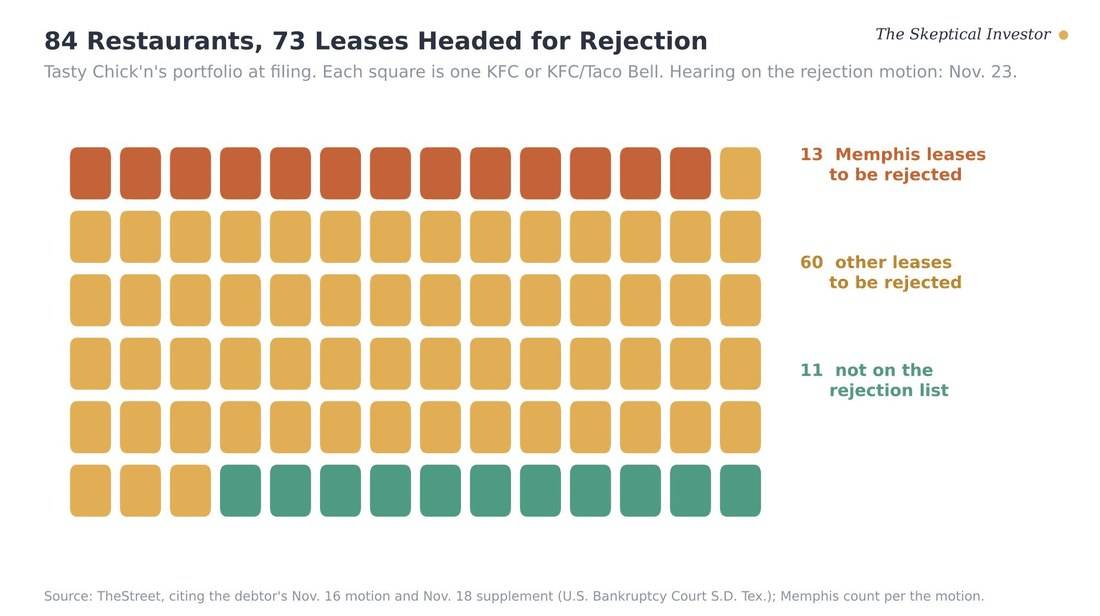
Source: , citing the debtor's Nov. 16 motion and Nov. 18 supplement (U.S. Bankruptcy Court, S.D. Tex.).
Among the creditors is NNN REIT, one of the largest owners of net-lease restaurants in the country, listed as an unsecured creditor owed more than $470,000 (TheStreet). The company has arranged $20 million in debtor-in-possession financing from MidCap, of which $5 million is new money, against estimated liabilities of $100 million to $500 million and assets of $50 million to $100 million. That last comparison is worth sitting with: even at the most generous end of both ranges, the asset side may not be large enough to make every landlord whole.
The Bankruptcy Wave Nobody Calls a Wave
Tasty Chick'n is not an isolated case. Restaurant Dive counted at least 10 significant multi-unit franchisee bankruptcies in 2026 as of mid-September, covering several hundred locations under brands including Hardee's, Subway, Popeyes, Carl's Jr., Moe's and Applebee's, and Bisnow reports that such filings have risen every year since 2024 (Bisnow). The pattern is consistent. A franchisee borrows to buy dozens of stores when money is cheap, labor and food costs rise faster than menu prices, the brand's traffic softens, and the margin that was supposed to service the debt disappears.
KFC's own numbers show how much pressure the brand has been under. U.S. same-store sales fell 5.2% in 2024 and 4.6% in 2025, and Tasty Chick'n's filing describes a roughly 6% decline in the third quarter of 2026 (TheStreet). A study by Local Falcon found that KFC closed at least 312 U.S. restaurants in the year through July. When a franchisee's sales are falling faster than its costs, its weakest stores stop being assets and start being liabilities, and the lease is the first thing a bankruptcy lawyer looks to shed.
The stress is not confined to chicken. Noodles & Company has said it will close up to 35 more restaurants this year after closing 42 last year (AOL), and searches for “kfc closing” and “noodles & company restaurant closures” each topped 200,000 on Google this week, according to Google Trends. Diners have noticed what landlords sometimes have not: the casual end of the restaurant business is shrinking its footprint, and every closed store leaves behind a building with a lease attached.
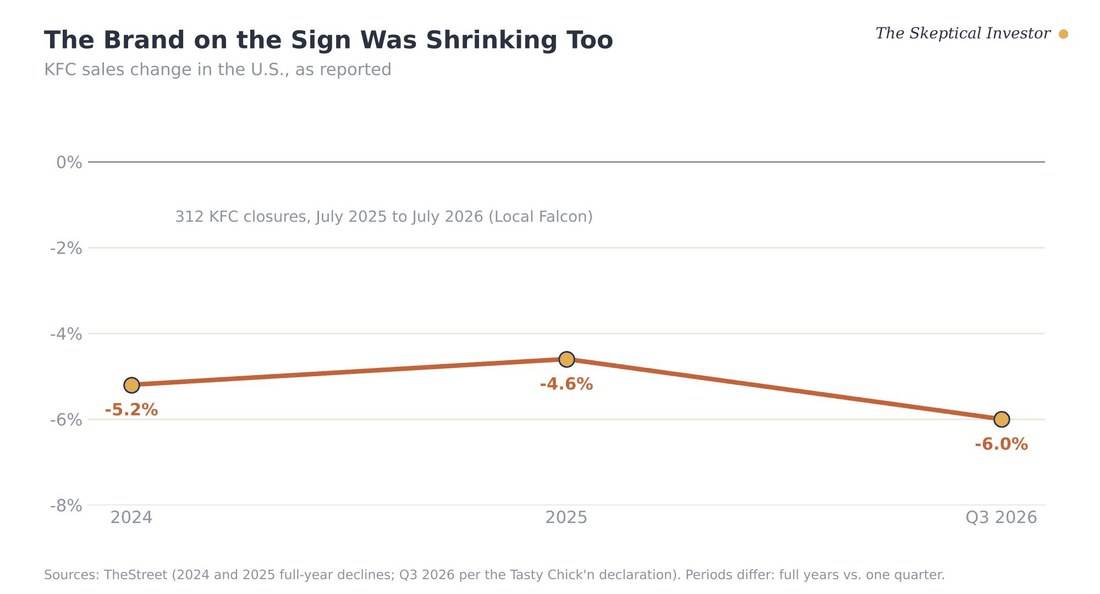
Source: (full years; Q3 2026 per the Tasty Chick'n declaration); closures per . Periods differ.
The Market Already Prices It, by About One Point
The net-lease market is not naive about any of this; it simply speaks in cap rates. In the third quarter, the Boulder Group found that the average cap rate across all single-tenant net-lease properties reached 6.92%, the highest in more than a decade (Boulder Group via MENAFN). Within that average, quick-service restaurants backed by a corporate guarantee were priced at a 5.90% cap rate, while those backed only by a franchisee were priced at 6.87%, a spread of 97 basis points (CRE Daily). At the very top of the ladder sit ground leases to McDonald's and Chick-fil-A at 4.50%.
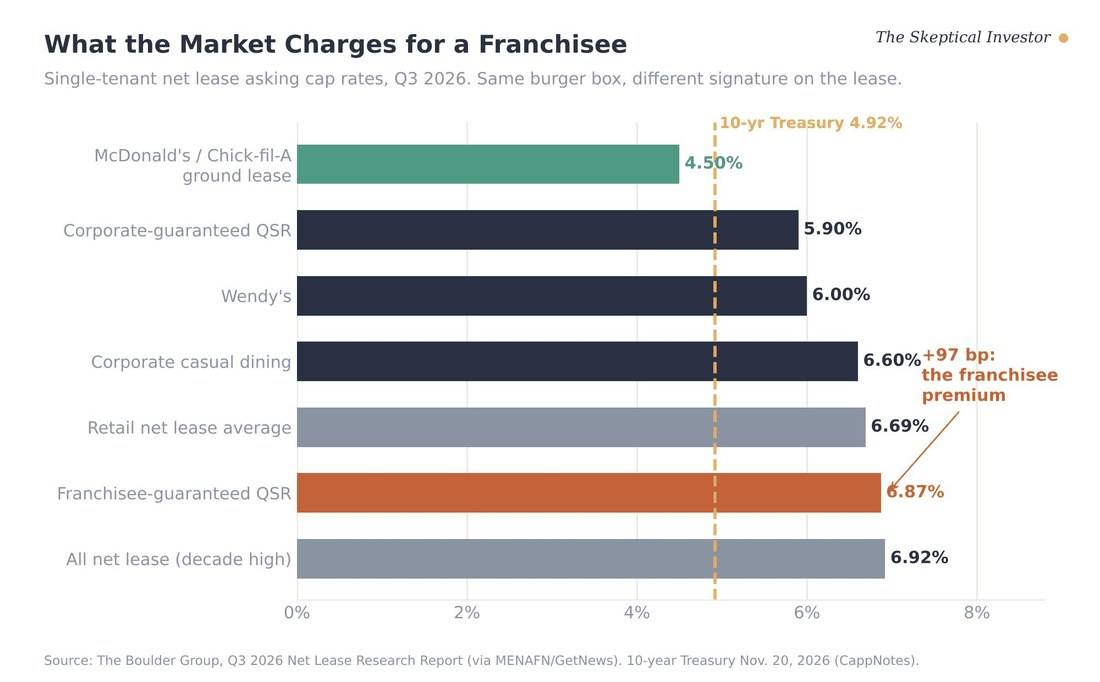
Source: ; 10-year Treasury Nov. 20 via .
Translate that spread into dollars and it becomes concrete. A building with $120,000 of annual rent is worth about $2.03 million at a 5.90% cap rate and about $1.75 million at 6.87%, a difference of roughly $287,000, or 14% of the price (my calculation). That gap is the market's estimate of what a franchisee's signature is worth relative to a corporation's. The question each buyer has to answer is whether 14% is enough of a discount to compensate for the possibility of receiving a rejection notice instead of a rent check.
Notice, too, how thin the cushion over Treasurys has become. A corporate-guaranteed fast-food building at 5.90% yields less than one percentage point more than a 10-year Treasury at 4.92% (my calculation), which pays its coupon without a roof, a parking lot or a tenant. An investor accepting that spread is betting that the brand's imprimatur is nearly as reliable as the government's, and Tasty Chick'n's landlords would like a word.
What Happens to Your Building in Chapter 11
Bankruptcy gives a tenant an option that no ordinary lease would allow: within a set period, it can assume each lease and keep paying, or reject it and walk away, leaving the landlord with an unsecured claim for damages that the Bankruptcy Code caps and that is often paid at cents on the dollar, if at all. A franchisee decides store by store, and the test is ruthless and simple. If a restaurant's sales comfortably cover its rent, the lease is kept or sold to another operator along with the store. If they don't, the lease is rejected.
The claim a landlord keeps is smaller than most owners assume. Section 502(b)(6) of the Bankruptcy Code caps a landlord's damages for a rejected lease at the greater of one year's rent or 15% of the remaining term, up to three years' rent, plus any unpaid rent owed at the filing. On a lease paying $137,400 a year with 15 years left, the cap works out to roughly $309,000 (my calculation), and that is only the size of the claim. It is unsecured, it sits in line behind the lender providing the bankruptcy financing, and in a case where the debts may exceed the assets several times over, it may be paid at a small fraction of its face value.
To make the stakes concrete, consider an illustrative case, using assumptions rather than reported figures. An investor pays $2 million for a franchisee-guaranteed fast-food building at the 6.87% market cap rate, collecting $137,400 a year. The franchisee files and rejects the lease. The building sits dark for 12 months while the owner pays the taxes and insurance the tenant used to cover, and then a new restaurant signs at a rent 10% lower, $123,660 a year. A buyer underwriting the re-leased building at a 7.5% cap rate, to reflect a newer and less proven tenant, would pay about $1.65 million, roughly $351,000, or 18%, below the original purchase price (my calculation), before counting the lost year of rent, the leasing commission or any improvements the new tenant demands. Nothing about that scenario is exotic. It is simply what happens when the sign stays the same but the signature underneath it fails.
That is why the location underneath the brand matters more than the brand itself. A rejected KFC on a hard corner with strong traffic, good visibility and a drive-thru lane will usually find another restaurant tenant, sometimes at a higher rent. A rejected KFC on a fading suburban strip may sit dark for a year and then sell at something close to land value. The same sign, the same lease form and the same cap rate at purchase can produce two very different outcomes, and the difference is almost entirely the real estate.
How to Read a Guarantee
Not all guarantees are created equal, and the differences are worth learning before you sign a purchase agreement rather than after. At the top of the ladder is a corporate guarantee from the brand's parent company, a McDonald's Corporation or a Yum Brands, which places the full balance sheet of a public company behind the rent. Below that is a guarantee from a large franchisee, sometimes one with hundreds of units, audited financial statements and access to institutional credit. Below that is a guarantee from a small or mid-size franchisee, whose ability to pay depends on the performance of a few dozen stores. And at the bottom is a lease signed by a single-store entity with a personal guarantee from its owner, which is only as good as that owner's personal finances.
The paperwork reveals which of these you are buying, but only if you ask for it. Request the guarantor's most recent financial statements, ideally audited, and the store's own sales for the past three years. Ask how many units the franchisee operates, how much debt it carries, and whether its lenders have any covenants that are close to being tripped. Read the assignment clause to learn whether the original guarantor is released if the lease is assigned to a new operator, because a lease that can be passed to a weaker company without your consent can turn a strong guarantee into a weak one overnight. None of these questions is unusual, and a seller who refuses to answer them has told you something important.
For a broader framework on judging where a property's return actually comes from, The Book on Rental Property Investing by Brandon Turner is a good place to start: a property's return comes from several distinct sources, and investors get into trouble when they pay for one of them while assuming they are getting all of them. A net-lease restaurant is a bet on a tenant's credit wrapped around a piece of land, and it is worth knowing which of those two you are actually buying.
What to Do
If you are buying a net-lease restaurant, find out who signs the lease and who guarantees it, then ask for that entity's financial statements and the store's sales. A rent-to-sales ratio above roughly 8% to 10% for a quick-service store deserves a hard look. Price the building twice: once as a leased investment, and once as vacant land with an empty box on it, and make sure you can live with the second number.
If you already own one, look up how many units your franchisee operates and whether any of its peers have filed. A tenant with dozens of stores and falling brand traffic is worth a phone call to your attorney before it becomes a court notice.
If you are selling, a corporate guarantee is now the scarcest feature in this part of the market, and you should price it accordingly. If your guarantee is a franchisee's, sell on the strength of the location, because that is what a sophisticated buyer will be underwriting anyway.
The Market Has Capitulated: The Bottom Appears to Be In.
If triple net shows how a promise of safety can hide real risk, the stock market spent last week teaching the opposite lesson: the rush toward safety can be the most expensive move an investor makes.
Last week had the texture of an ending. The S&P 500 fell 8.6% to close at 6,910.39, its worst week since April 2025, and slid into correction territory; the Nasdaq lost 10.0% and the Dow 8.0%, while the VIX, Wall Street's gauge of fear, closed the week at 35.89 (UPI; CappNotes). Investors who had spent most of the year in thrall to a single company and a single founder discovered, over five trading days, how much of the market's mood depended on one man's employment status.
Then, on Monday morning, Nvidia's board reversed itself. In a filing with the Securities and Exchange Commission, the company said its directors had unanimously reinstated Jensen Huang as chief executive, citing his “candor and ability to lead,” input from “senior levels of the United States government,” and a conclusion that he “poses no national security risk” (Nvidia 8-K). Nasdaq-100 futures rose about 7% before the bell, roughly the overnight limit (Beinsure), and in early trading the S&P 500 was up about 4.5%, the Nasdaq about 7%, the Dow about 1,200 points and Nvidia about 34% (Yahoo Finance).
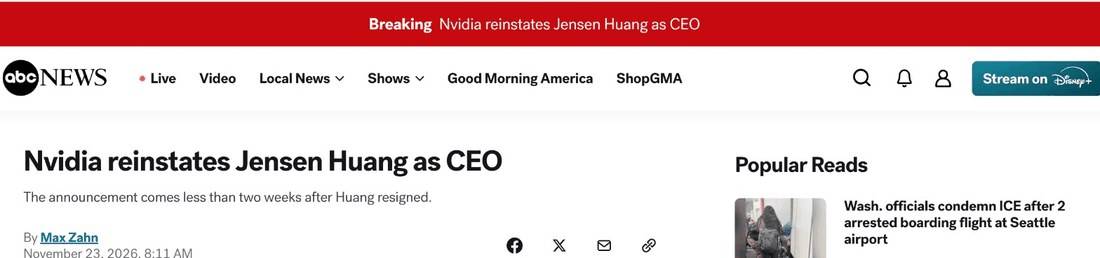
Source: ABC News, by Max Zahn, Nov. 23, 2026, 8:11 a.m. (screenshot).
That sequence, a week of indiscriminate selling followed by a violent snapback on a single piece of good news, is what capitulation looks like: the moment when the last nervous holders finally sell, leaving nobody left to sell to. My read is that the bottom is in. Much of last week's damage appears to have been a liquidation of crowded positions rather than a verdict on the underlying economy, and the investors who sold on Friday in search of safety appear to have sold at the low. It is the triple-net lesson in reverse. Safety is a feeling, and paying for that feeling at the wrong moment can cost more than the risk you were running from.
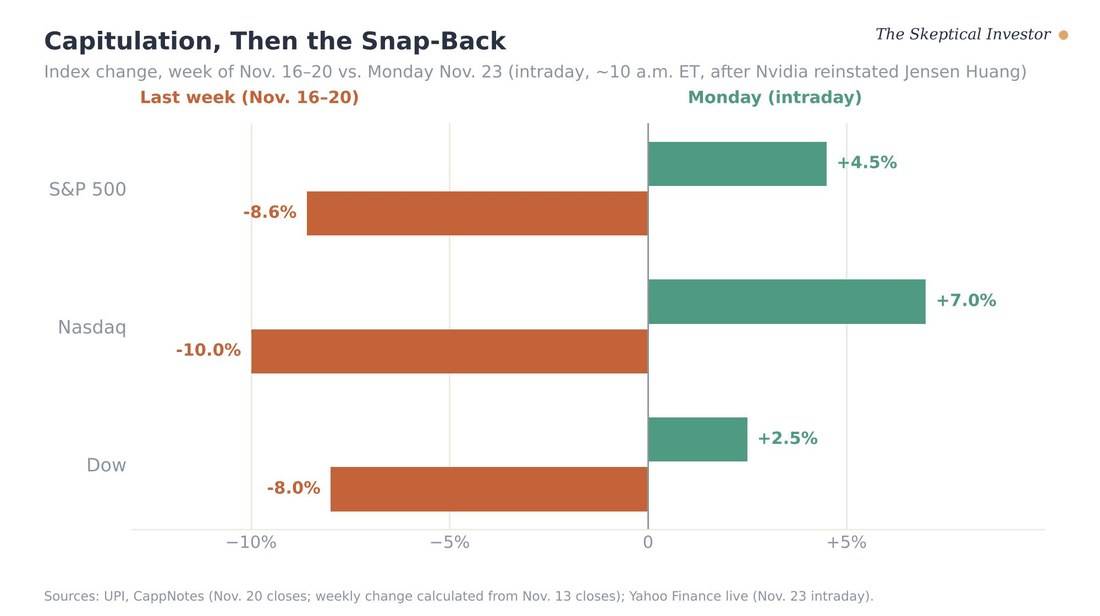
Source: , (Nov. 20 closes; weekly change calculated from Nov. 13 closes); (Nov. 23 intraday).
The Economy Underneath the Panic
The best evidence that last week was about positioning rather than fundamentals comes from the labor market. Jason Furman, who chaired President Obama's Council of Economic Advisers, wrote this month that this “might be the best--or among the best--job markets we've ever had,” measured by its ability to deliver jobs to the people who want them. His chart makes the case plainly: unemployment has now stayed at or below 4.5% for 60 consecutive months, from October 2021 through October 2026, the longest such run on record and three months longer than the stretch from July 1965 to March 1970.
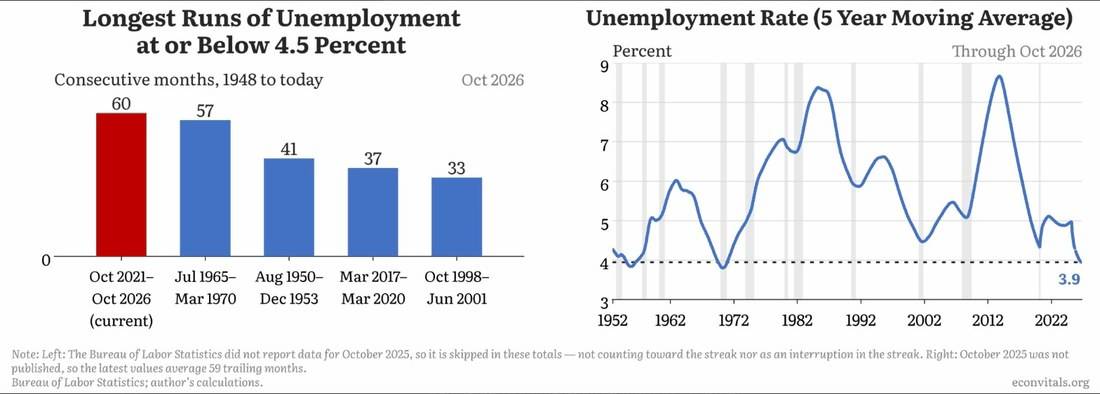
Source: , using data from (screenshot).
The October payroll report supports him. Employers added 165,000 jobs against a consensus near 65,000, and the unemployment rate fell back to 4.1%. Tennessee, for its part, held at 3.4% unemployment, well below the national rate. A market can panic over a chief executive, but an economy with that labor market rarely slips into recession on a weekend's notice, which is the main reason I believe last week was an ending rather than a beginning.
The Bond Market Grabbed the Wheel From the Fed
For real estate investors, the more consequential move happened in the bond market. The Fed still says it intends to raise rates in December, but the bond market made its own decision. As money ran from stocks to the safety of Treasurys, the 10-year yield fell 23 basis points over the week to 4.92% (CappNotes), and the MND 30-year rate dropped to 7.33%, down 0.17% from a week earlier. The Fed sets the overnight rate. It does not set the 10-year, and the 10-year is what your mortgage is priced from.
The mechanism is old and reliable. When investors are frightened, they sell what is risky and buy what is safe, and few things are considered safer than a Treasury bond. Heavy buying pushes bond prices up and their yields down, and because lenders price 30-year mortgages off the 10-year Treasury plus a spread, mortgage rates tend to follow within days. On a $400,000 loan, the move from 7.50% to 7.33% lowers the monthly principal and interest payment by about $46, or roughly $557 a year (my calculation). That is not life-changing, but for a buyer who was a few dollars short of qualifying, or an investor whose deal penciled out only at the lower payment, it is the difference between a closing and a canceled contract.
It also arrives at a moment when the rest of the housing market badly needs it. Single-family building permits have fallen to their lowest level since January 2023, and the median price of a new home fell to $400,400 in September, down 3.9% from a year earlier, according to Census data. Buyers who can act this winter are negotiating with sellers who have fewer alternatives than at any point in years, and a lower rate strengthens their hand.
What would prove me wrong is straightforward to watch. If the Dec. 4 jobs report shows the labor market cracking, or if stocks break below last Friday's lows, the panic was a beginning rather than an ending. Until then, the evidence points to a bottom.
Nashville: Oracle's Campus Renderings Show a City Still Growing
Two weeks ago, Oracle broke ground on its East Bank headquarters, and in the days afterward it released a new set of renderings and details that show the ambition of the project more clearly than anything the company had published before. At the groundbreaking, one of Oracle's chief executives called it “the most iconic corporate campus in the world,” according to the Nashville Business Journal. Having looked closely at the plans, I can see why. In a week when so much of the investing world looked fragile, the East Bank is a reminder that Nashville is still growing, and that the growth is now being poured in concrete and mass timber.
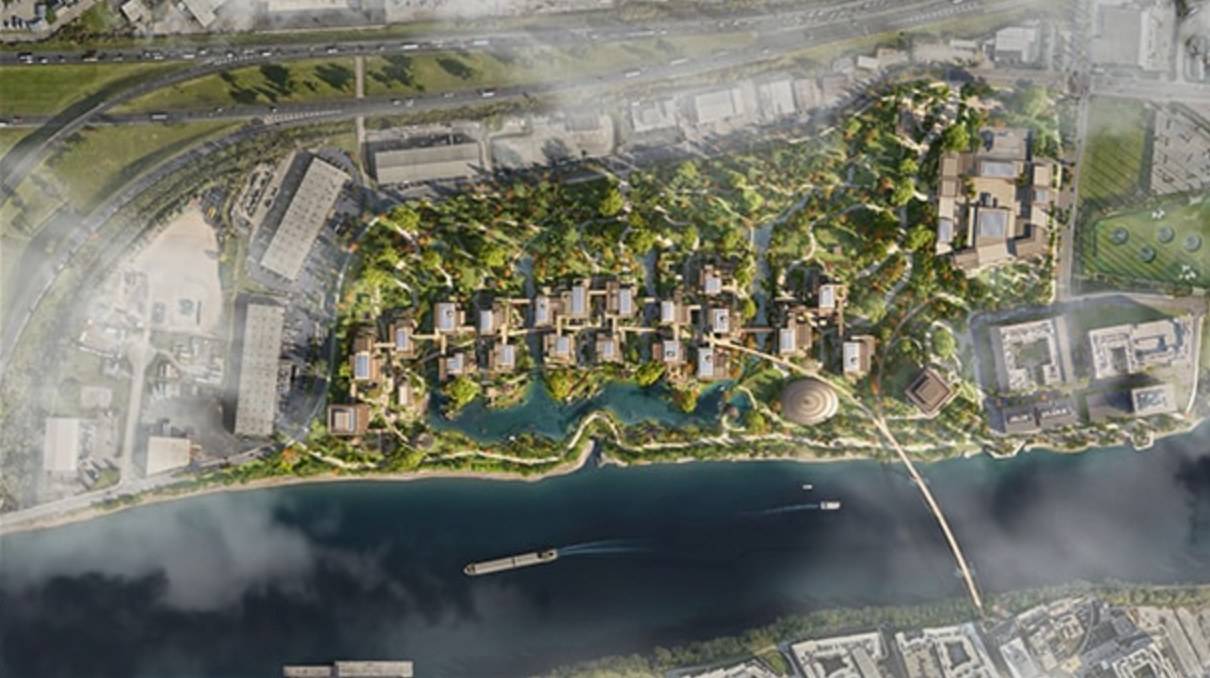
Oracle's own fact sheet describes a campus of 78 acres and 23 buildings with 759,838 square feet of office space, 11 retail spaces and a 120-room Nobu hotel (Oracle Nashville Campus Facts). Roughly 16.5 acres would be public green space, including a two-acre park, a six-acre lake, an amphitheater and a 2.1-mile greenway loop, and the buildings would use about 730,000 square feet of mass-timber construction on the way to LEED Gold certification. The first buildings are expected to open in 2030 (Oracle).
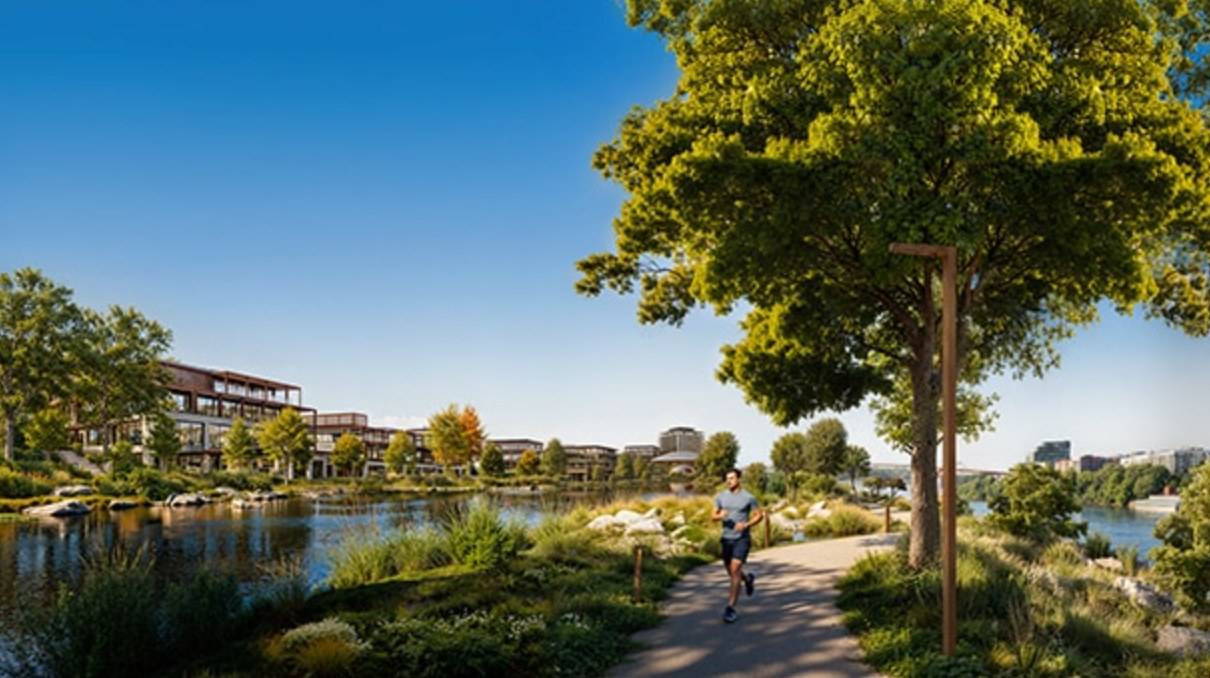
The most consequential piece for the neighborhoods around it may be the bridge. Oracle's plans include a pedestrian bridge of about 860 feet linking the campus to Germantown, which is now in the Army Corps of Engineers' permitting phase (Fox 17), and the company has committed $175 million toward that bridge, the park, the greenway, a pump station and new streets (Oracle). The project's price tag has grown from an original $1.2 billion to about $4.5 billion, supported by a $65 million state grant and as much as $175 million in Metro tax breaks (Construction Review Online).

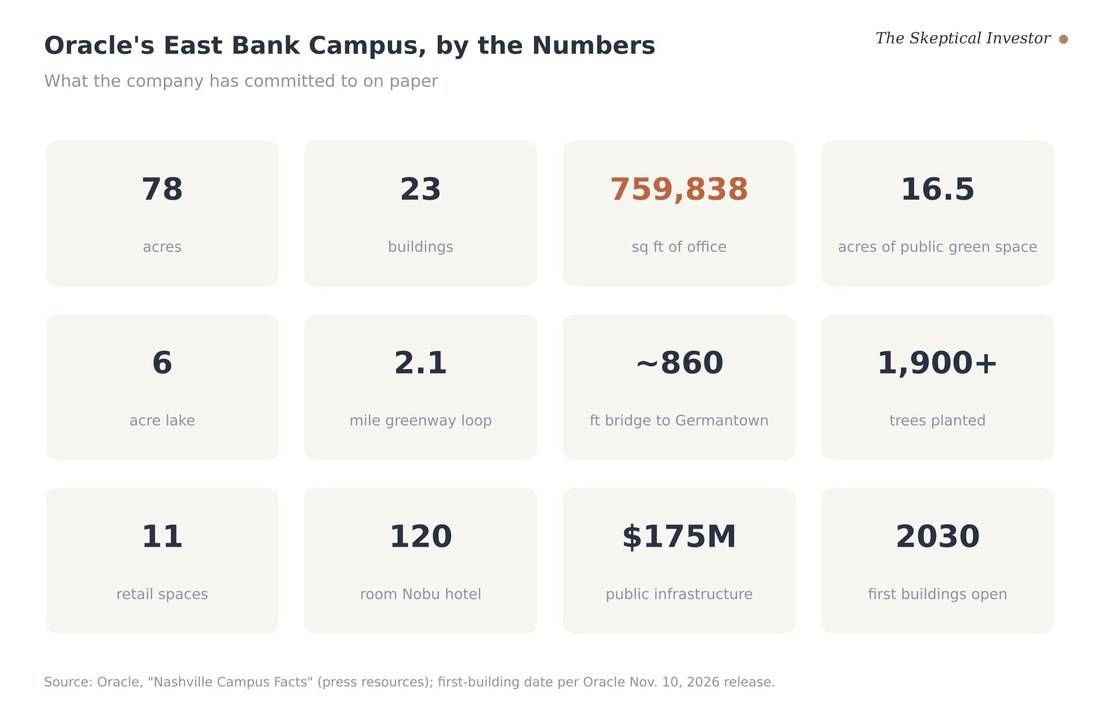
Source: ; first-building date per .
Where the Growth Will Land
The floor plans also hint at how far that growth may spread. Oracle has pledged about 8,500 jobs in Nashville (WSMV). Divide the campus's 759,838 square feet of office space by 8,500 workers, and you get about 89 square feet per job (my calculation). JLL estimates that the typical office now provides about 165 square feet per person, with many companies targeting 132. At 165 square feet, this campus would seat about 4,600 workers at once; at 132, about 5,750 (my calculation). Either way, the campus as described seats fewer people than the jobs Oracle has promised.
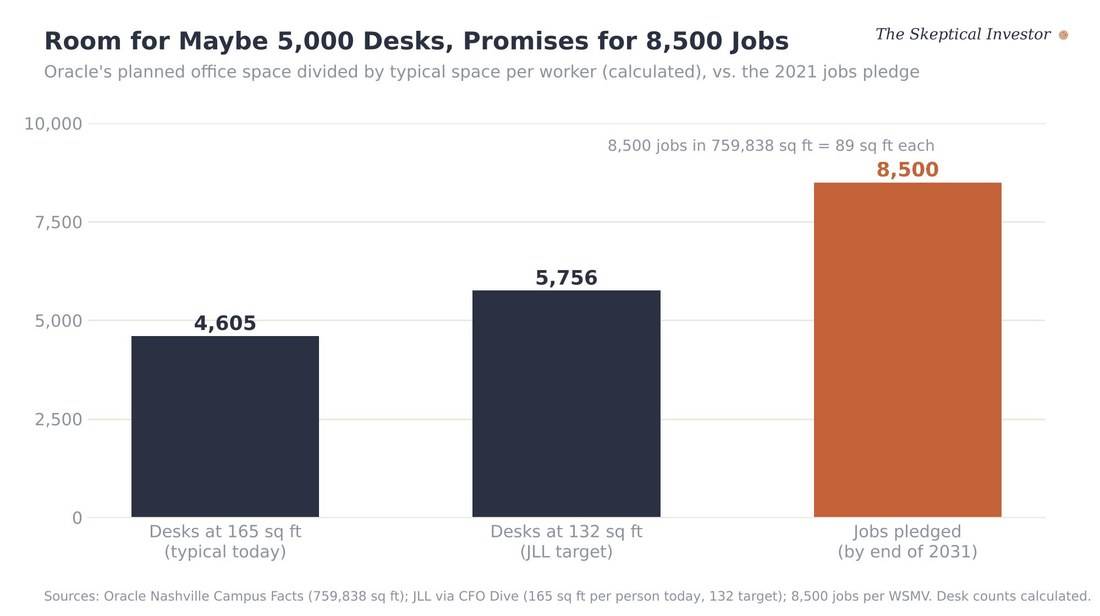
Source: (759,838 sq ft); (165 and 132 sq ft per person); 8,500 jobs per . Seat counts are my calculation.
The likeliest explanations are ordinary ones. Oracle may expect hybrid work and desk sharing, as most large employers now do; some of those 8,500 jobs may be housed elsewhere in the region; and the office total in the fact sheet may describe a first phase rather than the finished campus.
For investors, each of those explanations points in the same direction: the demand will not stop at the campus fence. Workers who come in a few days a week tend to live farther out, which is good news for apartments and small multifamily in East Nashville, Inglewood, Madison and the neighborhoods along the river, not just for the land directly next door. If some jobs land in other buildings, Nashville's office market gets a tenant it badly needs. And if more office space is coming later, the East Bank's construction cycle has a longer runway than the 2030 date suggests. The land around the campus has already priced in much of the optimism; the better value may sit a few miles away, where Oracle's employees will actually live.
What to Watch on the East Bank
Three things will tell us which version of the story is playing out. The first is the bridge: until the Army Corps of Engineers issues its permit, the promised walk from Germantown to the campus remains a rendering, and Germantown's restaurants and apartments are the most direct beneficiaries if it is built. The second is Oracle's local headcount as it is reported over the next few years; a steady climb toward 8,500 would suggest the jobs are real regardless of where the desks are. The third is the phasing of the office buildings themselves, because a campus that opens in 2030 with room for perhaps 5,000 people and adds space later is a very different neighbor from one that arrives fully built.
Nashville is a growin', and Oracle is the largest single bet yet that it will keep growing. Consistent with this week's theme, though, even a sure-looking bet deserves underwriting: buy where the demand will actually land, on the schedule it will actually arrive, rather than paying for the version in the brochure.
My Skeptical Take:
I said at the top of this issue that a culture of safetyism makes the world less safe, and I want to finish that thought, because it is the thread that ties a bankrupt chicken franchisee, a panicked stock market and a 1031 deadline all together.
Greg Lukianoff and the social psychologist Jonathan Haidt gave the idea its name in their 2018 book, The Coddling of the American Mind: safetyism is the belief that risk can be removed rather than understood. It sounds prudent, and in small doses it is. Practiced as a philosophy, though, it produces people and portfolios that are fragile in exactly the moments that matter, because a person who has been promised safety never learns what to do when the promise breaks. The risk does not go away. It simply goes unexamined, and unexamined risk is the most deleterious kind there is.
I learned the opposite lesson early. I was a latchkey kid. After school, I let myself into the house with my own key, and whatever came up before an adult got home was mine to handle. Nobody would describe that arrangement as “safe” by today's standards, and yet it gave me three things I have relied on every day since: independence, because no one else was going to decide for me; resilience, because things went wrong and I had to recover from them on my own; and problem solving, because the only way to fix a problem was to work it out myself. I would not trade those afternoons for any amount of supervision.
Investing works the same way. The investor who is sold “safety” never builds the habits that actually protect capital: reading the lease, checking the guarantor, stress-testing the rent, and sitting calmly through a drawdown. The investor who accepts that every asset carries risk builds those habits because there is no alternative. The first investor feels safer. The second one is.
This week showed it from both directions. The triple-net buyer who reached for safety bought a franchisee's credit risk without reading the lease. The stock investor who sold last Friday to get safe appears to have sold the bottom. One mistook a label for safety; the other paid a steep price for the feeling of it. In each case, the investors who got hurt were the ones who bought the label without reading what was underneath it.
The encouraging part is that what lies underneath is mostly knowable. The guarantor's financials are available if you ask for them. The store's sales can be requested. The cap-rate spread is published every quarter. The labor-market data is released on a schedule, and the next jobs report arrives Dec. 4. Single-family permits have fallen to their lowest level since January 2023, which will matter for rents two years from now. None of this requires a sinecure on Wall Street or a perspicacious hedge-fund analyst; it requires the patience to read past the sign. Knowledge is the only thing you can give away and keep hold of, which is why I write these posts every week, and why I hope you'll pass them along.
Galbraith, whose words close this column, spent much of his career documenting how investors forget the lessons of the last cycle almost as soon as it ends. The net-lease boom of the past decade was built on a sensible idea, that a creditworthy tenant on a long lease is a fine thing to own, and then stretched it to cover tenants whose credit nobody checked. The stock market's love affair with a single company followed a similar arc. Neither is a reason to avoid stocks or restaurants; both are reasons to remember that the price of an asset reflects what the crowd believes, while its value depends on what is actually true.
So here's how I'm operating:
If you're buying net lease: underwrite the guarantor first and the brand second. If the deal only works at a corporate cap rate but the signature is a franchisee's, walk away.
If you're financing anything: treat last week's drop in rates as a window, not a new floor. If I'm right that the bottom is in for stocks, some of the money that fled into Treasurys will rotate back out, and yields could drift up, while the Fed still looks likely to raise rates on Dec. 9. Lock when the numbers work rather than waiting for a pivot that may arrive later than you'd like.
If you own rentals: the labor market is still producing jobs for the people who want them, which is what keeps tenants paying. That argues for holding good properties through the noise rather than selling into a nervous market, and for keeping your best tenants happy rather than testing them.
If you're selling: winter is usually the slowest season for sellers, and this one is starting with a second straight record low in contract signings. If you can wait until spring, you likely should. If you can't, price to the buyers who are active now, who have cash or conviction and will not pay for a rebound that hasn't happened.
What I'm reading: The Intelligent REIT Investor by Brad Thomas and Stephanie Krewson-Kelly, a clear guide to how professional net-lease landlords think about tenant credit.
There is no “safe” in investing.
There is only the risk you understand, and the risk you don't.
Until next time. Stay Curious. Stay Skeptical.
Herzliche Grüße,
-The Skeptical Investor