Buy out co inheritors VS sell single family home

Buy out co inheritors VS sell single family home

Member since 2026 · 4 posts · 3 votes

Hi all,

Just joined and this is my first post so appreciate any guidance if I didn't do it properly.  I'm looking for guidance on whether or not to buy out co inheritors of a single family home vs just selling the property and being done with it.   I've never done any form of real estate investing before and think there is a lot of potential in my region but obviously also risk.  Here is the relevant info I can think to include but please let me know what else is needed.  I didn't know this community existed until recently and the advise I have gotten on other forums seems inherently anti real estate investing and a bit confrontational, honestly.  I appreciate any assistance.  

Inherited home with two other people, each own 1/3

Appraisal home value: $1.1m

Local real estate: could sell for $1.4-$1.5 today

Family to sell to me for $600,000 ( I know this is a steep discount, it was not my price, this is what they are offering to me as younger family member that whey want to help)

Trying to decide to just sell the home, take the approx $450K (approx amount minus realtor fees) and likely use that money as a combination of long term investment in S&P, kids college funds, home improvements, fun stuff, etc VS buy home from them and use as a rental.  In my area this could include yearly rentals vs taking advantage of the summer seasonal rental market.  

Would take out a mortgage for the $600K buy out value so as to maximize leverage and not need to use my own funds. Between mortgage principal and interest, property tax, landlord policy would be approx $4800-5000 a month. Rentals in the area for all year rental of $6000 a month with potential for $6500/month. Could also take advantage of the location and use for seasonal rental, which may be more profitable but is more work.

Prior responses have included responses such as "would you buy this home to use a rental if it wasn't part of an inheritance?" the answer then and now is the same: I would not be looking for a rental home, it is just a great opportunity that came up. Many people have also said to just take my portion and invest it, but my calculations show that a $1.4M appreciating asset (of which I would have approx 800K in equity from day 1) is going to greatly outpace a $450K investment in the S&P over a 10-20 year time horizon.

Real estate in this area tends to outpace the national average for appreciation due to its seasonal desirability on Long Island. In a year or so if being a landlord is the worst decision of my life I can sell and come out ahead of my share if we were to sell today.

Please let me know whatever else is needed to make an informed decision and to help me decide as much as possible.

1Reply
213 views

Most Popular Reply

Ashish AcharyaBusiness Member
CPA, CFP®, PFS · FL · Member since 2017 · 5k+ posts · 3k+ votes
2mo

Louis, I’d look at this as two separate decisions: Is this a good rental on its own? And is keeping this much equity tied up in one property the best use of your money?

The $600,000 buyout price is attractive, but the monthly spread is tighter than it first appears. At $6,000–$6,500 in rent against roughly $4,800–$5,000 in mortgage, taxes, and insurance, you have about $1,000–$1,700 left before vacancy, repairs, maintenance, capital expenses, management, utilities, and seasonal turnover costs. That doesn’t automatically make it a bad deal, but I’d want to see the true net cash flow before counting on appreciation.

I also wouldn’t compare a $1.4 million property directly with investing your estimated $450,000 share in the S&P 500. By keeping the property, you’re also giving up the cash you could receive today and taking on a $600,000 mortgage. A better comparison would be the projected return on your equity under both options after expenses, taxes, selling costs, and the time involved in managing the rental.

The tax side needs to be mapped out before the family transfer. Your inherited one-third interest generally receives a basis tied to the property’s date-of-death value. The additional interests you purchase may have a different basis, and buying them well below fair market value could make part of the transaction a gift, which may affect both basis and reporting.

Before deciding, I’d confirm the date and purpose of the $1.1 million appraisal, get realistic long-term and seasonal rental projections, price out repairs and reserves, and have a CPA and estate or real estate attorney review the buyout structure. How long ago was the inheritance appraisal completed?

Happy to connect!

INVESTOR FRIENDLY CPA®5240 Reviews
TaxMD® | Tax Planning Software
See this reply in the discussion

11 Replies

Jump to latestLatest
  • Abel CurielBusiness Member
    Real Estate Agent · Queens, NY · Member since 2016 · 2k+ posts · 1k+ votes
    2mo

    Hello @Louis Spiegel and welcome to BiggerPockets!

    This seems like it could be a great opportunity. Purchasing a property at/below 50% of market value is rare in any competitive market BUT Long Island is in its own lane.

    Earlier this year, Long Island was named the most competitive Seller's Market in the U.S. by Redfin. Earlier this summer, they ranked Nassau County as the #4 most competitive market in terms of % of homes that sell above asking price.

    One thing I'm curious about is the property's market value.
    If it appraised at $1.1M, what makes you believe it is worth $1.4-1.5M? Is this based on the potential value after upgrades? Is this based on multiple SOLD comparable properties?
    ^ Happy to assist with this if you'd like to look further into the market trends and pricing.

    Also needed to make an informed decision:

    - In addition Mortgage, taxes, insurance, I'd account for other expenses - i.e. vacancy, maintenance and capital expenditures. BiggerPockets calculators and other investment calculators would use 5% of rental income to account for each of those expenses (15% total). With $6,000/month in rental income, your approximate monthly vacancy, maintenance, and capEX would be ~$900 month. Some months, you'll have $0 in expenses for these 3 categories. Other months, you could have $1,000s or $10,000s.
    - Consider repairs needed to make the property 'rent-ready'. If you're unsure what prospective tenants are looking for in the area, check out the finishes & amenities offered by nearby rentals. If the property is turnkey and in 'move-in' condition, great!!
    - If selling is an option, use a seller net proceeds calculator to determine just how much you and the family would walk away with after New York State transfer taxes, capital gains taxes (if applicable), attorney fees, broker commissions, holding costs (i.e. utilities, taxes, insurance, etc.), and other miscellaneous costs (i.e. cleaning fees, pre-listing inspection).
    - If you are going to hold onto it and lease the property, take your time with tenant screening and lease signing. Its better to have a slightly higher vacancy and pick the best candidate than to pick the wrong candidate too quickly and have to deal with the backlash retroactively.

    As it stands now, you could be looking at low or negative cash flow for the first few years, but that is very common in New York, especially Long Island.

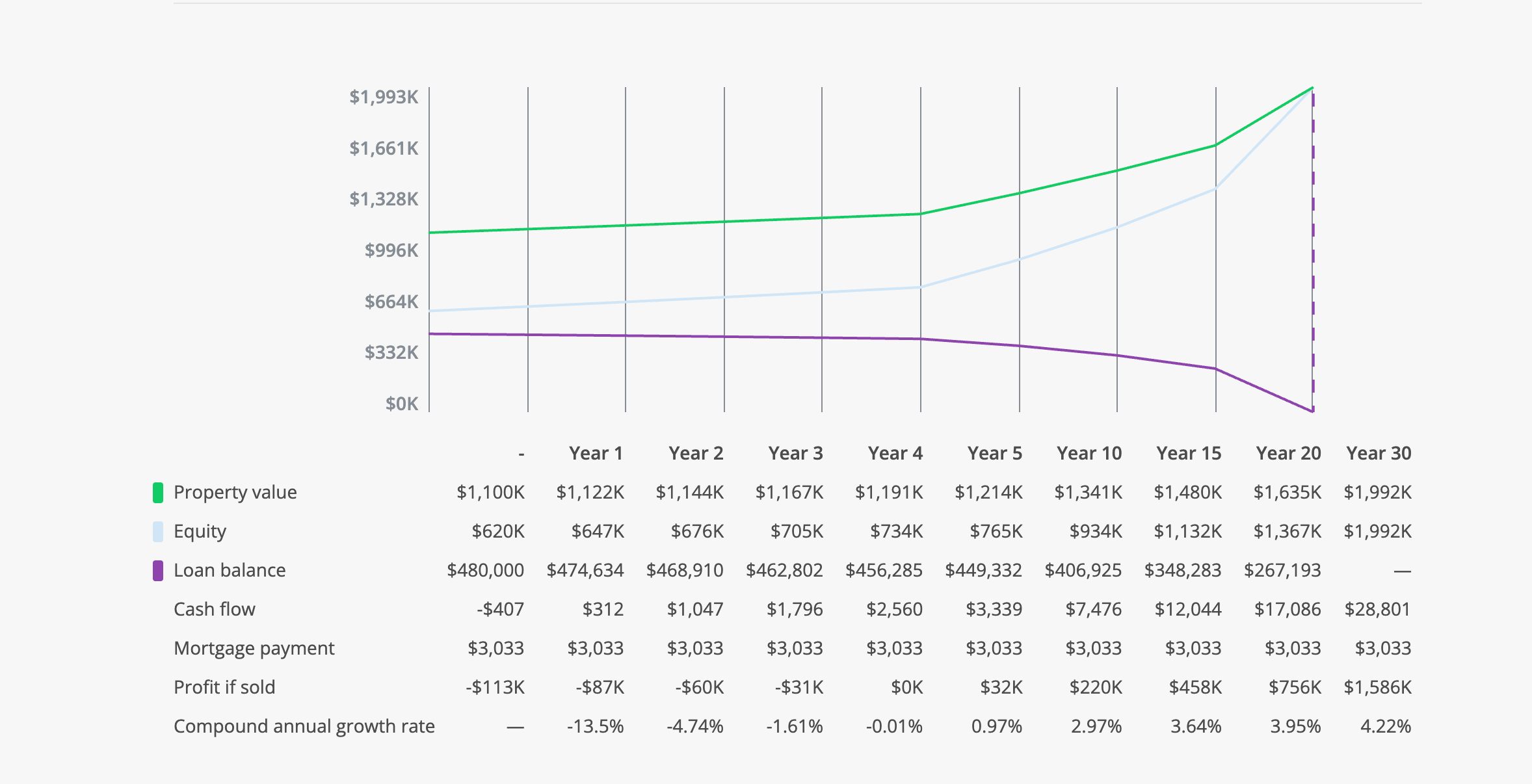
    What you'll want to pay close attention to are the 3, 5, 10+ year returns. The screenshot has an example of a $1.1M property with a $480K (assuming 20% down on a $600K purchase) mortgage and $20K in annual property taxes. Vague example, but you can see how the 5+ year trajectory shows significant upside compared to the first few years of ownership.

    All the best!

    Abel

    REbuild Team - eXp Realty5234 Reviews
  • Member since 2026 · 4 posts · 3 votes
    2mo

    The $1.4-$1.5 is from a realtor looking at  recent sales in the area.

    • Abel CurielBusiness Member
      Real Estate Agent · Queens, NY · Member since 2016 · 2k+ posts · 1k+ votes
      2mo
      Quote from @Louis Spiegel:

      The $1.4-$1.5 is from a realtor looking at  recent sales in the area.


      OK Great! 

      In that case, you can look into other factors if considering selling.
      - Active inventory aka competition. Are there more/less listings on the market now compared to recent months/quarters/years
      - Sale date of comparable sales and projected sale date of the subject property. In some submarkets, fall and winter closings have lower median sale prices compared to spring/summer

      If you're holding onto the property and purchasing at $600K, you'll have considerable equity from day 1. If you'd like to diversify in the future, you can use some the equity to invest in lower-cost and more landlord-friendly markets outside of NY.

      Either way, you are in a solid position!

      REbuild Team - eXp Realty5234 Reviews
  • Colleen F.Pro Member
    Investor · Narragansett, RI · Member since 2013 · 8k+ posts · 4k+ votes
    2mo

    @Louis Spiegel  you need to look at the condition/location/size of the house and whether it makes a good rental. Is it something you would position as a seasonal rental?  a long term rental?  What is the demand in the area?  Are the systems up to date?  What are your expected capitol improvements?  Need a new roof?  furnace?  etc.   Have you done  the numbers on what you would earn if you mortgage that buyout and rent it out?    A real estate agent is giving you comps but that is not what your house in the condition it is in will sell for. There was over 100,000 difference in the market appraisals on the last house I sold.  If your house isn't cookie cutter they aren't the best at estimating and you should always get multiple relators because if you sell you should get multiple people to compare before hiring. 

  • Member since 2026 · 4 posts · 3 votes
    2mo
    House is in good condition and no initial capital improvement is needed.  High demand for both yearly rental as well as hyped up seasonal demand.  There is more work involved in seasonal rentals I'm sure, but may be worth it.  
    Yes, I expect yearly rental  to either be cash flow neutral or positive maybe $1,000 a month.  The benefit to this in my opinion is the appreciation over 10 or more years.  So more delayed gratification. 
  • Abel CurielBusiness Member
    Real Estate Agent · Queens, NY · Member since 2016 · 2k+ posts · 1k+ votes
    2mo

    @Louis Spiegel Looking 10 years down the road, you can conservatively have $800-900K in equity.

    If demand keeps up, $1,000 in monthly cashflow is doable as well.

    Very rare in most scenarios on Long Island, but thankfully you're getting the property far below market value.

    REbuild Team - eXp Realty5234 Reviews
  • Colleen F.Pro Member
    Investor · Narragansett, RI · Member since 2013 · 8k+ posts · 4k+ votes
    2mo

    @Louis Spiegel Neutral or positive maybe $1000/month is alot of spread! I understand the long term appreciation model but if it is neutral or barely positive sell. It would take a lot of appreciation to make up for that. You have to run the rental calculator under tools putting aside for Property management, eventual capex, taxes, landlord insurance etc both as a STR/MTR vs LTR. Ask yourself what would that money do for you if you invested it somewhere else? It is alot of calculation but worth the effort. I just went over this with my neice. Do you want to be a landlord? If you hand it to a PM how much would you make? It is worth doing if you want to do and the numbers work. You don't have to make a ton if you are accounting for extra expenses and seeing appreciation but don't just count the taxes and mortgage. The other thing, no matter what you do get a date of death appraisal, its harder to go back for one down the road and you will need it.

  • Ashish AcharyaBusiness Member
    CPA, CFP®, PFS · FL · Member since 2017 · 5k+ posts · 3k+ votes
    2mo

    Louis, I’d look at this as two separate decisions: Is this a good rental on its own? And is keeping this much equity tied up in one property the best use of your money?

    The $600,000 buyout price is attractive, but the monthly spread is tighter than it first appears. At $6,000–$6,500 in rent against roughly $4,800–$5,000 in mortgage, taxes, and insurance, you have about $1,000–$1,700 left before vacancy, repairs, maintenance, capital expenses, management, utilities, and seasonal turnover costs. That doesn’t automatically make it a bad deal, but I’d want to see the true net cash flow before counting on appreciation.

    I also wouldn’t compare a $1.4 million property directly with investing your estimated $450,000 share in the S&P 500. By keeping the property, you’re also giving up the cash you could receive today and taking on a $600,000 mortgage. A better comparison would be the projected return on your equity under both options after expenses, taxes, selling costs, and the time involved in managing the rental.

    The tax side needs to be mapped out before the family transfer. Your inherited one-third interest generally receives a basis tied to the property’s date-of-death value. The additional interests you purchase may have a different basis, and buying them well below fair market value could make part of the transaction a gift, which may affect both basis and reporting.

    Before deciding, I’d confirm the date and purpose of the $1.1 million appraisal, get realistic long-term and seasonal rental projections, price out repairs and reserves, and have a CPA and estate or real estate attorney review the buyout structure. How long ago was the inheritance appraisal completed?

    Happy to connect!

    INVESTOR FRIENDLY CPA®5240 Reviews
    TaxMD® | Tax Planning Software
  • Aaron ZimmermanBusiness Member
    Accountant · Chicago, IL · Member since 2018 · 2k+ posts · 1k+ votes
    2mo

    It's a low ROE but I'd be looking to forecast total return. If it were Me, I'd probably sell unless there's other tax benefits I don't see

  • Member since 2026 · 4 posts · 3 votes
    2mo

    This is all very interesting, thank you for taking the time to respond.

    Based on what I'm gathering through this  thread it seems that the amount of monthly cash flow and how it may in fact end up being neutral or negative should outweigh the potential appreciation?  Isn't the fact that homes in this area outpace national averages for yearly growth worth something?

    The above calculations are for a yearly tenant and what could be expected for monthly rent.  If I went the seasonal rental route I could reasonably collect more.

  • Jason MalabuteBusiness Member
    Accountant · Los Angeles, CA · Member since 2016 · 2k+ posts · 908 votes
    2mo

    I'd break this into two separate questions: is this a good rental on its own merits, and is tying up this much equity in one property the best use of your money? The $600k buyout is a great price, but the monthly spread is thinner than it looks; at $6,000-6,500 of rent against roughly $4,800-5,000 of mortgage, taxes and insurance, you're left with about $1,000-1,700 before vacancy, repairs, maintenance, capex, management, utilities and seasonal turnover, so I'd nail down the true net cash flow before leaning on appreciation. I also wouldn't compare a $1.4M property head-to-head with putting your ~$450k share in the S&P, because holding it means giving up that cash today and taking on a $600k mortgage; the cleaner comparison is your projected return on equity under each option after all costs, taxes and the time you'll spend managing it. On taxes, your inherited one-third generally gets a basis tied to the date-of-death value, the interests you buy will carry a different basis, and buying well below fair market value can make part of the deal a gift that affects basis and reporting, so before anything closes I'd confirm the date and purpose of that $1.1M appraisal, get realistic long-term and seasonal rent projections, price out repairs and reserves, and have a CPA plus an estate or real estate attorney review the buyout structure.

    Malabute & Company CPAs525 Reviews
Join the conversationCreate a free account to reply, vote on answers and follow this thread.