The spreadsheet column most landlords are missing

The spreadsheet column most landlords are missing

online · Member since 2026 · 99 posts · 45 votes

Most reserve spreadsheets I've seen have the same columns: property, rent, expenses, cash flow. Useful, but they're all backward looking, they tell you what already happened.

The column that changed things for me was a forward looking one: for each major system in the property, what's its age and what's its expected remaining lifespan. Once that's sitting next to your cash flow numbers, you stop being surprised by "why did this month's expenses spike" and start seeing it coming months in advance.

It's a small addition but it shifts the whole spreadsheet from a record of the past to something closer to a forecast. Suddenly a good cash flow month next year might already look shaky once you know two systems are aging out in it.

Anyone else tracking this alongside the usual financials, or is it still mostly a separate mental note for most people?

1Reply
471 views

5 Replies

Jump to latestLatest
  • Contractor · Dallas, TX · Member since 2026 · 13 posts · 6 votes
    1mo

    The column I keep coming back to is next action owner. A date and status are useful but if nobody owns the follow up the item just sits there until it becomes urgent.

  • Ryan SpathBusiness Member
    Real Estate Agent · Boise, ID · Member since 2017 · 566 posts · 377 votes
    1mo
    Quote from @Giuseppe Cavucci:

    Most reserve spreadsheets I've seen have the same columns: property, rent, expenses, cash flow. Useful, but they're all backward looking, they tell you what already happened.

    The column that changed things for me was a forward looking one: for each major system in the property, what's its age and what's its expected remaining lifespan. Once that's sitting next to your cash flow numbers, you stop being surprised by "why did this month's expenses spike" and start seeing it coming months in advance.

    It's a small addition but it shifts the whole spreadsheet from a record of the past to something closer to a forecast. Suddenly a good cash flow month next year might already look shaky once you know two systems are aging out in it.

    Anyone else tracking this alongside the usual financials, or is it still mostly a separate mental note for most people?


    Agree with you 100% here. Ive actually created this for myself, we are yet to implement it however as I still earn active income through RE sales and other business interests. Currently we save a certain % of rents each month and it work. When we decide to rely 100% on the re income to live this will be something we live by, if you save $3000 a year for a property and the hvac & roof are end of life you have a suprise coming!

  • Don KonipolBusiness Member
    Investor · The Woodlands TX / Avon, CT · Member since 2009 · 6k+ posts · 10k+ votes
    1mo
    Quote from @Giuseppe Cavucci:

    Most reserve spreadsheets I've seen have the same columns: property, rent, expenses, cash flow. Useful, but they're all backward looking, they tell you what already happened.

    The column that changed things for me was a forward looking one: for each major system in the property, what's its age and what's its expected remaining lifespan. Once that's sitting next to your cash flow numbers, you stop being surprised by "why did this month's expenses spike" and start seeing it coming months in advance.

    It's a small addition but it shifts the whole spreadsheet from a record of the past to something closer to a forecast. Suddenly a good cash flow month next year might already look shaky once you know two systems are aging out in it.

    Anyone else tracking this alongside the usual financials, or is it still mostly a separate mental note for most people?

    Great post.  It should be BASIC, but somehow I see it done only by large, sophisticated investors like REITs.  This is why one size fits all formulas like buy at 100 times monthly rent, etc. often end in loss. 
    Private Mortgage Financing Partners, LLC
  • Investor · Washington, US · Member since 2021 · 101 posts · 34 votes
    2w

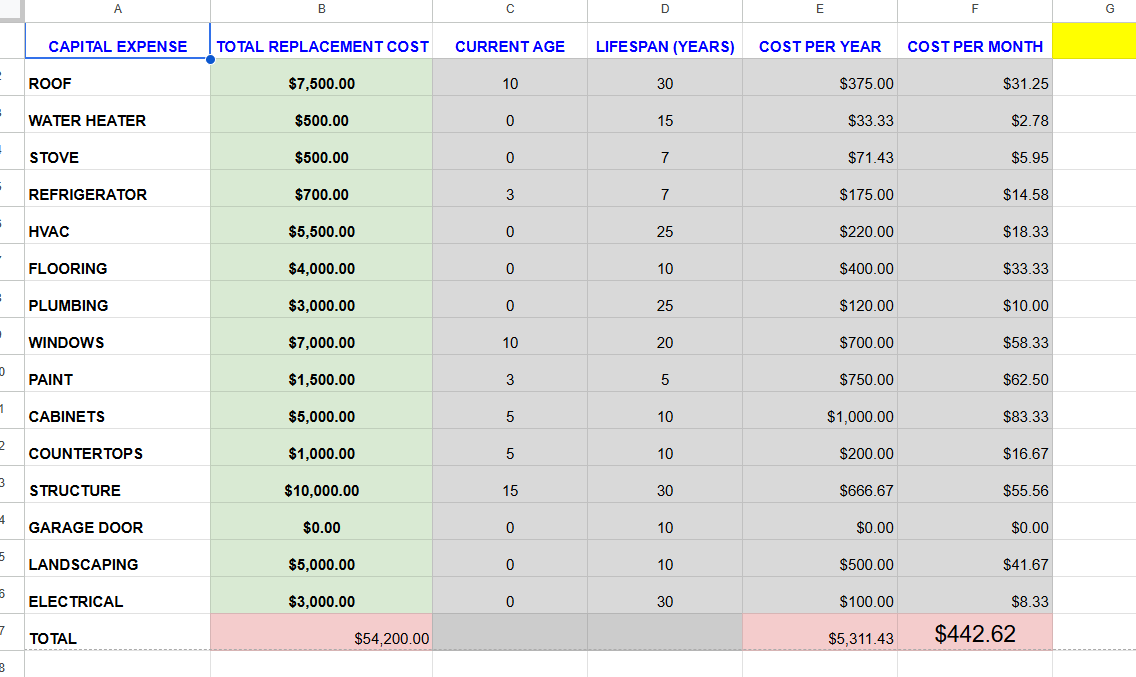
    The column I'd add is a per component capex reserve: roof, HVAC, water heater, flooring, each with its replacement cost and remaining useful life, so the monthly set aside is the sum of cost divided by years left. That almost always comes out higher than the 5 to 10 percent of rent rule of thumb, often $150 to $250 a month on an older single family. Cash flow after subtracting that number is the one actually worth comparing between properties.

  • Investor · Toledo, OH · Member since 2020 · 28 posts · 16 votes
    2w

    I do something along those lines. I do it for each property when I buy it. Here is a screenshot. This way I can allocate that money each month.

    @Alex S. , you are right, it is often more than 10% rule.


    I guess, if you want to take it a step further, you can calculate future cost value based off inflation rate.

    Victor
    I guess, if you want to take it a step further, you can calculate future cost value based off inflation rate. 

Join the conversationCreate a free account to reply, vote on answers and follow this thread.