Own a medical or dental office building? You may be depreciating it too slowly
Quick share for anyone who owns (or is thinking about buying) a medical office, dental office or specialty clinic, like an imaging or surgery center.
By default, these buildings are depreciated over 39 years. But a lot of what’s inside a medical building isn’t really “building” in the IRS’s eyes. A cost segregation study separates those parts out so they can be depreciated over 5 or 15 years instead.
The tricky part: there’s no IRS chart for medical buildings
The IRS cost seg guide (Publication 5653) includes ready-made classification charts for industries like retail, restaurants and car dealerships. Medical isn’t one of them. So every item gets judged on its own facts, using the general rules and court cases.
The key case actually involved hospitals (Hospital Corporation of America, 1997). The Tax Court ruled that many hospital components could be treated as personal property rather than building.
The basic rule: parts that make the building work for anyone (walls, floors, general plumbing and wiring, central HVAC, regular lighting) stay at 39 years. Parts that serve the business or specific equipment can often move to 5 years.
What commonly qualifies in medical and dental space
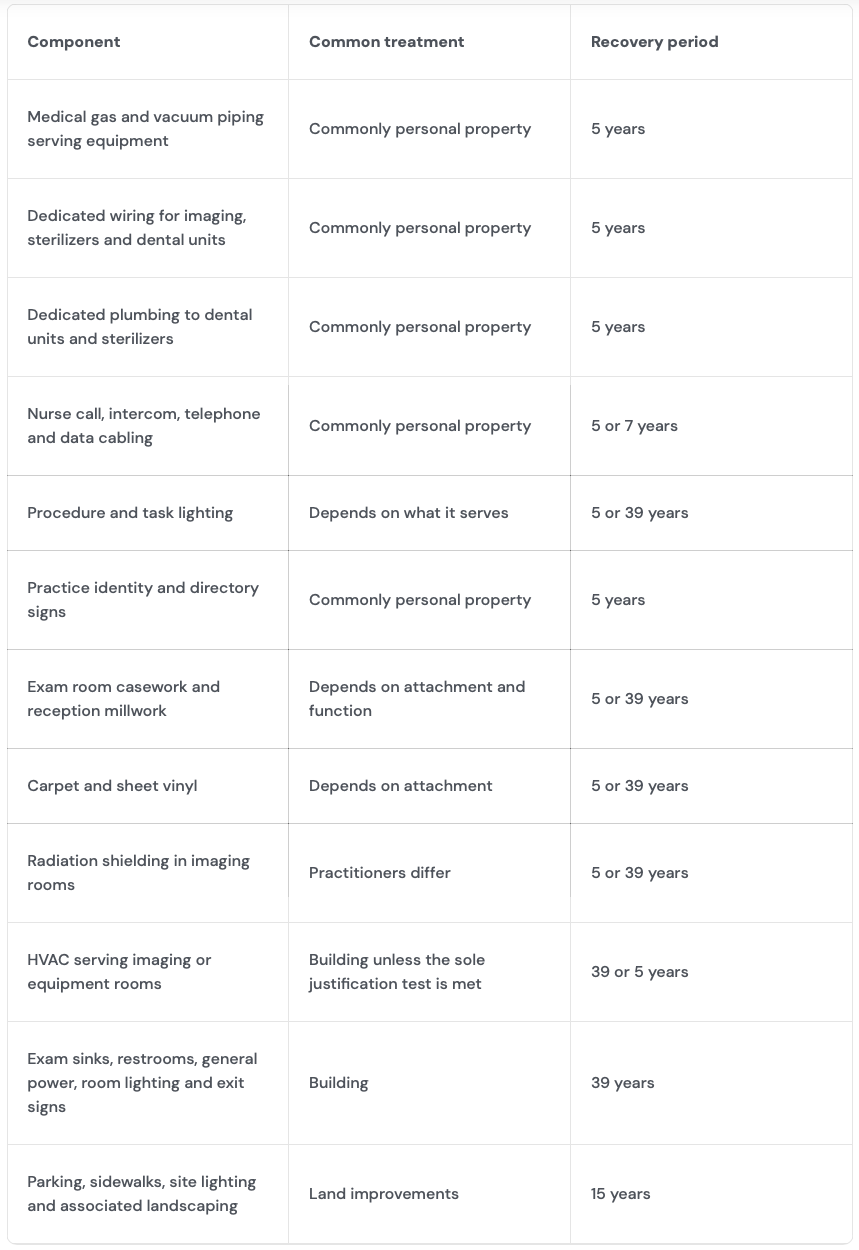
Usually 5-year:
Medical gas and vacuum piping serving equipment
Dedicated wiring for imaging, sterilizers and dental units
Dedicated plumbing to dental units and sterilizers
Practice signs (identity and directory)
Nurse call, intercom, phone and data cabling (5 or 7 years)
Depends on the facts (5 or 39 years):
Procedure and task lighting depends on what it serves
Exam room cabinets and reception millwork: removable leans 5, built-in leans 39
Carpet and sheet vinyl: glued down permanently leans 39
Radiation shielding in imaging rooms: practitioners disagree
HVAC for imaging or equipment rooms: building, unless its only purpose is keeping equipment running. If it also keeps people comfortable, it’s 39.
15-year:
Parking, sidewalks, site lighting and landscaping
39-year:
Exam sinks, restrooms, general power, room lighting and exit signs
Note: equipment the practice buys (dental chairs, imaging units, sterilizers) is already depreciated separately. A study looks at the building work installed to support it.
If the doctor owns the building and rents it to the practice
This setup is common, and it has a catch. If you work in the practice, net rental income from it is treated as non-passive. But if accelerated depreciation creates a rental loss, that loss usually stays passive. Grouping the rental with the practice can sometimes change this, but only under specific ownership rules, and it’s generally permanent. Review this with your CPA before counting on the deductions.
Bonus depreciation timing
Under the One Big Beautiful Bill Act, 5-year and 15-year property acquired and placed in service after January 19, 2025 can generally get 100% bonus depreciation. “Acquired” means the date of the binding written contract, not the closing date. Property acquired before January 20, 2025 gets 40% if placed in service in 2025, or 20% in 2026. The 39-year portion never qualifies.
Renovating? Interior improvements to an existing commercial building can often be depreciated over 15 years. And if you rip out old components, a partial disposition election may let you write off their remaining value. It has to be made on a timely filed return for that year.
Curious to hear from medical and dental building owners here: have you done a cost seg study on your property? Did anything surprising qualify, or anything you expected to qualify get pushed back to 39 years?
General information only, not tax advice. Talk with your CPA about your situation.
1 vote total

