The Landlord Loyalty Tax: Big REITs Discount New Tenants and Charge Loyal Ones
Today's Read Time: 16 minutes (totally worth it, we go deep!)
This week, we're talkin' the loyalty tax: America's largest landlords are cutting rents for applicants and raising them on tenants. What gives?! I'll walk through why they can get away with it, what it does to the value of the building you're about to buy, and why small landlords should do the opposite this winter. Along the way, a humdinger of a jobs report and a ballot box that sent its own bill to the newcomers.
Let's get into it.
Today's Interest Rate: 7.17%
(👇 .10% from this time last week, 30-yr mortgage)
The 30-year index closed down a tenth of a point on the week and nearly four-tenths of a point below where it stood a month ago (Mortgage News Daily). A falling oil price appears to have done most of the work, holding the 10-year Treasury near 4.84%.
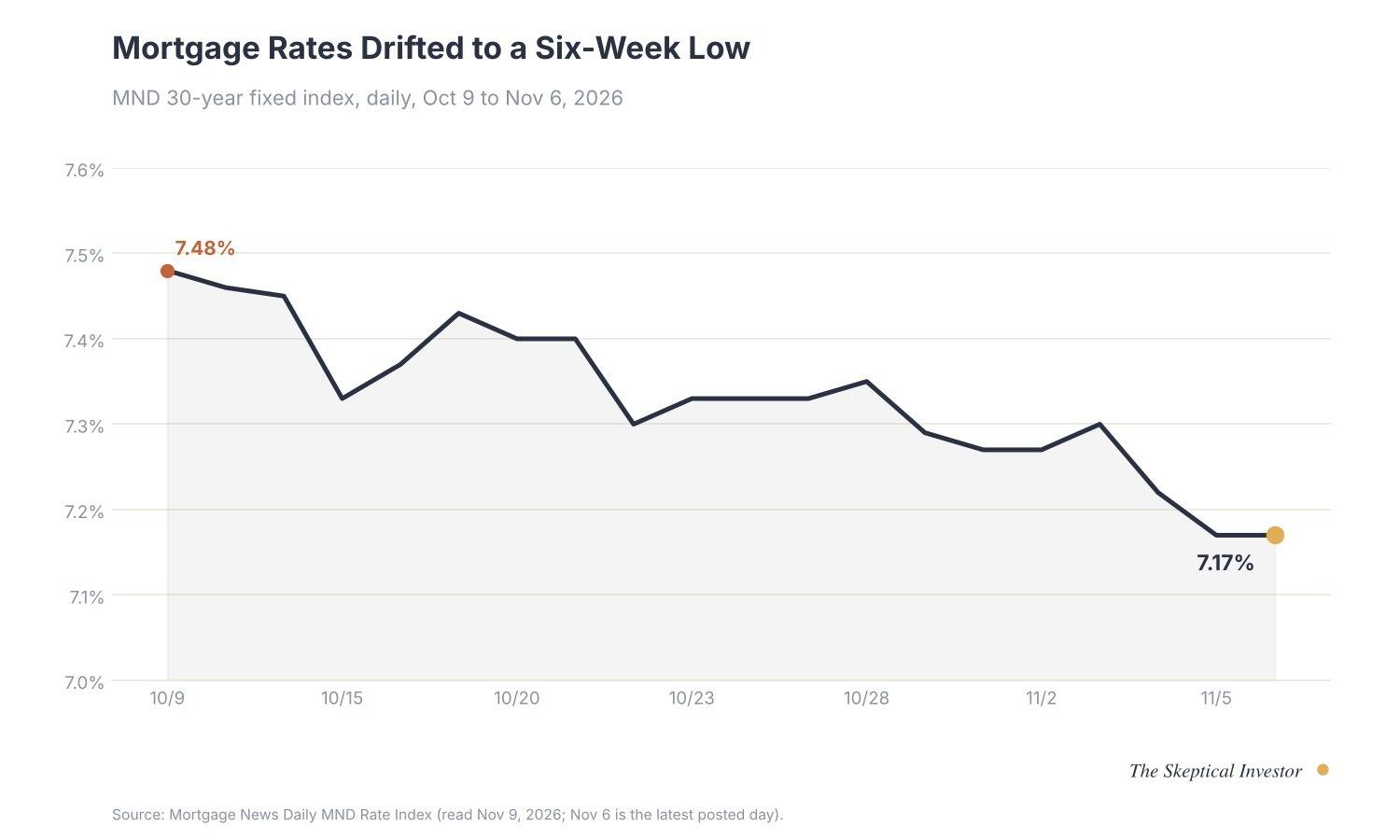
Source: Mortgage News Daily MND Rate Index, 30-year fixed, Oct 9 to Nov 6, 2026.
The Weekly 3 in the News:
1) Apartment lenders are selling foreclosed buildings for 72 cents on the dollar. On its third-quarter call, Starwood Property Trust said the properties it resolved out of foreclosure in the quarter sold at 72% of its original basis, with deals under contract at 71%, and its finance chief said all of the sales were in cash with no seller financing (Starwood Q3 call transcript). A week earlier, Arbor Realty Trust, one of the largest multifamily bridge lenders, suspended its common dividend and reported 32 non-performing loans totaling $647.6 million, up from 19 loans and $428.8 million three months earlier, along with $491.2 million of foreclosed real estate on its books (Arbor Q3 release, SEC). The distressed deals many of us have been waiting for appear to be arriving, and the sellers want to exit into cash.
2) Five years of data suggest data centers have not driven up utility bills, and they may help bring down both power rates and property taxes. The actual culprits for higher utility costs are gas prices, an aging grid and storm and wildfire damage (The Washington Post via Yahoo). The Electric Power Research Institute estimates that from 2019 to 2024 data centers lowered average residential electricity rates by roughly 6%, because a large new customer spreads the grid’s fixed costs across more kilowatt-hours (EPRI). Property taxes were lower too. In Loudoun County, Va., home to the world’s largest cluster of data centers, they generate nearly half of all property tax revenue on just 3% of the county's land, and the county has cut its real property tax rate from $1.145 per $100 of assessed value in 2016 to $0.805, a rate officials say would likely top $1 without them (Loudoun County; CBS News). The research cuts against one of the most common arguments made in local fights over new data centers.
3) Commercial property insurance has been cheaper for 4 straight quarters, but policies are covering less. Property premiums fell an average of 6.3% in the second quarter, the steepest decline since 2010, while umbrella coverage rose 5.3%, its 35th consecutive quarterly increase, according to the insurance broker IMA, which also reported that broader habitability exclusions are becoming more common (IMA). A month ago I was complaining about a 28% increase on my own policy; if you own rentals, this is the moment to re-bid your property coverage and read the exclusions line by line.
A Few Fun Things Happening in Nashville This Week
KEDAGORO, The Age Is Yours, My Liege! Saturday, Nov. 14, at 8 p.m., and Sunday, Nov. 15, at OZ Arts Nashville, 6172 Cockrill Bend Circle. A Japanese dance-theater company in a converted warehouse off the river, with a hamster wheel and pastel princess gowns somewhere in the mix; tickets $35 to $40 (OZ Arts).
Christmas Village, Nashville's Original Holiday Market Friday through Sunday, Nov. 13 to 15, at The Fairgrounds Nashville. The 65th edition of the city's oldest holiday market, with more than 250 merchants, all run by volunteers for charity; $15, children 9 and under free (NewsChannel 5; hours via Nashville Guru).
Employers Hired Far Faster Than Forecast in October, and Workers Grew Bolder About Quitting
Economists expected employers to add about 59,000 jobs in October.
They added 165,000, nearly three times the forecast (BLS; consensus per Dow Jones via KY3/Gray DC).
The Labor Department also revised August and September up by a combined 84,000, the unemployment rate slipped to 4.1% from 4.2%, and average hourly earnings rose 3.1% from a year earlier to $38.00 (BLS).
This was, as my grandfather would say, a humdinger!
The gains were concentrated. Professional and business services added 70,000 jobs, health care 42,000, transportation and warehousing 25,000 and manufacturing 19,000, while construction was little changed (BLS). Claims for unemployment benefits tell the same story from the other side of the ledger: initial claims fell to 189,000 in the week ending Oct. 31, below the 196,000 economists expected (investingLive).
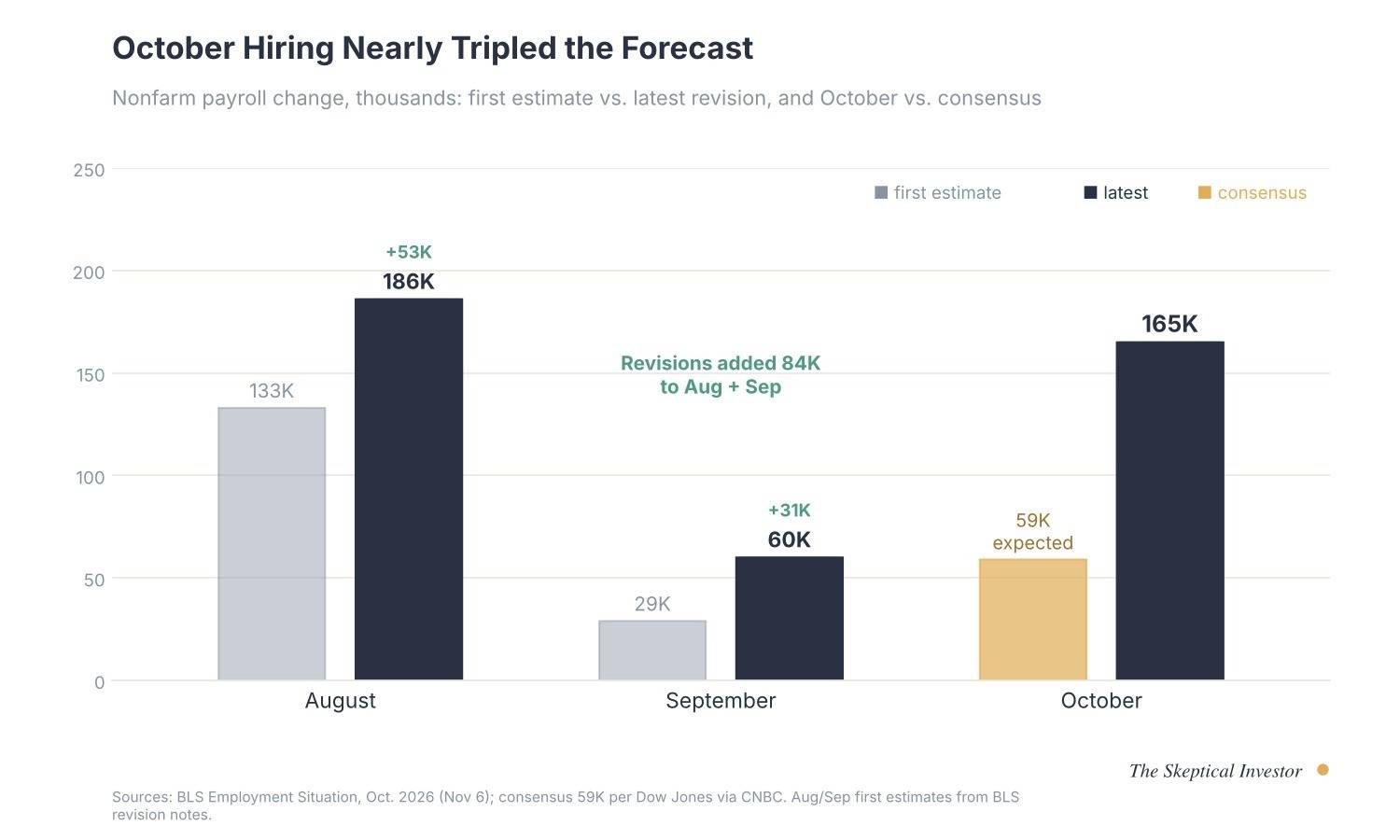
Sources: BLS Employment Situation, October 2026 (released Nov 6); consensus of 59,000 per Dow Jones via CNBC. First estimates for August and September from the BLS revision notes.
Workers are feeling “safe” to quit their jobs. Renters aren't quitting their apartments.
In September, 3.4 million workers quit their jobs, up 321,000 from August and 375,000 from a year earlier, while employers listed 7.5 million openings, including 298,000 in construction (BLS JOLTS). Quits are the economy's confidence gauge: people leave a job when they are fairly sure they can find a better one.
Dynamo is not too strong a word for a labor market that produces that kind of momentum.
Let’s overlay that on the apartment business. At MAA, the largest apartment owner in the Sun Belt, resident turnover over the past year fell to 39.6%, and the share of residents moving out to buy a house fell to a record low of 10.1% (MAA Q3 release, SEC). Workers feel free to change employers; renters, priced out of buying at a 7% mortgage rate, appear to feel stuck where they are. The combination of a tenant with a rising paycheck and nowhere obvious to go allows landlords to raise rents. (Keep reading, it’s the subject of this week's deep dive.)
Now, I wrote in May that the labor market, not inflation, would decide where rates go. Traders agree: after Friday's report, fed funds futures put the odds of a quarter-point rate increase at the Fed's Dec. 9 meeting at 82.5%, up from about 75% a week ago (CME FedWatch).
I still think the oil-driven part of inflation fades and rates follow it lower, but a hot jobs market buys the Fed time.

Source: BLS Employment Situation, October 2026. Government figure via Fox Business citing BLS. Construction employment was little changed; BLS published no figure.
The Steelman: The Job Market May Be Less Healthy Than It Looks
The best case against reading too much into October starts with paychecks. Wages rose 3.1% over the year, while consumer prices rose 3.7% in the year through September (BLS; BLS CPI via DOL), which means the typical worker's raise still buys less than it did a year ago. A renter whose real income is shrinking is not a renter who can absorb a 4.5% renewal increase indefinitely, whatever the payroll count says.
The second point is the one I make to myself every month: one month is one month. Before October, the economy had been averaging 48,000 jobs a month over the past year (ZForex, citing BLS), and consumer sentiment, while improving, sits at 51.0, the same level as a year ago (University of Michigan). I need a second strong month before I call this a turn, and a third before it means something.
The Loyalty Tax: Landlords Are Charging Their Best Tenants for the Ones Who Leave
America's largest landlords are discounting rents for new tenants and charging more to current residents.
Picture two neighbors in the same building at an MAA community this fall, in identical units. One signed a lease in September as a new resident and, on average, paid 6.0% less than the previous tenant in that apartment. The other had lived there for a year, kept the place clean, paid on the first of every month and renewed, and paid 5.3% more (MAA Q3 release, SEC). That 11.3-point spread is wider than in either of the two previous third quarters (calculated from MAA's releases), and it is not peculiar to one company. Look across the industry's third-quarter reports and the same shape appears almost everywhere the supply wave hit.
The Same Pattern, Five Times Over
Camden, the Houston-based apartment REIT, reported new leases down 2.0% and renewals up 3.6% in the third quarter, and said its December and January renewal offers are averaging increases of 4.5% (Multifamily Dive). Independence Realty Trust posted new leases down 0.6% and renewals up 4.6%, with resident retention climbing to 60.5% (IRT Q3 call transcript). The single-family landlords show the same pattern on a smaller scale: Invitation Homes raised renewals 4.3% while new leases slipped 0.2% (Invitation Homes Q3 release), and AMH raised renewals 3.3% against new leases up 1.0% (AMH Q3 release).
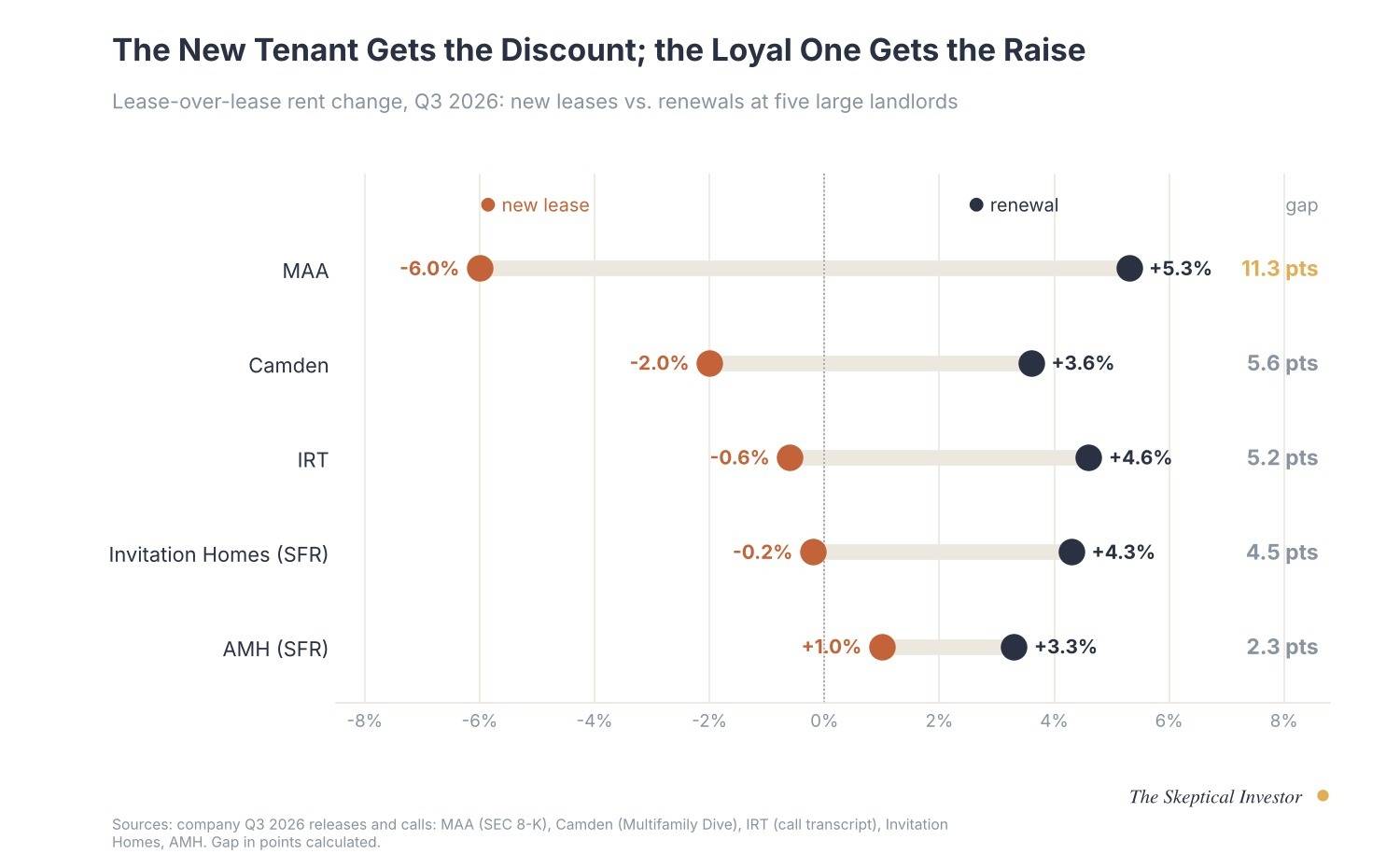
Sources: Q3 2026 company releases and earnings calls: MAA (SEC 8-K), Camden (Multifamily Dive), IRT (call transcript), Invitation Homes, AMH. Gaps calculated.
Headline numbers hide all of this. MAA's blended rent growth, the figure most investors glance at, was a placid 0.4%. Camden's was 1.0%. Read only the blended line and you would conclude that the apartment market has gone quiet. Read the two components and you see something more interesting: landlords look weakest exactly where tenants have choices, on the new lease, and strongest where tenants feel stuck, on the renewal.
The gap is also not standing still. At MAA, renewals rose 4.1% and new leases fell 5.4% in the third quarter of 2024, a spread of 9.5 points. A year later it was 9.7 points. This year it is 11.3 (calculated from MAA's releases and its stated year-over-year changes).
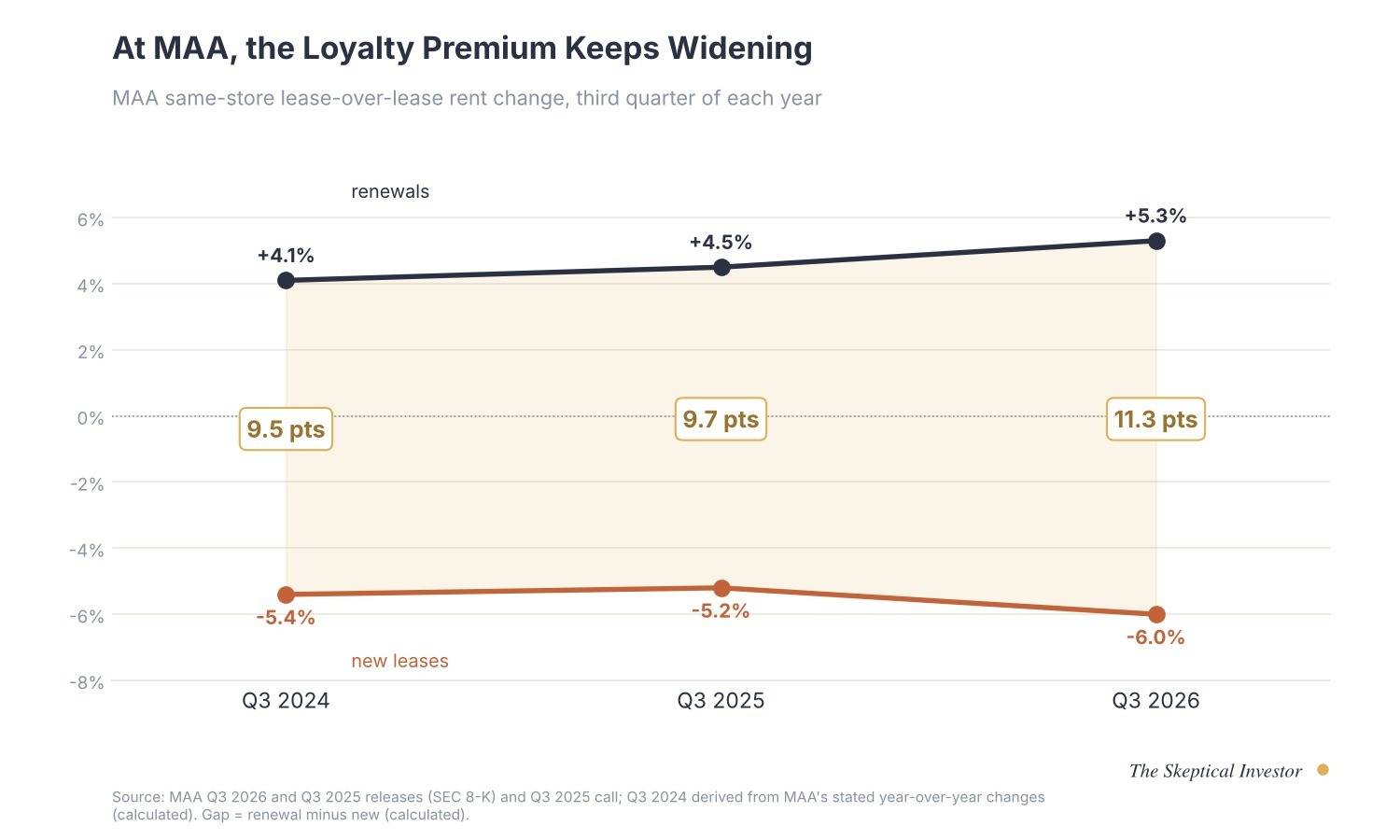
Source: MAA Q3 2026 and Q3 2025 releases (SEC 8-K) and Q3 2025 earnings call; Q3 2024 derived from MAA's stated year-over-year changes. Gaps calculated.
Why the Stayers Pay
Landlords can charge loyal tenants more for the oldest reason in commerce: moving is expensive, and everyone knows it. A renter who leaves pays for movers, application fees, a new deposit and a lost weekend, and in the torpor of today's housing market the obvious escape route, buying a house, is mostly closed. Pending home sales in the four weeks through Nov. 1 were down 16.4% from a year earlier, a record low in Redfin's data (Redfin). I described this as the landlord's moat back in August; the moat has gotten wider since.
New residents, by contrast, are being courted with every tool in the shed. Camden's chief executive, Alex Jessett, called concessions "incredibly sticky," ranging from three weeks free in West Palm Beach to two months in Austin, and its operating chief named Denver and Nashville as the markets where concessions have been most persistent (Multifamily Dive). Nashville, a city I love and invest in, is in the middle of a murrain of free rent, the hangover of a construction boom I have written about many times. Landlords have to discount to fill a building that opened last spring; they do not have to discount to keep a tenant who has lived in one for three years.
There is also a quieter income stream riding along with the renewal. IRT said its "other property revenue" grew 16% from a year earlier, led by $2.3 million of Wi-Fi fees (IRT Q3 call transcript). Bundled internet can be a fair service at a fair price. It is also the kind of line item a tenant notices only after signing, and the kind critics point to when they describe the industry as rapacious.
What It Does to the Building You're About to Buy
When a seller hands you a rent roll, the in-place rents on that roll include every tenant who has renewed at 4% or 5% above what the unit across the hall just leased for. That is not market rent; it is loyal-tenant rent. The day one of those tenants moves out, the unit resets to the new-lease price, minus whatever concession it takes to fill it.
On a stabilized Sun Belt building, the difference may be modest in any one month and large over a hold period. If a third of the units turn over each year, roughly MAA's turnover rate, and each turn resets the rent 6% to 11% lower than the departing tenant was paying, the building's income can drift down for a year or two even while the market "stabilizes" (calculated, illustrative). Lenders and buyers who capitalize the trailing twelve months of in-place income at a 5.5% cap rate are paying for a premium that disappears on turnover. Underwrite at new-lease rents and treat today's renewal premium as a fillip, not a foundation.
The Arithmetic for Small Landlords This Winter
The big REITs can afford to price renewals aggressively because they own thousands of units, run pricing software and can absorb a vacancy without noticing. A small landlord copying their "renewal plus 4.5%" may be making an expensive mistake.
Take a $1,650 apartment, about MAA's average rent in Nashville (MAA supplemental). Renew the tenant at 4.5% and you collect $20,691 over the next year. Renew at the same rent and you collect $19,800. Lose the tenant and, with one month vacant, a $1,500 make-ready, two weeks of free rent and a new lease 6% lower to match the market, you collect about $14,786 (calculated). The raise is worth $891. The vacancy costs roughly $5,000 to $5,900.
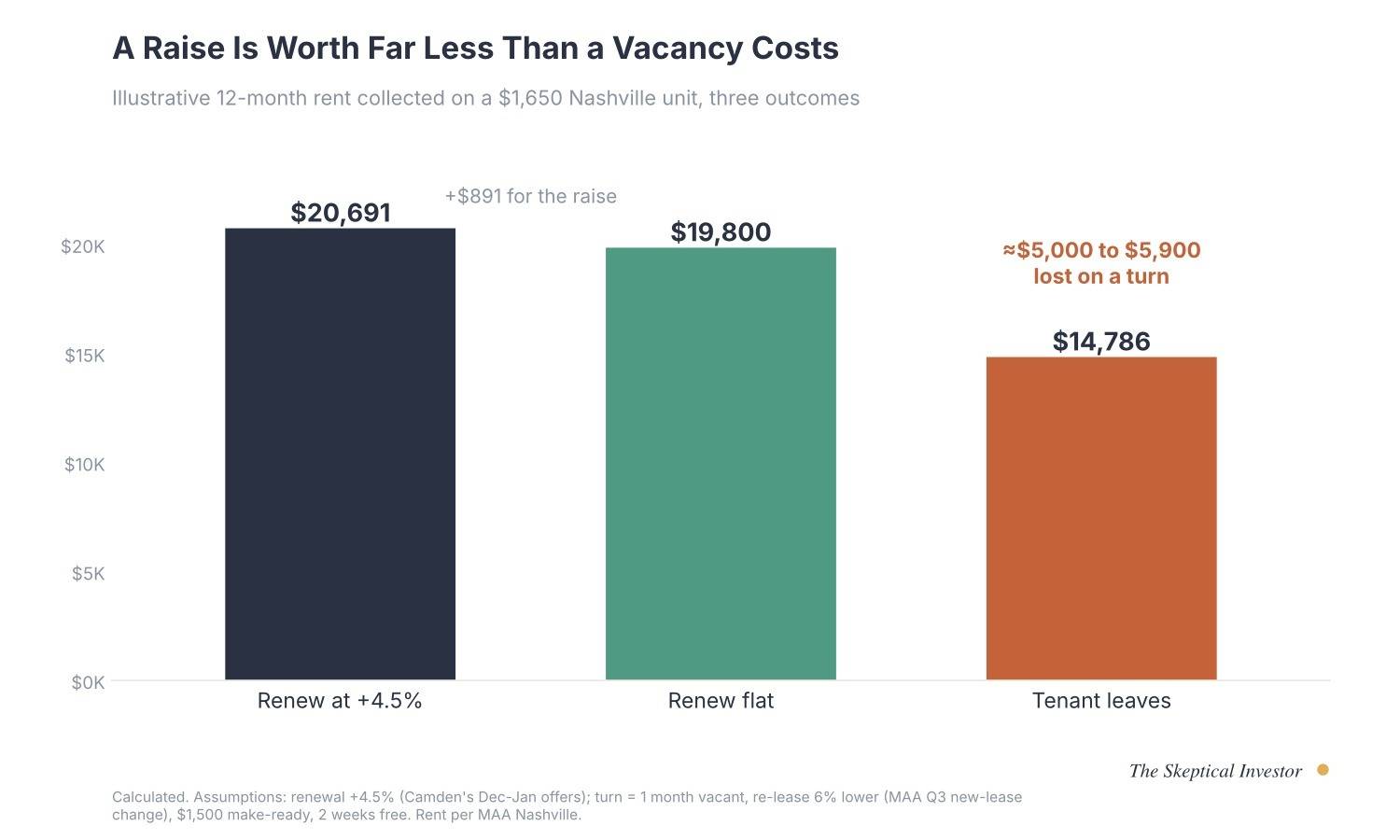
Calculated, illustrative. Assumptions: renewal at +4.5% (Camden's Dec–Jan offers); a turn means one month vacant, a new lease 6% below the old rent (MAA's Q3 new-lease change), $1,500 make-ready and two weeks free. Rent level per MAA's Nashville average.
Put differently, a 4.5% raise pays for itself only if it raises the odds that your tenant leaves by less than about 15 percentage points (calculated). For a good tenant in a market where the building down the street is offering six weeks free, that is not a comfortable margin.
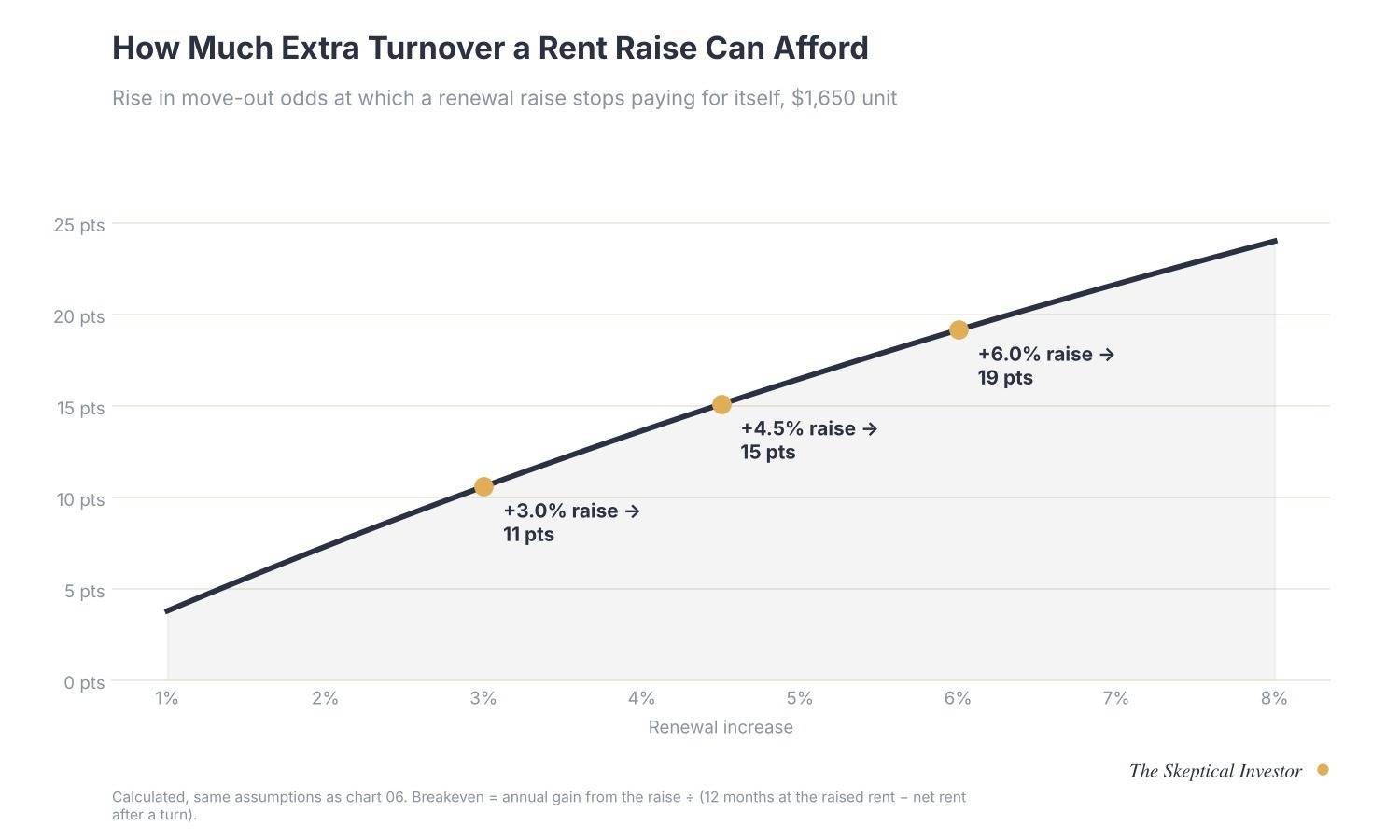
Calculated, using the same assumptions as the chart above. Breakeven = annual income from the raise divided by the income lost on a turn.
Every investor I respect treats a good tenant as an asset on the balance sheet, not a source of incremental revenue to be squeezed, because turnover is the quiet thing that stalls cash flow. If you want a practical playbook for renewals, screening and keeping good residents, The Book on Managing Rental Properties by Brandon and Heather Turner is a good place to start.
So this winter, give your inveterate renewers, the tenants who pay on time, call before a small problem becomes a large one and have lived in the unit for years, a flat renewal or something close to it. Move tenants who are paying well below the new-lease rate up gradually. A raise that pushes a good tenant out the door is not a rent increase; it is a $5,000 expense.
Where the Politics Goes Next
Bills that go unexplained tend to get legislated. Berkeley's Measure X, which caps annual rent increases at 10% and is aimed at landlords who "bank" allowable increases and impose them all at once, appeared to be passing in early returns (KQED). In Nevada, Gov.-elect Aaron Ford supports banning algorithmic rent pricing, which he calls price fixing, and housing economist Jay Parsons calls the state the place where the midterm results matter most for rental housing. Renewal offers generated by software are an easy target, and "rapacious landlord" is an easy campaign line. Tennessee looks different: Parsons groups Gov.-elect Marsha Blackburn with leaders emphasizing supply rather than rent rules. That is one more reason I like owning here.
Voters Sent Their Own Bill to the Newcomers
Landlords are not the only ones who have noticed that the people with the least leverage are the easiest to charge. Voters noticed, too.
Florida's Amendment 3 passed with 62% of the vote, two points above the 60% it needed, raising the non-school homestead exemption to $150,000 in 2027 and $250,000 in 2028 (NBC Miami). The newcomer toll I wrote about last week survives: anyone who establishes a Florida homestead after Dec. 31, 2026, gets a $50,000 exemption for five years before graduating to the full amount (Kaufman Rossin). The second measure on the same ballot, a tax break for farm equipment, fell short at 58.25%.
Tennessee's Amendment 2, which writes a ban on a state property tax into the constitution, passed with about 67%, unofficially (Ballotpedia). It is symbolic, since Tennessee has not levied one since 1949, but it is one more line in the carrying-cost comparison that keeps tilting toward this state.
Elsewhere, voters balked when the hole in the budget was obvious. Wyoming rejected a 50% exemption on home values with only 41.75% voting yes (Cowboy State Daily), and Oklahoma voted down tighter assessment caps, while North Carolina approved a limit on future local levies (Reason). Local voters also rejected data centers in all but two of 41 measures on the ballot (Reason).
The pattern is the same one running through the rent rolls: the tax cut passes when someone else seems to be paying for it. In Florida, that someone is the newcomer, the renter and the landlord who owns where he does not vote.
My Skeptical Take:
Every business eventually learns what its customers will tolerate, and every customer eventually learns what the business is counting on.
This fall, the apartment industry appears to have learned that its most loyal customers will tolerate a great deal. They are working, their wages are rising, the house they hoped to buy is out of reach and moving is a nuisance. So the bill for the industry's oversupply, the free months and the lease-up discounts, is quietly being sent to the tenants least likely to object. Voters in Florida did something similar with property taxes, handing the cost of their own relief to people who have not arrived yet.
Neither arrangement is scandalous. Both are a matter of leverage. And leverage has a way of changing hands.
When it does, the owners who priced loyalty as a revenue source will discover it was a liability, and the owners who protected it will have a building full of tenants who never thought about leaving. I would rather be the second owner.
So here's how I'm operating:
If you own rentals: price your renewals off what a turn costs you, not off what the REITs are sending out. A flat renewal for a great tenant is often the highest-return decision you will make all year.
If you're buying: underwrite at new-lease rents and today's 7.2% rate, and ask the seller for the renewal and new-lease history by unit. The gap between them is a negotiating tool.
If you're selling: the premium in your rent roll is real today and may not be in two years. That is an argument for selling into it, not waiting.
Sam Walton built the largest retailer in the world on a principle that landlords would do well to tape to the refrigerator. Among the ten rules for building a business he set down near the end of his life:
Your tenant is your customer.
Keep the good ones.
Then go find the next building.
Until next time. Stay Curious. Stay Skeptical.
Herzliche Grüße,
-The Skeptical Investor