Technology · Vancouver, BC · Member since 2026 · 312 posts · 89 votes
I think every landlord has one repair they kept paying for long after they should have stopped.
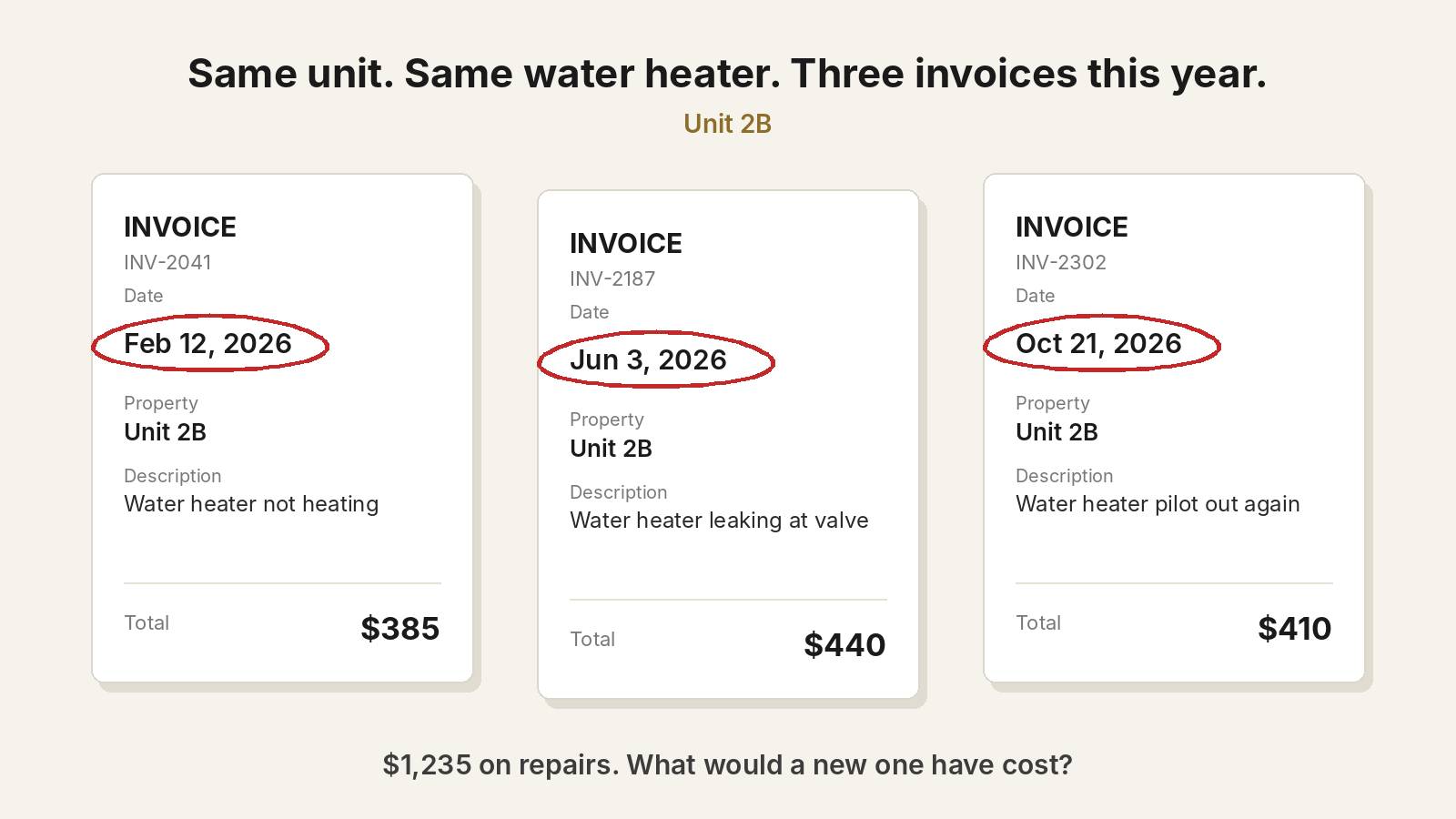
It usually isn't one big bill. It's the same water heater, the same unit and the third invoice this year. Each fix looks reasonable on its own, so nobody stops to add them up.
Here are the questions I'd want answered before approving the next repair on something that keeps breaking:
What have we spent on this item in the last 12 months, including the service calls?
How old is it, and how long does this kind of equipment usually last?
What would a replacement cost, installed?
Is the repair fixing the cause, or just the symptom again?
What would the next failure cost if it happened with a tenant living there?
The hard part is usually the first question. The invoices are spread across emails, vendor portals and owner statements, so the full number is rarely in one place. Pulling a year of invoices together by unit is the kind of reading AI handles really well, and it makes the pattern obvious. The decision itself still belongs to the owner.
I'm curious, what's the repair you kept paying for, and what finally made you replace it?
Lee, your five questions are the right test, and the first one is the one most owners never actually answer — because, as you said, the invoices are scattered everywhere. The rule I share with owners is simple: add up what you have spent on that item in the last twelve months, and if it is approaching half the cost of a replacement, or the equipment is already past its expected life, stop repairing and replace it. A water heater that has failed three times is not just costing three invoices — it is costing emergency calls, tenant frustration, and the risk of a failure that floods a unit. I also keep a simple list for every property from day one: the age of the roof, the HVAC, and the water heater, so the replacement decision is planned instead of panicked. Your framework turns a feeling into a number, and that is exactly what owners need.
Not a landlord story, but I see this a lot from the software side. I’ve set up systems for property management companies, and the reason this happens is usually that nobody can see the pattern.
Each invoice gets paid and filed on its own, so the third water heater repair looks just as reasonable as the first one did.
The companies that catch it early are the ones that file every invoice against the specific unit and appliance. Then you look back and it’s obvious, like oh, we’ve spent $900 on this thing this year, just replace it.
Curious what everyone else ends up with though. My guess is water heaters win.
Thank you for being the first to jump in. Filing every invoice against the unit and the appliance is such a simple habit, and I think you're right that it's exactly what turns three separate bills into one obvious pattern.
I have a feeling you're right about water heaters, too. I'll be curious to see whether anyone can beat them.
Lee, your five questions are the right test, and the first one is the one most owners never actually answer — because, as you said, the invoices are scattered everywhere. The rule I share with owners is simple: add up what you have spent on that item in the last twelve months, and if it is approaching half the cost of a replacement, or the equipment is already past its expected life, stop repairing and replace it. A water heater that has failed three times is not just costing three invoices — it is costing emergency calls, tenant frustration, and the risk of a failure that floods a unit. I also keep a simple list for every property from day one: the age of the roof, the HVAC, and the water heater, so the replacement decision is planned instead of panicked. Your framework turns a feeling into a number, and that is exactly what owners need.
Thank you for this. The half the replacement cost rule is such a clean way to make the call, and I think it takes a lot of the emotion out of a decision people usually end up making in a hurry.
I really like the idea of writing down the age of the roof, the HVAC and the water heater on day one. It means the owner sees the replacement coming years ahead, instead of finding out on the worst possible day.
Lee, at 236 doors the one that taught us the lesson was a dishwasher that got a new pump every few months. Each fix was cheap, but every visit was a truck roll, a tenant without a working kitchen, and a unit that couldn't turn on time. The math that settled it for us: add up the repeat repairs and the days the house sat, not just the invoice. Turnover and vacancy cost more than repairs, so if a part has failed twice, we replace the unit during the turn and move on. We also stopped deciding this in the moment — the turn scope gets set at inspection, the contractor is already tested in small paid steps, and the 21-day clock is running. A cheap repair that keeps a house empty is the most expensive one we own.
On one renovation we decided not to replace the old plugs, because the workers had none with them and the store was 40 minutes away. One rusty plug burst, and we repainted almost the whole first floor at our own cost 🙂
Since then the rule is simple: when the wall is open, every old fitting next to the work gets replaced.
In your experience, is the repeat repair usually the appliance itself, or the small part next to it?
That's a painful way to learn it, but it's a really good rule. Once the wall is open, the labor is already paid for, so the old fitting next to the work is the cheapest it will ever be to replace.
From what owners share here, I think it's more often the small part next to the appliance. The shutoff valve, the supply line or the drain connection is usually older than whatever was just installed, and it gets left alone because it isn't leaking yet.
I'd add one line to every plumbing work order asking the plumber to note the age and condition of the valves and lines within reach. It costs almost nothing while they're already there, and it gives the owner a short list of what to replace the next time the wall is open.
@Lee Futcher, a work order line like that saves an argument a year later 🙂
One small addition: write the note for the next person, not for the invoice. "Shutoff under the sink, original, stiff" tells the next plumber more than "checked, OK".
From what you see here, where does that note usually end up: in the plumber's invoice, or in a file the owner keeps?
From what landlords tell me while I build budgeting tools, a lot of 'one more repair' calls happen because there's no cash set aside for the replacement, not because the math favors repairing. Then it dies anyway and you pay emergency pricing with a tenant waiting.
Lee, the change that helped us most was putting the math inside the approval request itself. When a vendor quotes a repair on something that already failed once this year, the note to the owner has three lines: what we have spent on that item in the last 12 months including trip charges, the installed replacement quote, and our recommendation. Owners decide faster when two numbers sit side by side, and nobody approves the third repair out of habit. If the unit is occupied, we also ask the vendor to price the replacement as a scheduled visit, because a planned install on a Tuesday costs less than the emergency call at 9 PM. We manage rentals in the south and southwest Chicago suburbs through M Property Group LLC, and I have personally been doing this since 1991, so a repeat repair list is one of the first things I look at each month.
Putting the 12-month spend and the installed replacement quote side by side in the approval request is such a clean way to stop the third repair from getting approved out of habit. Two numbers next to each other make the decision for most owners.
The scheduled replacement point is a good one, too. A planned install on a Tuesday costs less, and the tenant gets a heads-up instead of a broken appliance at 9 PM.
One thing that could make it even easier is adding the age of the unit and its expected life as a third line. When an owner sees a water heater past its expected life sitting next to the repair history, the recommendation almost explains itself.
Good add, Lee. Age against expected life is the missing third line. A water heater in year 11 with two tickets already on it makes the call before the owner even reads the quote. When the install date is unknown I mark the age as an estimate so nobody treats a guess as a fact. Thanks for the push on this one.
That's about as clear an answer as anyone could give. Dishwashers, washers and dryers seem to be the ones where a repair buys a few months at best, and a big box warranty takes a lot of the guesswork out of the next failure, too.
That's a really good point. The repair-or-replace math only helps if the money for the replacement is actually there, and without a reserve, one more repair can feel like the only option even when the numbers say otherwise.