First Potential Rental (Listed at $1mil) at 20 years old

First Potential Rental (Listed at $1mil) at 20 years old

Member since 2019 路 13 posts 路 1 vote

Hello everyone!! This is my first post on bigger pockets and I just wanted to pick everyones brain about my first potential rental property.

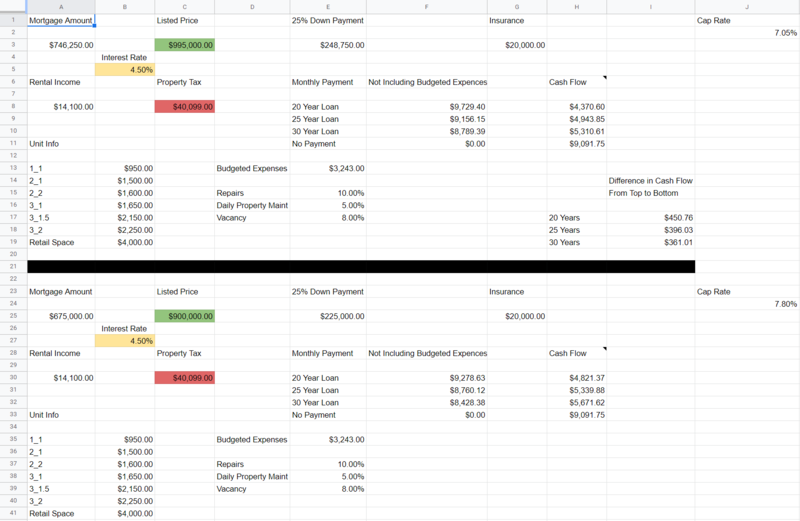
This property has 2 homes on it, one home has 3 residential rentals in it, the other has 3 residential units and 1 commercial space. As I mentioned in the description, the listing price is currently at $995,000. It was originally listed for $1.3 mil on 07/19 and with-in 2 months they dropped the price 3 times to what it is currently at. All 7 units are currently rented for a total rent of $14,100/month. The total property tax for both homes is $40,099/year, and the one home is in a flood plain, so I need to purchase flood insurance and the listing agent told me that runs about $20,000/year for this home.

I'm someone who struggles with analysis paralysis and over analyzing my spreadsheets. I'm mostly writing on here to see if other people would consider purchasing this property with the details given. If you would consider it, would you offer asking price or throw a kind of low ball offer at like $850,000?? I want to lean on the side of offering asking price cause how could they say no to that; and also when you do the math on the month-to-month income, it only comes out to be like a $500-$600 dollar difference in monthly cashflow. I'm scared to offer something like $850,000 and loose the deal all for a couple hundred bucks more a month, this already seems like a pretty big home run. I'm only 20 years old, never bought a rental property before, have a ton to learn and just seeking some advice from those who are more experienced. Thank you so much for taking the time to read this, I really appreciate it!!
0Reply
18 views

Most Popular Reply

Real Estate Investor 路 Milford, PA 路 Member since 2014 路 395 posts 路 299 votes
5y

Kaden never be embarrassed to ask for clarity. It's the only way to learn. 

I tip my hat to your father in-law. I was the first class hired after the 11th. I still remember my very first day, October 28th. Some really big shoes to fill. God Bless him.

Caps can get complicated but the real "simple" explanation is this.

Commercial property whether it is office space, storage, Multifamily, mixed used, etc. they all produce income. They all have cost to run them which is your operating expenses (OPEX).

You minus your expenses from your income and you are left with your Net Operating Income (NOI) Now here is where cap rates come in. Depending on your market and your asset type there will be cap rate that specific asset type in that market trades at. So a Multifamily in Virginia Beach may trade at a 7 cap where as in NYC it may be a 5 cap.

The formula to find the cap rate is NOI / Value = cap rate. If you know two you can always find the third.

NOI / Value = Cap Rate

Cap Rate * Value = NOI

NOI / Cap Rate = Value

So on your property they are receiving 169,200 in annual rent (14,100*12) from that you subtract expenses for this example we will say they have 50% expenses or 84,600. This leaves us with an NOI of 84,600 ( remember noi=income-expenses)

Now we take that 84,660 / 995,000 = 8.5% or an eight and a half cap.

The cap rate is never really determined until you and the seller agree on a sales price. When using it in conversation it will go something like "Class B properties are trading at a 6 cap". It gives you a reference point.

Lastly if you were to purchase this property all cash for 995,000 and that property returned to you 84,600 annually then the property would return 8.5% annually to you. Is the risk you are taking in investing in the property worth an 8.5% return? 

See this reply in the discussion

9 Replies

Jump to latestLatest
  • Real Estate Investor 路 Milford, PA 路 Member since 2014 路 395 posts 路 299 votes
    5y

    Kaden I applaud you looking at properties at 20. Good for you.

    I would build my buying criteria BEFORE I look at properties. In doing so you can take the emotion out of it. For example I look for 12 to 75 doors 1960 or newer more two bdrms then one bedrooms 10-15% up side in rents, NOT in a flood plain and in a "safe" area. 

    Now you may not hit every one of those but that's a starting point. For me flood zones are a deal breaker. Flood insurance can change year to year and it's just to much of an unknown for me. Next is the rent upside I need be able to push rents or lower expense's in order to hit my return metrics.

    I would caution leaving 500 a month on the table. That's 6,000 annually and at a mere 10 cap you are talking about 60,000 and at a 7 cap it's 85,000 in value you are leaving on the table so it's not 500 it's 60 to 85K. Also keep in mind that when things go sideways you are going to potentially need that 500 a month in cashflow.  

  • Member since 2019 路 13 posts 路 1 vote
    5y

    Thank you @Neil Schoepp for getting back to me and giving me a little insight on flood insurance. I didn't know the rate fluctuations so much. Also I saw on your page that you were with the FDNY, my wife's father was one as well, but unfortunately passed during the 9/11 incident 馃様馃檹  This is slightly embarrassing to say, and I've tried to do so much research on it to understand, but I don't understand what exactly you mean by 10 cap and 7 cap. I don't understand "caps" in general.

  • Real Estate Investor 路 Milford, PA 路 Member since 2014 路 395 posts 路 299 votes
    5y

    Kaden never be embarrassed to ask for clarity. It's the only way to learn. 

    I tip my hat to your father in-law. I was the first class hired after the 11th. I still remember my very first day, October 28th. Some really big shoes to fill. God Bless him.

    Caps can get complicated but the real "simple" explanation is this.

    Commercial property whether it is office space, storage, Multifamily, mixed used, etc. they all produce income. They all have cost to run them which is your operating expenses (OPEX).

    You minus your expenses from your income and you are left with your Net Operating Income (NOI) Now here is where cap rates come in. Depending on your market and your asset type there will be cap rate that specific asset type in that market trades at. So a Multifamily in Virginia Beach may trade at a 7 cap where as in NYC it may be a 5 cap.

    The formula to find the cap rate is NOI / Value = cap rate. If you know two you can always find the third.

    NOI / Value = Cap Rate

    Cap Rate * Value = NOI

    NOI / Cap Rate = Value

    So on your property they are receiving 169,200 in annual rent (14,100*12) from that you subtract expenses for this example we will say they have 50% expenses or 84,600. This leaves us with an NOI of 84,600 ( remember noi=income-expenses)

    Now we take that 84,660 / 995,000 = 8.5% or an eight and a half cap.

    The cap rate is never really determined until you and the seller agree on a sales price. When using it in conversation it will go something like "Class B properties are trading at a 6 cap". It gives you a reference point.

    Lastly if you were to purchase this property all cash for 995,000 and that property returned to you 84,600 annually then the property would return 8.5% annually to you. Is the risk you are taking in investing in the property worth an 8.5% return? 

  • Member since 2019 路 13 posts 路 1 vote
    5y

    @Neil Schoepp okay that's starting to make sense, thank you for taking the time to explain that. So when your owning something, the higher the cap rate the better? Cause that would mean a higher NOI to divide by the value of the home right? Just trying to make sure I understand haha

  • Member since 2020 路 1 post 路 0 votes
    5y

    Yes, higher CAP is better. An easy way for me to evaluate is start with the NOI, for example let's say $100,000. At a 10 cap the value of the property would be $1,000,000. As the CAP goes down, the price of the property goes up.

  • Member since 2019 路 13 posts 路 1 vote
    5y

    @Neil Schoepp  this is what my spread sheet looks like, the top and bottom graph are exactly the same other than the purchase price. If a property you were looking to purchase needed little to no repairs, and your spreadsheet looked like this would it be something you would consider buying? Is there anymore information you would factor into your spreadsheet?

  • Real Estate Investor 路 Milford, PA 路 Member since 2014 路 395 posts 路 299 votes
    5y

    @Kaden Fascella As far as cap rates go when you are an owner you favor lower cap rates. A buyer favors higher cap rates. When cap rates are declining the are compressing. Pretend you had an NOI of 100,000 and you had a 10 cap the property value would be 1M. Now take the same NOI and use a 7 Cap The value changes to 1.42M.

  • Member since 2019 路 13 posts 路 1 vote
    5y

    @Neil Schoepp okay yeah I get that, thank you for taking the time to explain that, I finally understand what people mean by a cap rate.

  • Real Estate Investor 路 Milford, PA 路 Member since 2014 路 395 posts 路 299 votes
    5y

    @Kaden Fascella  There are plenty of underwriting templates out there below is a basic one. I would itemize the expenses and break them out per unit (the J column) as you underwrite more and more in your market you will get to know if for example cell J 42 (insurance) at 457 is avg. below or above. I would add closing cost. I allot for 2-3% of my bid price. Cap ex @ 350 per door.

    Property Maintenance looks low. I would plan on 10% unless you are actually talking to a PM and they are giving you 5.  Always ask about additional cost like evictions, lease sign ups, being on site for maintenance calls, etc. You can absolutely build your own spreadsheet to analyze properties. If you are comfortable in excel I actual suggest you do so because it makes you much more familiarized with which numbers affect which numbers and your spreadsheet will grow as you do. If you are not so inclined to do so and would rather purchase one then https://www.themultifamilyanal... is the one I would use. It's way more then you would need to purchase a smaller MF but you will never need another one again. I use both the below and this one exclusively.  

    But the thing that immediately jumps out at me is you state taxes are 40K a year. that's roughly 3300 a month yet you have your expenses listed at 3200. from what I can see it's looking like your expenses per month are going to be 8200 monthly 3200 listed expenses + 3300 taxes) + 1700 (flood). i would expect them to be higher after you really drilled down on the numbers. 

Join the conversationCreate a free account to reply, vote on answers and follow this thread.