https://www.biggerpockets.com/...
The latest podcast touting getting seller to carry notes at 0 interest rates. The IR doesn't like that because interest is taxable as income where the higher price and no interest pays capital gains. At this point it is really low so no big deal but should be mentioned.
@Jay Hinrichs barely registers the needle at this point. If done then worth renegotiating at some point for a big discount. With rates so low maybe can sell at a reasonable discount
with zero interest the term of the note is very short term 3 to 5 years so to find PV of the note the discount to the seller to achieve a 12% return for the investors is not as bad as one might think. but we hold ours.
https://www.biggerpockets.com/...
The latest podcast touting getting seller to carry notes at 0 interest rates. The IR doesn't like that because interest is taxable as income where the higher price and no interest pays capital gains. At this point it is really low so no big deal but should be mentioned.
Not sure if this is touted as some new way to finance.. but data point I used zero interest seller carry backs starting in the early 80s.. when rates got to 18% and I had Saudi clients that were not allowed to pay interest per their religious doctrines. We killed it.
even to this day this is how I sell off some of my OREO props.. I have never had a zero interest seller carry back default . Yes you have imputed interest you have to pay.. so your paying some small amount of tax on money your not collecting.. but U can usually sell for a premium.
@Jay Hinrichs barely registers the needle at this point. If done then worth renegotiating at some point for a big discount. With rates so low maybe can sell at a reasonable discount.
@Jay Hinrichs barely registers the needle at this point. If done then worth renegotiating at some point for a big discount. With rates so low maybe can sell at a reasonable discount
with zero interest the term of the note is very short term 3 to 5 years so to find PV of the note the discount to the seller to achieve a 12% return for the investors is not as bad as one might think. but we hold ours.
I am wondering from a buyers perspective, it is better to have higher buying price or higher interest? Assuming no prepayment penalty, the property can be refinanced. A higher buying price means you basically want to hold the 0 percent as long as you can. No interest also removes a tax deduction, but increases depreciation expense (assuming that is the trade off). From a sellers perspective, 0 percent is fine as long as they understand IRS imputed interest rules. Unfortunately many sellers believe 0% just means they pay no taxes on interest. This is why it is best if any seller financing agreements are drafted by an attorney and reviewed by an accountant. Sometimes sellers also fail to record the mortgage, which is a much bigger issue if the buyer stops paying or even worse sells the property.
Well I think it was 1982 that I learned of inputed interest IRS rules.. so they have been around a long time. given that everything is done correctly this is a viable option for what generally is a weak selling area or a distressed property..
I am wondering from a buyers perspective, it is better to have higher buying price or higher interest? Assuming no prepayment penalty, the property can be refinanced. A higher buying price means you basically want to hold the 0 percent as long as you can. No interest also removes a tax deduction, but increases depreciation expense (assuming that is the trade off). From a sellers perspective, 0 percent is fine as long as they understand IRS imputed interest rules. Unfortunately many sellers believe 0% just means they pay no taxes on interest. This is why it is best if any seller financing agreements are drafted by an attorney and reviewed by an accountant. Sometimes sellers also fail to record the mortgage, which is a much bigger issue if the buyer stops paying or even worse sells the property.
Well I think it was 1982 that I learned of inputed interest IRS rules.. so they have been around a long time. given that everything is done correctly this is a viable option for what generally is a weak selling area or a distressed property..
You are pretty sophisticated on real estate and business topics. I was referring to the average investor. Whenever 0% interest comes up in the forums, it almost guaranteed that the person talking about it has never heard of imputed interest. Tax law in general is something most small investors and the average person knows very little about. All I was trying to say is people who don't have experience in seller financing should involve experts. I wasn't referring to you specifically, sorry if it came across that way.
I am wondering from a buyers perspective, it is better to have higher buying price or higher interest? Assuming no prepayment penalty, the property can be refinanced. A higher buying price means you basically want to hold the 0 percent as long as you can. No interest also removes a tax deduction, but increases depreciation expense (assuming that is the trade off). From a sellers perspective, 0 percent is fine as long as they understand IRS imputed interest rules. Unfortunately many sellers believe 0% just means they pay no taxes on interest. This is why it is best if any seller financing agreements are drafted by an attorney and reviewed by an accountant. Sometimes sellers also fail to record the mortgage, which is a much bigger issue if the buyer stops paying or even worse sells the property.
Well I think it was 1982 that I learned of inputed interest IRS rules.. so they have been around a long time. given that everything is done correctly this is a viable option for what generally is a weak selling area or a distressed property..
You are pretty sophisticated on real estate and business topics. I was referring to the average investor. Whenever 0% interest comes up in the forums, it almost guaranteed that the person talking about it has never heard of imputed interest. Tax law in general is something most small investors and the average person knows very little about. All I was trying to say is people who don't have experience in seller financing should involve experts. I wasn't referring to you specifically, sorry if it came across that way.
No I did not take it that way was just commenting on this as it seems there was a pod cast on it and maybe it was something that was brand new on how to sell property.. my point was at least for me I was doing these zero interst deals back in 82 and have done them ever since there is a time and a place for them.
Warren Buffet has a quote that is along the lines of Bad ideas are rarely just bad ideas, but rather good ideas taken to far.
I think this idea falls into that bucket. Along with things like DST, 1031 exchanges, wholeselling, syndication, buying tax liens, court house step auctions, the list goes. We see it all the time on BP where some tactical idea, a tool if you will, that has a use for a specific set of circumstances, gets blown out of proportion as a way to riches and is co-opted by people that don't 100% understand the implications, but will use it anyway and tell others to use it.
We see that here. This idea of 0% seller carry clearly has its uses as @Jay Hinrichs has laid out. I mean its not that crazy of an idea. But as with everything in life, it has its trade offs. One of them is Imputed Interest, which in today's rate environment and the size of deals that the podcast guest is talking about isn't a ton of money, but it also opens up a conversation about the ethics of getting a zero interest loan. Zero coupon bonds exist and are traded every day and the taxes aren't an issue, so it can work.
My personal opinion is, if it is two investors who know what is going on, like Jay and @Joe Splitrock and for whatever reason [I can't think of one off top of my head besides a halal loan] Jay wants to buy Joe's SFR rental that's worth $75k, but wants to do a balloon-like loan where he pays him $100k in five years, then go for it. The Yield to Maturity is 5%, which is a fair rate. Joe has an accountant and all will be well.
That story changes when you buy from a 79 year old grandmother who needs to sell her hoarder house so she can move into an assisted living closer to her kids. There here no way the guy at H&R Block who does her taxes will get Imputed Interest and the odds that the loan will be for $100k on the $75 home are approaching zero. Its more likely the loan will be for $75k and the term 25 years.
Sure it is legal, buyer beware ect, but it feels like this tool is ripe for abuse when used in the low dollar home space.
IDK, maybe I'm a pessimist.
@Bill F. I did not listen to the pod cast.. so not sure what context they were touting this or if it was some new never heard of before formula or system for real estate etc.
for me it was beneficial in very specific niches
1. Saudi clients in San Francisco that could not pay interest as stated and what I sold them was Land so these were 10 to 50k parcels same purchase price as a cash buyer.. terms were 30 to 48 months.. this gave me a very saleable note if needed and when rates at that time were in the 15 to 18% we sold a lot of land this way to all faiths. It was a simple PV of a note play.
2. sell my props I take back and did not want to rehab.. so I helped a lot of BRRR folks get some pretty good deals .. how would you like to bRRRR with none of your own cash and no interest accruing ??? the benefit to me is I could get fair market value of the asset without having to deal with some low balling wholesaler. So I picked up the wholesalers delta.
3. Lower value assets as you allude to thats where this works best.
@Jay Hinrichs #2 is a great idea; give to get, you give them what they don't have: extra cash that they can throw into the rehab and you get someone to take the risk of cleaning and rehabbing the home. Learn something new everyday.
The way the guy on the podcast talks about seller financing is basically you name the price, I name the terms, but without saying that and framing it in a way that he gives a better price than wholsellers.
He gives an example about how he offered a lady full asking price for her home [$100k] when everyone else was lowballing her with offers of $60-70k. But he names the terms, which were 0% interest for 20 years.
I don't need to tell you the PV of that is like $70-75k to keep up with inflation. If you talk HML rates of 7-9%, which is what this really is, now the PV is $40-50k.
Not the most upfront deal in my book, but he talks about it as if he set her free and solved all her problems.
Like you said @Bill F. he was negotiating some pretty long term no interest deals which makes great cash flow for him. If you are the seller you want short term like @Jay Hinrichs was doing 3-5 years.
@Jay Hinrichs #2 is a great idea; give to get, you give them what they don't have: extra cash that they can throw into the rehab and you get someone to take the risk of cleaning and rehabbing the home. Learn something new everyday.
The way the guy on the podcast talks about seller financing is basically you name the price, I name the terms, but without saying that and framing it in a way that he gives a better price than wholsellers.
He gives an example about how he offered a lady full asking price for her home [$100k] when everyone else was lowballing her with offers of $60-70k. But he names the terms, which were 0% interest for 20 years.
I don't need to tell you the PV of that is like $70-75k to keep up with inflation. If you talk HML rates of 7-9%, which is what this really is, now the PV is $40-50k.
Not the most upfront deal in my book, but he talks about it as if he set her free and solved all her problems.
not to throw cold water on the pod cast but 20 years of no interest U would have to get your PV calcs working and of course most sellers wont have a clue.. add in the inputed interest and that is most likely a one way deal and not a win win.. Myself I shoot for win win.
@Jay Hinrichs #2 is a great idea; give to get, you give them what they don't have: extra cash that they can throw into the rehab and you get someone to take the risk of cleaning and rehabbing the home. Learn something new everyday.
The way the guy on the podcast talks about seller financing is basically you name the price, I name the terms, but without saying that and framing it in a way that he gives a better price than wholsellers.
He gives an example about how he offered a lady full asking price for her home [$100k] when everyone else was lowballing her with offers of $60-70k. But he names the terms, which were 0% interest for 20 years.
I don't need to tell you the PV of that is like $70-75k to keep up with inflation. If you talk HML rates of 7-9%, which is what this really is, now the PV is $40-50k.
Not the most upfront deal in my book, but he talks about it as if he set her free and solved all her problems.
not to throw cold water on the pod cast but 20 years of no interest U would have to get your PV calcs working and of course most sellers wont have a clue.. add in the inputed interest and that is most likely a one way deal and not a win win.. Myself I shoot for win win.
I don't think its throwing cold water to call a spade a spade Jay. 100% that's not a win-win at all. He used this tactic to give the seller at best the same or at worst FAR less than others had offered, but dressed the offer up in such a way to make an unsophisticated buyer think she got a deal.
The worst part is that he then went on a podcast and bragged about it and the hosts were in awe of him.
Now I don't think either of them are bad people, I think they don't get time value of money, like most investors don't. But Brandon is a guy who writes books about this stuff, GPs a syndication, hosts the most well known RE podcast, so his heaping praise on this guy goes a long way to making this idea more mainstream.
@Jay Hinrichs #2 is a great idea; give to get, you give them what they don't have: extra cash that they can throw into the rehab and you get someone to take the risk of cleaning and rehabbing the home. Learn something new everyday.
The way the guy on the podcast talks about seller financing is basically you name the price, I name the terms, but without saying that and framing it in a way that he gives a better price than wholsellers.
He gives an example about how he offered a lady full asking price for her home [$100k] when everyone else was lowballing her with offers of $60-70k. But he names the terms, which were 0% interest for 20 years.
I don't need to tell you the PV of that is like $70-75k to keep up with inflation. If you talk HML rates of 7-9%, which is what this really is, now the PV is $40-50k.
Not the most upfront deal in my book, but he talks about it as if he set her free and solved all her problems.
not to throw cold water on the pod cast but 20 years of no interest U would have to get your PV calcs working and of course most sellers wont have a clue.. add in the inputed interest and that is most likely a one way deal and not a win win.. Myself I shoot for win win.
I don't think its throwing cold water to call a spade a spade Jay. 100% that's not a win-win at all. He used this tactic to give the seller at best the same or at worst FAR less than others had offered, but dressed the offer up in such a way to make an unsophisticated buyer think she got a deal.
The worst part is that he then went on a podcast and bragged about it and the hosts were in awe of him.
Now I don't think either of them are bad people, I think they don't get time value of money, like most investors don't. But Brandon is a guy who writes books about this stuff, GPs a syndication, hosts the most well known RE podcast, so his heaping praise on this guy goes a long way to making this idea more mainstream.
Ya I did not listen to the pod cast I dont really listen to any pod cast on real estate.. there are controversial subject matter just like marching Clayton Morris on a pod cast or touting wholesaling some like it some don't .. but we do all have to remember many many folks on this station their sole purpose in our industry is to get the absolute best deal they can for themselves with no regard to anything but their criteria or needs or wants.. So if this person who did the pod cast thinks his deal is great thats what sells.. so its only one side of the story and the other side does not get told.. other than what we discuss as the flip side of these deals. ??
@Bill F.@Joe Splitrock check out this thread that happened to me yesterday
Have you had a property stolen from you IE deed you did not sign (biggerpockets.com)
Jeff I think you will get a kick out of it too.. dont mean to tread on your thread..
I read that @Jay Hinrichs. I would be very sad about 40k.
Owe we wont lose it.. to me it was more like who risk criminal over 40k ? but then again people steal all sorts of stuff I guess
@Bill F. it is all about disclosure IMO. There is a value to this 20 year no interest note and that should be disclosed upfront rather down the road when she needs money. The property was worth far less for cash so it is her choice to do the note or take the wholesale value. If it is worth 60-70 cash not much of a property or area so she may have gotten the better end of the deal. They can negotiate cash for the note at any time so can work both ways for one another's benefit.
In all fairness to the presenter we don't know the details of what she does and does not understand. Just like an honest wholesaler who says to the seller hey look we need to make some money here and here are our numbers.
@Jay Hinrichs My days of listen to the BP podcasts are long since past. Only reason I read the transcript was to try and understand better what you and @Jeff S. we saying about Imputed Interest. Then I saw the 'you name the price, I name the terms' deal structure, did some math and figured out the deal was lopsided.
I get that greed and avarice sit in the core of most of us and bubble to the surface in some more than others. My real issue sits with the BP hosts for always being cheerleaders for their guests and not pushing back when they run across ideas like this. You'd think after they get bitten a few time, Clayton Morris, that guy in the early days who was active in the forums and went on the podcast, but defrauded a lot of people, they would change their process.
Jeff, I appreciate the glass half full mentality and maybe I'm the weird one here, but we know how much the note is worth and it is far less than the $70k she was getting offered in cash. And sure, she can sell the note, but the odds she knows that are vanishingly small, and even then, she'll get $30-40k on the $100k note when the buyer applies a normal discount rate.
@Jay Hinrichs that's a good one. I'm gonna tell my bank I don't pay interest either because my God and I don't like interest.
there are banks that set this stuff up for those that have religious doctrines .. I cant recall exactly how they do it but they do it.
It sure was a light bulb for me.. and I got very familiar with my PV function on my RE calculator until you run the PV you would be surprised .
for instance a 30 month Zero interest fully amortized note has he same cash value day one as a 15% 7 year note.. so in the day were we did land sales with seller carry back and our note version of BRRRR we always looked at what our note buyers wanted for a return then manipulated the terms to meet the note buyers goals.. And to be 100% frank about this.. It was when Datsun ( Nissans name before they changed it remember Datsun 240 Z ?) they were to my knowledge the first car company to offer 0% financing .. And I saw that and said well heck lets play with the numbers .. plus I at the time was working with this group of Suadi investors and were stumped on the no interest thing. So solve one problem make a bunch of sales.. And keep in mind this was the Carter years of 15 to 20% interest. So when I advertised 0 we just KILLED IT.. one year we sold over 500 parcels.. not me personally of course but in our real estate company.. And my family owned them all.
That is cool stuff @Jay Hinrichs. When I bought my Camry in 2011 they offered $1,000 rebate or zero interest for 5 years. Took the payments.
Guess someone should verify those number @Bill F. If the note is only worth 30k then a rip for sure. Easy deal to undo though. One lawyer call and back to ground zero.
That is cool stuff @Jay Hinrichs. When I bought my Camry in 2011 they offered $1,000 rebate or zero interest for 5 years. Took the payments.
Guess someone should verify those number @Bill F. If the note is only worth 30k then a rip for sure. Easy deal to undo though. One lawyer call and back to ground zero.
with out running the numbers I can tell you a zero % note from an investor buyer who is probably on top of this financing putting very little down and probably not providing a lot of financial data for the seller to consider ( guess on my part i could be wrong). that is 20 years in length to sell it even for a modest 10% return which is about as low as most note investors go.. I suspect the PV of that note today is work one heck of a lot less than the cash no risk the seller could have taken.. I would not be surprised if that note is only worth 20 to 30k today.. compared to the 70k in cash the seller could have gotten then had NO following risk.. and that does not include imputed interest the seller will have to pay on top of all this. As I stated the zero interest works in my mind of distressed assets low value and very short term 5 years or less they own it free and clear and your paid out.
Thank you @Jay Hinrichs for your very qualified opinion. That does take one back a bit. Thank you @Bill F. for your thoughts. We can hope that the buyer pays it off for a fair discount.
@Jay Hinrichs and @Jeff S.They go open kimono in the podcast:
The only thing left up to the listener's imagination is what is a fair return for the seller and you get the value of the loan in today's dollars.
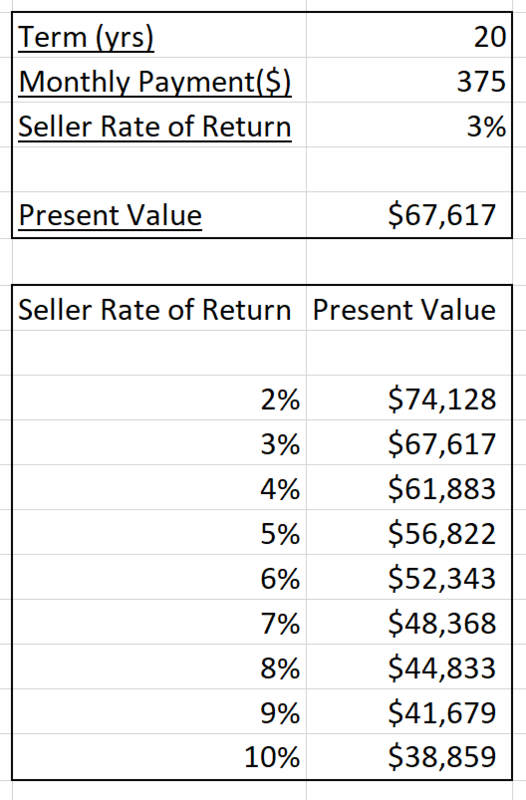
Considering she was getting around an 10% return from the property as rental [She got $1500/month in rent, assuming 50% expenses and a $80k home value], then a fair haircut would be 2-4%, which still puts you squarely in rip off range, in my opinion.