Seeking advice for improving returns on my portfolio of 8 units

Seeking advice for improving returns on my portfolio of 8 units

Rental Property Investor · Orlando, FL · Member since 2015 · 353 posts · 269 votes

Hello BP. I have been thinking about how I can improve my rental property portfolio consisting of 8 unit streams. I have been tracking returns on my properties with a spreadsheet I created for myself, and I have identified that 4 of the 8 units I own have been consistently underperforming the rest of the portfolio for 3 years now. I am tracking my returns based on cash flow numbers only (for conservatism reasons - I look at appreciation as icing on the cake).

A little background:

The underperforming units are all part of a small multifamily compound in a lower income neighborhood that I purchased in 2018 that looked great “on paper” but after tracking their performance for a few years, experienced less than expected returns due to one issue or another that has cropped up (more capex up front, tenant that I couldn’t evict for 10 months through covid, multiple vacancies causing turnover costs). They are older units (1960) so I will likely see other capex items sooner rather than later if I kept them for 30+ years. They have very little appreciation potential, which I don’t mind if cash flowing well. These properties have strengths of being very low mortgage cost, room to grow rents over time (they are almost 2% rule), and in a affordable rental class that seems to have a major shortage in today’s world. They still make enough cash flow to allow me to hold them if I choose.

So my questions are for experienced investors who do this sort of purge analysis on their rentals, how long do you typically give underperforming properties a chance to meet potential? Is my 3 year “leash” too short sighted if I decided to cut bait and 1031 exchange into something else newer build in a better neighborhood?

I see both pros and cons to keeping the properties in my portfolio, and I always envisioned keeping everything for 30 plus years, but I am now wondering if I should tweak my expectations. Thanks for your opinions and advice!
1Reply
262 views

Most Popular Reply

Joe VilleneuvePro Member
Plymouth, MI · Member since 2013 · 13k+ posts · 19k+ votes
4y

The duplexes are failures on epic proportion,  Get rid of them ASAP...sooner if possible.  They have absolutely no value, except in the equity which is useless to you...unless you sell.  So SELLLLLLL!!!!!!  EVery month your duplexes gain equity, and lose cash from negative cash flow (yes, $100/month is negative cf...just waiting to happen), they are losing money for you....big time.

Repeat after me.  "Sell, Sell, Sell, Sell,Sell,Sell,....SELLLLLLLL!!!!!!!


See this reply in the discussion

61 Replies

Jump to latestLatest
  • Member since 2020 · 984 posts · 1k+ votes
    4y
    Originally posted by @Mary M.:

    i think you need to immediately go buy this  book (What every investor needs to know about cash flow etc...)

    You have no idea how your units are performing as you dont have solid financials. people will tell you to sell, and that 8might* be the right answer, but you dont know until you get some spreadsheets showing your actual cash flow, IRR, etc etc etc.

    Thank you. I am always looking for better ways to do the math.

    I like to go with Kindle since I can carry all my books on my cell phone or a tablet.

  • Joe VilleneuvePro Member
    Plymouth, MI · Member since 2013 · 13k+ posts · 19k+ votes
    4y
    Originally posted by @Account Closed:
    Originally posted by @Joe Villeneuve:
    Originally posted by @Matt Leber:

    @Joe Villeneuve yeah years 1 and 2 we had a vacancy in each of the buildings for at least 2 months. It takes my pm about 2 months to fix them up and get a qualified tenant. Which is too slow in my opinion but that’s a whole different discussion. I could turn and fill much faster if they were local.

    Are you suggesting I look at trading into something that's likely to be more stable vacancy wise (SFH)? I feel like if I go multifamily again in my area I'm probably going to run into the same transient crowd if I'm still buying properties that are at a price I can cash flow. Places that are small and always have tenants wanting to upgrade out to something bigger and better. On the other hand, I think I can go the SFH route and get a higher quality product that I can hold for 30+ years, better tenant pool, and folks that want to stay longer so vacancy lower.

     Dump the losing properties...no matter what they are.  Find markets where you have high enough CF to recover all your cost (DP) in cash within a 3 - 3 year period.  Sell the property after free equity (from appreciation) equals paid equity (DP) then split and roll the now all cash from equity into new properties where your equity is now at full value instead of reduced value.  When your equity increases through appreciation it does so on a one to one basis...as in, every dollar increase in PV increases your equity that same dollar.  When you bought the property, your equity was worth 5 times its face value since your DP was only 20% of the PV.  As your equity increases this way, it dilutes the actual value of your equity.  When you sell the property, your equity goes back to that original 5 to 1 value...and your cash flow should double too.

    Don't get wrapped up in thinking your property is your asset.  It isn't.  Your cash is, which comes in 2 forms:  1 - Cash Flow (liquid) and 2 - Equity (solid).  Your Equity has value, but no use, until you convert it to cash...by selling the property.  The property is nothing more than the temporary location of your assets, until they move to better pastures.

    One of the most important factors many investors don't take into consideration is the paydown on the mortgage and this calculation often makes a huge difference when calculating your ROI's.

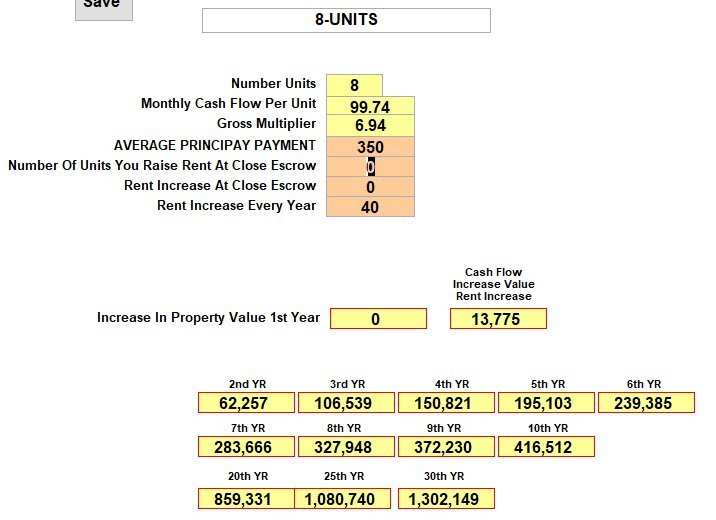
    Yesterday, I was working on my software program and was calculating the numbers for a 30-unit apartment building for $7.5 million with 30% down and the monthly principal payment for the loan is $9,000. I ran into this strange scenario where I would earn more profit in 10 years by getting a mortgage vs. paying cash for the property as shown in the two charts below. I haven't had the energy to dig deep into this matter because I am burned out, but my math has always been fairly accurate and these results are the reason I spend no less than 4 to 5 hours every day creating these charts and comparing the numbers for hundreds of properties.

    That's NOT a strange scenario. That's simple math. Once the REI understands that the only cost to them is what cash comes out of their pocket, and they don't make a profit until they recover it, and the smaller that number is, the faster the time it takes and the lower the dollars needed to get to that recovery, the light bulb shines brighter, and they stop focusing on paying down the principle, and just letting the tenants do their job by doing it for you...for free.

  • Member since 2020 · 984 posts · 1k+ votes
    4y
    Originally posted by @Joe Villeneuve:
    Originally posted by @Account Closed:
    Originally posted by @Joe Villeneuve:
    Originally posted by @Matt Leber:

    @Joe Villeneuve yeah years 1 and 2 we had a vacancy in each of the buildings for at least 2 months. It takes my pm about 2 months to fix them up and get a qualified tenant. Which is too slow in my opinion but that’s a whole different discussion. I could turn and fill much faster if they were local.

    Are you suggesting I look at trading into something that's likely to be more stable vacancy wise (SFH)? I feel like if I go multifamily again in my area I'm probably going to run into the same transient crowd if I'm still buying properties that are at a price I can cash flow. Places that are small and always have tenants wanting to upgrade out to something bigger and better. On the other hand, I think I can go the SFH route and get a higher quality product that I can hold for 30+ years, better tenant pool, and folks that want to stay longer so vacancy lower.

     Dump the losing properties...no matter what they are.  Find markets where you have high enough CF to recover all your cost (DP) in cash within a 3 - 3 year period.  Sell the property after free equity (from appreciation) equals paid equity (DP) then split and roll the now all cash from equity into new properties where your equity is now at full value instead of reduced value.  When your equity increases through appreciation it does so on a one to one basis...as in, every dollar increase in PV increases your equity that same dollar.  When you bought the property, your equity was worth 5 times its face value since your DP was only 20% of the PV.  As your equity increases this way, it dilutes the actual value of your equity.  When you sell the property, your equity goes back to that original 5 to 1 value...and your cash flow should double too.

    Don't get wrapped up in thinking your property is your asset.  It isn't.  Your cash is, which comes in 2 forms:  1 - Cash Flow (liquid) and 2 - Equity (solid).  Your Equity has value, but no use, until you convert it to cash...by selling the property.  The property is nothing more than the temporary location of your assets, until they move to better pastures.

    One of the most important factors many investors don't take into consideration is the paydown on the mortgage and this calculation often makes a huge difference when calculating your ROI's.

    Yesterday, I was working on my software program and was calculating the numbers for a 30-unit apartment building for $7.5 million with 30% down and the monthly principal payment for the loan is $9,000. I ran into this strange scenario where I would earn more profit in 10 years by getting a mortgage vs. paying cash for the property as shown in the two charts below. I haven't had the energy to dig deep into this matter because I am burned out, but my math has always been fairly accurate and these results are the reason I spend no less than 4 to 5 hours every day creating these charts and comparing the numbers for hundreds of properties.

    That's NOT a strange scenario. That's simple math. Once the REI understands that the only cost to them is what cash comes out of their pocket, and they don't make a profit until they recover it, and the smaller that number is, the faster the time it takes and the lower the dollars needed to get to that recovery, the light bulb shines brighter, and they stop focusing on paying down the principle, and just letting the tenants do their job by doing it for you...for free.

    Thank you very much. If an investor can make a higher profit by getting a mortgage I wish some broker would have explained the numbers to me 50 years ago because yesterday was the first time I ever saw the numbers show that an investor could make a higher profit by getting a mortgage. I am going to look at a few more properties today and do more comparisons to see how many properties will return a better profit by getting a mortgage vs. paying cash and then I am going to ask some brokers whether it is better to pay cash or get a mortgage. Almost every broker will say it is better to leverage with a mortgage, but I don't know if one broker will say you can make more profit with a mortgage with the exception of getting a mortgage and using your additional cash for more properties. I am baffled.

  • Investor · Raleigh, NC · Member since 2019 · 433 posts · 743 votes
    4y

    Here’s simple math.

    You have 68k equity in each, or 136k equity. You make $2400/year in cash flow… at best.

    (2.4k / 136k) x 100 = 1.7% Return on Equity.

    Those are some sh**ty returns. Sell and 1031 exchange.

  • Rental Property Investor · Portland OR · Member since 2018 · 2k+ posts · 3k+ votes
    4y
    Originally posted by @Matt Leber:

    My question is more about giving the properties a longer leash vs pulling the trigger to exchange them now. Or some other less obvious strategy.

    You wont know until you create some spreadsheets, using the criteria and analysis that is used in the RE industry.   If you look at the book I suggested it will show you how to analyze for your question.  

  • Rental Property Investor · Portland OR · Member since 2018 · 2k+ posts · 3k+ votes
    4y
    Originally posted by @Joe Villeneuve:

    That's NOT a strange scenario. That's simple math. Once the REI understands that the only cost to them is what cash comes out of their pocket, and they don't make a profit until they recover it, and the smaller that number is, the faster the time it takes and the lower the dollars needed to get to that recovery, the light bulb shines brighter, and they stop focusing on paying down the principle, and just letting the tenants do their job by doing it for you...for free.

    Can we please can the 'tenant pays down our mortgage'  trope?  this breeds massive angst in the tenant world, and is not helpful in creating a win/win vibe that we really should be striving for.   Nobody wants to feel they are being taken advantage of and this trope does just that. 

    LL's provide a good and tenants pay for this good. What we as LLs use that money for should not be rammed down the tenants throat as a massive benefit for us. (what other industry does that? none AFAIK) 

  • Rental Property Investor · Portland OR · Member since 2018 · 2k+ posts · 3k+ votes
    4y

    @Account Closed you are missing expenses from your examples (PM, CapEx etc) and your vacancy rate is low - it should be more along the lines of 4-5% 9 (what mortgage brokers will use).... in general 50% is the expense ratio that should be used and any...

    Any investment will look good if you dont include all expected expenses.  Hope the book helps you :) 

  • Rental Property Investor · Orlando, FL · Member since 2015 · 353 posts · 269 votes
    4y

    @Tucker Cummings this is a great, simple way to look at it. I’m not sure I subscribe to ROE over all, as I would like to have at least some paid off properties one day (I’m sure lots of BP folks find that controversial). But I’m going to bake ROE into my spreadsheet for each property as another metric I need to consider. Especially on this set of properties the ROE plain sucks as you have pointed out. Thanks again.

  • Investor · Raleigh, NC · Member since 2019 · 433 posts · 743 votes
    4y

    @Matt Leber

    I agree with you on having some paid off properties, but you may want to still set a metric to shoot for. I would say you wouldn’t really want anything less than 4.5% for a paid off property. Reason being that you could either put that into dividend stocks or overfunded whole life insurance policies and easily make that kind of cash flow yield without the landlord headaches. If you’re giving up the leverage advantage of real estate, these might be good alternatives.

  • Rental Property Investor · Orlando, FL · Member since 2015 · 353 posts · 269 votes
    4y

    @Cory Binsfield I am 100% looking to move them within 1.5 hrs of home, and I could cut out the PM. I self manage the other 4 singles I own and effort is minimal, I actually like it most of the time. Getting them closer to home base is definitely part of my strategy if I go for the exchange.

  • Joe VilleneuvePro Member
    Plymouth, MI · Member since 2013 · 13k+ posts · 19k+ votes
    4y
    Originally posted by @Account Closed:
    Originally posted by @Joe Villeneuve:
    Originally posted by @Account Closed:
    Originally posted by @Joe Villeneuve:
    Originally posted by @Matt Leber:

    @Joe Villeneuve yeah years 1 and 2 we had a vacancy in each of the buildings for at least 2 months. It takes my pm about 2 months to fix them up and get a qualified tenant. Which is too slow in my opinion but that’s a whole different discussion. I could turn and fill much faster if they were local.

    Are you suggesting I look at trading into something that's likely to be more stable vacancy wise (SFH)? I feel like if I go multifamily again in my area I'm probably going to run into the same transient crowd if I'm still buying properties that are at a price I can cash flow. Places that are small and always have tenants wanting to upgrade out to something bigger and better. On the other hand, I think I can go the SFH route and get a higher quality product that I can hold for 30+ years, better tenant pool, and folks that want to stay longer so vacancy lower.

     Dump the losing properties...no matter what they are.  Find markets where you have high enough CF to recover all your cost (DP) in cash within a 3 - 3 year period.  Sell the property after free equity (from appreciation) equals paid equity (DP) then split and roll the now all cash from equity into new properties where your equity is now at full value instead of reduced value.  When your equity increases through appreciation it does so on a one to one basis...as in, every dollar increase in PV increases your equity that same dollar.  When you bought the property, your equity was worth 5 times its face value since your DP was only 20% of the PV.  As your equity increases this way, it dilutes the actual value of your equity.  When you sell the property, your equity goes back to that original 5 to 1 value...and your cash flow should double too.

    Don't get wrapped up in thinking your property is your asset.  It isn't.  Your cash is, which comes in 2 forms:  1 - Cash Flow (liquid) and 2 - Equity (solid).  Your Equity has value, but no use, until you convert it to cash...by selling the property.  The property is nothing more than the temporary location of your assets, until they move to better pastures.

    One of the most important factors many investors don't take into consideration is the paydown on the mortgage and this calculation often makes a huge difference when calculating your ROI's.

    Yesterday, I was working on my software program and was calculating the numbers for a 30-unit apartment building for $7.5 million with 30% down and the monthly principal payment for the loan is $9,000. I ran into this strange scenario where I would earn more profit in 10 years by getting a mortgage vs. paying cash for the property as shown in the two charts below. I haven't had the energy to dig deep into this matter because I am burned out, but my math has always been fairly accurate and these results are the reason I spend no less than 4 to 5 hours every day creating these charts and comparing the numbers for hundreds of properties.

    That's NOT a strange scenario. That's simple math. Once the REI understands that the only cost to them is what cash comes out of their pocket, and they don't make a profit until they recover it, and the smaller that number is, the faster the time it takes and the lower the dollars needed to get to that recovery, the light bulb shines brighter, and they stop focusing on paying down the principle, and just letting the tenants do their job by doing it for you...for free.

    Thank you very much. If an investor can make a higher profit by getting a mortgage I wish some broker would have explained the numbers to me 50 years ago because yesterday was the first time I ever saw the numbers show that an investor could make a higher profit by getting a mortgage. I am going to look at a few more properties today and do more comparisons to see how many properties will return a better profit by getting a mortgage vs. paying cash and then I am going to ask some brokers whether it is better to pay cash or get a mortgage. Almost every broker will say it is better to leverage with a mortgage, but I don't know if one broker will say you can make more profit with a mortgage with the exception of getting a mortgage and using your additional cash for more properties. I am baffled.

     PM me.

  • Member since 2020 · 984 posts · 1k+ votes
    4y
    Originally posted by @Tucker Cummings:

    Here’s simple math.

    You have 68k equity in each, or 136k equity. You make $2400/year in cash flow… at best.

    (2.4k / 136k) x 100 = 1.7% Return on Equity.

    Those are some sh**ty returns. Sell and 1031 exchange.

    1.7% is horrible, but what will his return be when considering mortgage paydown, depreciation tax credit, rent increases and appreciation. Then, he may be looking at a 20% to 30% annual return and that is why we need a lot more information about the properties and we need to know his abilities to manage the properties to get the best paying tenants and to reduce his vacancy rates. How many horrible landlords (not referring to the OP) mis-manage properties and the buyers turn them into goldmines.

  • Joe VilleneuvePro Member
    Plymouth, MI · Member since 2013 · 13k+ posts · 19k+ votes
    4y
    Originally posted by @Mary M.:
    Originally posted by @Joe Villeneuve:

    That's NOT a strange scenario. That's simple math. Once the REI understands that the only cost to them is what cash comes out of their pocket, and they don't make a profit until they recover it, and the smaller that number is, the faster the time it takes and the lower the dollars needed to get to that recovery, the light bulb shines brighter, and they stop focusing on paying down the principle, and just letting the tenants do their job by doing it for you...for free.

    Can we please can the 'tenant pays down our mortgage'  trope?  this breeds massive angst in the tenant world, and is not helpful in creating a win/win vibe that we really should be striving for.   Nobody wants to feel they are being taken advantage of and this trope does just that. 

    LL's provide a good and tenants pay for this good. What we as LLs use that money for should not be rammed down the tenants throat as a massive benefit for us. (what other industry does that? none AFAIK) 

     So what you're saying is the tenants can't figure out that we use the rent to pay the mortgage?  You're saying this is news to them?...or, are you saying this makes the tenants mad because they think the LL's must use their own money to pay the mortgages on their rental units?  I'm really confused as to why this would upset tenants.  What did they think we did with the rent money?  Buy booze, smoke pot, and vacation 6 months of the year?  I would think the fact that we use the rent money to pay for the place they live in would give them comfort...not angst. 

  • Rental Property Investor · Henrico, VA · Member since 2019 · 265 posts · 155 votes
    4y

    @Matt Leber did you say you analyzed what the next three years might look like with these multis vs. single family in nicer neighborhood for a price you think you could get it at in your spreadsheet? How does that look and compare side by side? The last three years dont sound like they would repeat the next three, it sounds more stabilized with the changes made. Sounds like you had to deal with a lot there . The single would probably be less time intensive and a headache, which is something, sounds like you might be leaning toward that but maybe I'm reading into itttoo much

  • Member since 2020 · 984 posts · 1k+ votes
    4y

    My calculations are strange because it looks like the OP could actually be earning almost $42,000 per year as it is and I my math does not include depreciation and this is the reason I would like to see all the numbers from the OP including total gross income, mortgage payment, principal payment, etc.. It is difficult to take wild guesses without the proper numbers.

  • Member since 2020 · 984 posts · 1k+ votes
    4y

    I had to play with the numbers and did not do enough work to increase the Gross Multiplier. In the example the Gross Multiplier is 6.94, but in today's market it should be 10+ and in California multi-units are 16 to 18+. So, if he has a Gross Multiplier of 10+ he may be currently earning $50,000 per year and does not know it unless he does the math.

  • Rental Property Investor · Orlando, FL · Member since 2015 · 353 posts · 269 votes
    4y

    @Alex Forest I did. I took this years return on the duplexes and bounced it off the expected return of exchanging for 2 SFH in the 185-200k range w rents at the 1600-1700 range which I've identified a couple markets where this is possible within 1.5 hrs of my home that I could easily self manage. Cash flow return looked like a wash even going from 4 down to 2. Overall return if counting pay down and appreciation potential would be better on the 2 SFH. I think they would be more quality tenant pool and properties. Another reason I'm leaning this way is that my overall portfolio property class would become much better, bc I would be eliminating the ones in the worse neighborhoods. I'd like to get my daughter involved some day and I'm not taking her to certain neighborhoods if I can avoid it hahaha

  • Rental Property Investor · Portland OR · Member since 2018 · 2k+ posts · 3k+ votes
    4y
    Originally posted by @Joe Villeneuve:

     So what you're saying is the tenants can't figure out that we use the rent to pay the mortgage?  You're saying this is news to them?...or, are you saying this makes the tenants mad because they think the LL's must use their own money to pay the mortgages on their rental units?  I'm really confused as to why this would upset tenants.  What did they think we did with the rent money?  Buy booze, smoke pot, and vacation 6 months of the year?  I would think the fact that we use the rent money to pay for the place they live in would give them comfort...not angst. 

    Its how so many of you say it - you are 'using' someone to benefit yourself...  its not really the fact (all businesses benefit from each of us buying form them) its how you say it.  and, its just human nature - nobody wants to feel used. 

    we have a massive abnd growing issue of people hating LLs...  and the pandemic made it much much worse. 

  • Warsaw, IN · Member since 2017 · 229 posts · 270 votes
    4y

    @Matt Leber you mentioned your duplexes are long distance…and your concern with long distance is how long it takes to turn a unit-not annoying/erroneous fees or having a lack of integrity with your PM. A long distance property manager you can trust is the ONLY WAY long distance investing works…so you have that going for you.

    If you're thinking of selling/1031 there is no better time than the present….just like this market is about as expensive and you'll find. Do you have the deal flow or can assume the equity on a new SFH from 1031 will give you the same returns you're currently getting from SFH?

    That’s the question I would ask myself. It sounds like You’re in a great position either way. I wish you the best.

  • Dave FosterBusiness Member
    Qualified Intermediary for 1031 Exchanges · St. Petersburg, FL · Member since 2013 · 9k+ posts · 9k+ votes
    4y

    @Matt Leber, There are a lot of red flags in your discussion:

    1. You bought it as a portfolio from an individual who was making money because he collected rents in person etc etc.  Unless that's your goal a portfolio in this demographic might not be the best to hold as a passive investor.

    2. Your cash flow on each wouldn't sustain one AC let along the huge cap ex you're anticipating and fearing.

    3. No appreciation potential!  Appreciation is about the only reason to hold a property for 30 years. 

    4. You even mentioned the C-D demographic - always the first to get hit in any blip (yes covid, but also any downturn the lowest and the highest are hit first). 

    5. @Account Closed brings up a great point on amortization.  And this is definitely the only other reason to hold properties for the long haul.  But Your numbers are much smaller than they need to be to maximize the amortization of your loans.

    I'm not bringing the crystal ball.  But history tells us what happens to low end properties that don't appreciate. 

    But just like you wanted to get your feet wet and this was set up for you to do so, you've got some very nice appreciation and paydown.  And hopefully all of those allowances you have planned for are sitting in a bank account somewhere.

    I'm with @Joe Villeneuve and others who say it's time to sell and use that equity to buy better cash flow and amortization in a sector with some appreciation potential  

    The 1031 Investor5140 Reviews
  • Rental Property Investor · Orlando, FL · Member since 2015 · 353 posts · 269 votes
    4y

    @Nick Barlow I ran the numbers and I can exchange into 2 newer build SFH in the 185-200k range with rents in the 1600 range and make it work. I have a couple markets nearby that I could find these and self manage (I already self manage 4 SFH and that's fine). Returns would be a wash or better if these two SFH perform at all alike to my other SFHs. Plus better tenant pool and appreciation potential.

  • Rental Property Investor · Minneapolis, MN · Member since 2016 · 214 posts · 132 votes
    4y

    @Matt Leber

    I’d try it with another pm. Seems like they suck. My pm does a same day turn most of the time.

    Why the long time between fills? When do they start marketing them and what is involved in a turn. (I’m looking for justification for their slowness if there is any.)

    12% is high unless it includes more than is typical stuff.

    I like my local units that I pm, but it’s nice to have properties making money elsewhere.

    What’s your goal with rental investing?

  • Rental Property Investor · Orlando, FL · Member since 2015 · 353 posts · 269 votes
    4y

    @Dave Foster that’s not my goal at all, which is why we switched them over to property management right away. The tenants from the old LL weren’t a fan of the rigidity of the new rules and we lost all of them in the first year. Which was sort of expected.

    But yeah, it was my first venture into semi-long distance and low income property investing, and I think I’ve gained education about both of those though it.

    Anyway, I might be asking you about 1031 soon!

  • Rental Property Investor · Orlando, FL · Member since 2015 · 353 posts · 269 votes
    4y

    @Justin V. Usually takes them about 2 weeks to turn and about 6 weeks to qualify someone. Takes them about a week to get the scope list to me after the tenant move out, I redline items that aren’t needed day-of and then the get their contractors going and it’s done in second week. I’ve seen it go 3 weeks if weekends or holidays get in the way of communication. They don’t start marketing until the unit is turned and showable. We usually get tons of interest bc the units are affordable class less than 800 per month, but a lot of the applicants have issues qualifying due to credit or criminal history or issues submitting all the necessary paperwork. That’s what the PM tells me is the major drag on the full time.

    I’ve considered switching PMs multiple times. I think they’re too slow too. I just always revert back to reminding myself of year 1 for these properties and losing all the original tenants bc they resisted the change from mom and pop collector to PM rules. I have a little fear I could de-rail what actually is working now by rocking the pm boat again.

  • Joe VilleneuvePro Member
    Plymouth, MI · Member since 2013 · 13k+ posts · 19k+ votes
    4y
    Originally posted by @Mary M.:
    Originally posted by @Joe Villeneuve:

     So what you're saying is the tenants can't figure out that we use the rent to pay the mortgage?  You're saying this is news to them?...or, are you saying this makes the tenants mad because they think the LL's must use their own money to pay the mortgages on their rental units?  I'm really confused as to why this would upset tenants.  What did they think we did with the rent money?  Buy booze, smoke pot, and vacation 6 months of the year?  I would think the fact that we use the rent money to pay for the place they live in would give them comfort...not angst. 

    Its how so many of you say it - you are 'using' someone to benefit yourself...  its not really the fact (all businesses benefit from each of us buying form them) its how you say it.  and, its just human nature - nobody wants to feel used. 

    we have a massive abnd growing issue of people hating LLs...  and the pandemic made it much much worse. 

     It has nothing to do with the way I way it.  It has everything to do with the way it is perceived, and I am not responsible for that.  I say it the same way every time:  "The tenant is the one that pays down the mortgage because they are the source of the funds that is doing it".  There is no other way of saying it.

    Where is this massive growing issue of tenants hating LL's?  The idea of the tenant's rent being used to pay the mortgage isn't new.

    My question then to you is simple.  If you have issue with the way "it" is said, what is your suggestion of how in the future "it" should be said?

Join the conversationCreate a free account to reply, vote on answers and follow this thread.