How do you decide whether to sell, refi, 1031 exchange, or hold?

How do you decide whether to sell, refi, 1031 exchange, or hold?

Eric FernwoodBusiness Member
Realtor · Las Vegas, NV · Member since 2014 · 1k+ posts · 1k+ votes

I see a lot of investors struggle with this question, especially after owning a property for several years.

The way I think about it is pretty simple:

Does the property still support your long-term financial goals?

That sounds obvious, but I don’t think it can be answered by looking at cash flow alone. I would look at a few things:

  1. Has rent growth outpaced inflation over the last 5 to 7 years?
  2. Has appreciation been strong enough to justify keeping the equity in the property?
  3. Are taxes, insurance, maintenance, and vacancy costs eating up too much of the income?
  4. Is the property in a landlord-friendly market, or are local regulations starting to create more risk?
  5. If you sold or exchanged, could you move the equity into something that performs better?

The part that gets overlooked, in my opinion, is net rent, not gross rent.

A property can look good based on rent alone, but if insurance, property taxes, vacancy, turnover, or maintenance are too high, the actual income may not support the investment thesis anymore.

For example, if one market has much higher insurance and property taxes than another, that property has to generate more rent just to produce the same net result. Otherwise, the investor may be taking on more risk without getting paid for it.

Same issue with vacancy. A property with a tenant who stays five years is very different from a property that turns every year, even if the monthly rent looks similar.

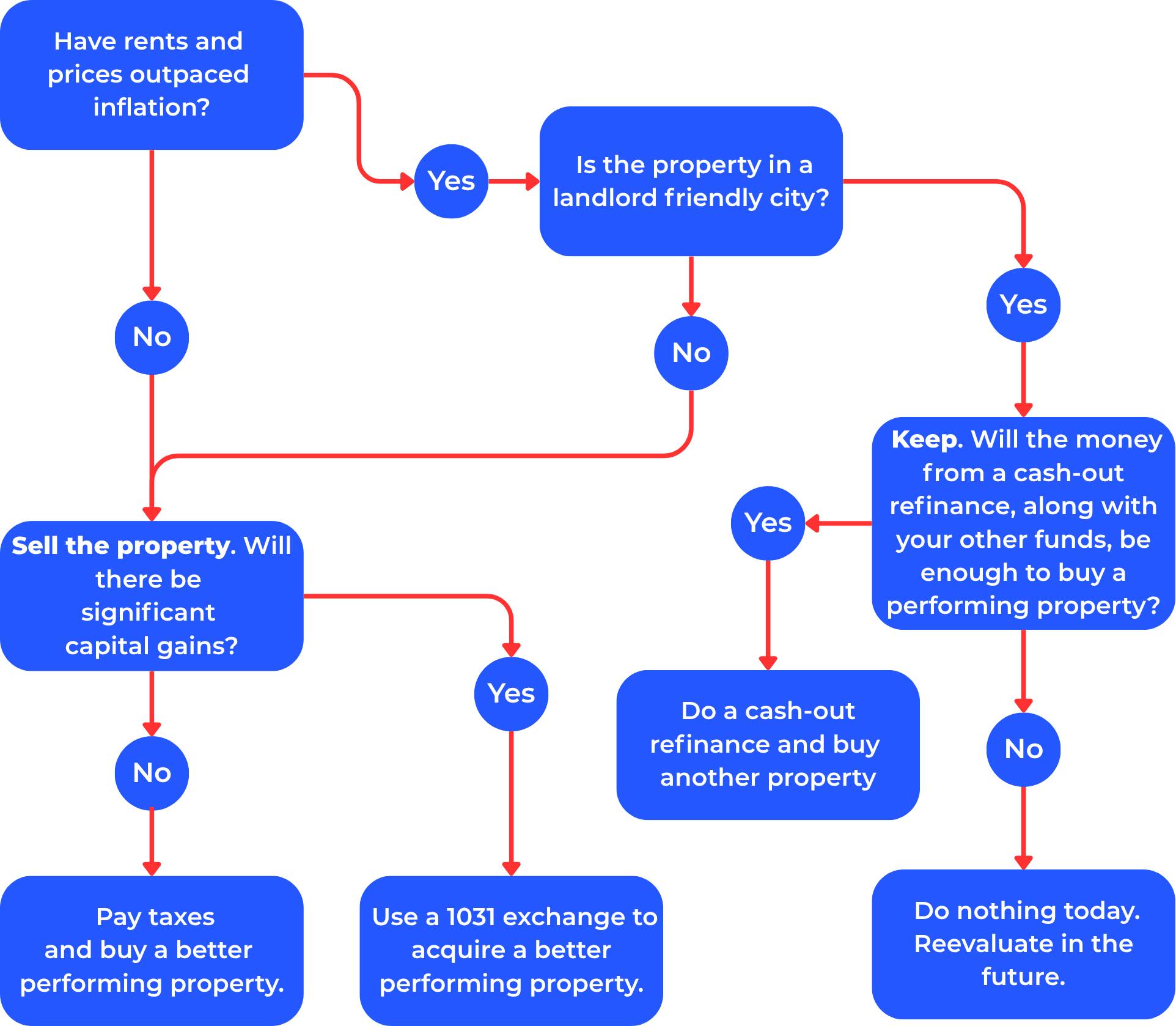
My rough decision framework is:

  • Hold if the property is still producing reliable income, rents are growing faster than inflation, and the market still supports the long-term goal.
  • Refinance if the property is strong, but trapped equity can be used to buy another good property without weakening the original investment.
  • 1031 exchange if the property has appreciated, but the income, tenant quality, operating costs, or market outlook no longer justify keeping it.
  • Sell if the property no longer fits the goal and there is no better exchange opportunity, or if the investor needs to simplify.
Curious how others think about this.

FERNWOOD Team, KW VIP Realty520 Reviews
1Reply
236 views

Most Popular Reply

Member since 2025 · 45 posts · 47 votes
5mo

Another thing is your age, and family situation. I am now over 70, my kids do not want to engage in rental income, so I am slowly trans-ing to DST income. As tenants move I fix them up, sell them, and tax defer into usually 3 to 5 DSTs. It maximizes what I get for the properties, and provides the same or more net income. Using multiple DST give me comfort that if one goes bad, the rest should carry me through.

Down side to the DST is when they close it in a few years. Its either a rinse, repeat or take the 721 UPRIET option. Since the basis in each DST is much less than the original property I can also decide to take the tax hit (on the much smaller piece).

See this reply in the discussion

4 Replies

Jump to latestLatest
  • Flipper/Rehabber · Bloomfield CT · Member since 2020 · 1k+ posts · 409 votes
    6mo

    My belief is to just pay the taxes and avoid 1031 exchanges as finding deals that meet criteria are not guaranteed within allotted time period 

  • Member since 2025 · 45 posts · 47 votes
    5mo

    Another thing is your age, and family situation. I am now over 70, my kids do not want to engage in rental income, so I am slowly trans-ing to DST income. As tenants move I fix them up, sell them, and tax defer into usually 3 to 5 DSTs. It maximizes what I get for the properties, and provides the same or more net income. Using multiple DST give me comfort that if one goes bad, the rest should carry me through.

    Down side to the DST is when they close it in a few years. Its either a rinse, repeat or take the 721 UPRIET option. Since the basis in each DST is much less than the original property I can also decide to take the tax hit (on the much smaller piece).

  • Rental Property Investor · San Francisco Bay Area · Member since 2022 · 1k+ posts · 1k+ votes
    5mo

    Excellent questions. I'm in this situation. Google said the current inflation rate is 3.3% to 3.6%. So if my rental increases aren't at least 3.6% that's one factor to consider? The decision tree is directing me to keep it. 

    With regards to landlord friendly vs non-landlord friendly city, I would 100% sell off my Midwest properties before selling off California properties (great appreciation, I can drive over in less than 30 minutes and check on them). Headache would be an understatement for dealing with properties 2000 miles away, ever increasing property taxes (no Prop 13 like in CA where my property taxes go up a max of 2% a year) being taken advantage of by flaky contractors, etc. I'm very lucky to have good tenants (so far). 

    I wouldn't do a 1031 exchange on a Midwest sale. I have passive losses to offset the gains and if there is a small gain, I'll pay the tax. I'm fine with paying the depreciation recapture which isn't that much. I could get a better IRR with index funds (which is truly passive income) over the net rent.

  • Rental Property Investor · Tulsa · Member since 2022 · 9 posts · 9 votes
    4mo

    Good framework and thanks for posting it. The thing I'd add is the number that most often pulls it all together, return on equity.

    Most people look at cash flow to decide hold or sell, but cash flow doesn't tell you much once a property has gone up in value. What matters is what your equity is earning. Take your yearly net cash flow, like you said net not gross, plus the principal you're paying down, and divide it by the equity you have in the property right now. That's what your money is actually making sitting where it is.

    I leave appreciation out on purpose. It's real but it's often an educated guess at best, and in a flat market it's a guess paying zero. I'd rather know what the equity earns for sure.

    And the number only matters against your goal. ROE doesn't tell you to sell, it tells you if a property is pulling its weight toward where you're trying to get. An investor who needs cash flow now reads it different than an investor building net worth over 20 years.

    So run it on each property, not the whole portfolio at once, because the average hides the dead weight. Then zoom back out. Look at the property and the whole portfolio against your long term plan and make the call from there. A property might have a weak number on its own but still help the portfolio, or look fine on its own but not be moving you toward your goal. You decide each one based on what it's doing for the whole thing.

    The hard part really isn't the math, it's that almost nobody does both halves. People run the property numbers and never tie them to the goal, or they think big picture and never check the return on each door. A savvy investor needs both, and doing it by hand across a real portfolio is a grind.

Join the conversationCreate a free account to reply, vote on answers and follow this thread.