Amortization Schedule - 30 Year Mortgage

Amortization Schedule - 30 Year Mortgage

Richmond, RI · Member since 2019 · 124 posts · 40 votes

Hello Everyone,

I was at a local real estate investor group meeting last night, and I was told something that I could not believe at first. I was told that amortizations are never good, especially for 30-year mortgages. The presenter told us that we are being told by the bank that we are paying, for example, a "5%" (or any "low") fixed interest rate on a 30-year mortgage, but what the bank is not telling us is how much we are actually paying altogether. The presenter continued and said that those who are on 30-year mortgages are paying 60%-100% interest (or 160% - 200% of the loan value), not the traditional "5%" that we are applying for. I just could not believe it, until tonight, where I built an amortization schedule and I ran a scenario. 

I created an amortization schedule for a $484,000 loan on a 5% interest rate. Upon completing the schedule, I took the total amount of the simple interest for all 360 periods and the principal for all 360 periods. I totaled each separately, and then I added them together. 

Simple Interest - $451,358

Principal - $484,000

Simple Interest + Principal = $935,358

If I did this correctly, the borrower is paying back nearly double of what he or she borrowed (over 193%) at the last period. I find this ratio to be the same for any 30-year mortgage, and I also found the ratio to be smaller for loans with shorter terms. 

With the way the amortization schedule is structured, 5% is being applied, but it's the interest that's deducted first before the principle, as with any other schedule. The simple interest and principal still add to the monthly payment, but the banks are making more money (a lot more I guess) by deducting the interest first. I don't find the banks to be lying, but I rather find them to be a bit cunning...

Am I missing anything here? I added the link to the spreadsheet that I generated, if anyone wants to review it:

https://docs.google.com/spread...

Why should real estate investors take out 30-year mortgages if the investor has to pay back nearly double to the bank, even if the investor makes profit off of the property?
1Reply
386 views

Most Popular Reply

Rental Property Investor · East Providence, RI · Member since 2018 · 1k+ posts · 1k+ votes
7y

You are paying interest based on your current balance. This is no secret. The banks are not trying to trick you. They often give you an amortization schedule at closing. If you pay down extra, then next month the payment stays the same but more money goes to principal, which pays off your mortgage faster.

2 things that you might be missing are the time value of money and inflation.

Time Value- Being able to use $1 now is more valuable to you than waiting 30 years from now to get it.

Inflation- Money will typically be worth less in the future. Basically a future $1 bill is going to be worth less than a present $1 bill. Future pay down will actually cost less than paying it down now.

I have no problem with the current system. I have over a dozen mortgages. Each of my properties is making a profit which can help me take care of the payments.

I am able to use leverage to buy more properties, which is giving me more profit, which in turn allows me to buy more properties, if I see fit.

It is even more amazing for someone doing a house hack. You get to collect 100% of the income even though you may have only put down 3.5% of the purchase price. (Maybe the bank should get a portion of the rents? jk)

What type of Real Estate meeting was this? I have been to hundreds over the years and most people want the longest amortization schedule possible. Were they trying to sell you something?

See this reply in the discussion

85 Replies

Jump to latestLatest
  • Whitman, MA · Member since 2018 · 104 posts · 80 votes
    7y

    @Chauncy Gray try this website

    https://www.timevalue.com/tcalc-financial-calculators

    Scroll down to "Home Financing Calculators". Put in all the details. This is easier than having to create a spreadsheet.

  • Investor · FL · Member since 2017 · 266 posts · 220 votes
    7y

    @Thomas J Allen

    Get a side by side calculator and just compare your return on leveraged money vs a paid off asset.

    Instead of doing quick paydown your money has a better chance of making you more money being utilized purchasing more property now.

    Essentially your tenants are buying you more properties while paying them off. There is nothing wrong with paying down properties quickly but it depends on your goals.

    If i want 10 houses for example bringing me 10k a month in net income then what is fastest way there? Paying them off one by one or leveraging, getting more and once you have enough assets to reach this goal why not buy more and selling those to pay off your better performing properties. I hope I explained myself well...

  • Rental Property Investor · Brooke Park Drive · Member since 2018 · 1k+ posts · 2k+ votes
    7y

    @Chauncy Gray

    Sounds like simple arbitrage the bank takes depositors money gives them 0.01% lends it at 5%, bank wins.

    You take it from bank at 5% invest into real estate getting you 10% you win.

  • Rental Property Investor · Member since 2018 · 828 posts · 810 votes
    7y

    @Michael Ealy Your point about the benefits of appreciation in a leveraged asset is the biggest driver for leverage that people miss. Many folks believe that having more properties is what creates the wealth, but that is not true.

    Having more properties diversifies your risk, but comes at the cost of inefficiency (ie. extra work).

    But when you get to capture the benefits of appreciation on 100% of the property value when you only have 20% or less skin in the game is when people realize that leverage is powerful.

  • Real Estate Agent · Jacksonville, FL · Member since 2015 · 1k+ posts · 1k+ votes
    7y

    The calculation is the calculation.  It has been the standard for as long as there have been mortgages.  They are disclosed along with a huge list of other items no one reads.  How many people have actually read what is in the folder you get at closing?

    The biger issue is what is the real cost of the money?  After tax deduction and inflation, the current cost of money is almost ZERO.  

    Interest rate 5% 

    30% tax bracket

    net interest after tax 3.35%

    Inflation average 3%

    Net interest cost.35 

    Futher, this does not take into account, leverage and appreication.  

    Unless someone is going to lend you money as a gift, it is just a cost of doing business no different than the cost of materials.  

  • Property Manager · Lindenhurst, IL · Member since 2016 · 854 posts · 506 votes
    7y

    In a way, 5% 30-year fix mortgage is like 3% simple interest. You will end up paying $451,358 interest in 30 years or $15,045 interest ever year on average. That is about 3% simple-interest of the $480,000 principal. Also, you could get some tax deduction, so chances are it's even lower than that. Very good deal, in my opinion.

  • Rental Property Investor · Rockford, IL · Member since 2014 · 4k+ posts · 2k+ votes
    7y
    Originally posted by @Chauncy Gray:

    Hello Everyone,

    I was at a local real estate investor group meeting last night, and I was told something that I could not believe at first. I was told that amortizations are never good, especially for 30-year mortgages. The presenter told us that we are being told by the bank that we are paying, for example, a "5%" (or any "low") fixed interest rate on a 30-year mortgage, but what the bank is not telling us is how much we are actually paying altogether. The presenter continued and said that those who are on 30-year mortgages are paying 60%-100% interest (or 160% - 200% of the loan value), not the traditional "5%" that we are applying for. I just could not believe it, until tonight, where I built an amortization schedule and I ran a scenario. 

    I created an amortization schedule for a $484,000 loan on a 5% interest rate. Upon completing the schedule, I took the total amount of the simple interest for all 360 periods and the principal for all 360 periods. I totaled each separately, and then I added them together. 

    Simple Interest - $451,358

    Principal - $484,000

    Simple Interest + Principal = $935,358

    If I did this correctly, the borrower is paying back nearly double of what he or she borrowed (over 193%) at the last period. I find this ratio to be the same for any 30-year mortgage, and I also found the ratio to be smaller for loans with shorter terms. 

    With the way the amortization schedule is structured, 5% is being applied, but it's the interest that's deducted first before the principle, as with any other schedule. The simple interest and principal still add to the monthly payment, but the banks are making more money (a lot more I guess) by deducting the interest first. I don't find the banks to be lying, but I rather find them to be a bit cunning...

    Am I missing anything here? I added the link to the spreadsheet that I generated, if anyone wants to review it:

    https://docs.google.com/spread...

    Why should real estate investors take out 30-year mortgages if the investor has to pay back nearly double to the bank, even if the investor makes profit off of the property?
     

    As you read the other responses, remember that the choice of 15 vs 30 year vs ?? will depend on your expectations and business plans.

    For institutional residential loans, the shorter amortization period will result in a higher P&I payment and you will build up equity faster than you would with a 30 year even though that payment is lower. 

    That said, you could take it out for 30 years but pay it back as if it was 15 year so you can have flexibility in your cash flow: make the bigger payments when you, fall back to the  lower payments when you need to.

    Note, however, that the interest portion of the payment is larger with the 30 year than it is for the 15 year. This "decelerates" your payback, even if you're making the 15-year amortization payment. That's the price you pay for having that flexibility. Such loans can be "accelerated". However, in the investor's business model, that may only make sense when the goal is equity build-up rather than getting the higher cash flow.

    Commercial loans for multi-family, etc. are a bit tricky right now. If you have, say, a 7 year balloon with 30 year amortization, your P&I payment is lower, but you may not be building up enough equity to refinance when the balloon comes due. You may end up coming "out-of-pocket" again at that time just to accomplish the refinance. My personal recommendation would be go 20 year max, 15 if you can on such loans. The shorter the amortization the faster your equity build up.

    Yeah - amortization looks like the lender is scamming you. That's their business model: get the highest return.

    Here's a simple formula you can use to estimate the interest accrued over the life of the loan:

    (APR x 2) x 10 = Percentage of the initial balance.

    For example, for a 5% loan for 30 years, the total interest paid will be roughly 100% of the initial principal balance: 5 x 2 = 10, x 10 = 100. That is, you'll repay the loan twice over 30 years, in rough numbers.

    Here's a real life example:

    Initial balance: $200,000
    Term: 30 years
    APR = 5%

    At the end of 30 years, the total of payments is $386,511,57. Subtract $200,000 = $186,511.57 total interest paid - 93.26% of the initial principal balance.

    If paid to term, the principal portion of the payments remains less than the interest portion until after the 194th payment ... better than half of the lifetime of the loan - 16.25 years in. At that point, the total of payments is already $208,286.79 - more than the initial principal balance, and there's still 166 payments to make.

    Hope this helps ...

  • Rental Property Investor · East Wenatchee, WA · Member since 2014 · 10k+ posts · 16k+ votes
    7y

    What's more important to me than a few basis points or lifetime interest paid on a fixed rate of 5% or less is buying right.  Dont over-pay.

    My first loans were at 7.25% from latter 90s-2002ish.  Can you imagine 7.25%? But I was buying large 5  beds for $105k vs median price of $330k in my area today.  If I was hung up on lifetime interest paid (well over 200%) at 7.25% I never would have bought. Buy right. Capture equity.

    Choosing the 30yr early on at today's rates is a no-brainer.  I compare the 30 rate vs 15 now and often choose the 15 if the difference is greater than .5%.  But cashflow isn't my primary goal anymore.  15s pay down soooo much faster.  When most 15s are done, a 30 still has 70% to go.

    I used to add to my payment each month the amount of principal paydown.  Made me feel better and added a little equity along the way.  Now I have over a dozen free and clears, so you are smart to be aware of the principal/interest amort per payment as I was.

  • Rental Property Investor · CT · Member since 2019 · 105 posts · 68 votes
    7y

    @Chauncy Gray

    When I have my closings and the banks make you sign all the papers for your mortgage there is a piece of paper in there that clearly lays out how much money you are going to be paying over the 30 years of your loan in terms of total interest.

    The banks aren’t trying to hide anything, it’s just the cost of them lending you their money. Through leverage, we as investors, are able to accomplish some great things. No one lends money for free, a 4% return that the banks are getting is nothing compared to the 15% - 30% return you are making from renting out a small multifamily.

    I agree that when you look at the big picture and the total interest you pay to the bank over the course of a loan it can be sickening. This is why I have all 20 year notes on my properties. It is Less cash flow but you will save a ton in interest paid to the bank. However for my next loan coming up I am going to be trying out a 30yr, I would rather have the cash flow now to invest in more properties. As someone said above, $1 now is worth more then $1 tomorrow.

  • Rental Property Investor · Atlanta, GA · Member since 2017 · 127 posts · 75 votes
    7y

    I like 15 yr mortgage for my homestead. I like 15 yr mortgage on low price property like <75k. A lot of people here disagree with me I’m sure. All about how leveraged you want to be 

  • Member since 2019 · 2 posts · 0 votes
    7y

    @Frank Patalano what is a house hack?

  • Lender · Los Angeles, CA · Member since 2018 · 31 posts · 16 votes
    7y

    @Chauncy Gray

    In the US, housing prices double on average every 15 years. (At 3% appreciation)

    So even if you are paying 2x your principal balance over 30 years, in an average market you will still have an asset worth 4x the initial purchase price after you pay that down.

    Its no secret that lenders expect yield on their loans, but a savvy investor can use that leverage to acquire more properties.

    It might surprise people to learn that many large scale commercial loans don’t even pay down principal at all, they are interest only notes that have to be refinanced or renewed and investors still use those loans to make millions and millions of dollars!

    If people only invested in properties that they could buy in cash, it would be much harder to get into the game!

    What I’m saying is, don’t let interest scare you away from investing or you will never be able to get started

  • Richmond, RI · Member since 2019 · 124 posts · 40 votes
    7y

    @Jarod Dudley

    The numbers make it a lot clear now, crystal clear. Thank-you!

  • Richmond, RI · Member since 2019 · 124 posts · 40 votes
    7y

    @Frank Maratta

    Hello Frank, I am seeing and understanding the tradeoffs here. I appreciate you sharing, thank-you.

  • Richmond, RI · Member since 2019 · 124 posts · 40 votes
    7y

    @Steve Vaughan

    Thanks for sharing Steve! It's helping me a lot here.

  • Mark S.Pro Member
    Rental Property Investor · KY · Member since 2013 · 1k+ posts · 540 votes
    7y

    @Chauncy Gray

    What you are not considering, at least in your initial question (I started reading all the responses and then finally jumped to the end), is the opportunity cost of prepaying the mortgage. As others have said, your tenant is effectively paying the interest for you. Who cares if the bank “doubles their money” in 30 years in terms of total interest paid relative to the amount borrowed? You should be able to double your own additional capital (by NOT prepaying the mortgage to reduce total interest paid) much more quickly than once every 30 years. People that talk about the amount of “interest saved” in prepaying mortgages often fail to mention the opportunity cost of NOT investing those funds elsewhere. Simple example, using round numbers: If you can earn 10%/year with an extra $1 by investing it, why would you “pre-pay” a mortgage at 5% interest? By NOT doing that, you are creating positive financial arbitrage (ie, a spread) of, in this example, 5%. The larger of a pool of assets you can do that on, the better off you will be financially. With that comes risk, but virtually nothing in life is guaranteed. Couple this with the fact that long term inflation makes it easier to pay off the loans and, as previously stated, that your TENANTS are effectively doing so (NOT you!), it’s pretty much a no brainer - especially in the earlier stages of your investing career. As you get older, have been investing for a while, and your risk tolerance changes, MAYBE it makes some sense to have some paid off properties (there are many on here that will make this argument, and it can be viewed as a valid one), but until then, when you’re in GROWTH MODE, I don’t think it makes sense to prepay the mortgages. Check out Keith Weinhold’s Get Rich Education podcast (I believe episode 6/7 - Why You’re Not Financially Free - or something to that effect). Also, The Value of Debt in Building Wealth is a great book on the concept, too. Goodluck.

  • Flipper/Rehabber · Las Vegas, NV · Member since 2016 · 174 posts · 251 votes
    7y

    @Chauncy Gray You've received some good advice on the thread but I think most have glossed over the most important topic...inflation.  

    Let me start by putting it to you this way.  The US is one of the only countries on the planet, I'm actually not aware of any others, where 30 year fixed rate mortgages exist.  Why?  Because in a free market these loans don't make financial sense for the lender.  

    In other words, banks don't offer them because they lose money.  So if banks are losing money on these mortgages, borrowers are making money on these mortgages, regardless of how lopsided they may seem to you.  

    How do these financial unicorns not only exist, but thrive in the US?  Because our taxpayers subsidize them.  Just like food stamps, or welfare, it's a transfer payment from the tax payer to the recipient, or in this case, the borrower.  Unfortunately, most Americans don't like calling a spade a spade so we refer to these transfer payments as Fannie and Freddie.  

    Fannie and Freddie buy these money losing loans from banks who originate them.  If, or more likely, when Fannie and Freddie realize these loses, you/me and every other American taxpayer bails them out.  Again, it's a transfer of wealth from entity holding the paper (F&F) to the borrowers, then F&F are bailed out by the taxpayer.  So transfer payment from taxpayer to borrower and F&F facilitate the transaction.  

    And inflation is why 30 year fixed rates are money losers.  

    In the GFC everyone knows F&F was bailed out because it was holding the bag on so many mortgages that defaulted.  But think about what a default is...essentially it's the bank not being paid back how much it lent.  Like a straight default, inflation is also the bank not being paid back how much it lent.  

    To understand this you've got to temporarily suspend the way you think about money.  Money is only purchasing power.  So it's not just about the amount of dollars the bank receives from the borrow, but how much goods and services (purchasing power) of the dollars the bank receives.  

    As an example.  If you borrowed $1000 in the year 1900 and paid it back in the year 2019, the lender would have to receive almost $26,000 to break even.  And keep in mind, we've had very low inflation for almost 40 years.  Let's look at the 1970's as an even better example.  If you borrowed $10,000 in 1970, the bank would have to receive $21,000 by 1980 to break even.  

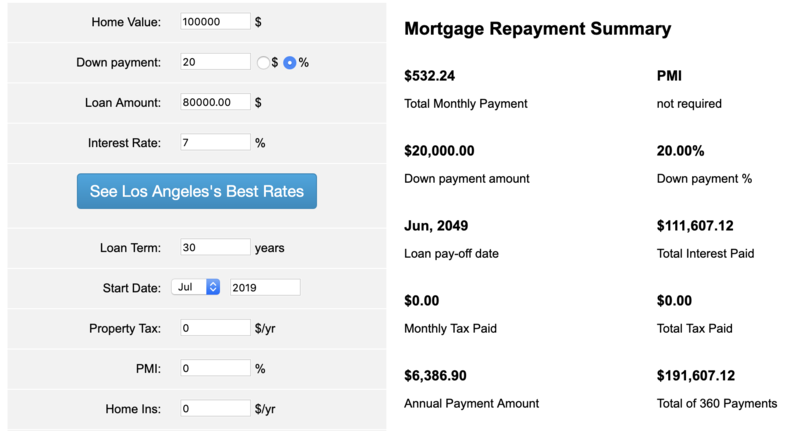
    Let's use even more specific numbers.  Here's a $100,000, 30 year fixed rate loan, with a 20% down payment (so 80k loan) at the going rate in 1970, about 7%.

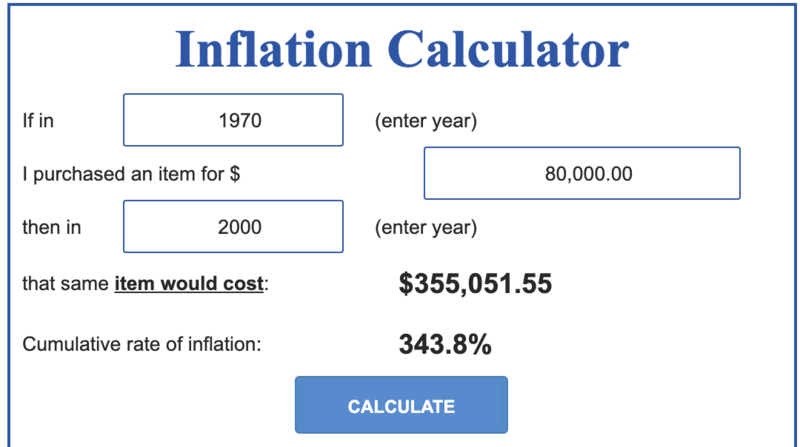
    As you can see, the bank would receive a total of $191,607, over the 30 years, for lending you 80k.  Now, check out 80k put into an inflation calculator, for 30 years, starting in 1970. 

    Ouch...355k.  That's a massive loss for the bank.  But this would be a massive gain for the borrower.  

    Now remember the US is the largest debtor nation in the history of world.  23 trillion in debt, and that doesn't include unfunded liabilities, which some estimate to be north of 200 trillion.  And the only way to solve a debt problem is 1. Default or 2. Inflation.  

    Point being, there's tremendous tailwind for inflation over the next 30 years, not to mention interest rates worldwide are at near 5000 year lows. 

    So the big takeaway is USE AS MUCH 30 YEAR FIXED RATE DEBT AS YOU CAN GET YOUR HANDS ON! ;) 

    If you have any further questions don't hesitate to look me up, all my contact info is on my profile.

    George 

  • Rental Property Investor · East Providence, RI · Member since 2018 · 1k+ posts · 1k+ votes
    7y
    Originally posted by @Benita G Baucom:

    @Frank Patalano what is a house hack?

     You have heard of house hacks before but you just don;t know the term. It is when you buy a multifamily and move into one of the units and rent the other units out. Technically you could do that with a single family and rent out bedrooms as well.

  • David NutakorPro Member
    Rental Property Investor · Palmdale, CA · Member since 2016 · 122 posts · 88 votes
    7y

    @George Gammon, thanks for the comprehensive information provided. This is an excellent information for real estate investors. We need more of this on the forum.

  • Rental Property Investor · Member since 2018 · 46 posts · 11 votes
    7y

    There is nothing else to say. The % returns are better when you leverage than you own with cash. EVERY major US company uses debt to scale quicker and grow. It is sad that people needed to attend an event to learn that banks aren’t giving someone’s 480,000 for 20,000 back over a 30 year period lol. The American economy actually couldn’t function if that’s how it worked. How is this news to anyone?

  • Rental Property Investor · Martinsburg, WV · Member since 2017 · 111 posts · 81 votes
    7y

    @Chauncy Gray No offense, but it sounds like you had little to no idea how interest works in the first place.

    Each lender is required, by federal law and prior to closing, to give you a document laying out exactly the findings you made with your amortization calculator (a Truth in Lending document) . These aren't hidden fees or gotchas. These are what your lender anticipated you'll you pay for not having 100% of the money you need for your investment. And they're much more forgiving than, say, credit card interest, because it is secured versus unsecured debt.

    I would strongly encourage you to spend some more time reading about and understanding this, as it is fundamental to borrowing.

  • Rental Property Investor · Chubbuck, ID · Member since 2018 · 532 posts · 466 votes
    7y
    Originally posted by @Chauncy Gray:

    Hello Everyone,

    I was at a local real estate investor group meeting last night, and I was told something that I could not believe at first. I was told that amortizations are never good, especially for 30-year mortgages. The presenter told us that we are being told by the bank that we are paying, for example, a "5%" (or any "low") fixed interest rate on a 30-year mortgage, but what the bank is not telling us is how much we are actually paying altogether. The presenter continued and said that those who are on 30-year mortgages are paying 60%-100% interest (or 160% - 200% of the loan value), not the traditional "5%" that we are applying for. I just could not believe it, until tonight, where I built an amortization schedule and I ran a scenario. 

    I created an amortization schedule for a $484,000 loan on a 5% interest rate. Upon completing the schedule, I took the total amount of the simple interest for all 360 periods and the principal for all 360 periods. I totaled each separately, and then I added them together. 

    Simple Interest - $451,358

    Principal - $484,000

    Simple Interest + Principal = $935,358

    If I did this correctly, the borrower is paying back nearly double of what he or she borrowed (over 193%) at the last period. I find this ratio to be the same for any 30-year mortgage, and I also found the ratio to be smaller for loans with shorter terms. 

    With the way the amortization schedule is structured, 5% is being applied, but it's the interest that's deducted first before the principle, as with any other schedule. The simple interest and principal still add to the monthly payment, but the banks are making more money (a lot more I guess) by deducting the interest first. I don't find the banks to be lying, but I rather find them to be a bit cunning...

    Am I missing anything here? I added the link to the spreadsheet that I generated, if anyone wants to review it:

    https://docs.google.com/spread...

    Why should real estate investors take out 30-year mortgages if the investor has to pay back nearly double to the bank, even if the investor makes profit off of the property?

    This is a valuable lesson to learn. Interest and amortization schedules should be taught in high school along with budgeting. I am glad you now understand interest and time value of money.  There are slot of people who make student loan payments and the amount they owe goes up everyday because their payment is less than interest is accruing and they will never pay it off. Hopefully you can use your new found knowledge to your advantage. 

  • Investor · Newark NJ · Member since 2012 · 104 posts · 61 votes
    7y

    @George Gammon

    You made one of the most cogent points in this thread. Thank you!

    Too many folks don’t realize how much ‘help’ they are getting from Uncle Sam.

  • Richmond, RI · Member since 2019 · 124 posts · 40 votes
    7y

    @Soh Tanaka

    Thank-you very much!

  • Richmond, RI · Member since 2019 · 124 posts · 40 votes
    7y

    @George Gammon,

    I express my appreciation for your help. Thank-you very much!

    V/R,

    Chauncy

Join the conversationCreate a free account to reply, vote on answers and follow this thread.