Machine learning and Real Estate Investing
Saint Petersburg, FL · Member since 2017 · 13 posts · 12 votes
Big question - why hasn't anyone applied data science and machine learning in the real estate domain?
With the recent (7 years?) advances in natural language processing, image recognition and the validation of various machine learning models why haven't savy investors started a mad race towards developing the ultimate valuation tool?
I've been dabbling in tackling this problem - and so far, it's not that bad.
The only big problems I see is that the data sources for national markets are not uniform.
That the given data might be incomplete or even contain errors (which will affect your model).
That the sample set might be orders of magnitude smaller than your feature space (fixable via removing or combining linearly correlated features to yield an orthogonal feature set)
...So why hasn't anyone done this yet?
Hi everybody!
I have used machine learning (ML) to build models that estimate values/prices for apartments and to predict the expected gross monthly rental income. I did this for my local market (Ålesund) here in Western Norway, but also for Oslo. I also focused on only apartments because that was the most relevant to me. (And no one rents houses in Norway, everybody buys.)
There is a ton to talk about here, so I'll just dive right into it and try to give a somewhat concise overview. I hope this will spark an interesting conversation ;)
So, the biggest challenge has been data volume. It took me a long time to collect over 200 samples in my local market, which is part of the reason I resorted to Oslo (Norway's capital) where I have almost 2.500 samples. Still not a ton by ML standards, but useful.
I used a linear regression model (LR) and a neural network (NN) to model both values/prices as well as gross rental income. For Oslo, I am now down to 6% median error rate (with the NN), and 90% of the test samples are within 18%-19% error rates at the worst. And this is by using only four features (input variables) for the model: living area, year built, and location (longitude and latitude). I am personally quite happy with that. The reason I only use those four is because others (I have a total of 22 features collected, many very sparse) didn't improve my models or made its performance even deteriorate.
I also use principal component analysis (PCA) as a very simple anomaly detection algorithm on the data set. I do this to help me automatically identify properties on the market which may be undervalued.
I know that Zillow's zestimate gets butchered left, right and center. But truth be told, 6% median error rate (also Zillow's national average) is quite good, and probably better than a lot of humans. On average, that is. Sure, it can be off by 20%. But humans can be too sometimes. At least I can. I would also like to point out that 6% median error rate means that, on average, all the stuff that is NOT captured by the models (living area, location, year built) only accounts for 6% of the price.
But still this means that I can't blindly rely on just the models. I use them to help me identify and decide on potential deals. And I can happily report that I just bought my first investment property (a studio apartment right in the city center) using these methods. Personally, I think this is pretty remarkable, because before I started with any of these in March I had NO clue about the local real estate market.
So, what's on the horizon? I have a lot of things I would love to try out. I would love to use image recognition methods to look at pictures of listings and detect things in them that influence the price (a nice kitchen, a pool, a pet elephant, etc.). It would also be great to use text recognition to do something similar. I also want to collect data on more markets to extend my investment horizon (Oslo is useless to me because it is way too hot and expensive, but Trondheim could be good).
Anyway, I would also definitely be up for a dedicated BP ML/AI group and to work together to improve our efforts and models! And I am more than willing to share more details. I'd like to point out, though, that I found ML and data science back in February, so I am far from an expert ;)
@Severin Sadjina I’m definitely interested.
Hi everybody!
I have used machine learning (ML) to build models that estimate values/prices for apartments and to predict the expected gross monthly rental income. I did this for my local market (Ålesund) here in Western Norway, but also for Oslo. I also focused on only apartments because that was the most relevant to me. (And no one rents houses in Norway, everybody buys.)
There is a ton to talk about here, so I'll just dive right into it and try to give a somewhat concise overview. I hope this will spark an interesting conversation ;)
So, the biggest challenge has been data volume. It took me a long time to collect over 200 samples in my local market, which is part of the reason I resorted to Oslo (Norway's capital) where I have almost 2.500 samples. Still not a ton by ML standards, but useful.
I used a linear regression model (LR) and a neural network (NN) to model both values/prices as well as gross rental income. For Oslo, I am now down to 6% median error rate (with the NN), and 90% of the test samples are within 18%-19% error rates at the worst. And this is by using only four features (input variables) for the model: living area, year built, and location (longitude and latitude). I am personally quite happy with that. The reason I only use those four is because others (I have a total of 22 features collected, many very sparse) didn't improve my models or made its performance even deteriorate.
I also use principal component analysis (PCA) as a very simple anomaly detection algorithm on the data set. I do this to help me automatically identify properties on the market which may be undervalued.
I know that Zillow's zestimate gets butchered left, right and center. But truth be told, 6% median error rate (also Zillow's national average) is quite good, and probably better than a lot of humans. On average, that is. Sure, it can be off by 20%. But humans can be too sometimes. At least I can. I would also like to point out that 6% median error rate means that, on average, all the stuff that is NOT captured by the models (living area, location, year built) only accounts for 6% of the price.
But still this means that I can't blindly rely on just the models. I use them to help me identify and decide on potential deals. And I can happily report that I just bought my first investment property (a studio apartment right in the city center) using these methods. Personally, I think this is pretty remarkable, because before I started with any of these in March I had NO clue about the local real estate market.
So, what's on the horizon? I have a lot of things I would love to try out. I would love to use image recognition methods to look at pictures of listings and detect things in them that influence the price (a nice kitchen, a pool, a pet elephant, etc.). It would also be great to use text recognition to do something similar. I also want to collect data on more markets to extend my investment horizon (Oslo is useless to me because it is way too hot and expensive, but Trondheim could be good).
Anyway, I would also definitely be up for a dedicated BP ML/AI group and to work together to improve our efforts and models! And I am more than willing to share more details. I'd like to point out, though, that I found ML and data science back in February, so I am far from an expert ;)
What do you think about the quality of data?
I mean, the best deals are off market, and the closing prices for real estate transactions are not public in some countries, so closing prices may differ significantly from ask prices.
@Jason Ling - pretty sure that most innovative prop-tech companies have their toe dipped into more advanced analytics of RE data.
The fact that Redfin will make you a cash offer / other i-buyers tells me they are pretty confident based on more advanced analytics.
As matterport becomes ubiquitous, I think it will create larger big data opportunities for real estate (I'd assume they are working on this now).
RE data is fragmented - but the big players with nationwide reach and tech culture are definitely taking the Astoria you're taking about
In my experience, having transaction histories available is a big plus, no doubt. At least for my market and what I've looked at, you can get reasonable performance without it too (using asking prices).
This actually touches on another issue I've been thinking about: What I want is the "real" market value of a property. That is, the value for which I would expect a property to get sold given all other properties and their transaction prices around. This could, for example, be the median of what I get if I tried to sell the same property at the same time several times (yes, this is pretty academic now :D) Neither actual sales prices nor asking prices or appraisals of ONE single property are equal to that idealized "real" value for that ONE single property. I am not sure I explained myself well, but the point is: Technically, we have targets (market values at a given time) for which we do not have accurate data. There is always some "noise in the measurements" (as neither asking price, appraisal nor actual selling price is equal to that "real" market value in a sense).
Anyway, slight digression :D
@Jason Ling I though companies like Redfin are doing this
In my experience, having transaction histories available is a big plus, no doubt. At least for my market and what I've looked at, you can get reasonable performance without it too (using asking prices).
This actually touches on another issue I've been thinking about: What I want is the "real" market value of a property. That is, the value for which I would expect a property to get sold given all other properties and their transaction prices around. This could, for example, be the median of what I get if I tried to sell the same property at the same time several times (yes, this is pretty academic now :D) Neither actual sales prices nor asking prices or appraisals of ONE single property are equal to that idealized "real" value for that ONE single property. I am not sure I explained myself well, but the point is: Technically, we have targets (market values at a given time) for which we do not have accurate data. There is always some "noise in the measurements" (as neither asking price, appraisal nor actual selling price is equal to that "real" market value in a sense).
Anyway, slight digression :D
Severin, I understand what you mean and I think you are spot on, but the figure you want to find out, the intrinsic value of a property, which could be the real estate equivalent to the "book value" of a company (provided it is accurate, and the financial statements filed are accurate) is very hard to ascertain, as it depends on a number of variables, and also on buyer expectations that are subjective:
- The comparable properties that are for sale on the market at a certain moment (the "rival" properties also for sale) and their condition. It is a bit like the bid - ask spread for a stock, but less dynamic. If a seller wanted to sell today a certain property, the seller would have to price it very carefully, and usually below the other comparable properties for sale.
- The scarcity of some feature of that particular property (top floors are very hard to appraise), like having a big balcony in an area where it is hard to find a property with a big balcony. A very specific feature would be views, very important for beachfront properties.
- The quality of the building (historical building, passive building, skyscraper, etc).
- The quality of interiors, flooring, kitchen, bathrooms.. and how they differ from the qualities of the surrounding properties.
For example, investors who have been around a certain local real estate market long enough have a very precise idea of what's the value of a sq m of an apartment (condo) for total renovation. There is usually quite a precise figure for that. This kind of property would be harder to finance and mostly available to cash buyers. On top of this figure all the items listed above would be added up to get the final price estimate per sq m.
In the stock market there are certain price levels that are more important than others (high and bottoms, moving averages), for stocks and indexes, and there are models that revolve around those figures, that would be the prices (moving averages) around which the market revolves and moves up and down.
For real estate there are also those sort of prices and price movements (but they adjust more slowly), but it is harder to know how much value a potential buyer will assign to a balcony, a view, or the fact that the property is already renovated. On top of this, certain buyers due to financial reason or a lack of sense of space, will discard automatically properties that have not been renovated. Other buyers, will just discard a property because they did not like the tiles on the floor, or the layout of the kitchen, etc
@Juan Pardo I think you are 100% spot on, as far as I can see it.
At least my models are no substitute for a professional on-site inspection and assessment by someone who is really knowledgeable in their market (like you portrayed nicely). I see the value of such models mainly for fast and accurate enough assessments of a large number of properties (given ones specific strategy) and in decision support.
I also really appreciate the "scientificeness" I can bring into the whole thing when using rigorous statistical methods to learn about the market (like change in rents and market values or how fast places sell and where etc.)
In the short-term rental space, more and more investors and enterprises have been utilising the data well. Websites like Airbnb show a good amount of booking related data publicly, and it made it easier for third-party vendors to collect the data from their website and a few million inventories. Also, OTA like Expedia has been using ML / Computer Vision to predict which professional images would have a higher conversion rate.
@Severin Sadjina I am interested in joining the meetup as well
Can't be done. Won't be done.
If it could then the same would have been done for the stock market. Companies have spent hundreds of millions into R&D trying to develop this and still no where close to it. Too many unpredictable factors. Zillow's zestimate takes into account data history of comps and factors of each property but those are finite categories, a local agent working in the same area for 20 years is a far more capable entity of valuing a homes worth.
Hi @Doug Elkerman,
I agree that a legitimate local agent can currently better estimate house prices.
Based on your experience what are the data points an agent has that a computer-generated value cannot have at the moment? As mentioned previously in this thread, I think the biggest one is the condition of the property which is very hard to analyze using ML or other property characteristics that are hard to extrapolate from the available data.
Its not so much data points, a ML model can hold a vast superior number of data than a human can but its useless unless it knows what to do with it. These models are built by python engineers not real estate agents. Yes visually humans are much more capable than a computer vision is ever going to be also. Real estate is such an emotional asset also that takes much more into account then comps, even comps aren't really comps when it comes down to someone disliking hardwood floors or loving the surrounding area. Its not really a matter of a technological glass ceiling, a local agent is always going to be better. It's just the nature of real estate.
@Doug Elkerman There is definitely quite a bit of truth in what you are writing, but you are underestimating algorithms and overestimating humans, at least in part.
But again, I definitely agree with you on the emotional part and the visuals. But even that is, in principle, absolutely not outside the reach of algorithms. Just a question of the right data (see Cambridge Analytics or Target and their pregnancy predictions).
Yes visually humans are much more capable than a computer vision is ever going to be also.
Not anymore. Tesla released the report for the fourth quarter of 2019: "We registered one accident for every 3.07 million miles driven in which drivers had Autopilot engaged. By comparison, NHTSA’s most recent data shows that in the United States there is an automobile crash every 479,000 miles".
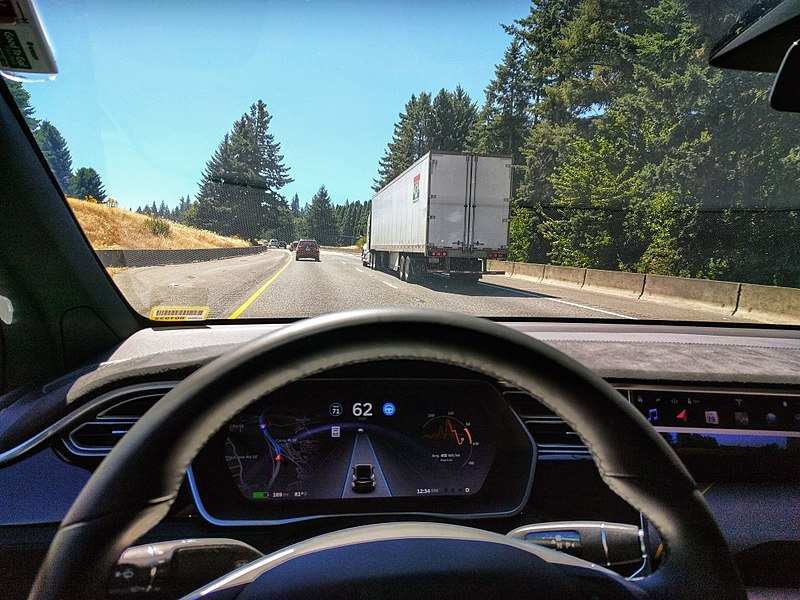
Image source Wkikmedia.org.
Doug Elkerman wrote: "Its not so much data points, a ML model can hold a vast superior number of data than a human can but its useless unless it knows what to do with it. These models are built by python engineers not real estate agents".
Engineers and real estate investors are often the same people. See hot list "RE Investors are Engineers"
Thats a little different, self driving cars. I'm referring to local agents that know their local baristas cats birthday.
@Severin Sadjina, I'm in on the virtual meetup on ML for RE... this thread was dead long ago... just curious if someone is still interested. I have a business idea that I'd like to bounce it off with like minded Software/Product oriented folks