Current PPR Reviews

Current PPR Reviews

Investor · Lynchburg, VA · Member since 2016 · 44 posts · 32 votes

I was searching for a PPR Review within the last year and I think the most current one I could find was from 3 or 4 years ago. I wanted to confirm that to date they have never missed a payment and always returned principal?

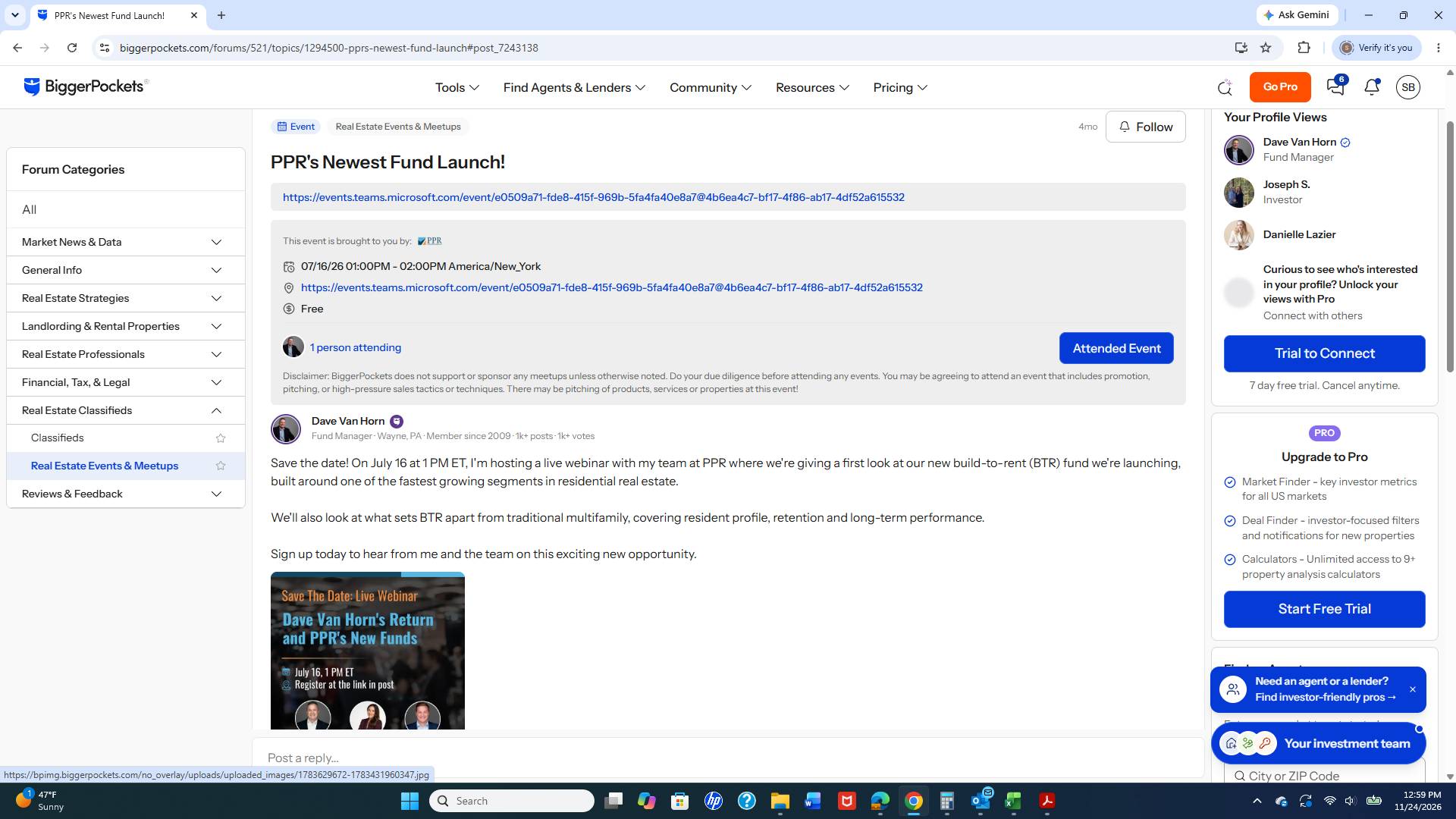
I'm new the notes world and frankly the 3-year locked in PPR preferred return of 12% seems almost too good to be true if they in 16 years have never missed a payment or failed to repay principal. Obviously past results are not necessarily indicative of future performance, but it seems like a great investment for accredited investors to get a low-risk, solid return in exchange for some illiquidity.

8Reply
5,677 views

Most Popular Reply

Investor · Cincinnati, OH · Member since 2016 · 1 post · 8 votes
2y
I can also vouch for Dave VanHorn and PPR.  I have been a PPR investor since 2019 getting anywhere between 8% to 12% return over the years with no payments ever missed.  I have found this much easier than being a private lender.  I also usually compound the return by reinvesting my payments, so the present 12% fund effectively returns 14.38% which is pretty awesome.  

I do have a fairly high percentage of my net worth (35%) in the PPR fund.  Does anyone have another good fund similar to PPR that I could get some diversification?   Please advise.  Thanks!
See this reply in the discussion

102 Replies

Jump to latestLatest
  • Investor · Fairfax, VA · Member since 2015 · 1k+ posts · 808 votes
    1mo

    If you are worried about the value add portion of the reliant income fund then take a look at 7E investments as they are 100% notes. At the end of the day you have to trust the management team to navigate the zoning, construction, and inflationary costs of an asset. There are definitely some situations where the multi family guys are hurting because of rising costs, especially those pesky interest rates. Might be a good time to buy one of these multifamily on the cheap from a distressed owner!

  • Pittsburgh, PA · Member since 2012 · 141 posts · 38 votes
    1mo

    Just wanted to follow up on this and whether anyone has put their 401k funds in any of PPRs funds. Obviously it concerns me to that but I wanted to see everyone else's experience doing that in the even it does make sense. Leaving it in an S&P 500 fund right now concerns me too given market prices so this may very well be a better option. Thanks in advance for any help.

    • Oakland, CA · Member since 2016 · 6 posts · 2 votes
      3w

      I did this in 2023 and regretted it because the S&P over that time has way out performed the PPR funds. I had the same exact logic as you, but it didn't work out. I had no issue placing the 401(k) funds there. Just the decision to take the money out of the S&P at that time was a poor decision

    • Pittsburgh, PA · Member since 2012 · 141 posts · 38 votes
      3w

      Did they not perform as stated? What were their returns?

    • Investor · Lynchburg, VA · Member since 2016 · 44 posts · 32 votes
      3w

      With all due respect @Arthur Johnson I think this is not the right way to assess your decision to invest in PPR. Yes after the fact, we know that the stock market has returned 20%+ per year that last 3 years, while PPR offered a 12% pref with no upside, meaning the most you could make was 12%.

      But we must assess the decision at the time you made it. To use a poker analogy, if you went all-in with pocket aces pre-flop and ended up losing the hand, you can't say the decision was wrong.

      Now there are plenty of good reasons to suggest investing in PPR was a bad decision, just not comparing it to stock market returns after the fact.

    • Member since 2022 · 3 posts · 0 votes
      3w

      I did at the beginning of 2026, before they reduced the preferred on future investments, and so far I'm pleased with the decision and plan to invest more. Let me add that my decision did not focus on comparing the preferred return vs my higher stock market returns and instead was part of my diversification and risk reduction strategy.

    • Investor · Lynchburg, VA · Member since 2016 · 44 posts · 32 votes
      3w

      @Hank Hernandez I am invested too. Just be aware there was some uncertainty mentioned above in the thread where some redemptions might not have been honored on time which has some of us a little on edge. Hoping they will continue to perform.

    • Member since 2022 · 3 posts · 0 votes
      3w

      Thank you Joseph! I went back through the mentioned thread and found the responses you mentioned. While I currently have no need or desire to redeem any of my investment, I will be monitoring more closely and hoping as you are they will continue to perform as they have for many years in the past.

    • Investor · Aliso Viejo, CA · Member since 2015 · 2 posts · 2 votes
      3w

      I am currently investing with PPR's Reliant Income Fund. Today (11/4/2026) I received an email with important investor update, but I cannot open the document in my portal. Did anyone else receive it? What's in the document? I am a bit worried. I received this month's return on time though, like always.

    • Flipper/Rehabber · Kansas City, MO · Member since 2011 · 2k+ posts · 712 votes
      3w

      The just sent out a new message with the documents attached, no log in needed.

  • Investor · Aliso Viejo, CA · Member since 2015 · 2 posts · 2 votes
    3w

    I just received an investor update, as of 11-4-2026, the PPR fund needs to pause redemption for at least 6 months??

    • Investor · Litchfield County, CT · Member since 2017 · 60 posts · 13 votes
      3w

      Can you send me the letter? I too am unable to access my PPR account.

    • Investor · Litchfield County, CT · Member since 2017 · 60 posts · 13 votes
      3w

      Actually, never mind - I got it now

  • Investor · Lynchburg, VA · Member since 2016 · 44 posts · 32 votes
    3w

    Can you post this letter? So many of us cannot access the website as we are getting the spinning wheel of death, but we are concerned and would like to see the letter.

    • Investor · Litchfield County, CT · Member since 2017 · 60 posts · 13 votes
      3w

      I am now able to access the letter and the PPR website is now fully accessible

  • Investor · Lynchburg, VA · Member since 2016 · 44 posts · 32 votes
    3w

    I’ve tried to be a student of the funds that were initially popular but then ended up collapsing, and the communication from the sponsors seem to follow a somewhat predictable pattern:

    Step 1: “Oh the missed payment this month was just an aberration due to a strange mix of redemptions and liquidity”

    Step 2: “Actually there are some deeper structural problems that should work themselves out in 3-6 months”

    Step 3: “Actually there might be some impairment of investor capital”

    Step 4: “Actually there will likely be serious impairment to investor captial”

    Unfortunately I find that PPR is on the same track. In late September, they were telling investors expecting to redeem in October that October just had an inordinate amount of redemption requests compared to normal, but that they expected things to go back to normal in November. Then yesterday, we get the letter and accompanying performance report that admits something more structural is going on with compressed returns on the notes and multifamily/BTR problems.

    My biggest issue with yesterday’s letter and performance report is the disconnect between how the letter describes the state of RIF/RFF’s multi-family and BTR portfolio and the actual property by property results in the performance report . From the letter: "We track every loan and every property in the Fund individually, and many assets are performing as expected with 4 properties in the lease up phase and a small number of multifamily properties underperforming expectations"

    How could PPR say this with a straight face? I made a property by property comparison of the current occupancy of each of the properties compared to budget and compared to underwriting. 16 out of the 17 properties are underperforming and most by a significant margin. The only property performing better on occupancy was acknowledged to have discounted rent by 30%. I know occupancy is only one metric, but they don't give us their underwriting on any other metric such as NOI that we could compare actual performance to.

  • Investor · Litchfield County, CT · Member since 2017 · 60 posts · 13 votes
    3w

    When PPR announced in 2024 they were "expanding" scope beyond their core expertise - which had always been NPLs - there was widespread skepticism whether they were getting ahead of their skis... Being "in" multi-family (for the ostensible sake of "portfolio diversification") and actually being experienced, cautious, and masterful at multi-family investing & property management are two very different things.... Time will tell.

    If PPR stays dedicated to radical, full, open & honest transparency, they can definitely ride this out and right the ship, but the next 12-24 months will test their character as professionals - and humans - of good faith. I hope they pass the test.

  • Stuart UdisPro Member
    Attorney · Philadelphia · Member since 2018 · 2k+ posts · 3k+ votes
    3w

    In this market, if an evergreen fund owns and develops real estate and offers a defined redemption timetable, my general rule of thumb cutoff for the LP’s last dollar of exposure is 60-65% of property value. That includes the debt and LP preferred equity, which means there probably has to be a meaningful amount of the GP’s own money invested behind the LP as common equity. Above that 60-65% threshold, I have a hard time seeing how any fund can reliably return capital on schedule without selling property (which is no easy task in this market).

     This is not PPR specific, but anyone with lock ups in real estate syndications right now needs to understand where their exposure sits in the capital stack with a realistic assessment of property value.

  • Investor · Lynchburg, VA · Member since 2016 · 44 posts · 32 votes
    3w

    I will say that while I am a bit worried and nervous about the situation, having Dave Van Horn back at the helm gives me some optimism. In my interactions with him, he has been super responsive and provided robust answers whenever asked. Others who know him better than I do have vouched for his character. As @Paresh Patel mentioned, I think the next 12 - 24 months are going to be very telling both from an asset performance / market conditions perspective, but also from a communications perspective.

    I do like this commitment to radical transparency, and hope it plays out. It can be tempting for sponsors to sugarcoat bad news and while I don't think they fairly characterized the current state of their multi-family / BTR portfolio, I do like that we are going to get quarterly updates and monthly townhalls so we can directly see if things are progressing as they plan.

    • Investor · Litchfield County, CT · Member since 2017 · 60 posts · 13 votes
      3w

      Let's just hope they are as committed to returning investor capital (in full) as they are to transparency.

  • Stuart UdisPro Member
    Attorney · Philadelphia · Member since 2018 · 2k+ posts · 3k+ votes
    2w

    @Paresh Patel Passive investing shouldn’t rely on hope. You should be able to review the numbers and understand where the fund’s exposure sits in each property’s capital stack and what must happen for the capital to be returned.

    How much debt is on each property? What makes up the equity, and where does the fund’s investment sit relative to other equity investors? What is the property’s current fair market value, and what supports that valuation?

    Can the fund recover its equity through a refinance or sale at today’s values and financing terms? If not, why? If the debt service coverage ratio limits refinancing proceeds, what needs to change—higher rents, lower operating expenses, lower interest rates, or some combination?

    Investors should understand both where their capital sits today and what must happen for it to be returned.

  • Investor · Bucks County · Member since 2023 · 201 posts · 158 votes
    1w

    My father in law is an investor in the Reliant Income Fund. He could have redeemed but chose to remain invested because of PPR's track record. A few months ago, someone on their IR team was promoting one of their new funds and using their repayment track record as a selling point. It's troubling to think PPR may have known it couldn't honor redemptions but delayed pausing them to protect its reputation while raising money for new funds. What happens if PPR can't deliver the promised returns or, even worse, return investors' principal? Those who redeemed a few months earlier were made whole, while everyone who chose to remain invested is left absorbing the losses? Im thinking about the worst case scenario here but if there is a total loss, that could have been spread out over more investors rather than being concentrated on the investors with their redemptions unfulfilled. Still a bad outcome for everyone, but at least everyone shares in the loss and everyone has some principal returned.

  • Investor · Lynchburg, VA · Member since 2016 · 44 posts · 32 votes
    1w

    @Sebastian Bennett Your point is spot on. It is troubling to think that investors who redeemed in July, August, and September received their full 12% pref (if they were 3-year duration) along with full principle back on time, and that investors who redeem later could be left "holding the bag" and absorbing larger losses/decreased return than would have been the case if PPR acknowledged the potential problems earlier. It's really hard to believe that they didn't realize there were potential problems until October/November.

    But to your point, PPR was not incentivized to acknowledge the problems earlier because they were actively raising money for their newer funds which just launched this year.

    • Investor · Bucks County · Member since 2023 · 201 posts · 158 votes
      3d

      The BTR fund was launched in July. Aren't there a number of BTR projects struggling in the current fund? How much did the new fund raise? Perhaps they can purchase the real estate in the reliant income fund and make the earlier investors whole?

  • Investor · Bucks County · Member since 2023 · 201 posts · 158 votes
    1w

    Not much more than a month ago tell me they didn't know....

  • Member since 2019 · 1 post · 0 votes
    1w

    I don't want to distract attention from the current redemption pause, but I have a tax-related question for anyone who has had a PPR Reliant Income Fund investment mature.

    I invested in 2025 under the one-year option, and my investment matured earlier this year. My first-year K-1 reported substantial losses, reducing my tax capital account well below my original contribution.

    I'm trying to understand how PPR handles the return to par and accumulated preferred return on the K-1 for the year of maturity. Specifically, does PPR allocate substantial taxable income to restore the capital account, or is some of that deferred?

    I chose to roll over the proceeds into a new investment, which PPR characterizes as a "redemption and reinvestment." Unfortunately, they haven't been willing to clarify how this will be reflected on my 2026 K-1, making tax planning difficult.

    Has anyone here had a PPR investment mature and received the corresponding K-1? I'd really appreciate hearing how the maturity was reported, particularly whether it resulted in a significant taxable income allocation and how any prior losses were treated.

    Thanks in advance!

    • Investor · Litchfield County, CT · Member since 2017 · 60 posts · 13 votes
      6d

      This is a fair question. I'll be following any responses here as they come in.
      FWIW, I too had some Reliant/Freedom mature, but chose to leave it invested. My understanding wasn't that they 'rolled it over in to a new investment' but that they effectively just left it to remain untouched, similar to how when a (1 or 3 year) Lease expires, it transitions to "month to month." I could be wrong, but that's how I viewed it...

  • Investor · Bucks County · Member since 2023 · 201 posts · 158 votes
    6d

    @Samuel A. This seems like something that should easily be explained by their IR team. What do you mean they aren't willing to clarify? Are you getting no response or simply inadequate explanations?

  • Investor · Bucks County · Member since 2023 · 201 posts · 158 votes
    5d

    I ran the PPM and Fifth Amended and Restated Operating Agreement through AI to evaluate some of these questions. Interestingly, there appears to be a inconsistencies between the two documents regarding the tax treatment of preferred returns.

    1. Taxation of deferred preferred returns

    Page 51 of the PPM expressly states that investors who elect to defer and compound their preferred returns will receive annual allocations of taxable income as those returns are earned, regardless of whether they receive distributions.

    However, Section 5.1(a) of the Operating Agreement bases the allocation of available income and gains on cumulative preferred return distributions actually received, less previously allocated income and gains. The Operating Agreement does not contain the additional language in the PPM regarding annual allocations of deferred preferred returns.

    2. Restoration of capital accounts upon redemption

    Section 5.1 does not appear to expressly require an allocation of profits to investor members to restore capital accounts previously reduced by losses before redemption. However, the special allocation provisions in Exhibit B and applicable partnership tax rules could influence the treatment.

    Even without an allocation restoring the capital account, a redemption exceeding an investor's adjusted outside tax basis could generate taxable gain.

    3. Redemption and reinvestment

    If PPR is treating the rollover as a redemption followed by a new capital contribution, rather than a continuation of the existing investment, that could create a taxable event even though the investor never actually receives cash.

    4. Suspension of distributions

    There is also a distinction between voluntarily electing to defer an otherwise payable preferred return and having distributions involuntarily suspended. It is unclear whether PPR intends to allocate taxable income associated with these unpaid preferred returns.

    5. IRA investors

    The PPM specifically acknowledges the potential for unrelated business taxable income (UBTI), meaning investors holding interests through IRAs could also face tax liabilities without receiving distributions.

    Given these uncertainties, I think PPR's legal and tax teams should issue a formal memorandum addressing these scenarios that investors' respective tax professionals can rely upon for tax planning and reporting purposes. This should be particularly important given the current suspension of distributions and redemptions.

    As a side note, this is interesting:

    Are these guaranteed payments?

    Section 1.1 defines a Guaranteed Payment as a payment to a Class A member for services. Investor members are Classes B through G.

    Any word on whether the PPR team on what fees they've been collecting and if any modifications to those fees have been made in light of their liquidity issues?

  • Investor · Phoenix, AZ · Member since 2020 · 8 posts · 6 votes
    2d

    My investment was already matured several months ago and I chose to continue on month-to-month basis so that I can request redemption with 30 days notice. I got the response from them that mine is also paused along with other investors. If there are other investors similar in mine, we can get get legal counsel as a group to get redemption.

    • Investor · Lynchburg, VA · Member since 2016 · 44 posts · 32 votes
      1d

      @Satya Surendra Double check the PPM/OM but my understanding is that when you chose to go month to month, there is no contractual guarantee that you can redeem in 30 days, but that it would be a "best efforts."

      I'm not sure if you watched their recent webinar explaining the situation, but the fund is now essentially 50% notes, 50% multifamily (much to the chagrin of many of us who were only interested in the note exposure and accepted the back then small amount of MF that came with it). They explained that due to the illiquid nature of MF and it currently being a bad time to sell, they would have had to offload the MF properties at a big discount.

      Reading between the lines, there is also probably a risk that not all investors will get their full pref (12% if you locked in for 3 years) as well as their full principal back. That being the case, and hearing them say they want to treat all investors fairly, I don't see how they are going to redeem anyone at full principal unless they are very confident they will be able to redeem everyone at full principal and paying full pref.

    • Investor · Phoenix, AZ · Member since 2020 · 8 posts · 6 votes
      9h

      Thank You @Joseph S. Does it mean that I may not get full principal back ?

  • Stuart UdisPro Member
    Attorney · Philadelphia · Member since 2018 · 2k+ posts · 3k+ votes
    1d

    To expand upon what Joseph wrote, there are no guaranteed payments, distributions or redemptions. And while the investment strategies appear to have shifted over the past few years, the ability to pursue strategies other than investing in notes was always disclosed in the OA and PPM.

    In reviewing the BiggerPockets discussions, my overarching takeaway is that very few investors understood what they were investing in or the underlying investment strategies. This is not exclusive to PPR. It's a common theme among syndications that market themselves as cash flow funds, “bonds,” preferred credit or income funds with flexible redemption provisions. They tend to attract investors who are almost exclusively focused on the headline marketing terms: fixed returns, short lock-up periods, flexible redemption options, etc.

    The next part of the analysis that often gets overlooked is the how and why. When you're investing in real estate, an inherently illiquid asset class, how can such predictable distributions and flexible redemptions be offered? Where is the liquidity coming from to facilitate those redemptions? Again, investors attracted to these types of offerings rarely care to ask those questions.

    The reality is that the predictability and liquidity emphasized in the marketing materials are rarely supported by contractual obligations but very few care to read what they sign up for.

  • Investor · Phoenix, AZ · Member since 2020 · 8 posts · 6 votes
    9h

    Any one knows if we can buy apartment they are stuck with in discount instead of principal and interest ?

    If they are having hard time selling them, is this an option ?

Join the conversationCreate a free account to reply, vote on answers and follow this thread.