I’ve been a wannabe real estate investor for most of my life, but am just now at a point where I’m able to pull the trigger on that goal. Like many other Californians, I’m not in a position to invest locally. So, my best bet is to invest out-of-state. I’m looking for some tips and guidelines on how to research and identify out-of-state markets. Those of you that have been doing this for a while all seem to have your buy box. What I would like to know is your story behind how you identified that market. How did you get started? What resources did you use for your research? How long did you search before you zeroed in on your market? Did you run into any red flags and have to abandon a market you were researching? Any guidance on how to actually get started is appreciated.
Hey @Paul Graebner, I was in the same boat when I started investing in 2019 living in NYC. I had to look an hour outside the city to find anything that cash flowed.
The first few decisions I had to make were deciding my budget (property value and how much I'd put down) and the type of property. I then got on Zillow and filtered for properties that fit my criteria, ultimately narrowing it down to a few markets in Northern Jersey that were close enough that I could make a trip out there if needed, but far enough from the city to actually cash flow. Some other tools I used were rentometer to get a sense of market rent, and neighborhood scout to get an idea of crime rates. And of course bigger pockets forums and even reddit to see what people were saying about certain areas.
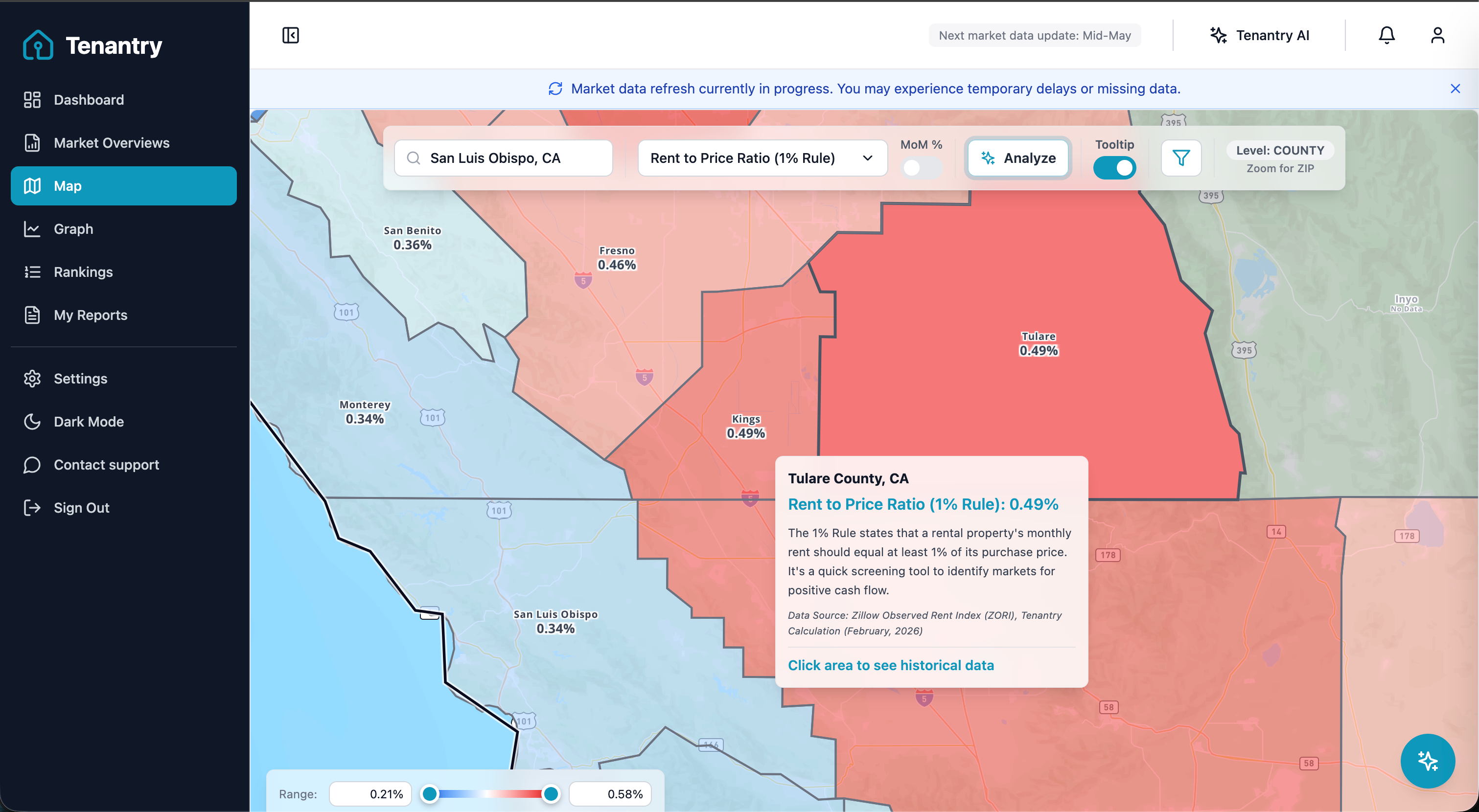
If you're still trying to nail down a market, what could be helpful is a tool I built called Tenantry AI for exactly this purpose, to discover and compare housing markets (metros/counties/zip codes) across 50 different metrics such as affordability, inventory, and demographics. Hope this helps!
My first suggestion would be to invest in areas that you know the most about.
Being an out of state investor is tough in the first place but if you know nothing about the market, it makes it infinitely more difficult. You have to build a team and if you don't know anything/anyone you are relying on people's goodness. And that doesn't get very far when they know you don't know what you don't know.
But at the end of the day, most markets are significantly undervalued compared to California values.
Sorry that doesn't really help but just wanted to make sure you knew the risks of investing when you can't put eyes on the property regularly or know much/if anything about the PM company you are going to use.
Thanks for your response Bryan
I am planning to know the market once identified, including boots on the ground. I'm more looking for guidance on identifying a location geographically before investing the effort to do all that due diligence. Just wondering how others in this forum strategically picked their buy box, or at least their first steps before researching a team.
Hey @Paul Graebner, I was in the same boat when I started investing in 2019 living in NYC. I had to look an hour outside the city to find anything that cash flowed.
The first few decisions I had to make were deciding my budget (property value and how much I'd put down) and the type of property. I then got on Zillow and filtered for properties that fit my criteria, ultimately narrowing it down to a few markets in Northern Jersey that were close enough that I could make a trip out there if needed, but far enough from the city to actually cash flow. Some other tools I used were rentometer to get a sense of market rent, and neighborhood scout to get an idea of crime rates. And of course bigger pockets forums and even reddit to see what people were saying about certain areas.
If you're still trying to nail down a market, what could be helpful is a tool I built called Tenantry AI for exactly this purpose, to discover and compare housing markets (metros/counties/zip codes) across 50 different metrics such as affordability, inventory, and demographics. Hope this helps!

@Nick Sansivero Thank you for the feedback. I just took a quick glance, but the tool you built looks very helpful. I'll have to dig into it deeper over the weekend.
Thanks
Hey Paul as a former SLO resident I know how expensive the market can be there. I moved to the Reno, NV area for lower cost of living and tax benefits. While it's best to invest locally like like San Miguel to the north or Guadalupe to the south or east towards Bakersfield like Lost Hills.
If you are considering out of state think about your time, energy, lifestyle, strategy and ideal tenants. Research the new housing starts, population migration, taxes, industry diversification, crime stats and read the local papers to get an idea of what is happening in the area. As a contractor will you have the time and energy to go visit properties in the Midwest? What is your risk tolerance? How much capital do you have and are willing to lose to still stay in the game?
Another option is to take on a partner on a property in SLO that needs a rehab. You have the experience and know how to make a flip or buy and hold on a duplex or multifamily.
Consider why you want to invest. Long term appreciation, pure cash flow, tax benefits, starting a new business etc... Also think about places you don't want to invest. If you think XYZ state is nasty cross it off your list until you can narrow down to 2-3 markets.
I’ve been a wannabe real estate investor for most of my life, but am just now at a point where I’m able to pull the trigger on that goal. Like many other Californians, I’m not in a position to invest locally. So, my best bet is to invest out-of-state. I’m looking for some tips and guidelines on how to research and identify out-of-state markets. Those of you that have been doing this for a while all seem to have your buy box. What I would like to know is your story behind how you identified that market. How did you get started? What resources did you use for your research? How long did you search before you zeroed in on your market? Did you run into any red flags and have to abandon a market you were researching? Any guidance on how to actually get started is appreciated.
Hey Paul, I start with population growth and job diversity. A market with a growing population and multiple large employers behind the rent demand gives you a cushion that single-industry markets don't. Be careful not to swing too far chasing low price points either, some markets are cheap for a reason and population decline is usually the first red flag. Work down the list until you find a market that checks most of the boxes for you. From there an investor-friendly agent in those markets can help refine your search and find deals that fit your criteria. With it being your first out-of-state deal I would go with something already in good condition so your focus can be on building your local team.
I’ve been a wannabe real estate investor for most of my life, but am just now at a point where I’m able to pull the trigger on that goal. Like many other Californians, I’m not in a position to invest locally. So, my best bet is to invest out-of-state. I’m looking for some tips and guidelines on how to research and identify out-of-state markets. Those of you that have been doing this for a while all seem to have your buy box. What I would like to know is your story behind how you identified that market. How did you get started? What resources did you use for your research? How long did you search before you zeroed in on your market? Did you run into any red flags and have to abandon a market you were researching? Any guidance on how to actually get started is appreciated.
When you invest out of state , just remember , EVERYTHING is going to cost you money . Every call from a tenant will require someone to address the issue . Unless you have a trusted property manager ( which will still cost you money ) Take that into consideration when running numbers .
You are from a expensive state , dont think a cheap price is a deal based on what you know of where you live . Baltimore for example , houses look great on paper , and there are people making money there , but they are experienced . I myself live 30 minutes from Baltimore and have no interest in investing there .
@Bradley Buxton, @Evan Hopple, @Jimmy Lieu, @Matthew Paul
Thanks everyone for the sound advice. I believe I'm getting closer to identifying some prospective locations. Ultimately, once I've identified a viable area, I do plan on visiting to put eyes on the neighborhoods and meet with potential team members. I've got some more work to do before zeroing in on a location, but I appreciate everyone’s input. This is what I was looking for; thank you!
I’ve been a wannabe real estate investor for most of my life, but am just now at a point where I’m able to pull the trigger on that goal. Like many other Californians, I’m not in a position to invest locally. So, my best bet is to invest out-of-state. I’m looking for some tips and guidelines on how to research and identify out-of-state markets. Those of you that have been doing this for a while all seem to have your buy box. What I would like to know is your story behind how you identified that market. How did you get started? What resources did you use for your research? How long did you search before you zeroed in on your market? Did you run into any red flags and have to abandon a market you were researching? Any guidance on how to actually get started is appreciated.
Good question @Paul Graebner. I personally own 28 units in my market and did it mainly by using the BRRRR strategy. Lots of Californians are buying here because landlord friendly, tech investments, and major population growth.
My recommendation is look for a different market where it is landlord-friendly, your dollar goes much further, and where there is tech, job, and population growth.
Connect with an investor agent. Have him connect you with his team of lenders, contractors, property managers. Look at off-market deals and buy them 80-85% of its true-value in turnkey shape or buy them at 75% of ARV for BRRRR/Flip deals.
Make sure to watch out for location, condition (Roof, HVAC, hot water tank, electrical, foundation, and sewer scope), and rentability.
When you re-finance, make sure deal cashflows and breaks even.