Conventional loan investment property- PMI for life?!?

Conventional loan investment property- PMI for life?!?

Investor · Cottage Grove, MN · Member since 2016 · 24 posts · 11 votes

During the recent period of low interest rates I acquired some rentals with a 15% down payment in order to stretch my cash further toward down payments on additional properties.

This helped with the down payments and my math showed that even with a little higher interest rate compared with 20% down and the PMI until I was able to remove that this would still be the wiser choice.

Due to the market appreciation during the last few years of regular payments I was able to remove the PMI from all loans except for one. It was admittedly somewhat of a frustrating process and I got the impression that lenders purposefully make it challenging to remove and do the bare minimum to meet the federal guidelines for removal (very slow responses to PMI removal inquiries requiring multiple follow ups, incomplete or missing information on the process of removal or borrower rights, calculating LTV incorrectly, etc, etc). This was not unique to a specific lender but some made the process easier then others for sure.

Anyway, I am now approaching 75% LTV (based on initial purchase price) for the last investment property with PMI so I reached out to start the process and was denied with no explanation. When I followed up and asked for a specific reason (thinking it might require an additional payment towards principle to put me under the threshold) they wrote back informing me that investment properties do not qualify for automatic termination and that PMI will remain for the life of the loan and if I want to remove it I can look into refinancing.

This is a conventional loan so my understanding was that I could request the removal of PMI once I got to 75% LTV (as opposed to 80% with a primary residence) as this was the case with the other properties. If I'd know that I'd be paying it for the life of the loan I would have been better off paying the extra 5% down payment and enjoyed the lower interest rate but I don't recall ever being informed of that or reading it anywhere in my documents. Refinancing doesn't make sense as I'd effectively double the current interest rate and have additional closing costs surpassing the PMI.

Am I stuck paying PMI like the lender says or are they somehow mistaken? This is not a multi-family unit and was purchased in the last several years if that makes any difference.


1Reply
23 views

3 Replies

Jump to latestLatest
  • Jay HurstBusiness Member
    Lender · Dallas, TX · Member since 2017 · 1k+ posts · 1k+ votes
    2y
    Quote from @Kyle Kipka:

    During the recent period of low interest rates I acquired some rentals with a 15% down payment in order to stretch my cash further toward down payments on additional properties.

    This helped with the down payments and my math showed that even with a little higher interest rate compared with 20% down and the PMI until I was able to remove that this would still be the wiser choice.

    Due to the market appreciation during the last few years of regular payments I was able to remove the PMI from all loans except for one. It was admittedly somewhat of a frustrating process and I got the impression that lenders purposefully make it challenging to remove and do the bare minimum to meet the federal guidelines for removal (very slow responses to PMI removal inquiries requiring multiple follow ups, incomplete or missing information on the process of removal or borrower rights, calculating LTV incorrectly, etc, etc). This was not unique to a specific lender but some made the process easier then others for sure.

    Anyway, I am now approaching 75% LTV (based on initial purchase price) for the last investment property with PMI so I reached out to start the process and was denied with no explanation. When I followed up and asked for a specific reason (thinking it might require an additional payment towards principle to put me under the threshold) they wrote back informing me that investment properties do not qualify for automatic termination and that PMI will remain for the life of the loan and if I want to remove it I can look into refinancing.

    This is a conventional loan so my understanding was that I could request the removal of PMI once I got to 75% LTV (as opposed to 80% with a primary residence) as this was the case with the other properties. If I'd know that I'd be paying it for the life of the loan I would have been better off paying the extra 5% down payment and enjoyed the lower interest rate but I don't recall ever being informed of that or reading it anywhere in my documents. Refinancing doesn't make sense as I'd effectively double the current interest rate and have additional closing costs surpassing the PMI.

    Am I stuck paying PMI like the lender says or are they somehow mistaken? This is not a multi-family unit and was purchased in the last several years if that makes any difference.


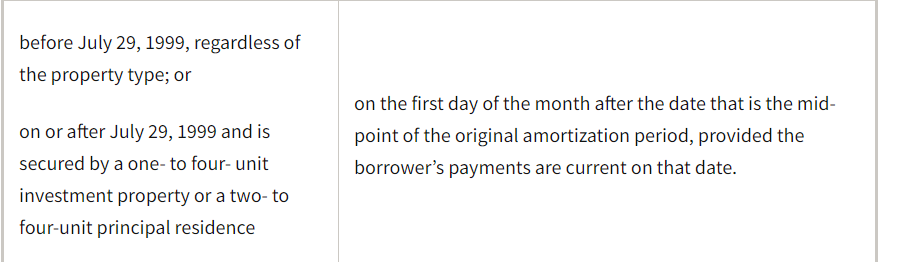
     Here is the link to the Mortgage insurance removal for Fannie Mae originated loans. If you read close the rules are different if owner occupied or second homes vs Investment.  https://servicing-guide.fanniemae.com/svc/b-8.1-04/terminati...

    It does not help you at this point, but this one of two reasons we split a 15% non-owner property into two mortgages to avoid MI all together with a first mortgage at 75% and a second mortgage for 10%.  It also gives you a much better total payment. 

    Hurst Real Estate, INC4.987 Reviews
  • Theresa HarrisPro Member
    Member since 2019 · 15k+ posts · 11k+ votes
    2y

    If they refuse to remove it, why not refinance and change lenders?

  • Lender · Washington DC · Member since 2015 · 2k+ posts · 2k+ votes
    2y

    a) you applied for owner occupied loan and the note says if you change to non owner the PMI for the full 61 months

    or

    b) the loan is NonQM and the note says the PMI is until month 61 or forever.

    c) the note says one rule for owner occupied can be released and a different rule for investment. There is more risk in investment/non owner therefore the insurance gives them security

    How does it read?

Join the conversationCreate a free account to reply, vote on answers and follow this thread.