Investor · Fort Lauderdale, FL · Member since 2013 · 919 posts · 607 votes
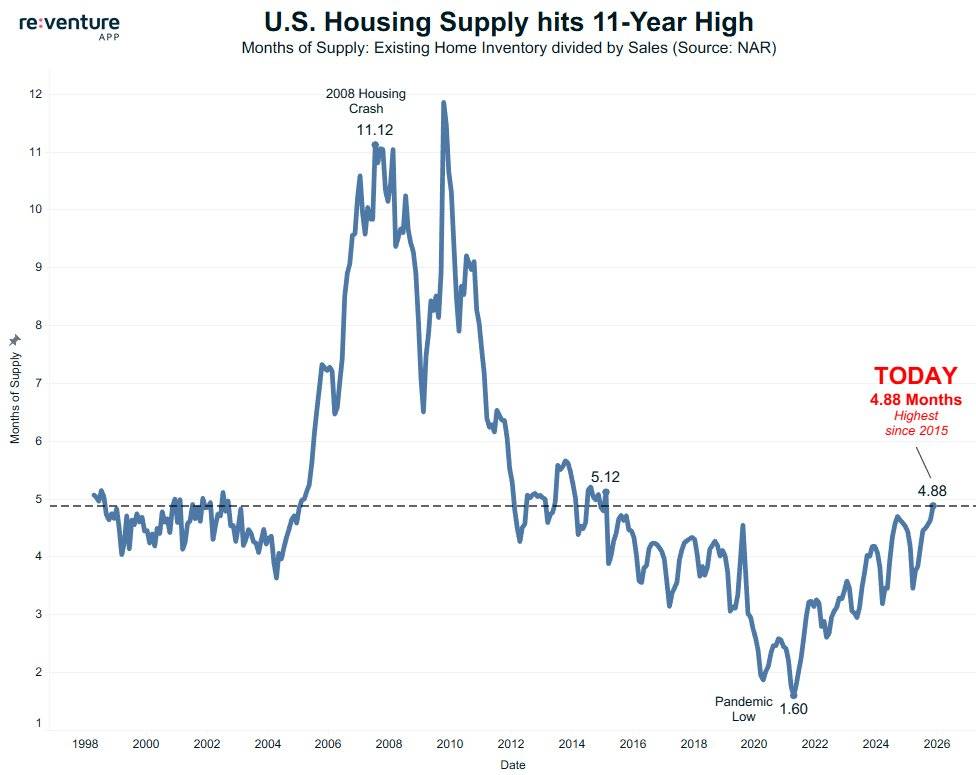
The “housing shortage” narrative is getting harder to defend. U.S. existing-home inventory just hit 4.88 months of supply. That’s the highest level since 2015.
Look at the direction of the chart.
After collapsing to just 1.60 months of supply during the pandemic, inventory has been steadily rebuilding.
We’re not anywhere near the 11+ months seen during the 2008 housing crash. But that’s not the point.
The market doesn’t have to repeat 2008 to become a very different market. In some markets today, inventory has already reached 6–7 months of supply.
That’s no longer a seller’s market.
It’s a market where buyers have choices and where sellers have to compete.
Where price reductions become more common, (over 50% in some markets).
The mantra of “Just wait, there aren't enough houses” becomes increasingly difficult to defend. The housing shortage may have been real. But that narrative is now history.
Investor · VA · Member since 2015 · 21k+ posts · 19k+ votes
3w
I think you need to look at this by metro area and just not nationally as some markets have very low inventory and other markets have very high inventory, for example TN is 45% greater inventory than 2019 but illinois is down 62% since 2019. Florida is only up 10% from 2019 and down 10% from last year.
So like most in real estate, it really has been determined by MSA
Investor · VA · Member since 2015 · 21k+ posts · 19k+ votes
3w
I think you need to look at this by metro area and just not nationally as some markets have very low inventory and other markets have very high inventory, for example TN is 45% greater inventory than 2019 but illinois is down 62% since 2019. Florida is only up 10% from 2019 and down 10% from last year.
So like most in real estate, it really has been determined by MSA
Real Estate Agent · Louisville, KY · Member since 2017 · 1k+ posts · 1k+ votes
3w
The shortage narrative is fraying at the metro level too, not just nationally. Louisville just posted 3.5 months of supply for August, up almost 30% YoY, and 4,490 active listings, up 33% YoY — still technically a seller's market by the old 5-6 month definition, but the direction is the story, not the snapshot. What's interesting here specifically: the supply build isn't just resales sitting longer, there's real new demand coming online too — a battery plant an hour away just went live with 1,500+ jobs, a couple billion-dollar manufacturing projects nearby are proceeding, and a multi-year appliance-plant expansion is ongoing inside the metro itself. So the shortage-vs-surplus question in a market like this is really a timing question: is housing supply outrunning the job pipeline right now, or catching up to it. Right now it's outrunning it, but that gap has a way of closing faster than people expect once payrolls actually ramp.
Coral Springs, FL · Member since 2018 · 487 posts · 106 votes
3w
The "shortage" is real if you only look at MLS. But there's a whole shadow inventory that never shows up in those months-supply numbers.
In Broward County where I buy tax deeds, there's no shortage at all. Code violations, abandoned properties, tax-delinquent parcels — they sit in a parallel pipeline that never touches the MLS. The shortage numbers count move-in ready houses sold through traditional channels. They don't count the distress that's sitting there for investors willing to do the work.
Louisville at 3.5 months is interesting but I'd bet a lot of that is conventional stock. Go look at tax delinquent lists in any of those markets and you'll find inventory the headline numbers completely miss.
The real story isn't shortage vs surplus. It's that the inventory exists but most buyers can't access it because they're stuck in the MLS mindset. Tax deeds, code enforcement liens, probate — that's where the supply is. It just requires actual work instead of Zillow scrolling.