


Managing rental properties across multiple LLCs, tracking income and expenses by property, and keeping security deposits organized requires more than a standard business checking account. Real estate investors need banking tools designed for the complexities of multi-property portfolios. The right banking solution for real estate investors and operators can help organize cash flow across properties and entities while connecting banking activity with bookkeeping and tax reporting workflows.
Whether you manage a single rental or a portfolio spanning dozens of properties, choosing a banking platform that understands real estate investing can streamline operations and support growth.
Key Takeaways
- Real estate investors should prioritize banking platforms offering property-specific accounts, integrated rent collection, and automated bookkeeping features.
- Baselane combines banking, bookkeeping, and rent collection in one platform, with no monthly account maintenance fees and unlimited property and entity accounts.
- Annual Percentage Yield (APY) varies substantially by provider and account type, so investors should compare checking, savings, and money market rates on a like-for-like basis.
- Traditional banks like Chase, Wells Fargo, and U.S. Bank offer branch access and commercial real estate lending for investors who need in-person service or financing relationships.
- Digital banking platforms may provide deposit accounts through partner banks, with terms and eligibility conditions varying by provider.
- Real estate investors and operators should evaluate how each banking option handles multi-entity structures, security deposit organization, and tax preparation needs before committing.
Banking Platform Comparison
| Platform | Best For | Key Features |
|---|---|---|
| Baselane | Integrated banking and bookkeeping for real estate investors | Property and entity accounts, automated bookkeeping with 120+ categories, rent collection, tax reporting |
| Stessa | Property management with financial tracking | Cash Management accounts, portfolio tracking, rent collection, leasing and maintenance tools |
| Bluevine | Working capital with banking | Subaccounts, business line of credit, QuickBooks integration, bill pay |
| Chase | Branch access and commercial lending | 5,100+ branches, CRE loans, merchant services, business credit cards |
| Wells Fargo | Multifamily and large-scale CRE financing | Agency lending programs, 4,100+ branches, Treasury solutions |
| U.S. Bank | Traditional investment property loans | Free Business Essentials checking, SBA loans, about 2,100+ branches |
| Live Oak Bank | SBA financing specialists | Top SBA 7(a) lender, high-yield savings, streamlined digital process |
| Mercury | Tech-forward LLC structures | API access, multiple subaccounts, Treasury accounts. Not FDIC insured. |
| Axos Bank | Online lending solutions | DSCR loans, interest-bearing checking, ATM reimbursements |
| Relay | Multi-property cash flow separation | Multiple checking accounts, Profit First cash flow organization, virtual debit cards, team permissions |
Note: SBA 7(a) and 504 loans generally can’t fund rental properties you don’t occupy.
Why Real Estate Investors Need Specialized Banking
Banking for rental properties differs from standard small business banking. A real estate investor or operator managing multiple properties across different LLCs has different needs than a retail business owner with one checking account. Separate bank logins and multiple apps can spread financial information across systems, making reconciliation and tax preparation more time-consuming.
A strong banking solution for real estate investors and operators should support:
- Property-specific accounts: Separate checking and savings for each property, entity, and reserve fund
- Multi-entity management: Easy handling of multiple LLCs without juggling separate bank logins
- Security deposit organization: Dedicated accounts or tracking tools for tenant deposits
- Rent collection integration: ACH payment processing that flows directly into the right accounts
- Automated bookkeeping: Transaction categorization by property and tax category
- Tax-ready reporting: Schedule E reports and transaction exports for federal and state returns
- High-yield savings: Competitive APY on reserve funds held in savings accounts
The following comparison covers digital platforms built for real estate, traditional banks with CRE lending, and online banks with specialized features.
1. Baselane: Banking and Bookkeeping Built for Real Estate Investors
Baselane is a banking and bookkeeping platform for multi-property real estate investors and operators. It combines property-level banking accounts, automated bookkeeping, and rent collection in one integrated system.
Why it fits real estate investors
Baselane addresses the core operational challenge real estate investors and operators face: managing cash flow across multiple properties and entities without losing visibility or spending hours on manual reconciliation. Real estate investors can open unlimited checking and savings accounts organized by property, entity, or purpose, all within a single dashboard.
Baselane automatically assigns transactions to each property, entity, and tax category using 120+ real estate-specific categories. This automation reduces the manual work of categorizing expenses at year-end and supports organized tax preparation workflows.
Key features
- Unlimited property and entity accounts: Create separate accounts for each rental, LLC, security deposit fund, or capex reserve with no monthly account maintenance fees.
- Automated bookkeeping: Transactions are automatically assigned to each property, entity, and tax category using 120+ real estate-specific categories.
- Integrated rent collection: Tenants pay via ACH, debit card, or credit card through a rent collection portal.
- High-yield savings: High APY on balances held in savings accounts
- Virtual debit cards: Issue cards with spend limits assigned to specific properties, useful for co-hosts managing short-term rentals
- FDIC insurance: FDIC insurance available up to $3 million for funds deposited via Thread Bank, Member FDIC. Pass-through insurance coverage is subject to conditions.
- Tax-ready reports: Generate income statements, Schedule E reports, and transaction ledgers.
What to consider
Baselane is a digital-only platform with no physical branches, though supported Allpoint+ ATMs allow cash deposits into checking accounts. Real estate investors and operators who need teller-based branch service or direct commercial real estate lending may still prefer to pair Baselane with a traditional bank for those specific functions.
Contact: 1-888-586-1618 | [email protected] | Monday-Friday, 9 a.m.-6 p.m. ET
Open your Baselane Banking account for free.
2. Stessa
Stessa is a property management platform based in Oakland, California, that includes cash management features for real estate investors and operators tracking rental portfolios.
Where it fits
Stessa is primarily a property management and portfolio tracking tool. Its built-in Cash Management accounts let real estate investors and operators separate funds by property or portfolio while connecting banking with Stessa’s bookkeeping, rent collection, and property management workflows.
Key features
- Property management tools: Listing syndication, digital lease creation, maintenance request tracking
- Cash management accounts: Checking accounts with banking features
- Portfolio tracking: Financial reporting across properties
- Rent collection: ACH payments with processing options
- Cash-back debit card: Earn cash back on eligible purchases
What to consider
Stessa combines Cash Management with its broader property management, bookkeeping, leasing, and portfolio tracking tools. Real estate investors and operators who primarily need banking and bookkeeping automation may find the platform oriented toward different workflows.
3. Bluevine
Bluevine is an online business banking platform that offers checking accounts with high-yield interest and access to business lines of credit.
Where it fits
Bluevine works for real estate investors and operators who want to separate funds using subaccounts within a single banking relationship while having access to working capital for repairs or gaps between properties.
Key features
- Multiple subaccounts: Create up to five, 10, or 50 subaccounts for different purposes, depending on the business checking plan.
- Lines of credit: Access working capital for qualified applicants.
- QuickBooks integration: Sync transactions with accounting software.
- Bill pay and invoicing: Built-in payment tools
- High-yield checking: Interest-bearing checking tiers available. Higher rates need a paid plan. Standard pays 1.3% with a monthly activity goal, and Premier pays 3% for $95 a month unless waived.
What to consider
Bluevine is designed for general small business use rather than specifically for real estate investors. Real estate investors and operators would need separate tools for property-level bookkeeping automation, rent collection, and Schedule E reporting.
4. Chase
Chase offers business banking with an extensive 5,100+-branch network for real estate investors and operators who need in-person service and cash deposit capabilities.
Where it fits
Chase is relevant for real estate investors and operators who regularly handle cash, need merchant services, or prefer a traditional banking relationship with physical branch access nationwide.
Key features
- Extensive branch network: Physical locations throughout the United States
- Commercial real estate lending: CRE loans for qualifying borrowers
- Merchant services: Payment processing for businesses
- Business credit cards: Multiple credit options with rewards
- Promotional bonuses: New account offers may be available.
What to consider
Chase operates as a traditional bank with fee structures that may include monthly maintenance charges, minimum balance requirements, and transaction limits. Property-specific bookkeeping and rent collection would require separate tools.
5. Wells Fargo
Wells Fargo provides business banking services with extensive branch presence and specialized multifamily lending capabilities.
Where it fits
Wells Fargo may suit experienced investors with large multifamily portfolios who need agency financing through Fannie Mae, Freddie Mac, or FHA programs.
Key features
- Agency lending programs: Fannie Mae, Freddie Mac, FHA multifamily financing
- Commercial real estate loans: Financing options for various property types
- About 4,070 branches: Physical locations nationwide
- Treasury solutions: Cash management and payment services
- Multiple financing types: Balance-sheet, CMBS, bridge, and mezzanine options
What to consider
Wells Fargo’s business accounts typically include monthly fees and may have transaction limits. The bank’s CRE division serves experienced developers and institutional investors with larger deal sizes.
6. U.S. Bank
U.S. Bank offers direct investment property loans for multifamily, office, warehouse, retail, and mixed-use properties with a free business checking option.
Where it fits
U.S. Bank works for established investors wanting branch access plus direct CRE lending without fintech complexity.
Key features
- Free Business Essentials checking: No monthly fees with unlimited digital transactions. Includes only 25 free teller and paper transactions per cycle.
- SBA loans: Government-backed financing for qualifying real estate projects
- About 2,100+ branches: Physical locations for in-person service
- Promotional bonuses: Limited-time offers may be available for qualifying new business checking accounts
- Investment property financing: Direct loans for various commercial property types
What to consider
While Business Essentials checking has no monthly fee, real estate investors and operators focused on property-level tracking would need separate bookkeeping software for automated categorization and Schedule E reporting.
7. Live Oak Bank
Live Oak Bank is an online bank that consistently ranks as a top SBA 7(a) lender nationally.
Where it fits
Live Oak works for investors specifically seeking SBA-backed financing for acquisitions or major renovations through a streamlined digital process.
Key features
- Top SBA lender: One of the most active SBA 7(a) and 504 lenders
- SBA financing: Offers 7(a) and 504 loan options for qualifying businesses, subject to SBA program limits
- High-yield business savings: Business savings currently earns 2.75% APY, subject to change. Business savings accounts have no debit card or ATM access.
- Online-first process: Faster SBA financing through digital applications
- Promotional bonuses: Limited-time offers on select accounts
What to consider
Monthly fees may apply depending on the account tier, though balance requirements can waive fees. Live Oak focuses on SBA lending rather than comprehensive banking features for real estate investors and operators.
8. Mercury
Mercury is a tech-forward business banking platform. Note that Mercury is not FDIC-insured and can lose money.
Where it fits
Mercury appeals to investors with complex holding company structures who need API access for custom financial automation workflows.
Key features
- Multiple subaccounts: Separate funds by property or purpose
- Treasury accounts: Options for idle cash yield
- API access: Custom workflows and automations
- Extended FDIC coverage: Coverage through sweep network
- Virtual and physical cards: Payment cards for team members
What to consider
Mercury is designed for tech-forward businesses rather than specifically for real estate investors. Property-level bookkeeping and rent collection would require separate tools.
9. Axos Bank
Axos Bank is a digital bank offering DSCR and rental property loan programs entirely online.
Where it fits
Axos suits investors wanting digital lending solutions without branch requirements, particularly those pursuing DSCR financing strategies.
Key features
- Investor-focused loans: DSCR financing from $150,000 to $30 million+, with rental property lending options available
- Interest-bearing checking: Earn interest on business balances
- Unlimited ATM reimbursements: No fees for domestic ATM withdrawals
- QuickBooks integration: Transaction sync for accounting
- Expanded FDIC coverage: Deposit sweep programs available
What to consider
Monthly fees may apply depending on average balance. Axos is a general business bank without property-specific features, rent collection, or real estate bookkeeping automation.
10. Relay
Relay is an online business banking platform that emphasizes multiple account management and team collaboration features.
Where it fits
Relay works for real estate investors and operators managing multiple properties who need per-property cash separation across a multi-LLC portfolio. The platform supports up to 50 checking accounts, depending on plan and entity type, with percentage-based auto-transfer rules for Profit First allocation.
Key features
- Up to 50 checking accounts: Create accounts for different properties or purposes, depending on plan and entity type
- Percentage-based auto-transfers: Route rent deposits into tax, maintenance, and profit buckets
- Up to 50 virtual debit cards: Issue cards with spend limits for team members or contractors
- Team collaboration: Multi-user access with role-based permissions
- CPA Partner Portal: Direct accountant access without sharing credentials
What to consider
Relay focuses on multi-account cash flow management rather than real estate-specific automation. While it offers a free plan, advanced features and higher account limits require paid subscriptions ranging from $30 to $120/month. Real estate investors and operators may also need additional tools for automated bookkeeping by property and tax category, as well as integrated rent collection.
Why Baselane Stands Out for Real Estate Investors
Real estate investors and operators managing multiple properties or entities face common problems: cash flow spread across different accounts, separate logins for each LLC, and manual work to categorize transactions at tax time. Traditional banks were not designed to handle the property-level organization that rental investing requires.
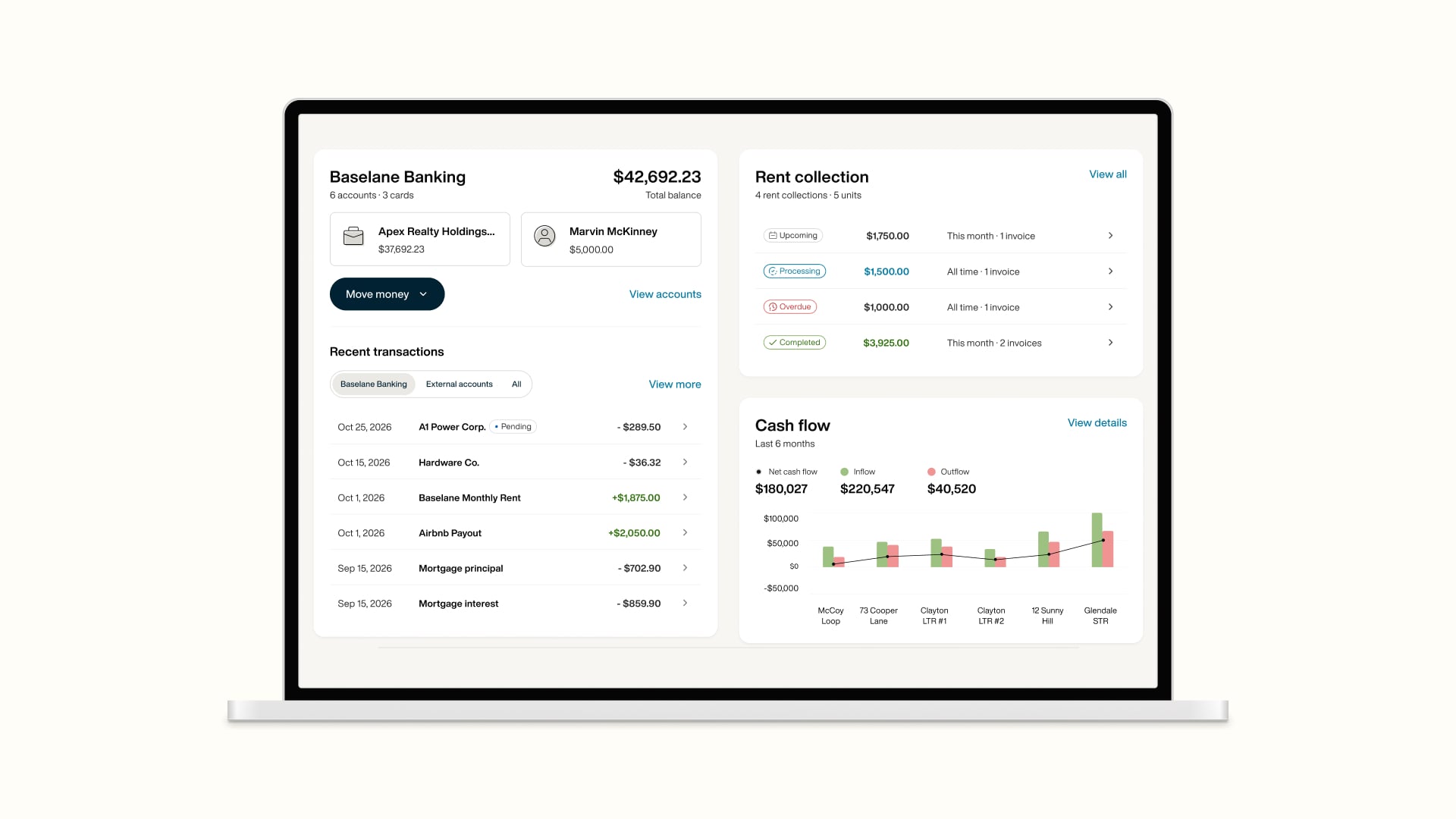
Baselane addresses this by combining banking for real estate investors and operators with automated bookkeeping in one platform. Real estate investors and operators can:
- Create unlimited checking and savings accounts organized by property and entity.
- Collect rent via ACH, debit card, or credit card payments that deposit directly to the correct account.
- View transactions automatically tagged to properties and IRS Schedule E categories.
- Generate tax reports without manual data entry or spreadsheet reconciliation.
- Earn a high APY on savings account balances; FDIC insurance is available for funds deposited via Thread Bank, Member FDIC. Pass-through insurance coverage is subject to conditions.
For short-term rental operators, Baselane allows issuing virtual debit cards with spend limits that can be assigned to co-hosts or cleaners for property-specific expenses.
Baselane allows creating dedicated accounts for tenant deposits, keeping funds clearly separated from operating cash while supporting organized recordkeeping.
The platform works alongside property management tools, providing the banking and bookkeeping layer while real estate investors and operators use other software for maintenance coordination, listing management, or tenant communication as needed.
FAQs
What should real estate investors look for when choosing a bank?
Real estate investors and operators should prioritize banks offering property-specific accounts, integrated rent collection, automated bookkeeping, and tax preparation support. Multi-property investors benefit from platforms that organize transactions by property and entity automatically. Security deposit tracking supports organized recordkeeping and can help real estate investors and operators identify and track tenant funds.
Can real estate investors open a business bank account online?
Digital platforms like Baselane allow real estate investors to open accounts entirely online without branch visits or paper applications. Traditional banks may require in-person verification depending on their policies and the business structure.
Do any banking platforms for real estate investors and operators offer high-yield savings?
Digital-first platforms generally offer higher APY on savings compared to traditional banks. Baselane offers high APY on savings balances, which exceeds the national average for business accounts. Traditional banks typically offer significantly lower rates on business savings.
Should real estate investors and operators use a local bank or digital platform?
The choice depends on specific needs. Digital platforms like Baselane offer property-level organization and automated bookkeeping that traditional banks typically lack. Traditional banks provide in-person service and commercial real estate lending. Some real estate investors and operators use both: a digital platform for daily operations and a local bank for financing relationships.
How do integrated banking and bookkeeping platforms help with taxes?
Platforms like Baselane automatically categorize transactions by property and IRS Schedule E category throughout the year. This reduces manual categorization at tax time and supports the generation of Schedule E reports and transaction ledgers that can be shared with accountants or used for self-filing.
