
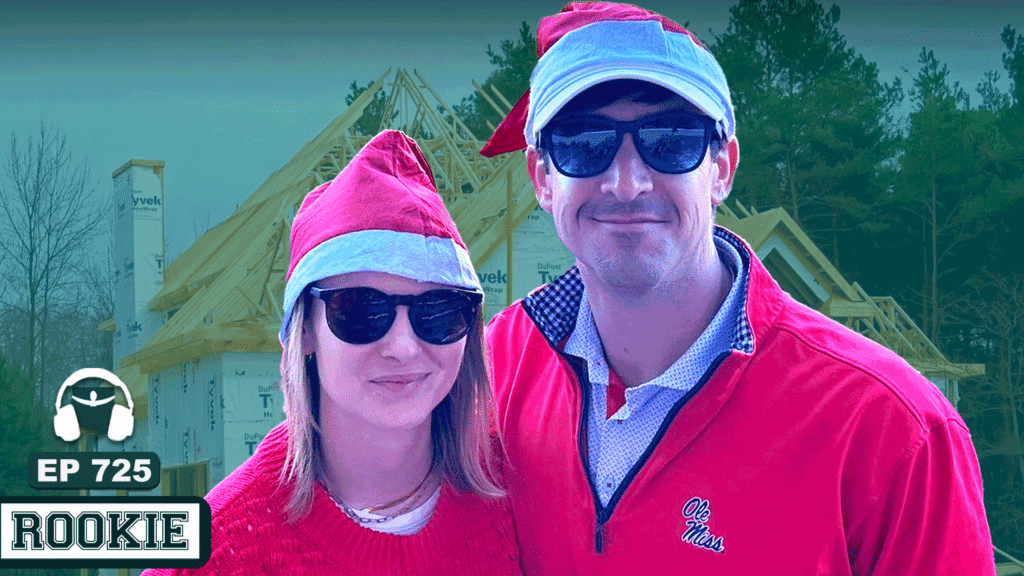
You don’t need a big market, huge salary, or even a college degree to invest in real estate. Today’s guest had a very simple goal when he started: replace his $12/hour construction job. He’s already achieved that, and today, he owns seven rental properties…and counting!
Welcome back to the Real Estate Rookie podcast! Nathan Shelby has dabbled in several investing strategies, from mobile home lots to fixer uppers. But he’s recently landed on a strategy that allows him to use the BRRRR method (buy, rehab, rent, refinance, repeat) on new construction homes—just without the renovations. Despite investing in a relatively small town, one of these properties appraises for roughly twice the cost to build it, allowing Nathan to pull 100% of his cash out for the next one!
Nathan has found his groove in the last couple of years, but it wasn’t always smooth sailing. In this episode, he shares some of the biggest mistakes he made early on—pitfalls you can easily avoid. Stay tuned to learn about the systems and tools you should implement on day one, how to dial in your tenant screening process, and why new construction is often easier than renovating!
Click here to listen on Apple Podcasts.
Listen to the Podcast Here
Read the Transcript Here
Ashley:
What if the secret to building a seven-figure real estate portfolio isn’t a big market, a big salary, or even a college degree? Today’s guest is prove that a promise to your spouse a willingness to see value where others don’t and the discipline to run your investing like a business from day one can take you further than any zip code.
Tony:
This is The Real Estate Rookie Podcast. I’m Tony J. Robinson.
Ashley:
And I’m Ashley Kehr. Today we are joined by Nathan Shelby, a real estate investor out of Pope, Mississippi. Nathan, welcome to the show.
Nathan:
Hey, I’m excited to be here. I feel like this is a long time coming or a long time wanted to be here, I guess.
Tony:
It’s a litle bit of both, man. And the pleasure is all ours and we’re excited to get into your story, man. So I guess give me the quick 30-second version, Nathan. Who are you? Where are you coming from and what does your portfolio look like right now?
Nathan:
I am 34, just turned 34, based in North Mississippi. Portfolio right now is three single family homes, one mobile home and four mobile home lot rent units with two new constructions underway going right now. The wiring is being finished today and the other one, the plumbing is being finished today. So we’re 10 properties, two under construction, and going every direction all at once.
Tony:
Dude, I love that, man. And Nathan, how long have you been investing? When did you start building this portfolio?
Nathan:
We’ve been investing since about 2016. We started with the mobile home lot rents and kind of built that slowly as we got married the same year in 2016 and just trying to get our lives off the ground and try to figure everything out and then on single family and then we really started growing probably about two or three years ago.
Ashley:
Now, Nathan, what were you doing before real estate?
Nathan:
Out of high school, didn’t go to college. I worked construction for a few years. I worked for a land surveyor for a few years. I guess about 10, maybe about eight years ago, got into sales and I worked for a lighting company selling lights, ceiling fans, doorknobs, and stuff like that to contractors. And so I’ve been around construction remodels basically from the civil engineering side to the land surveying to the actual jobs. And now I have a sales job, it’s no longer in the construction industry, but just working throughout the whole past 10 years of trying to grow the portfolio and trying to get further in. Of course, I started to replace my W2, which I’ve done that because it was a lot less 10 years ago, but I just really enjoy it.
Ashley:
Well, Nathan, 10 years ago, what made you decide that real estate was the wealth building tool, the tool to replace your income compared to other investments that are out there?
Nathan:
Well, I mean, at the risk of every single podcast I’ve ever listened to, it started with bigger pockets. My wife’s grandmother had a few rental properties and when we got married, she passed away about the same year, maybe a year later, and we inherited a property that had driveways and septic and all the infrastructure already in place. And that’s how we started off with the lot rent, with the mobile home lot rent, because I took trying to take what we had with minimal investment because we didn’t have much at the time and just to try to get something going and getting that first lot rent was really the, I guess, proof of concept, but bigger pockets really just I came across it, I think maybe a podcast first and then got my hands on a few books and just tried to follow along.
Tony:
Nathan, I’m curious, you said you guys didn’t have a whole lot when you got that first property. What do you mean by that?
Nathan:
I guess I would’ve still been working construction just as a laborer and probably making $12 an hour and my wife was still in college and that was it.
Tony:
I think a lot of people in that situation, Nathan, would’ve maybe said like, “Hey, let’s sell this property and maybe get a big chunk of cash.” What was the thought process for you guys to try and turn it into the beginnings of your portfolio?
Nathan:
Well, one part of it being her wife’s grandmother’s land, her grandmother grew up picking cotton here in Mississippi and she had several businesses. She was a great entrepreneur. She was tough and part of her portfolio or everything she did was real estate. And so we didn’t want to sell it because it’s family property. We don’t ever really plan to sell it, and just trying to get started with what we had without little to no money down or no money in our pockets. But I do have one regret. When we first got married, her grandmother still had one property and it was a mobile home and we lived there. My wife already lived there while she was going to college and we lived there for about a year after we got married and after we moved out of it, I sold it. I sold the home off the property and I regret that.
I’ve regretted that ever since because I could have put some money into it, fixed it up and that would’ve been an actual rental and I would’ve made more money than just a lot rent.
Ashley:
Nathan, when you started investing and you got this first property with the lot rent, how did you treat this? Was this a hobby to you or did you treat it as a business right out of the gate?
Nathan:
I treated it like a business. I ran full background credit. I tried to do software. I tried to make it into a large business even though we only had one property. I think at that time it was maybe $150 a month for that lot rental. But I started I think Cozy.co. And then over the years, of course, that went to apartments.com and then I moved to Inaugo and this year actually moved to TurboTenant.
Ashley:
I’ve never heard of Inago, I don’t think. TurboTenant I use also too in love. Yeah.
Nathan:
Yeah. Inaugo, it’s a good software. It does the full credit, collects rent, does what they all do. It’s kind of like a rent ready comparable, I guess, but it’s free for the landlord and they make their money off process and the payments. But I turned over to TurboTenant this year for the accounting side of it.
Ashley:
Okay. We’re going to take a short break, but when we come back, Nathan is going to walk us through a Facebook marketplace deal that turned a $43,000 house into $120,000 in equity in just six weeks. We’ll be right back. Okay. Welcome back. So we are here with Nathan and we’re talking about building a real estate portfolio and actually in some markets that most investors may overlook. So Nathan, tell us about this $43,000 house that you purchased.
Nathan:
So I’ll say this before I get into it. So when I first started doing the rentals and hounding my wife about wanting to do it and telling her all about it, she finally, one day she told me, “That’s fine, but I don’t want anything to do with it. ” So fast forward to last year, I was on Facebook looking at properties. I’ve jumped between there and Zillow and I’m always looking and I saw a house not about 10 minutes from where we live and I looked through it, looked at the listing, looked at what the guy said just for sale by owner, 43,000 and I just went on about my day and I guess about 30 minutes later she sent me the same post and I said, “Yeah, I saw it. ” I kind of looked at it and she said, “We need to go look at it.
” I said, “Okay.” I was excited. She was excited. So we went and looked at it. I think I was standing in his living room with him I think about three hours after he posted it in marketplace. So it was three bedroom, two bath, 1400 square feet on a corner lot in the county in a good school district. And I think he wanted originally a little over 50,000 and we worked our way down to about 43. So we closed on that in about six days, just a cash but purchased with a line of credit on another property. We put, I guess about 20,000 into it and it appraised for 120,000 and I rented that property for 1,400 a month in about a day and a half.
Tony:
That’s an incredible deal.
That’s an incredible deal. I guess a few questions, Nathan, but the first one is you went direct to seller and I think for a lot of rookie investors, they tend to really just focus on Zillow, Redfin and what’s listed on the MLS, but you decided to go directly to the seller. How did you open up that conversation? Now, obviously he listed it, right? But you said you were able to negotiate. How did you actually open up that dialogue to get from, “Hey, I saw this on Facebook Marketplace to, hey, we’re closing in six days.” What did that negotiation process look like?
Nathan:
I think there were two pictures posted and a little bit of information, not much. And so I sent him a message, said, “Hey, I’m really interested. Do you have any more pictures? Can you give me any more information after my wife sent it back to me? ” And we kind of went back and forth and he didn’t really act like he really wanted to sell it at first. I was asking for, of course, I’m sure he was getting just flooded with messages because a lot of people saw what I saw and I was basically on my way there because he said, “Well, I’ve got some people coming to look. Well, maybe tomorrow, maybe this weekend.” And so I called my banker and said, “Hey, do I have this much money? Can we move some things around?” I said, “Can you send me a letter?” And she emailed me a letter saying, has whatever, and I sent that to him and I said, “I’m very interested.” And he said, “Okay, I’m home.”
Ashley:
Show me the one kind of moment.
Nathan:
Yeah. You know he had a lot of people asking for this and asking for that, but I wanted to prove it. I am actually interested. I’m not just hitting you with the, is this still available like everybody else?
Tony:
Yeah. And what did you see, Nathan, when you actually got there? Was it a validation of what you initially thought or were there some surprises? What did you actually see when you got there?
Nathan:
So it was pretty rough. It was old carpet. It was several dogs in the house. It was an older house and it was kind of funny because when we got there, my wife actually went with me and when we got there and I saw all of that, I got a lot more excited and she was a lot less excited. She was thinking, “Oh my gosh.” And I was thinking, “We could pull this carpet, we could do this. ” So it was rough, but I saw the potential. I thought I was pretty sure what it would appraise for as is without changing anything and that we negotiated there on the spot in the guy’s living room just because I went through and said, “Well, I’ll have to do this and I’ll have to do this. I’m going to rent this property. I’m not going to live here and I’ll have to do it as quick as possible.” And threw some numbers around and we went back and forth and made a deal and then I sent him a typical little contract letter and we both signed it the next morning.
Ashley:
Now Nathan, what about the funds for this? You said you had emailed your banker to ask to move things around to write this letter to show that you had the cash to buy it. What did you actually use to fund this deal?
Nathan:
So I used a line of credit on another property. So we’ve kind of done that over the past, I guess four years, five years. We fixed up this house, increased the equity and used it to do the next and do the next and do the next. And that’s kind of put us over into the new construction would be the same way I’m doing those now.
Ashley:
So you’re having these properties that are completed as the collateral, is it just one line of credit or are you doing separate lines of credit on each one as they’re done?
Nathan:
Separate right now. Yeah. I’m of course, like everybody else, I’ve been waiting for rates to come down and then they did for five minutes and then they went back up. But I feel over the past couple of years, I’ve been waiting to term some things out, but I feel like I haven’t slowed down enough to do that just because I’ve kind of just rolled into the next project, but I want to after we get these two going now finished actually do that, but we’ll see.
Tony:
And Nathan, you mentioned you’ve been moving quickly. Well, first congratulations on that deal because that is a phenomenal deal, but you mentioned that you’ve been moving super fast and yeah, you’re doing a few different strategies and you mentioned this at the beginning of the episode where you’ve got the mobile home play, you’ve got the Burr strategy that you’re leveraging and then you’ve got some new construction. I guess break down each one and what you feel the benefits are and why you’ve spread to multiple strategies.
Nathan:
So we started with a lot rental and we inherited about, I guess about 15 acres in total from her grandmother. And that was her grandmother’s house and then some just property and then kind of on the south side of that property were the mobile home lots that she already had. So our strategy has kind of been we got the lot rentals field and that became kind of our base. And then we moved into her grandmother’s house after she passed away, had to do some rebuild the foundation and put some money into it and went ahead and did a full remodel and then got that stable and then that was kind of … So we’ve grown slow over the past 10 years I feel like. I mean, if you went back or I look back now at where we could be, but a lot of that was just trying to not overextend, but we got the mobile homes to a base and then we’ve kind of moved into a couple of single family and gotten back to like a place of being comfortable and then we just kind of keep moving up.
Ashley:
Now you kind of have built this portfolio mix as you’re talking about here of the different strategies that you’ve done, but what would you say was maybe your biggest mistake that you’ve made along the way and is it specific to one of those strategies?
Nathan:
The first would be selling that original mobile home and then of course I’ve had some letting people move in quick. I’ve had some kind of turning my head to a few things on a credit report because I wanted to get somebody in there and I guess that’s really the main couple. Maybe if you wanted to get real deep, maybe keeping up with expenses a little better throughout the journey, but that’s really it.
Ashley:
When you say about keeping up with expenses, are you talking about like insurance costs or your standard expenses or what do you mean by that clarify?
Nathan:
Well, that and just the accounting of like sitting down every 90 days or whenever I kind of had time or thought about it and just kind of sitting there and physically catching up, going back through bank statements and credit cards and catching up, this was for this house and what was that for? And that’s why this year when I knew we would be stepping into the new construction back in January, I really started looking into different softwares and tried a few and seeing the best thing to kind of automate some of that because it can be a chore, especially when you get to several properties and you’re doing a little remodel here and then you’re thinking about this and then this comes up and even like you said with the typical just insurance and the bank and a couple of utilities here and there, just if you only do it every few months, it’s a lot.
Ashley:
Yeah. I think that especially as you’re growing and scaling, that is a super common problem that investors get themselves into. I mean, I went to school over accounting and finance. I knew how to do bookkeeping, but the acquisition side, so much more exciting, so much more fun to go buy another property than to sit at my computer entering data.
Nathan:
Right. And not going to college, but you are looking at the main bookkeeper, the accountant, the tax expert, the contractor, the maintenance man. I mean, you’re looking at all of them, they’re sitting right here. So it’s been a learning experience for sure.
Tony:
And Nathan, one thing I’m curious about, and not to say that this is a mistake, but I’m just curious what drove it. But you bought your first property, I think you started in 2016, but you said you really didn’t start aggressively growing the portfolio until a few years ago. What was happening in between that time? There was already some proof of concept with that first deal. What was it that prevented you guys from scaling that portfolio sooner?
Nathan:
I would say just life. We moved out of her grandmother’s house and moved in with my wife’s brother and we built ourselves a personal house and we only had the mobile homes up until that point, the lot rents. And so we moved out and got somebody in that house and then just kind of building our personal house, life, job changes, just kind of taking our eye off the ball for a few years and just hanging out with what we had and then kind of got to the point last year, because I’ve always had this 10 years from now idea with the rental property and other things in life and I looked up and said, “Man, 10 years from now was 10 years ago.” I was like, “We have this that I’ve been, hey, we want to do this eventually.” And we’re kind of staring down the barrel of eventually.
And so I felt like it was just we were at a place and it was time to really go all in to see what we could do and just try to make the most of it.
Ashley:
What are the first steps that a rookie investor needs to take to actually start new construction? Where do you start if you want to go on this investing strategy path?
Nathan:
I would say, I mean, property is a big thing. We’re in a very unfair place having inherited property. I mean, I have land that’s free and clear so that makes it pretty easy. But I mean, looking for land in the right place, paying attention to school districts, paying attention to the utilities, water, septic, power, what are you required to do? What is your county permitting? And like here where my personal house is, we poured concrete and it’s in the county on a local water association and we poured concrete to build our house and the guy that works for the water association called me and said, “Hey, the health department just cut us off on new service.” And so we had to drill a well for our personal house, but that would be something to check into because you’re looking at a large expense that you definitely weren’t planning for and the association here, I think we’re going on three years now.
They have not been able to offer new service. So in their coverage area, if you want to build a house or put in a mobile home or do anything, you have to drill a well.
Ashley:
I think the last well that I put in was probably four years ago and at that time it was $13,000 to have a new well put in.
Nathan:
Yeah. I think we came out about 8,500 on hours, but that was I think almost five years ago now.
Tony:
Nathan, just for context, what city are you in?
Nathan:
The closest city would probably be Oxford, Mississippi.
Tony:
How big is Oxford, Mississippi?
Nathan:
I don’t know. I don’t know the population or anything, but it’s not super big. I’m about an hour south of Memphis.
Tony:
So I mean, you’re not necessarily doing new construction in a massive metro or even like a large suburban city. And the reason I ask that question is that there might be people who are in markets of a similar size who might think that new construction maybe doesn’t work in a market like that. I guess you’re building this out. What was it that made you think that new construction was the right model for your market and for where you were at in your investing career?
Nathan:
Well, there’s some other people here that have done it, have been doing it and I’ve seen it work for them. And then just from a cost standpoint, we should on a almost just under 1,200 square feet, three bed, two bath, we should be at about 82,000 if everything budgets out, which means we’ll probably be at about 87, but I think here it’ll rent for about 1,250, 1,300 a month and probably appraise close to 200. And I mean, you can’t go buy a property or a single family home for that and it not need a lot of work or be very old. And then there’s some properties here in the city of Batesville that are in that price range, but it’s just not the … A lot of them aren’t in the best area, I guess, would be the way to put it.
Tony:
Yeah, that’s incredible. You said the bill cost is about 85, right? Somewhere in that ballpark. And you’re saying it’ll appraise for north of 200?
Nathan:
Well, it should get close to 200. Wow. Yeah. And that’s based on, I’ve talked to my appraiser that I’ve used over the past couple of years and just getting some feedback from him on the plan and some comps, but I mean, prices are kind of stalling and coming down everywhere right now, but I believe it’ll appraise at least 150. I mean, I’m very comfortable at 150.
Ashley:
I mean, even if it did at 150, you’re still going to be able to recoup your costs that you put into it by refinancing it. So you use your line of credit to build this, correct? And then you’re going to go and refinance it?
Nathan:
Right. So we should stair step in, we should wind up with a property at the end that is free and clear and then our plan is to kind of stair step the cashflow backwards and pay everything back down and back off.
Tony:
I feel like I need to go build a property right now in Oxford, Mississippi, because those numbers are fantastic.
Nathan:
We’re kind of in a sweet spot here. Of course, it’s by accident, but a lot of the movement from Memphis coming down into DeSoto County, Mississippi, and then all of that kind of moving east based on the school district and then coming south from both directions and then Oxford is pushing back west toward where we are. And so we’re just kind of in a sweep pocket because it’s a main highway from Memphis and then the turn to Oxford, which I mean, there’s a ton of traffic, a ton of students, a ton of grad students, small families, young families. And so we’re just positioned in a really good area.
Tony:
And you said you’re in Batesville?
Nathan:
That’s right.
Tony:
Got it. Okay. Interesting.
Nathan:
I may want to not post this. I may have made it sound too
Ashley:
Good. I’m writing it down because in a couple days, I’m actually going to be on the BiggerPockets podcast and every quarter we each have to come on and pick three markets and I haven’t selected any markets yet and I’m running out of markets to pick because we can’t use any we’ve used before. So I’m writing this down as maybe one of my markets I could talk about.
Nathan:
Right. Well, I would definitely look at, because I’m going to be where I am for a couple of years. I’m not really looking at properties outside of where we’re building, just I’m just going to build that out and see what happens. But I would look east of South Haven and south of Olive Branch That is a booming area. It’s kind of south of Collierville, east of Memphis and then all the way down to Oxford. It’s really booming, which I saw a lot of that selling construction supplies and everything. That’s where all the push people moving and buying and everything was going. All
Tony:
Right. Coming up, Nathan shared the exact systems that let him manage tenants, screen applicants, and scale from one mobile home lot to over $1 million in real estate while keeping this full-time job. So don’t go anywhere. We’ll be right back. All right. So we’re back here with Nathan. Now, Nathan, let’s get into the tactical side of how you’re actually running this thing. So I think the first thing I want to focus on, Nathan, is just like the systems, right? You’re managing your own tenants, you’re handling your own screening. Can you just walk us through what does that system look like today versus when you first started as a landlord?
Nathan:
Today it is turbo tenant for screening, rent collection, accounting, everything. And then mainly Facebook and Facebook Marketplace as far as posting vacancies, a lot of word of mouth, but mainly Facebook Marketplace. And I’ve really used Facebook Marketplace throughout our whole past 10 years. It seems to work better. I’ve put some things on Zillow and apartments listening it that way back when I used it, but I just don’t feel like I got as much feedback or applications or anything from those posts. And that may be just regional here. If you pull up where we are and you look for a rental on Zillow, I mean, there just really aren’t. It’s like nobody uses it so probably nobody looks at it.
Tony:
Now you mentioned earlier, Nathan, that maybe some of your challenges or mistakes are around letting certain people get into the units that maybe you shouldn’t have. What is your actual screening process look like today compared to what it was when you first started?
Nathan:
So I’ve always used some type of screening, just a typical credit check. And we had the power co-op here, it’s probably been about five years ago they started doing the rural fiber internet and so they started hanging internet on the power lines to service the county and of course that brought in a lot of contractors and we had just moved out of our house and I had just posted it and I got a phone call from a guy and he was a contractor and he was driving here for the job and I tried to get him to fill out an application. He did not have a social security number, I didn’t do the full screening. I did sign a lease with them. They moved in, paid rent perfect every month, never late, no issues, but I couldn’t tell you exactly how many people may have been living in that house at one time.
I mean, they didn’t tear the property up, but it was rough. There’s a lot of contractors, a lot of guys. I mean, it may have been three or four to a bedroom. It’s a three bedroom house. It was just a lot of wear and tear. I kind of regretted that, but in terms of just business cashflow or however you want to look at it, it worked out fine. We had a little bit of a flea issue, a little bit of a bedbug issue while they were there and after they moved out and that’s a testament to the next tenants that moved in. They really stuck with me. Of course, we cleaned it, but I didn’t know there were bedbugs, but But anything can be fixed.
Tony:
And what about on the maintenance side, Nathan? Are you handling maintenance yourself? Are you outsourcing that? What is your process for when something does come up at a unit like bedbugs or some other more minor issue? How do you work to get that resolved within your portfolio?
Nathan:
Right. So I used to do a lot of it myself. I mean, I’ve fixed water lines. I’ve done just about everything. I’ve stood in knee deep water trying to use a waterproof glue to fix a leak. But now I have a great handyman. I’ve basically hired him part-time at this point and he’s doing a lot for me on the new construction too as far as the interior finish, but he’s my go- to. I would not be where I am without him for sure. He handles the bulk of it.
Ashley:
Now Nathan, on the new construction, are you the GC or have you hired a builder or anything like that to oversee the project?
Nathan:
So I’m working with a general contractor paying him a fee to work with me. But as far as the job and the scheduling and the subs and everything, I’m handling all that.
Ashley:
So basically you’re paying someone to consult with you really so that you can learn to do this on your own in the future. Yeah, that’s a great idea.
Nathan:
Basically, basically. And I mean, I’m really, really enjoying it. And the same, like you were saying earlier, talking to somebody about new construction, I mean, contractor costs are not cheap. You may go to build a small single family home and the builder may have $30,000 figured in there. And that’s a lot of money when you’re going to try to turn around and rent it and you’re talking about appraisals. So I’m very fortunate to have him because it’s nowhere near that amount.
Tony:
Nathan, let me just ask, because new construction is different than doing a regular renovation. And the sequencing of those events I think is even more important in new construction than it could be in a traditional renovation. How are you keeping track of just the overall, this person needs to be here on this day, this person needs to be here on this day. I got to make sure that I time this up to line up with this. There’s a lot of moving pieces there. How are you personally keeping track of all those as you move through the project?
Nathan:
Basically in my head.
Ashley:
I thought you were about to hold up a notepad. Oh,
Nathan:
Well, yeah. I have three of these composition books and one is my full-time job and one is my rental property and then one is my construction. I mean, it is a process of semi-controlled chaos, no doubt.
Ashley:
I mean, if it works for you. I mean, everyone’s brain can function differently. I use monday.com and I love it, everything like that, but I could very easily go back to pen and paper very easily. Every brainstorm initial dump is pen and paper and then it’s put into a system or a process, but I still love paper and pen.
Nathan:
Right, right. And it works great. And really the new construction, in my opinion, versus a remodel, I mean, so far it’s really been easier because it’s based on this and everybody has that and everybody’s going to come in and do their thing and that’s the only part they’re doing. And then the next guy’s going to come in and do his thing versus me being there, tearing out cabinets, tearing out carpet, trying standing there with two or three people trying to figure out how to fix this and how do we make this kitchen
Tony:
Work
Nathan:
Better when we move this here and a remodel is like a puzzle whereas new construction, everything’s figured out before you get started. So it’s just a matter of scheduling everybody to do it, but it’s not really. I mean, of course the dirt pad, the concrete, the plumber, the electrician, and then I guess I’ve got my finished guy, but my framer actually did more like a turnkey package. So it was the exterior, interior walls and the siding and roof and windows and doors. So that cuts out a lot of different people trying to bring a roofer in and do everything like that. So condensing some things into one person, it makes it a lot easier.
Tony:
Yeah. We’ve heard that from a lot of folks that new construction is sometimes simpler than rehab because you know what you’re stepping into from the beginning, right? There’s a blank slate and once you got all your permits and everything approved, you’re just kind of following the plan, right? Whereas with the rehab, you get in there and you could open up a wall and now your whole plan has to change. But Nathan, I want to go back to, because you started the episode by telling us what your portfolio looked like today. And you mentioned at one point that, hey, you guys had this 10-year plan. In terms of the actual cash flow that you’re producing, what is the actual end goal for you and where are you at today?
Nathan:
Ooh, I don’t actually know what my cashflow is. I have an okay idea of what it is, but our plan right now is just to … I think I’ve got it platted on one piece of the property to build four and then maybe one or two more down the road. And then as some of those lot rentals when or if they do leave, I will go back with new construction in its place because those are, you think mobile home park, but they’re basically all on an acre to theirselves. So there’s plenty of space to go back with a new construction in their place. I mean, it’s a great setup cash flow wise. I mean, all of my expenses are dirt down, which is essentially none. But as far as the equity and everything where we are now thinking in the future, we would have a lot better portfolio if we had five more houses versus five mobile homes.
Ashley:
Well, Nathan, thank you so much for joining us today on Real Estate Rookie. Where can everyone find you, reach out to you and learn more about your investing journey?
Nathan:
Mostly just on Facebook. I mean, I’m on LinkedIn, Twitter, Instagram, but really I just use Facebook. I’m an old man. So just Nathan Shelby on Facebook, Shady Grove Properties is our business page. And I mean, I love talking about it. I’d be willing to help anybody. I mean, we’ve been really fortunate in how we’ve grown. We haven’t had to figure out a lot of things like down payments, but I’d be willing to help anybody with anything. I love talking about it, so just reach out.
Ashley:
Well, Nathan, we enjoyed having you on the podcast today and you provided a lot of value and great success stories to share with our listeners. So thank you. For everyone listening, thank you for tuning in to Real Estate Rookie. I’m Ashley. He’s Tony and we’ll see you guys on the next episode
Watch the Episode Here
Help Us Out!
Help us reach new listeners on iTunes by leaving us a rating and review! It takes just 30 seconds and instructions can be found here. Thanks! We really appreciate it!
In This Episode We Cover:
- How Nathan scaled to 10 rental units without a big salary or college degree
- How to find highly profitable real estate deals outside of the MLS
- Why new construction is often easier than rental renovations
- Must-have systems and tools to build and scale your real estate portfolio
- Three of the biggest mistakes new investors make (and how to avoid them)
- And So Much More!
Links from the Show
- Ashley’s BiggerPockets Profile
- Tony’s BiggerPockets Profile
- Join BiggerPockets for FREE
- Real Estate Rookie Facebook Group
- Real Estate Rookie YouTube
- Ask Your Question for a Future Rookie Reply
- “Like” Real Estate Rookie on Facebook
- Follow Real Estate Rookie on Instagram
- Join us at the BiggerPockets Conference October 2-4 in Orlando. Buy tickets
- Sign Up for the Real Estate Rookie Newsletter
- BiggerPockets Pro Membership
- Apartments.com
- Innago
- TurboTenant
- Monday.com
- Nathan’s Facebook
Interested in learning more about today’s sponsors or becoming a BiggerPockets partner yourself? Email [email protected].
