Fort Worth, TX · Member since 2020 · 1k+ posts · 2k+ votes
Welcome to our Question of the Week! We have a lot of people who are entering the world of real estate investment who could use your wisdom. When evaluating a property, what are your automatic no or exclusion list items and why? Was there an experience that caused you to exclude them? How did you handle that experience?
Let's help each other learn to analyze a deal quickly and effectively. Share your thoughts!
What are your "hard pass" items when evaluating real estate?
Good question. Unfortunately, there is no short answer. So my answer will make sense, I will first explain my overall property selection process.
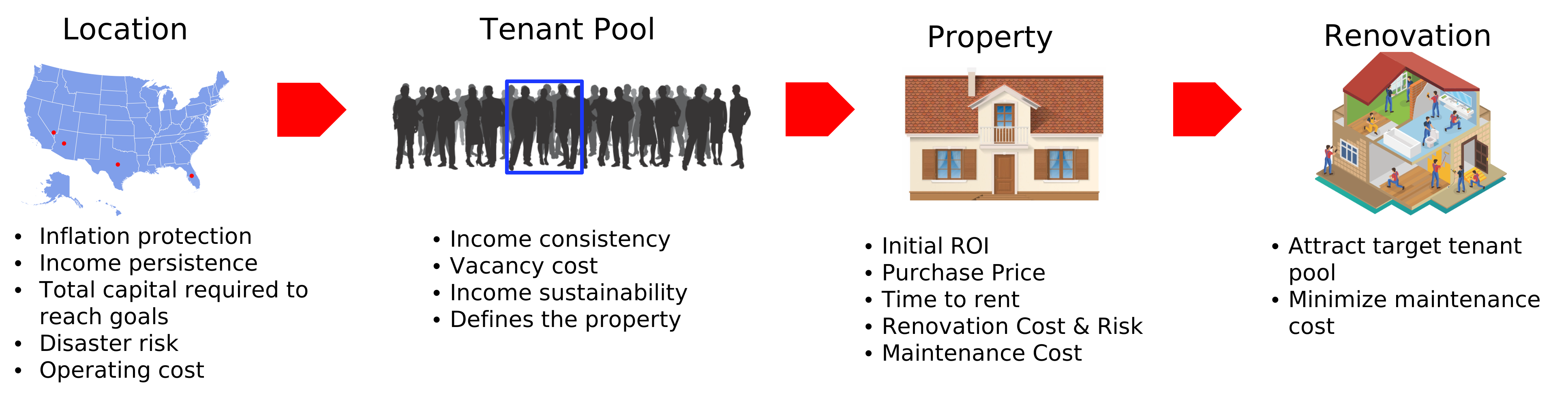
Consistently acquiring dependable passive income properties is a process. We've delivered over 400 passive income properties, and we know our process works because >90% of our clients buy 2 or more properties. The process is illustrated below.
The first step is to select the location. While there are multiple criteria a dependable passive income location must meet, I will mention three.
Inflation protection - Unless your rental income rises faster than inflation, you will no longer be able to continue buying the same goods and services. Any location where rents do not keep pace with inflation is a declining market and will not provide the dependable passive income you want.
Jobs - Your rental property is no better than the jobs around it. So the major employers of your tenant pool must be doing well today and likely to do better in the future.
Population - An excellent barometer of the desirability of a location is the population change. If the state and city's population increases, the location will have increasing demand, which drives up prices and rents. If the population at either the state or city level is not increasing, the city is in decline and not a good place to invest.
Now that you understand the importance of the location to dependable passive income, I will next talk about the property. Many people take the approach of buying a property only based on the initial ROI. I disagree with this approach for two reasons.
First, ROI and similar metrics only predict how the property is likely to perform on day one of a lifetime hold; ROI tells you nothing about how the property will likely perform in the future.
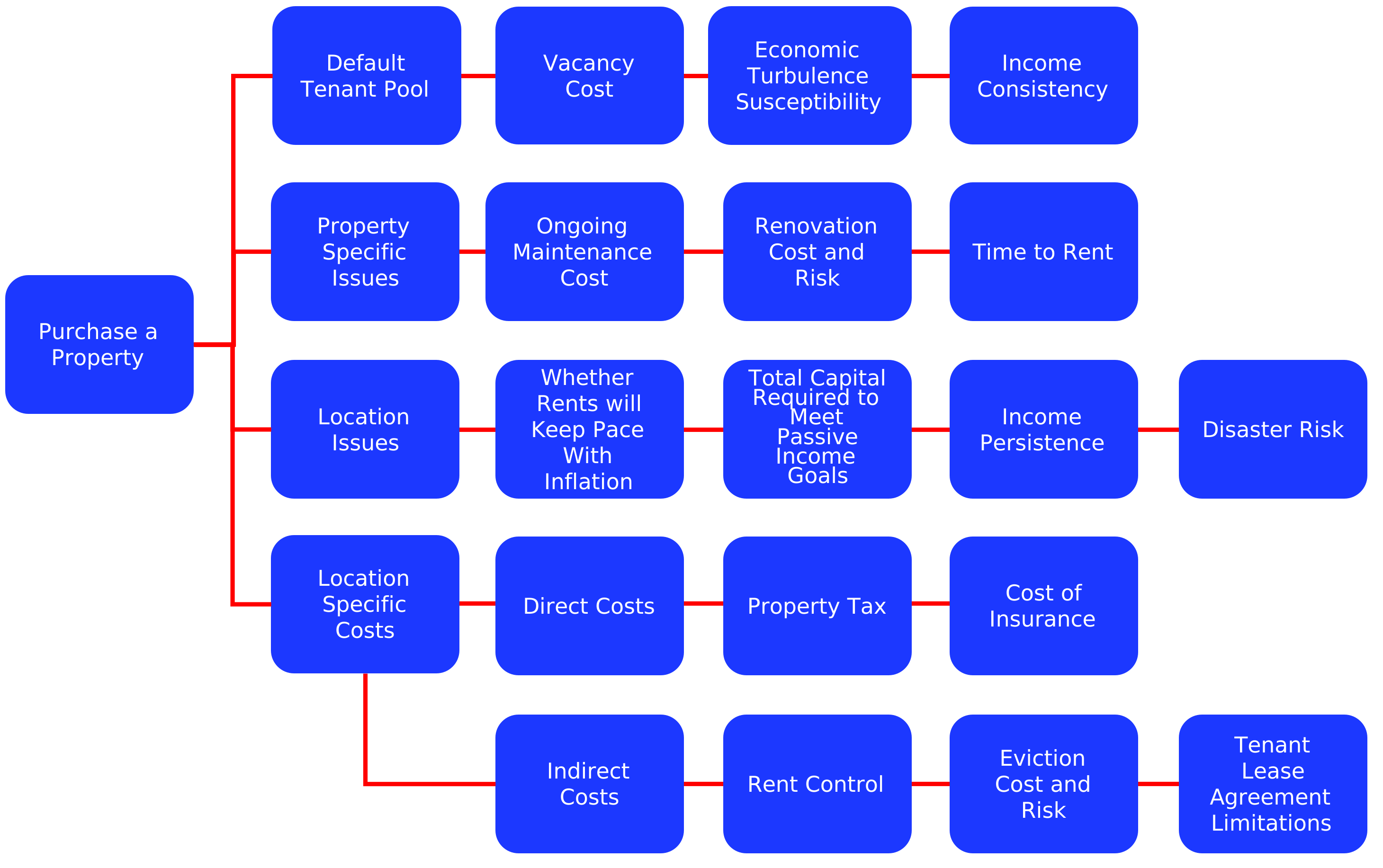
When you select a property, you are selecting much more than just the property. Every property will only attracts a narrow tenant pool segment. When you select a property, you get the default tenant pool segment for that property and a lot more. See the diagram below.
Choosing the property first is the wrong approach. After selecting a good passive income location, select a tenant pool segment that:
Consistently pays all the rent on schedule.
Remains employed in good times and bad.,
Takes care of the property
Stays for many years.
Only if such a tenant continuously occupies your property will you have a dependable passive income.
Now that you understand my dependable passive income process steps (location > tenant pool > property), I will list my "hard pass" items.
My hard pass items fall into the following categories:
Desirability to your target tenant pool
To attract your target tenant pool, the property must meet a minimum set of tenant pool specific requirements.
Type: Condo, high rise, single-family, etc.
Configuration: For example, 2,000SF, two bedrooms, three-car garage, large back yard, single-story, two stories, etc.
Location: Where the target tenant pool wants to live.
Rent range: Usually about 1/3 of the median gross monthly household income for your target tenant pool segment.
Any property that does not conform to all 4 of the above is eliminated from further consideration.
Renovation cost and risk
There are two primary renovation considerations for any renovation, cost, and risk. There are the two cost considerations.
Can you afford the renovation? Acquisition cost = down payment + closing costs + renovation cost + startup costs. The property is eliminated if I cannot afford the total cash required.
Will the total acquisition cost exceed the property's market value? I will eliminate the property if the total acquisition cost (Purchase price + renovation cost) exceeds the market value.
Renovation risk is always a big consideration. Below are examples of high-risk renovation items.
Foundation issues
High water
Structural
Mold
Improper wiring (aluminum, etc.)
Fire damage
Some roof damage
Dry rot
Settlement
Termites
Significant plumbing issues
Water damage
We eliminate any property from consideration with any high-risk renovation due to the unpredictability of the total renovation cost.
Maintenance Cost
The only way to have low-cost maintenance is not to buy properties that require a lot of maintenance. Below are some generalizations about the property and ongoing maintenance cost
Older properties require more maintenance than newer properties.
The tenant pool has a large impact on your ongoing maintenance cost.
Composition roofs require more maintenance than tile roofs.
Properties in climates with hard freezes require more maintenance than properties in mild climates.
Properties in locations with a lot of moisture require more maintenance than dry climates.
Wood siding requires more maintenance than aluminum or stucco siding.
Properties with lush vegetation require more maintenance than properties with little or no vegetation.
Locations with high levels of termite activity will require more maintenance than areas with little or no termite activity.
Future rentability
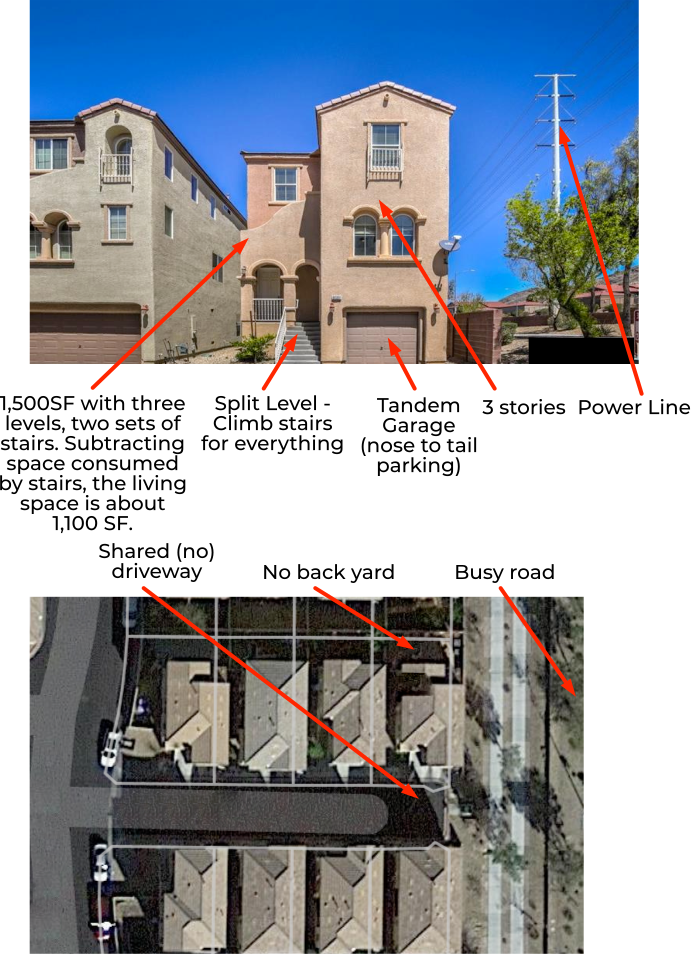
Today, almost anything will rent in the Las Vegas market due to high demand and limited rental inventory. However, this was not always the case and will not always be the case in the future. During the 2008 crash, I studied which properties were rented and which did not. We eliminate any property type or configuration that did not rent well during the 2008 crash. While this is location and tenant pool specific, below is an example property with several negative characteristics, any one of which would cause us to eliminate a property from consideration.
Just though of one I forgot to mention. Being too close to a school, especially an elementary school. I passed on a house (as a personal residence) in an otherwise great location because of this. When I went to check it out, I realized that at the wrong time of day I could get stuck behind the long line of cars going in and out of the “cone zone” and the general disruption that this would have at my favorite times of the day. Plus worrying about a kid zipping down the sidewalk from behind the bushes right as I’m backing out of the driveway, or having to be conscious of being shirtless with the windows open.
I realized that the the constant comings and goings of the kids would be a stressor that I just did not want to deal with. That said, I could see how this could be a plus for a family who’s kids would be attending that school.
Another that would not be a dealbreaker, but certainly annoying- being a dog owner on a street with lots of dog walkers! There’s a pedestrian friendly street on my block that naturally gets a lot of dog traffic, and every dog along that route barks at every dog passing by . . . .
Foundation issues, houses near homeless shelters, high crime areas, houses near housing projects, houses next door to a railroad tracks, houses next to trailer parks, houses near creeks/rivers in flood zones, manufactured homes...
Busy roads and near highways will still rent... it is the areas that you might feel like your life could be in danger at some point in time that are hard to rent here.
In then” old days”, I could buy a house for $25,000, put $30,000 in to it ( all in ) and then give it away this weekend at $80,000 or sell it and close in 6 weeks for $100,000.
In other words….
For risking less than the equivalent of one years income … Buy and flip a property SOLD …CASH IN MY BANK….in less than three months… And DOUBLE my investment / or triple my cash out position.
AND…. have multiple exits…. Flip for killer cash, rents for killer flow, refi for zero out of pocket but still with equity.
What is a a hard pass for me.?
I don’t mean to be rude but NONE of the opportunities I am offered now are HALF what the deals used to be. The relative risks are twice as high and the returns are half
And the equities are now ZERO at closing and 20%-30% AFTER repairs.
What are the exit strategies on these deals? Months of work for 10% return after risking a year or two worth of salary?
Again I don’t mean to be rude…. BUT ALLLLLL … of these deals are a hard pass…. NONE of these deal have attractive equity and have too few exit plans…... Unless BK is also one of your planned options.
If you have 2 million to go all in…. Sure…. You can flow $80,000/ year…. But you are also risking losing it all. If you have great credit and a little cash… you might be able to create $60k cash flow. BUT WITH ZERO EQUITY and if the bottom falls out… you….will…. File …BK.
Very respectfully. Truly I don’t mean to be the buzz kill… but we know that my numbers are true.…MOSTLY BECAUSE wholesale prices have doubled… which is MOSTLY due to TWO factors… 1) wholesalers MAXING out their profits and continually pushing their prices higher…. And…2j new buyers entering the market and thinking that the outrageous wholesales prices are normal/reasonable/ typical.. ( just like when realtor fees were 6%, the buyer ALWAYS PAID “ these fees” and the seller paid “ THESE FEES”… all of that was true… until it wasn’t…. . which turns the focus back to experienced buyers…. If WE would say…”NO…AND THIS IS WHY…” then little by little the pressure for wholesalers to back down…. Would push prices down … 30%…..????… maybe not…. 15%? All day.
Advertising a nonconforming bedroom and price it as if it were a conforming bedroom. I don't care if it has five bedrooms if I can only rent four of them.
My short answer, and since I do rental properties-- a property that's located in an area that will only attract low-quality tenants. Tenants have been my absolute biggest headache over the years (well, in my case indirectly behind bad property managers), and cost me the most. I'm very much in the camp now of taking a little hit on cash flow to invest in a property that will attract better tenants. I didn't get into investing to increase my number of headaches.
I'm going to address this from a non fix and flip perspective. If I don't plan to fix it up - functional obsolesce (such as bedrooms that can only be accessed through other bedrooms) is a hard pass for me. Funnily, if I plan to fix it up and flip or hold then I LOVE functional obsolesce, because I have the opportunity to fix it (like adding a hallway) and easily increase the value.
If I am looking at an STR opportunity in Scottsdale AZ, anything less than 4 bedrooms is a hard pass for me because that market caters to large groups. So each market should have a hard pass number specific to them.
Flood zones are a hard pass for me.
Fronting to a busy street is a hard pass. Backing to a busy street is not automatic. Many times a water feature can drown the noise and renters don't care as much as home owners.
Crappy neighbors with unsightly, unkempt houses. They are likely to stay forever and decrease property value.
Flood zone, a pool, and foundation cracks. I looked at one house with a really bad animal smell and passed because all of the flooring would have had to be replaced and the house repainted.
See, that's funny. I see the same house and I think money. In fact, I bought a house once years ago I still call the "cat piss house". The smell was so bad when you went in it would be like an instant asthma attack. But I got it really cheap, and I factored in the idea of tearing all floors and bottom half of walls out to solve the problem. In reality, my flooring contractor (all hardwood floors) was able to sand the smell out of it - and let me tell you, you've never smelled anything like freshly sanded cat piss - and 98% of the stains, and put down 3 nice thick coats of polyurethane, and the smell was completely gone at the end and never came back.
That's called the "smell of money" according to my real estate colleagues..... I thought the same thing....that is a recipe for equity!
Same here. You smell cat pee, I smell opportunity!
One of my biggest "hard pass" indicators isn't actually the property—it's uncertainty.
If I can't confidently answer questions like Should I buy now? Should I negotiate? Should I wait? with actual evidence, I don't move forward.
Beyond the numbers, I pay close attention to days on market, inventory trends, price reductions, financing costs, rent support, and whether the seller has lost leverage. A property can look great on paper but still be the wrong purchase if the timing isn't right.
That's actually why I started building VectorPrime. I wanted something that evaluates the evidence and continues watching after the initial analysis instead of relying on a one-time spreadsheet. As a former real estate professional, I learned that making the right decision at the wrong time can be just as costly as making the wrong decision.
Curious if anyone else has walked away from a deal that looked good initially, only to realize later it was the right call.