Rental Property Investor · Singapore · Member since 2018 · 128 posts · 48 votes
My partner and I started investing in SFH doing mainly BRRRR exactly 3 years ago. We starred with 160k and right now we're liquidating our portfolio and should have a bit over 300k to work with.
Our end goal is to have cash flow but it's not our primary objective for the next 5 years and we would prefer growing our equity as much as possible, then 5 years from now converting it to cash flow.
Another think to point out is we're foreigners so the max leverage we can get is 60-65% LTV.
Given all the above, how would you recommend we utilize these 300k for maximum equity growth in a 5 year period?
Investor · Fairfax, VA · Member since 2015 · 1k+ posts · 798 votes
3y
syndication is not the answer when your in growth mode. You dont need cashflow right now, so i agree with the residential flip or value add strategy and continue to leverage your money. Once you bury your money in a syndication you are stuck and dont have access to your capital.
Fair point, each syndication is different. But if the $300K could be split up in $50K chunks across different growth syndications with 18 month to 3 year exit plans (possible on new construction multifamily) it's possible to still be growth focused.
Real Estate Agent · Keller, TX · Member since 2022 · 62 posts · 37 votes
3y
Stick with what you know. Don't liquidate your portfolio, cash out refinance and invest in new properties. Why take the risk of learning a whole new type of real estate when you have experience in SFR which builds equity faster than most investments?
Rental Property Investor · St. Paul, MN · Member since 2016 · 3k+ posts · 3k+ votes
3y
Depends on how much sweat equity you want to put in. If you want to double your money with very little effort and lower risk in 5 years, then a value add syndication would be a great fit. Also, tax advantaged
If you are looking for higher risk/higher return, then flipping properties is a great way to go. Not tax advantaged.
Otherwise, do much of the same in what you've already done.
@Nicholas L. Great question. We had good deals with a lot of built in equity and I don't think our current area is going to see a lot of appreciation, so rather taking the capital and putting it somewhere else
I think this is your answer. Do the same thing you were doing but in an area likely to see more rent/price growth. Perhaps step up onto multi family if you can, though i don't see $300k at 65% ltv getting you there.
I would be hesitant to make your first steps into commercial properties now. As you mentioned, interest rates are higher than cap rates in most markets. Eventually, if interest rates don't go down, cap rates will, and you'll lose a bunch of equity.
syndication is not the answer when your in growth mode. You dont need cashflow right now, so i agree with the residential flip or value add strategy and continue to leverage your money. Once you bury your money in a syndication you are stuck and dont have access to your capital.
Fair point, each syndication is different. But if the $300K could be split up in $50K chunks across different growth syndications with 18 month to 3 year exit plans (possible on new construction multifamily) it's possible to still be growth focused.
I think his point was that syndications, even "growth" syndications, are best for people who are in wealth maintenance mode. If you have $5m-$6m to invest, then perhaps 10%-12% returns work for you. But if you have $300k, you need to double and triple that money over a short period of time.
Investor · Idaho Falls, ID · Member since 2016 · 912 posts · 629 votes
3y
@Roy Gottesdiener There are several options. Some of it depends on how "active" you want to be. Being out of the country it may be best to be more passive. The suggestion of a syndication is probably the best option to be hands-off.
I personally am involved with two syndication groups. One that purchases RV Resorts and the other builds ground up developments of large multifamily communities as a build to rent investment.
The BTR is a fantastic option if you want to build a lot of equity, but it may take longer than 5 years to see most of the gain. But you can get a return of capital within that time and then keep that equity building for a longer term, generational wealth play.
The RV Resorts are great if you need excellent cash flow and good equity multiples. We target between 12-16% COC paid out quarterly and 2.5-3X multiples on a 5 year hold. That usually comes out to be a 20%-25%+ IRR.
If you want to be more "hands-on" then you could do as others suggest and try more flips, though that could be a bit more risky in the current environment, or buy some STR in good areas of appreciation that also attract a lot of people to visit, such as something in my area near Yellowstone Park.
I'd be happy to discuss any of these with you if interested.
Realtor · Tampa/St Pete/Clearwater/Bradenton · Member since 2020 · 396 posts · 353 votes
3y
@Roy Gottesdiener
1) Get a STR here in the Tampa Bay area. Arguably the top market to invest in for the next 5-15 yrs. I can get you a STR and Co-Host it to make it quite passive for you to own. With $300k, we can get you a great property at 45% down that will not only appreciate well, but cash flow you $30k+/yr after all expenses.
Investor · Fairfax, VA · Member since 2015 · 1k+ posts · 798 votes
3y
The syndication sharks are circling, but don’t give in. You can find 7 % cap deals on commercial, have access to your equity, be passive, and get all the tax benefits of ownership. There is nothing wrong with getting a 5% cap deal as long as there is a value add component. It just depends on how much work and what asset type you are comfortable with.
Real Estate Agent · Los Angeles, CA · Member since 2018 · 2k+ posts · 1k+ votes
3y
You said your goal is equity gain, you do that through appreciation and loan buy down.
The fastest way to do it without syndication is to buy high priced assets. The bigger the loan, the bigger the principal buy down is each month, which is paid by the tenants.
So in your case, with 60% LTV, that would be about $750K in purchasing power. Go into a higher priced market like Tennessee, Texas, Florida, etc. and see what your options are. Notice I picked no state income tax states to increase cash flow. Over the first five years, you get principal buy down equity that is essentially for free because of the tenants, and you get appreciation along with cash flow.
Flipper/Rehabber · Pittsburgh · Member since 2018 · 6k+ posts · 5k+ votes
3y
None of these responses address him liquidating his portfolio to do this. We don't know enough to help. He didn't say he had 300K cash to invest.
Selling off a portfolio of single families, getting crushed with taxes, and then investing in syndications he may or may not be able to find doesn't make any sense.
Rental Property Investor · Dallas, TX · Member since 2016 · 261 posts · 170 votes
3y
@Roy Gottesdiener if you have the time, I would keep doing what you are doing. You will typically make a higher return the more active you are in the investment. If you are looking for something more passive, just give it to me and I will double it in 5 years :) .
I see you live in Singapore. I lived in Katong for a few years and my business partner lived in Bishan. Great place, especially the food (Newton Circus!).
Every investment decision you make should be measured against your ultimate goal: to get off and stay off the daily work grind. To achieve this goal, you need a passive income that meets three requirements:
Inflation-Compensating - Rental income increases faster than inflation, compensating for rising prices.
Persistent - Your income will last; you and your partner won't outlive it.
Reliable - Your income continues even in difficult economic times.
The three requirements depend on the right location and properties.
Location Selection
The location determines all longtime income characteristics including.
Whether rents will keep pace with inflation
How long your income stream will last
How much of your rental income is lost to overhead
Whether you or the government control your property
Years ago, when searching for a location to set up my investor services business, I focused on cities with a metro population exceeding 1 million. Small towns rely too heavily on a single business or market segment.
Next, I eliminated any cities where either the state or city population was not increasing. Rents and prices only rise significantly when the population is growing.
I then eliminated any city on Neighborhood Scout's list of the 100 most dangerous US cities. Your future is tied to the local economy. High crime rates and economic growth are not found together.
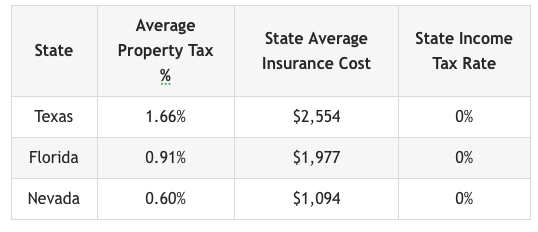
Next, I eliminated locations with high operating costs. Every rental dollar lost to overhead is less money for you to live on. Overhead costs vary significantly by location. For example, below is a cost comparison between three popular states for investing: Texas, Florida, and Nevada. Please note that these figures represent state averages; individual cities may impose additional taxes.
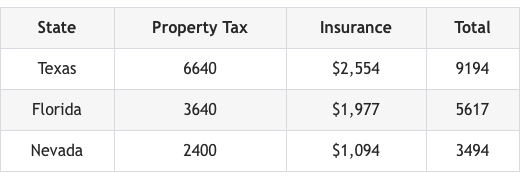
To demonstrate the impact of overhead costs, I compared the costs associated with a $400,000 property.
There are several additional elimination criteria. If you would like more information, DM me for my free guide on selecting a good location for passive income.
Property Selection
To have a reliable income, your property must be continuously occupied by a reliable tenant. A reliable tenant is someone who pays the rent on schedule, takes care of the property, and stays for many years. You will have multiple tenants over the lifetime hold of your property, so it's important to select a property that attracts people from a tenant segment with a high concentration of reliable tenants.
Identify this segment through property manager interviews or by working with an experienced investment team. Once you do, determine what and where they currently rent. Then, buy similar properties. This approach works anywhere and requires no luck or opinions. It's a straightforward process that works anywhere. Find the tenant segment you want to occupy your property and buy what they are willing and able to rent.
DM me if you would like a copy of my free guide on selecting reliable passive income properties.
Local Investment Team
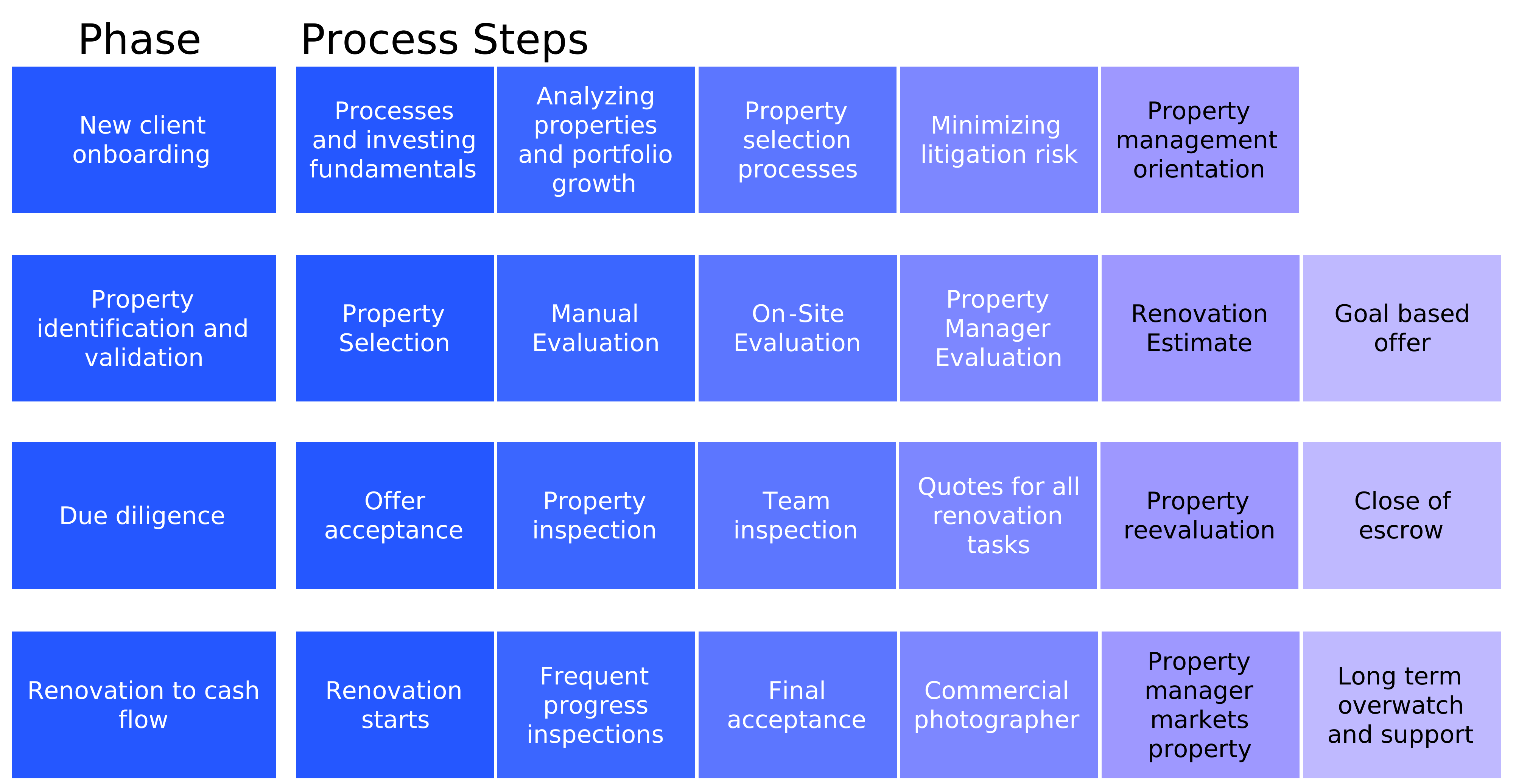
As a remote investor, it's important to have an experienced local investment team. You can't do everything remotely. An experienced investment team possesses the necessary experience, resources, skills, and processes that you need. For example, below is a diagram of the process we use. Any successful investment team will have a similar process.
Roy, I hope this helped. Please reach out if I can be of service.