Tucson, AZ · Member since 2020 · 64 posts · 53 votes
Newbie question here: I'm looking to buy a Class A triplex or quad within 10 minutes of my house and doing property management and maintenance myself. I live close to a large university. Of the 20 recently-sold small multis I've analyzed, nearly all have little to no cash flow and cap rates averaging 4.6%. (2048/2050 E 6th St, Tucson, AZ 85719 is one example.) Some even have substantial negative cash flow. Everything I'm reading says these cap rates are not favorable. So why are people buying these properties?
I'm thinking the buyers are A) hoping for appreciation and don't mind no cash flow, B) planning to increase NOI or hoping that market rents will rise, C) wealthy parents buying a place for Johnny/Susie to live for four years or D) house hacking. Can folks offer their insights into why buy properties with negative cash flow and low cap rates?
For anyone interested, here are my estimates for my example property: 2048/2050 E 6th St, 85719
Yeah, that wouldn't cashflow like you observed. The short answer is that these people don't know what they're doing, or they're buying with cash just to have a more predictable asset versus holding stocks or something like that.
I've done hundreds of deals and never bought a listed property before. Don't worry too much about what's going on with listed properties, the real savvy investors are often operating off-market, unless they're in a really cheap market where rent/price ratios are inherently better.
@Brian Ellwood any tips on strategically identifying off market listings? I’m in the Southwest Louisiana region and while most forums are geared toward our large metro areas, I’m trying to gain knowledge to overcome fear of a first deal crashing and burning. Any insight is appreciated.
Hey Wren! It starts with picking a good market, then setting up campaigns to find deals, (I use direct mail) but then the price you buy it at and your due diligence process is hugely important (to make sure you estimate repairs correctly) and then the final "risky" piece is the rehab/managing the contractor.
But, as Kiyosaki says, it's risker to NOT invest than it is to take a calculated risk that is likely to catapult your financial picture :)
I didn't read all the responses. Having dealt with investors all across the spectrum 1 million net worth to 100 million or more I have seen various thought processes.
In real estate you have wealth generation, wealth stabilization, wealth preservation.
Someone might look at a property like you describe and go they can't make any money with it TODAY. Another investor might see it as an A location, already have more cash then they know what to do with, and are simply looking to park money for tax benefits and hope property appreciates over time.
When someone has millions to tens of millions in net worth they can do that. Typically they already have 500k to 1 million a year income after expenses coming in from a job, business, other investments in their portfolio, etc.
The more someone's net worth goes up the less they tend to need to live on thus the less yield they need with real estate. The mindset tends to shift more to high quality and less headache over any potential yield the property throws off.
I would have to respectfully disagree with Joel. I have a lot of mid to high net worth clients also who buy A properties and they are definitely buying them to make above stock market level returns. Wealth preservation is an added bonus but NOT in any way the main objective. It's a mix of value add (create equity), rent increases (create cashflow) and steady appreciation. Plus lower risk of lawsuit tenants (ever wonder why property insurance is so expensive in lower income areas it's due to lawsuits those people sue you a lot more statistically).
I think a lot of newbies on Biggerpockets are incorrectly being pushed towards higher cap rate riskier assets often by realtors/turnkey operators in these historically dead markets. These areas look good on paper but real life is very different. The percent of rents that go towards cap/ex on cheap low rent buildings can be 3x 4x or even more compared to $2000+ a unit class A rents. Then for vacancy our units we aim to have a new lease signed for the day a tenant leaves so there is ideally 0 vacancy on re-leasing. With lower/working class rentals you never know if the tenant will actually leave on time so there is typically 1-2 months minimum turnover as can't even attempt to sign a new lease until old tenant leaves. Lots of huge differences in running numbers that new investors aren't properly calculating.
A lot of these C class or lower buildings used to be selling for 15-30% of today price so even though it looks high cap rate it's really just a historically junk asset that also rode the market boom.
Henry you are in Illinois. Different market up there. Property taxes are really high and is a tenant friendly state for residential. Illinois has a pension problem long term as well.
I think on a comparative basis a market that has lower taxes, high rent growth, more landlord friendly state an investor might view upside and risk differently for desiring a return today.
Cold belt states many areas are dying off as net migration of retirees to warm belt states fueling more overall outer ring growth in urban to suburban core markets. Cold belt states more isolated pockets of growth.
My clients tend to all buy commercial with tenants paying for all costs so the viewpoints might vary more from your investors.
I have been through a few cycles for multifamily over the years. I focus more on commercial retail these days although I still have clients buying the larger stuff from time to time. Multifamily I agree is heavily overvalued for the most part and you have to underwrite to almost perfection for the property to make sense. You still hear stories of those investors still making the deals work.
My investors that are already wealthy tend to want to outpace inflation by a factor of 2 and are happy with that. Example if their net worth is 10 million, they make 1 million as a doc, they want to get 6% total return before tax benefits (Inflation at 3% times 2).
Of course some investors want to keep doing value add and adding more and more net worth at the fastest clip they can. Some investors they reach a point where enough is enough and as long as they outpace inflation they have met their goals.
Money is only money. TIME is what is priceless. Someone can be worth 10 billion and that clock is ticking and ticking away for their legacy and life. At the end of their life do the they want people to say ( THEIR life was their business OR that their life was much more than that and the business COMPLIMENTED their lives?)
Whatever investor is buying a potential property ask yourself if the attributes of that particular asset class align with what your goals are ( the type of life you want to live, net worth, and cash flow )?
I have been there with apartments. I do not like dealing with residential landlord laws, tenants, or their sob stories on why the rent can't be paid.
I would rather be on the beach without a care in the world then waiting for the shoe to drop on what crap the residential tenants are trying now. Some people can have renters live in the same building as them. It's all about personal preference as an investor what you deem acceptable or not.
Guys I am not going to debate with you. You have your clients and your business and I have mine.
My experience has been over 17 years that the more a busy professionals ( job or business) net worth increases the more they are looking for passive and headache free assets even if that comes at less yield.
Some research it and still find they want to keep equity growing at an accelerated clip and others are fine to ramp down and beat out inflation for less yield.
It's all about the individual investor. I have talked to thousands over the years and just like taxes they are all different with some commonalities.
Not every investor finds appealing the types of properties I focus on. I find maybe 2 to 3 out of 10 inquiries want to proceed. The rest like it but want more yield but supply and demand dictates it doesn't work that way. Someone might find an active yield and headache at 14% and willing to take headache free and passive at 10% return but the market is buyers fighting over 6% to get to being passive.
New York City residents are flocking to Florida in droves because of Covid & the current problems in NYC (& other major cities such as Chicago, Portland, & Seattle). Some may come back, but many will get used to the low cost of living, great weather, & lifestyle. There has also been a net migration because of lower taxes for some time now.
Does anyone want to predict the next hot area before it starts?
Yes I do a lot of business in the warm belt states. Even if my clients live in cold belt states many do not have a positive long term view for staying there and buy assets in other states. This way if they ever want to leave they just sell primary residence and can move easily elsewhere. I find that common with a lot of my CA clients as well.
Cold belt still isolated pockets of growth in good areas but also lot's of dead areas not coming back anytime soon. Warm belt states tend to have larger pockets of overall growth in multiple directions.
Newbie question here: I'm looking to buy a Class A triplex or quad within 10 minutes of my house and doing property management and maintenance myself. I live close to a large university. Of the 20 recently-sold small multis I've analyzed, nearly all have little to no cash flow and cap rates averaging 4.6%. (2048/2050 E 6th St, Tucson, AZ 85719 is one example.) Some even have substantial negative cash flow. Everything I'm reading says these cap rates are not favorable. So why are people buying these properties?
I'm thinking the buyers are A) hoping for appreciation and don't mind no cash flow, B) planning to increase NOI or hoping that market rents will rise, C) wealthy parents buying a place for Johnny/Susie to live for four years or D) house hacking. Can folks offer their insights into why buy properties with negative cash flow and low cap rates?
For anyone interested, here are my estimates for my example property: 2048/2050 E 6th St, 85719
Price: $245,500, two 1BR units, 1219 sq ft total
Rent: $1454
Maintenance: $205
P&I: $938
Taxes: $195
Cash flow: -$39
Cash on cash: -0.7%
Cap rate: 4.4%
What would this investment look like, relative to projections of returns, if you could renovate the units and increase rents $350 per unit per month? Would it be more attractive to you?
Inflation expectations have been recalibrated for higher inflation - that's what's driving up prices right now. If you figure rents will increase 10% yoy for the next 5 years then buying a house with neg cash flow at today's rents makes sense.
Sadly, there is an abundance of people who are blissfully ignorant and they are buying over-priced properties because they are either too ignorant to do simple math, too lazy and/or they are ignorant enough to invest based on advice from either people who are ignorant or based on advice from people who have their own agenda.
OOC - When's the last time you bought a property?
BTW - I could answer all your questions and am not THAT smart. Though I understand where you're going - Every student should sue 90% of public schools for taking 12 years of their lives in return for no marketable skills.
@Ben Leybovich You could push rents by $200, not $350, but yeah, I get what you are saying. It does cash flow better with some upgrades. So I guess I need to look for places with some upside potential. There must be a few dumps around here still!
@Brian Ellwood it took me sometime to realize this but yes the best deals are not found on the MLS. My focus now is off market properties only. I currently have a 3 family building that I bought from the MLS at retail price but fortunately it has appreciated a lot since I bought it back in 2018. What is your best source for finding Off Market properties? There's a lot of investors in my area and with the market being this hot (I'm in NJ) it's hard to come across a good deal nowadays.
@Brian Ellwood it took me sometime to realize this but yes the best deals are not found on the MLS. My focus now is off market properties only. I currently have a 3 family building that I bought from the MLS at retail price but fortunately it has appreciated a lot since I bought it back in 2018. What is your best source for finding Off Market properties? There's a lot of investors in my area and with the market being this hot (I'm in NJ) it's hard to come across a good deal nowadays.
Wholesalers, property managers, and direct mail (done the right way!)
Detroit prices are also going up but thats been par for the course for the past 8 yrs. We are actually buying at a speed of about 4-6 per week. Also, the rise in property prices here in Detroit are still not to the point that they are hindering savvy operations on delivering rental properties to investors at the 2% rule, 20%+ COC returns or the best rent to values ratio in the country. Nor are these higher prices impeding or interfering with the exceptional section 8 rents that can be delivered here in Detroit to investors by those who know there way around. GO DETROIT GO!
Newbie question here: I'm looking to buy a Class A triplex or quad within 10 minutes of my house and doing property management and maintenance myself. I live close to a large university. Of the 20 recently-sold small multis I've analyzed, nearly all have little to no cash flow and cap rates averaging 4.6%. (2048/2050 E 6th St, Tucson, AZ 85719 is one example.) Some even have substantial negative cash flow. Everything I'm reading says these cap rates are not favorable. So why are people buying these properties?
I'm thinking the buyers are A) hoping for appreciation and don't mind no cash flow, B) planning to increase NOI or hoping that market rents will rise, C) wealthy parents buying a place for Johnny/Susie to live for four years or D) house hacking. Can folks offer their insights into why buy properties with negative cash flow and low cap rates?
For anyone interested, here are my estimates for my example property: 2048/2050 E 6th St, 85719
Price: $245,500, two 1BR units, 1219 sq ft total
Rent: $1454
Maintenance: $205
P&I: $938
Taxes: $195
Cash flow: -$39
Cash on cash: -0.7%
Cap rate: 4.4%
Maybe I should have read every single reply before mine, but I read the first page and it didn't seem like anyone was going to hit on this.
Everyone will tell you people don't "know what they're doing" are "overpaying" or are stupid because "a crash is coming!!!!". Even the reasons you listed, while potentially true to an extent, completely miss the macro picture. And until you recognize that, you'll fall in the camp of thinking that nobody knows what they're doing, except you (speaking generally here) who sits on the sidelines waiting for a crash that will NEVER happen.
Yup, I said never.
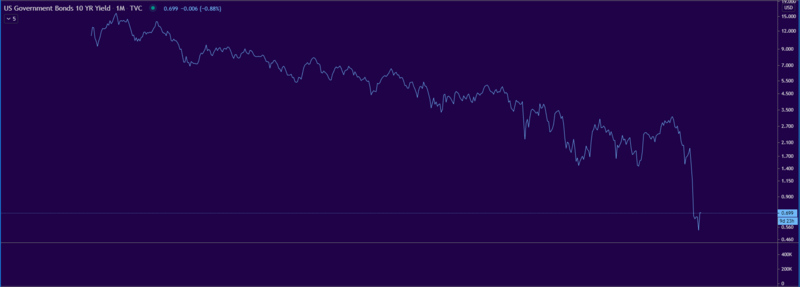
Here's the thing... interest rates are at record lows and are NOT going back up. Period. The Fed just came out last week and said they'd be "at or near zero until at least 2023". Spoiler: they aren't going up even after that. And I could go into a very long, boring economic lecture about the current state of monetary policy and economics to explain why. But it's easier to just look at a multi-decade chart of the 10-year T-bond and say, "yeah, there's zero reason to fight that trend". It's the same reason I will ALWAYS get an ARM for my primary.
Anyway, so rates are extremely low and, if anything, will go lower (yes they can go negative... just look outside the US). And we've got a bunch of baby boomers entering retirement. What happens when you enter retirement? You need income. You need that stash of cash to work for you so you can live comfortably with little risk.
In the past, that was easy. Buy bonds, CDs, or your trusty savings account for a decent yield. That yield is gone from everywhere. They don't want to hold stocks for two reasons, 1) many folks believe they're overvalued (rightfully or not) and 2) when you're retirement age it's not feasible to ride out a multi-year decline in stocks (aka it's too risky to have your retirement money there).
OK, so we understand there's a massive number of folks that NEED yield (not just want like so many here on BP) and there are increasingly fewer places to get it. Go tell them they can get a 4.6% return on their money on a hard asset that will likely continue to appreciate in value.
Where else can they get that? I'll wait...
Yep, pretty much nowhere. So they're buying up real estate to park their money and live out their golden years. Can you blame them? Isn't that what we're all trying to do?
The only difference is we're all trying to get to retirement while they're already there. So they don't need the yield that we feel we need.
The bottom line is real estate investing is becoming increasingly popular. Margins are getting squeezed from that direction and from those that are NEEDING yield for retirement. So we have to accept lower ROI or find a market that's less desirable.
@Travis Biziorek Wow, BP saved the best for last here with this response. Yeah, I get what you are saying. The average yield for Vanguard Total Bond Market over the past 10 years is about 3.8%, so the yield here is better, and that's without factoring in potential appreciation in rents or home value. So if you are looking for somewhat better yield, security, diversification, and maybe an inflation hedge, it makes a lot of sense.
@Travis Biziorek Wow, BP saved the best for last here with this response. Yeah, I get what you are saying. The average yield for Vanguard Total Bond Market over the past 10 years is about 3.8%, so the yield here is better, and that's without factoring in potential appreciation in rents or home value. So if you are looking for somewhat better yield, security, diversification, and maybe an inflation hedge, it makes a lot of sense.
Right, I’d also be careful looking at blended return for a bond fund. Bond prices are inversely correlated to yield.
So even though the fund’s return is going up, it’s been largely due to bond prices rising over the years.
Most retirees want to avoid selling assets to fund their retirement, hence the importance for yield.
All I’m really saying is to make an apples to apples comparison you’d need compare that 10-year bond fund return to a blended real estate return that includes appreciation on the RE, not just cash flow.
@Travis Biziorek Thank you for being super tactful in pointing that out. So it seems like RE is a better deal than that comparison suggests.
Absolutely, by a mile. I'm not sure if you took my reference to the "10 year T-bond" and thought I was referencing a fund. What I was actually referencing is the trend on interest rates of the US Treasury 10-year bond.
Below is a chart of that instrument going back to 1980. That's 40-years of declining interest rates.
Back in the 1980's you could invest in bonds and receive interest payments in the low double digits (12-13%). In the 1990's you could get high single digit interest payments. By the late 90's... mid single digits. By 2005-2010 you'd be looking at low single digits. From 2010 and on it's been between 1.5-2.5% until recently where we sit at just 0.70%.
The 10-year interest rate is the best barometer for for mortgage rates (add in a bank's margin). Now tell me why you'd ever bet on rates going higher? It's also almost impossible to find a 5-7 year period (standard ARM length terms) where you'd be in trouble when you're ARM came to maturity, let alone screwed like so many people believe. Never mind there are plenty of other reasons why ARMs aren't at all toxic.
I drifted. My point is, again, there just isn't an easy place to find yield anymore, so retirees need to move into real estate to live comfortably. Sure, a 30-year treasury bond pays a WHOPPING 1.45% right now which is about double a 10-year, but that's still below average inflation. So why not pay cash for the deal that "makes absolutely no sense" at a 4.6% cap rate, make a comparatively killer yield compared to what they could get elsewhere, know that the apartment will likely appreciate AND they'll be able to raise rents at a clip better than inflation. That 4.6% yield today may be 5% in a year, 5.5% in two years, and maybe 10% in 20 years.
What do you think the yield on bonds will be in 20 years given what you know now?
Yeah... makes a lot more sense now, huh? ;-)
Thank you for this explanation, Travis. I have been in the 'you've got to be kidding me, they happily paid that?' camp on A- quads in my market for a few years now.
Now I have a better idea who is paying what, to me, are exorbitant prices. I finally asked the LA of several quads that recently sold at a 15 GRM and a 4 cap. .5%ers. She said 2 couples will get together and form an LLC partnership. They pay cash and are usually from Seattle. Compared to there, we are cheap. Tough to compete with that other than to buy before they hit the market.
I predict future motivated sellers, but I see what you are saying about not having safe alternatives for yield. Management in my area is pretty horrible and partnership honeymoons end, so I still see sellers in 3 years, but by then there may be even more retirees looking for 'safe' returns. Gotta let owners in your desired neighborhood know you're there so they call you before listing.