Rental Property Investor · Fort Mill, SC · Member since 2021 · 22 posts · 12 votes
Hello everyone, I'm not holding myself to any specific area to invest since my W-2 job moves me around the country.
Not sure if this matters but my goal is to own apartments. I have a list of cities on spreadsheet but I'm not sure if I'm thinking creatively in what categories I'm using to compare.
So far I have the following:
A. Crime rates
B. Schools
C. Income levels
D. Employment
E. Overall growth of the city
(This seems to short)
I know I need to look at this from the perspective of an investor and I'm think I'm off track. I feel like I'm looking at this for my personal home.
@Keisha D Dobney-Boykin, this is a good start. Before you get too far along, are you focusing on apartments with this search? This will change things. Regardless, I’d pay close attention to vacancy rates versus new housing permits pulled. What’s the delta?
@Bryan Mitchell thank you for taking time out to reply, I appreciate it. I learn something new everyday on this platform to add to my "research" list. Would you mind expanding on what you mean by "delta"🤔?
Yes, I was hoping to use this excel document to help me narrow my future search for 5 plus units with a goal of apartments (are they one in the same?). However, I wasn't even thinking about occupancy rates. Any recommendations on what sources are best to find accurate information? (The learning curve is feeling steep)
@Jeffrey Donis awesome! I'm working on my excel today so I'll defiantly implement, thanks. You mentioned "anchor" if you have time can you explain? You also said "cap rate", I have no idea what that is... 😒
Personally, I purchase properties in several states and never waste one minute looking at demographics until after I find a property that meets my numbers for my return on my investment.
Almost every major city has war zones and properties I would not purchase for any price because I always envision myself strapped with an AR-15 when collecting my rent. Even though many cities have war zones there are often diamonds in the rough that borderline the combat zones.
Example: In 2004, I purchased a 14-unit apartment building across the street from a war zone. I have all super decent tenants, never had a robbery and the property increased in value from $825,000 to $4 million. I paid off the building 2 years ago and net about $180,000 per year.
So, for myself, all that number crunching is a waste of valuable time until after you find a property.
One more thing! Never believe or trust what you think you figured out about the future by reading or listening to so-called experts. It takes a long time and you have to have a lot of experience with doing math to understand how to evaluate properties before you read and listen to experts.
Example: I currently have a 6-unit property in escrow in Hawthorne California. For the past 47 years, I shied away from investing in Hawthorne because of the crime and other factors. After looking at more than 200 properties for sale, I decided to purchase a 6-unit building because the current rents were high and the price was reasonable (not low).
To purchase the property for $1750,000 (292,000 per unit) I sold 6 homes I own in Las Vegas for $1.6 million. I am paying cash for the property. All tenants appear to be decent and the seller claims he did not have 1 late rent in the past 7 years. The reason I decided to buy the property is because my calculations indicate that on the low side I will net about $1.5 million and maybe $2 million in 10 years. This property had great upside to increase rents.
Example 2: This is a 6-unit that is currently for sale and it is only a few blocks from the building I have in escrow. You can purchase this 6-unit building for $2.4 million or $600,000 per unit. The bright side to this building is the current rental income is amazingly high because it has larger units than the building I purchased. It brings in $14,000 per month, or $168,000 per year compared to my building at $125,000 per year.
The reason I would not purchase this building is because even though it is only 3 blocks away from the one I purchased is because this building is in a war zone and the rents are already so high there is no room to increase the rents for several years. When you cannot increase the rents you cannot increase the property's resale value and the real profit is when your building appreciates and you don't keep up with inflation when collecting rents.
Pick a city close to you and look at number first. There are great properties in every city. So, why not look at properties closest to where you reside most often.
Although, after multiple properties in many states for several years, I finally figured out there are hundreds or reasons you lose tons of money by having to pay management companies to do an inferior job compared to your being hands-on. I've been working hard for the past two years to sell all my out-of-state properties. It took me several years to decide to sell my properties and the decision was difficult to make, but since interest rates are so low my selling my dogs has been the best business decision I've made.
@Keisha D Dobney-Boykin I think you’re off to a great start! I learned a great way to evaluate rental markets from @Lee Ripma. It’s called the DISCERN method.
Demographic Group
Income
Schools
Crime
Expansion (Population & Income Growth)
Rent
Neighborhood (indicator stores along with general research on business in target area)
I think it covers everything you need to evaluate a good market for rentals. She writes about it in detail here.
@Keisha D Dobney-Boykin, the last two are your starting point. Crime rates, schools, and income will vary greatly within any market, when you start comparing submarkets/neighborhoods, but important metrics.
You also need to understand who your end buyer is. Almost all properties under 50 units will sell to local buyers. So you can limit yourself if you buy a 50 unit property in a 1,000 person town, but in a reasonable size market, these properties will trade, and most of the time to local operators. The larger the project, the fewer buyers are available, and therefore you need to be more selective in the markets you pick, before drilling down to properties and the submarkets.
@Jack Orthman I very much apperciate you sharing your knowledge and giving examples. As I was reading your response I noticed you dropped a ton of gems. Felt like there was a theme to be involved and hands on. (My goal) I'll continue to do my due diligence to "learn the math". Again, I appreciate your advice and taking time out to respond.
Also, I must say... your examples are motivational. I know I need to put in the work and time. It hard to see what is possible when you don't have the exposure of seeing the process being done or done well.
My dad has an entrepreneurial spirt and bought a triplex when I was young. Because of my mother's fear (she didn't see the vision) they sold. My dad is standing by to help me in anyway he can. But I know he wishes he could have provided the foundation. My point... what your doing is where I want to be and I appreciate the glimpse into what can be possible with serious effort, drive and vision.
A lot of cities, especially lately, are looking at their cash flows and realizing that they can't both pay for their operations *and* fund their pension obligations.
So what has to happen? They either go through retrenchment (reduce spending - hurts the local infrastructure/economy), they increase local taxes (hurts the local economy), or they restructure pensions (hurts their credit and the local economy).
@Jeffrey Donis awesome! I'm working on my excel today so I'll defiantly implement, thanks. You mentioned "anchor" if you have time can you explain? You also said "cap rate", I have no idea what that is... 😒
Here is cap rate explained-
By Anchor I am referring to things such as major universities, hospitals, etc- things that add to a markets dependability.
I never look at the cap rate because it gives you a picture of the current financial situation that is based on the current owner and his abilities, or lack of abilities to manage real estate. The property's current financial condition is nowhere as important as what I (YOU) can do with the property.
EXAMPLE: I am looking for a property to purchase and look at cap rates in the listings. I am making a huge mistake because I choose to purchase a property with a great cap rate, but there are thousands of properties with poor cap rates with huge upside to do some rehabbing, double rental income and increase the value of the property by several hundred thousand, or millions of dollars.
I evaluate every property according to only the math.
This is the breakdown for the 6-unit building I have in escrow. I put this breakdown in my archives to keep track of what actually occurs as time goes on.
Rental Income $125,400. Property Taxes $21,875 Gas $1300 Trash $1,400 Water $3,000 Insurance $3,600 Net Annual Income $940,000 X 10 Years = $140,000
Now, I look at profit with annual rent increases plus increased property value that results from rent increase multiplied times the Gross Multiplier over a 10-year period. This is where I use a spreadsheet-type database. AS I stated in a previous post, my projection for this property is $1.5 million profit in 10 years. I need to know what I can do with this property and looking at cap rates causes me to ignore gold mines. Although, with prices currently so high for multi-units this is the best I could find and nothing like what was available a few years ago when the value of multi-units properties was increasing 100% per year for almost 18 years.
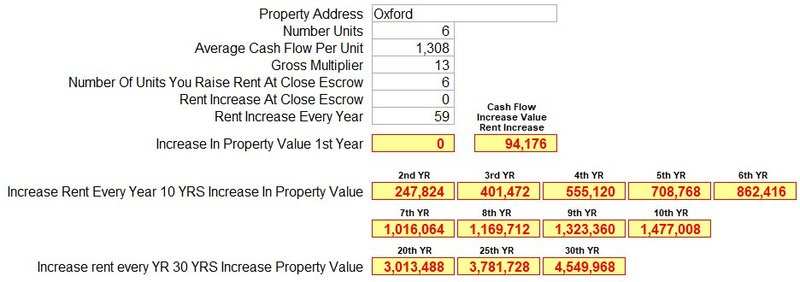
Sorry! I forgot to say I paid $1,750,000 cash for the property, but if a person gets an interest-only 3.2% 5-year loan the profit on this property is stil more than $50,000 per year, or about $1 million in 10 years when calculating rent increases and appreciation.