For the longest time people have predicting inflation, now we are at 6.8% in November after I thing 6.2% in October. The FED said this is going to be short term, but I have a feeling it's going to stay with us and leading us into an asset bubble. Where do you see this go long term? Is this like 2007, where we should all see it in the data, but we didn't?
There is a part of me that likes inflation for what it does no real estate debt, at least as long as wages are following and with that hopefully rents. So far I have not seen income grow that much for tenants.
At this point I think it is pretty clear what we can expect from the housing market in 2022. And intererest rates are predicted to go up, but will the go up faster/longer and higher than generally expected (just like inflation itself?) and does that mean a change in startegy is on the table?
It was a monthly reading of 6.8%. And for comparison last Novemeber was 0.2%, and last October 0.0%...so the year over year inflation rate are being measured against a zero inflation environment.
The yearly inflation rate is projected to be 4.8% for 2021, after 2020's 1.2% (the 2nd lowest since 1960). So we are on a 2 year average of 3%. So 3% per year worry anyone? Probably not. Does 4.8% even seem that concerning? it is higher than the average....but that is how we get to averages...half the years are above the average, half the years below the average.
Will inflation be higher over the next decade than it was in the previous decade? More than likely yes. But the current inflation rate is bumping up, because 2020 had virtually no inflation. Supply line disruptions and the cost of used cars (a normally deflationary asset) have put pressure on the CPI upward.
Context matters.
Jerome Powell finally recently admitted that this inflation isn't transitory. Asset bubbles aren't driven by inflation, there's usually some other driver that causes one asset to outpace all of the others.
Prior to the Great Recession, the expansion in credit led to a real estate bubble. The Great Recession itself was caused by a lot of things, including fraud on the part of ratings agencies, the assumption that real estate values can never fall being baked into the entire bond market, and a number of other factors.
I believe the Fed will be forced to make a choice between raising rates and risking tanking the public markets. We saw just a few years ago that they will happily continue to provide monetary stimulus to prevent turmoil in the markets. Inflation may be higher now, but I expect markets to take precedence over the CPI.
We'll see, though. Expect the unexpected. Plan as though rates will actually begin to rise.
@Taylor L. well, good point about asset bubbles, but we do have other drivers at work when it comes to real estate. And it will take us at least 5 years (10?) until housing supply gets caught up with demand. Inflation is now extra gasoline that you throw on that fire. Powell went from being dove-ish to hawk-ish; I would not want to be in his shoes!
And as people across the nation are getting rich on equity, they have the option to either pull equity out or sell. We rent single family homes and as of recent we see people apply with a reason I never seen before; they are selling their personal home to cash out; and Milwaukee has only seen modest appreciation this year, will see where we land, looks like barely double digits.
There are large parts of the country where homes are a lot more expensive to begin and now you add 20% appreciation, per year - how long before everyone is a equity millionair? And what does this mean?
Part of me says calm down, its going to be business as usual, just a little higher rates; the other possibility is that we are seeing a much more fundamental change of the game and this is just the beginning...?
@Taylor L. well, good point about asset bubbles, but we do have other drivers at work when it comes to real estate. And it will take us at least 5 years (10?) until housing supply gets caught up with demand. Inflation is now extra gasoline that you throw on that fire. Powell went from being dove-ish to hawk-ish; I would not want to be in his shoes!
And as people across the nation are getting rich on equity, they have the option to either pull equity out or sell. We rent single family homes and as of recent we see people apply with a reason I never seen before; they are selling their personal home to cash out; and Milwaukee has only seen modest appreciation this year, will see where we land, looks like barely double digits.
There are large parts of the country where homes are a lot more expensive to begin and now you add 20% appreciation, per year - how long before everyone is a equity millionair? And what does this mean?
Part of me says calm down, its going to be business as usual, just a little higher rates; the other possibility is that we are seeing a much more fundamental change of the game and this is just the beginning...?
There is always uncertainty. The thing is, we just forget what the uncertainties of the past felt like because, well, it's no longer uncertain. We know what happened, but we've also forgotten what "I have no idea what's going to happen in the future" felt like in the past.
You're right, 20% appreciation is not sustainable in the long run. But I don't believe anyone really expects it to keep moving at that pace.
@Marcus Auerbach You bring up some good points. We just rented a property in Cleveland for the exact same reason you noted, our new tenants sold their home and are renting, 750 credit score and income is 6x rent. I have not seen this before.
I think the Feds flooded the economy with cash. Not just the stimulus checks but the PPP money and other bail outs. The shrewd investors took the flood of cash they were receiving and bought hard assets, including stocks and houses. I think you hit the nail on the head about the affect of inflation on real estate debt and that is contributing to the real estate rush.
As people see rates going up I expect there will be a rush to get the last available properties before rates go up. Followed by a pause an a pull back. While some people are cash buyers most are still using financing and they don't buy houses based on the price, they buy based on the payment. As we go back to normal interest rates this will stall price increases.
The big unknown in all of this is how much interest rates will rise. The low rates of the last 15 years have supported massive growth in the federal deficit. With 29 trillion in debt there is a massive incentive for the fed to hold down rates. Check out the national debt clock at: Debt Clock As all of this sorts itself out in the economy I expect a recession will be triggered.
One other note, margin debt for stocks is at record highs right now. down't be surprised if we have a big pull back in stocks. as Warren Buffet once said, be greedy when others are fearful, be fearful when others are ready".
@Bob E. the average rate forecast for end of 2022 is currently 3.6%. When you do the math on an average 300k loan thats not that much of a difference. I would say 90% of our clients buy significantly below their max pre-approval, the rest are very young first time home buyers, they sometimes have to stretch. I don't think rates will have any impact until we get to 4 or even 5%.
My experience is that rates don't make people buy houses, their life does make that decision and then they just deal with whatever the rates are at that point.
I don't think people have fully realized what inflation means for them long term (outside of gas and steak prices they complain about; big deal, buy a smaller steak). I don't hear anyone worried about their 401k!! If you are close to retire and you have a conservative portfolio that does not yield 7% this year, your nest egg is shrinking! It will be interesting to see what happens once the public starts to realize that. And the news media!
If inflation keeps rising the way it does right now, is it possible that we see 10% in 2022? To your point about the national debt clock - this is great for the federal deficit as well, a few years of inflation and magically you have cut your debt in half. And Europe is on a similar trajectory.
Right now you can get a 30 year fixed mortgage for 3% - at 6.8% inflation they are basically paying you almost 4% to take on debt. Is it possible that we will see rates go that high quickly? Nobody seems to expect that, but they also forecast only 5.1% price appreciation (average of top 5 forecasters) for 2022 and I am pretty sure thats way to conservative.
It was a monthly reading of 6.8%. And for comparison last Novemeber was 0.2%, and last October 0.0%...so the year over year inflation rate are being measured against a zero inflation environment.
The yearly inflation rate is projected to be 4.8% for 2021, after 2020's 1.2% (the 2nd lowest since 1960). So we are on a 2 year average of 3%. So 3% per year worry anyone? Probably not. Does 4.8% even seem that concerning? it is higher than the average....but that is how we get to averages...half the years are above the average, half the years below the average.
Will inflation be higher over the next decade than it was in the previous decade? More than likely yes. But the current inflation rate is bumping up, because 2020 had virtually no inflation. Supply line disruptions and the cost of used cars (a normally deflationary asset) have put pressure on the CPI upward.
Context matters.
A few thoughts.
Marcus, This is great discussion The 3.6% may or may not be correct, given that the government has constantly underestimated inflation this year I will bet they are low. Remember a few months ago when we were told this is transitory? If the estimate is right we will have seen 10% inflation in two years. One of the reasons I think inflation will be higher is wages are going up across the board, employers will HAVE to charge higher prices to cover the higher wages.
I agree with you that people don't buy homes because of rates but those looking to buy for other reasons will accelerate their plans if they think rates are going to go up. I agree with your math, with borrowing rates at 3% and inflation close to 7% borrowers are being paid to buy property. This also raises the question, how long will lenders continue to loose money before they demand higher rates?
I fully expect that we will enter a recession in the next 12 months for the following reasons 1) Prices are going up slower then wages by about 1% a year. This means consumers will have to reduce the amount of stuff they buy by 1% or borrow. Over a multi trillion dollar economy 1% is a large hit. If purchase drop by 1% fewer employees will be needed, starting a cycle of layoffs. As a confirmation I looked up the history of recessions (History of Recessions) The range of GDP decreases during recessions since WWII ranges from -3% in 2001 to 4.3% in 2007-09 with the typical range being between 2.5 and 3.5%. given the government data and drop in real earnings we are half way there. Also, keep in mind that the published 6.8% inflation rate does not include food or energy. Energy is up roughly 30% and while food varies that steak you mention is up 20% and General mills is pushing aerial prices by 20%. for most families they will have to make cuts of more than 1%. 2) Worker productivity is going down at the same time wages are going up. If you have to pay people more and get less output than the cost to make a product is going up. These costs have to be passed on.
As far as the stock market, the record high margin rates mean that a lot of investors are stretched thin, if stock drop they will get a margin call and have to sell. This could end badly for a lot of people, probably younger. I expect a lot of the MEME stock investors will get hurt when stock drop.
You are right that inflation means the US debt will be paid back with cheaper dollars. Unfortunately there is a cost to that. The inflation that drives the math is basically a tax on money, someone, somewhere, is paying for it. The trick here, as you mentioned is to not have money, or have Negative money (debt).
When the recession hits we are likely to see more renters delinquent on rent. Hopefully the government does not take a page from the COVID playbook and try to put a moratorium on evictions. Given that the courts stomped that down last time there is some hope but you never know, they could do something just different enough that it has to go through the courts again.
right now prices are up as the supply is having problems getting to people. You have low interest rates and pent up consumer demand. I don't see this lasting, at least not at that rate. Same thing is happening in other countries-I'm in Canada and inflation rates have also gone up.
@Marcus Auerbach it’ll settle down
It was a monthly reading of 6.8%. And for comparison last Novemeber was 0.2%, and last October 0.0%...so the year over year inflation rate are being measured against a zero inflation environment.
The yearly inflation rate is projected to be 4.8% for 2021, after 2020's 1.2% (the 2nd lowest since 1960). So we are on a 2 year average of 3%. So 3% per year worry anyone? Probably not. Does 4.8% even seem that concerning? it is higher than the average....but that is how we get to averages...half the years are above the average, half the years below the average.
Will inflation be higher over the next decade than it was in the previous decade? More than likely yes. But the current inflation rate is bumping up, because 2020 had virtually no inflation. Supply line disruptions and the cost of used cars (a normally deflationary asset) have put pressure on the CPI upward.
Context matters.
I might be wrong and I appreciate you making a counter point Russel. Context does matter, but here is what I would say: predicting future inflation based on a look in the rear view mirror is not a strong argument. And I don't know how much weight I'd like to put on an inflation forecast that was off for 2021. If it is correct and it turns out to be in fact transitory, then you are right - no big deal, things average out and we all move on.
The way it reminds me to the mortgage crisis is that in 2006 almost everyone said the mortgage market is bullet proof and the major argument was the historic performance. They ignored sub-prime lending and over production of houses. It was an inflection point and I often ask myself when would I have seen it? If you look back at the data of the 3 years leading up to 2007 it seems quite obvious. But hindsight is 20-20.
My question is, could 2021 be an inflection point (of different nature then 2006 of course) and IF inflation keeps running what does that mean for the big picture and for the best strategy for the comming years? Esentially, should one keep buying and if so what? Should I use the next 5 to 7 years to de-leverage my commercial notes agressivley? How do you diversify risks for a scenario like this? And what opportunities are there?
Bear in mind that the Government stopped including Food, fuel, Etc in their inflation numbers. Their stated reason was that those commodities would skew more often and were therefore not accurate. We all know that they removed them because it just makes them look bad. ACTUAL inflation now is estimated to be closer to 20%.
A good thing to remember when thinking hard about this issue IMHO....
right now prices are up as the supply is having problems getting to people. You have low interest rates and pent up consumer demand. I don't see this lasting, at least not at that rate. Same thing is happening in other countries-I'm in Canada and inflation rates have also gone up.
Europe as well, I read the news from Austria every morning. The reasons cited are essentially the same, monetary policy amplified by supply chain issues. The difference is that they have dumped less stimulus money during covid than the US, which seems to be the reason for the higher US rate we see.
So, I think the questions of "how long" and "how much" will depend on how hard the fed is willing to step on the interest rate breaks and I think they don't want to do that because that will reduce our consumer spending dependant GDP.
@Marcus Auerbach inflation is highly manipulated by politicians to make themselves look better. Politicians want and even need inflation to pay back debt. Inflation allows us to pay back borrowed money with dollars future dollars that have less purchase power. The problem is that inflation makes politicians look bad. When prices go up, you blame politicians for your worsening financial situation. This is why politicians are slow to acknowledge inflation and even try to cover it up. Inflation hurts re-election.
One of the ways inflation is hidden is by decreasing portions. I joked years ago about Obama's shrinking cereal boxes. Over the course of his first three years in office, I watched our breakfast cereal box shrink three times. The price stayed the same, but quantity reduced. I believe inflation was grossly underreported during those years, making it appear we had near 0% inflation.
Another method of manipulation is directly changing the CPI shopping cart. The items in the "shopping cart" today are different than what was there 10 or 20 years ago. That is necessary, but also can be deceptive. Our standard of living has increased significantly. If you tried to live by the standards of someone in 1970, your cost of living would be lower than todays standards.
The methodology is also a problem, specifically when it comes to shelter. Shelter measures housing prices two ways. One way is rent surveys and the other is OER (owners equivalent rent). OER surveys owners to ask them what their house would rent for in todays market. Shelter is 30% of the CPI, so it makes up a big chunk. The strange thing is that shelter has measured between 1.6% in January 2021 up to 3.8% in November, year over year increase. Ask any landlord or tenant if those numbers are at all realistic and they will say NO. I am including a link below to the CPI index categories. You can select specific categories and see how they measure independent of the overall number. Shelter is bringing down the overall CPI, which makes no sense given how much rents and housing prices have increased.
Look at YOY Shelter (in blue) for the last 12 months. Every month accept November is reflecting lower YOY compared to any month over the previous five years. I am not a aware of any market that was measuring this small of rent increases.
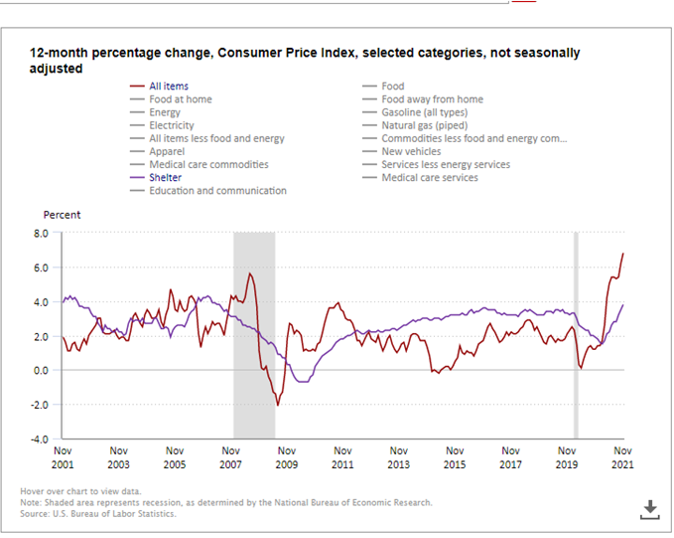
Here is the interactive CPI chart. Click on items to add or remove them from the chart. The category called "Shelter" is housing and represents 30% of the overall number:
https://www.bls.gov/charts/con...
Pretty much no economist said that inflation was only transitory. It was just the FED and the administration pushing that narrative. They finally had to stop saying that because people aren't dumb. They see it at the pump and at the grocery store. Inflation will continue a rapid rise into 2022 as supply side challenges and wage increases will continue into the new year. It should cool off as we move closer to 2023. The FED is taking action to raise rates and stimulus money is being spent out of the economy. That will reduce demand and allow supply to catch up.
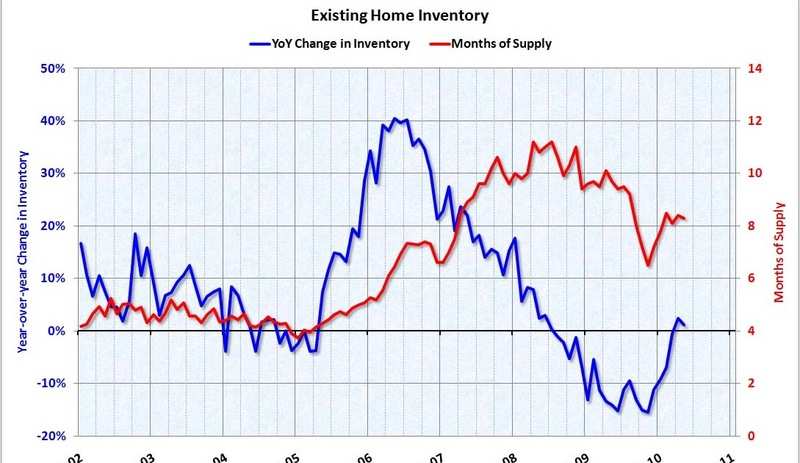
You mention "Is this like 2007, where we should all see it in the data, but we didn't?" Keep in mind that housing inventory started increasing in 2005. It increased 20% YOY in 2006 and 40% YOY in 2007. Look at the chart below. Short of a blinking sign warning everyone, I am not sure how much more obvious it could have been. Of course the actual crash took years to unfold with the depths of the housing crisis hitting in 2010 to 2012 depending on market. The good news is that the housing crash (start to finish) took 5 years from first warning to the bottom. Hardly a crash when you put it in context of how long it took. Inventory today is at record low levels, so you could say we pre-warning signs at this point for housing.
My personal situation, I am actually being very cautious right now. I see a lot of risk with the risking interest rates, the crypto bubble and supply chain snap back in later 2022. What I mean by supply chain snap back is excess inventory. Companies have large inventory orders placed and there is risk when everyone gets fully stocked at the same time. I fear too much of the spending was stimulus money, which is a one-time windfall. With that money spent and inventory piling up, it could cause economic strain. It could push prices down, which could have effect on profits and hurt the stock market.
It is honestly all very complex and hard to predict. Looking back it is easy to connect the dots, but hard when you are in the middle of it all.
@Joe Splitrock That was great information. I remember in 2006 and 2007 housing prices going up at insane rates. It was obviously a bubble when housing prices went up 40% when income was going up at 3%. When Jim Cramer had his famous rant in August of 2007 I told my wife we were going to have a recession and it was going to be bad. I based this on the simple assumption that the SnL crisis in the early 90's had caused a decent recession and 2007 was a much bigger segment of the economy.
Currently with wages going up, productivity going down and a lot of money sloshing through the economy the inflation will likely continue for a while. I honestly think the only way you break the cycle is raising rates and that will likely create a recession. The problem with raising rates is that with the massive Federal debt it won't take much of a rate rise to make the debt unaffordable. If the debt becomes unaffordable the Government won't default, they will print money and that will cause inflation.....
How all this plays out in the market is tough to forecast. It will cause distress in some areas and that always create opportunities for investors with cash. My recommendation at this time would be to convert all debt to long term fixed rate debt and hold larger reserves. When the next recession hits you are likely to see more delinquent rents end evictions. As a landlord this will decrease income and increase turnover expenses. Those that are over leveraged will be forced to sell creating opportunities in Non Performing notes, Deed in Liu transactions, etc.
@Joe Splitrock That was great information. I remember in 2006 and 2007 housing prices going up at insane rates. It was obviously a bubble when housing prices went up 40% when income was going up at 3%. When Jim Cramer had his famous rant in August of 2007 I told my wife we were going to have a recession and it was going to be bad. I based this on the simple assumption that the SnL crisis in the early 90's had caused a decent recession and 2007 was a much bigger segment of the economy.
Currently with wages going up, productivity going down and a lot of money sloshing through the economy the inflation will likely continue for a while. I honestly think the only way you break the cycle is raising rates and that will likely create a recession. The problem with raising rates is that with the massive Federal debt it won't take much of a rate rise to make the debt unaffordable. If the debt becomes unaffordable the Government won't default, they will print money and that will cause inflation.....
How all this plays out in the market is tough to forecast. It will cause distress in some areas and that always create opportunities for investors with cash. My recommendation at this time would be to convert all debt to long term fixed rate debt and hold larger reserves. When the next recession hits you are likely to see more delinquent rents end evictions. As a landlord this will decrease income and increase turnover expenses. Those that are over leveraged will be forced to sell creating opportunities in Non Performing notes, Deed in Liu transactions, etc.
I agree. I have done four refinances in the last year, all to 30 year fixed rate debt around 3%. I have been in the mindset of taking on debt to hedge inflation for a year now. We increased cash flow $2000 a month and ended up buying two more properties with no cash into the deals. We did this using cash out refinances.
@Bob E. good point about delinquent rents. This is a possibility when we hit a recession after the fed has increased rates. But: it is also a possibility if the cost of living (food, gas etc) is getting so high that tenants can't afford rent anymore (even if not increased to inflation). So what everyone needs is a portfolio stress test (in xls): how many rents can you delete in your spreadsheet before your cash flow turns zero and then negative. 10%, 20%, 50%? And with that, how long can you survive with negative cash flow, before you have to negotiate with your lenders.
Inflation is not that bad as long as wages follow and at the moment it seems that would be the case. There is the debate if the perceived anticipation of inflation will cause inflation. As a self fulfilling prophecy. When I was in corporate we usually talked comps right after the Xmas. And I really wonder how that is going to look this year. How many people are going to demand 5% or more..
@Joe Splitrock- agreed on politicians, every single one does the same thing, both sides; I have a built in filter for that.
The CPI shopping cart is imperfect for sure and I have been reading debates about what it should include, how large the share for housing should be. Thinking about the housing cost portion, I'd go out on a limb here and say while you are certainly right on rent increases, I believe the majority of small landlords do not increase rents YoY, so that does not move the needle much there. Apartments take 12 months to cycle through, so you have a delay. But we have some 65% home owners in the US, and many have famously refinanced their homes into lower interest rates about a year ago. And for those who have not there was no increase. That may explain why the cost of housing has not gone up that much in the CPI. It only hits new home buyers and (mostly) new renters.
Your chart about the 2005 supply is perfect; that's what I mean - but the majority still had the mindset it will be okay, because it has been okay as long as they can think. Meanwhile... we know the rest of the story. So this makes me wonder if we are at a similar point - although about a different topic: not a housing market crash, but a monetary crisis. Not only the US, but much of the western world. I know that's pretty far out there, and I am far from convinced it will happen in a dramatic way, but I believe it's worth considering the possibility.
In the end it might come down to pest vs cholera - meaning run-away-inflation or recession induced by rising interest rates. Powell tried rising rates and his own goal was 3%, but we saw how quickly the markets pushed back and he had to lower rates again. Maybe when it comes down to it they will put the hammer down and rise rates, cause a recession to save the dollar.
It sounds all pretty utopian, but my grandfather, who has seen 4 different currencies in his life time, once told me: just because YOU have never seen it in your life time, that does not mean in can't happen! So that's why I am scratching my head..
I bet it stays north of 4 or 5% for a few years with this administration making it a great time to buy rentals. Until they stop printing money and giving out all these freebies, I don’t see it slowing down too much. Buckle up!
In my view high inflation was eventually inevitable. The level of federal debt and the dominance of the housing market and all ancillary (furniture, automobiles, etc) parts as a huge part of the economy meant that the fed has had to keep interest rates low for so long that eventually the creation of so much money through real estate lending was going to start weighing heavy on hard assets. Essentially, they painted themselves into a corner. There's nowhere to go; if rates start rising, debt servicing becomes much more expensive and the housing market starts coming apart.
Naturally, inflation is a leveraged investor's best friend, so anyone who bought RE with borrowed money over the last 7-10 years looks pretty smart right now. But I think there's some serious danger signs out there. Housing supply is never going to catch up with demand without huge government incentives or intervention, because there's no financial incentive to build housing for sale, much less for rent, in the slots most desperately needed (sub 200k); the cost of labor and materials makes low-income housing construction make no financial sense whatsoever. And government intervention has been making things worse, with things like rent control and other heavy tenant-favored rules and regs that encourage more low-level housing to end up in wealthier hands. You will find more people doubling up because they can't live on their own or staying with their parents longer, the same way you see in Europe where kids with their parents into their 30s and 40s is not uncommon.
The higher inflation levels will also continue to drive housing prices up, and encourage investors to take on even more leverage as a way of combatting the reduced value of the cash in their properties. In fact, everyone will be encouraged to take on more debt because saving money will make little financial sense other than as a backstop against a financial disaster.
I don't have the level of confidence in any of these predictions or the CPI, itself since you can't compare it to historical data if the metric has changed.
When some asked, "where do you see yourself in five years?" I know it was not here.
We are in unprecedented times. Debt at levels not seen since WWII. Interest rates at record lows, fed pumping money. Markets at all time highs. People are not working by choice, since they are being subsidized by the government.
There is a global supply problem that is effecting inflation. This does not appear in any stats. For example, I need to replace a work truck. I am not going to since there is a shortage and even if I could find one, the prices are up. My choosing not to purchase is an example of unwinding of this mess. People are getting priced out of the market and consumption is going to fall off as long as there is no more free money chasing fewer goods.
The question is, are we on the way to Weimar Germany and hyper inflation? Representing a complete collapse? The scenario that I find most concerning is we are, "out of rounds in our economic stimulus gun." In the event of a negative economic event, there is no way to soften the blow.
There are a few things I do know….
Politicians will act in their own best interest, re-election, financial benefit.
Inflation will outpace interest rates. It is called economic repression and will ultimately fix this mess. Inflation will erode the future value or cost to payback the debt. It will be at the cost of millions of Americans that do not hold hard assets that will increase in value with the inflation. They will never know why or how it happened only that they are worse off and the top 10% is richer than they have ever been.
This is not: the great recession, depression or the dot-com bust, market crash of 1987, gas crisis of the 70s, the economic contagion in Asia.
There may be similarities, but none of them were caused by a health crisis, resulting market boom, real-estate boom, consumption boom, supply chain falling apart.
In my view high inflation was eventually inevitable. The level of federal debt and the dominance of the housing market and all ancillary (furniture, automobiles, etc) parts as a huge part of the economy meant that the fed has had to keep interest rates low for so long that eventually the creation of so much money through real estate lending was going to start weighing heavy on hard assets. Essentially, they painted themselves into a corner. There's nowhere to go; if rates start rising, debt servicing becomes much more expensive and the housing market starts coming apart.
Naturally, inflation is a leveraged investor's best friend, so anyone who bought RE with borrowed money over the last 7-10 years looks pretty smart right now. But I think there's some serious danger signs out there. Housing supply is never going to catch up with demand without huge government incentives or intervention, because there's no financial incentive to build housing for sale, much less for rent, in the slots most desperately needed (sub 200k); the cost of labor and materials makes low-income housing construction make no financial sense whatsoever. And government intervention has been making things worse, with things like rent control and other heavy tenant-favored rules and regs that encourage more low-level housing to end up in wealthier hands. You will find more people doubling up because they can't live on their own or staying with their parents longer, the same way you see in Europe where kids with their parents into their 30s and 40s is not uncommon.
The higher inflation levels will also continue to drive housing prices up, and encourage investors to take on even more leverage as a way of combatting the reduced value of the cash in their properties. In fact, everyone will be encouraged to take on more debt because saving money will make little financial sense other than as a backstop against a financial disaster.
Good points JD, you share my midwest perspective. Do we have to call homes under 500k now affordable housing? That's another question I have been pondering: how are we going to fix housing supply?
At lease for Milwaukee I can tell you there is zero progress to improve the shortage: the median existing home price is about 219k and the typical new build is between 600k and 800k, unafforable for probably more than 95% of the population. The price gap is just too wide, plus they are built in these massive conservative subdivisions with large lots 1-5 acre often with buffer spaces in between; a huge waste of land in the belt near the city that can never be used again for denser housing!
This is a zoning issue and could be fixed with legislation. We need large developments with literally 1,000's of homes (not dozens) on small lots with city water and sewer. About 1,400 SF and retail for under 325k. This is about as low as you can build currently if you have a cheap enough lot, say 25k. In comparison: most of our lots are 100-200k.
I don't see it happening anytime soon; that's why I feel every house under 300k is like bitcoin: finite suppy and bound to go up in value for probably a decade (if nothing else changes).
And yes, it seems like we have painted ourselves in a corner, no pretty way out.
I don't have the level of confidence in any of these predictions or the CPI, itself since you can't compare it to historical data if the metric has changed.
When some asked, "where do you see yourself in five years?" I know it was not here.
We are in unprecedented times. Debt at levels not seen since WWII. Interest rates at record lows, fed pumping money. Markets at all time highs. People are not working by choice, since they are being subsidized by the government.
There is a global supply problem that is effecting inflation. This does not appear in any stats. For example, I need to replace a work truck. I am not going to since there is a shortage and even if I could find one, the prices are up. My choosing not to purchase is an example of unwinding of this mess. People are getting priced out of the market and consumption is going to fall off as long as there is no more free money chasing fewer goods.
The question is, are we on the way to Weimar Germany and hyper inflation? Representing a complete collapse? The scenario that I find most concerning is we are, "out of rounds in our economic stimulus gun." In the event of a negative economic event, there is no way to soften the blow.
There are a few things I do know….
Politicians will act in their own best interest, re-election, financial benefit.
Inflation will outpace interest rates. It is called economic repression and will ultimately fix this mess. Inflation will erode the future value or cost to payback the debt. It will be at the cost of millions of Americans that do not hold hard assets that will increase in value with the inflation. They will never know why or how it happened only that they are worse off and the top 10% is richer than they have ever been.
This is not: the great recession, depression or the dot-com bust, market crash of 1987, gas crisis of the 70s, the economic contagion in Asia.
There may be similarities, but none of them were caused by a health crisis, resulting market boom, real-estate boom, consumption boom, supply chain falling apart.
Thanks for sharing your perspective Lesley. The only similarity is that it's hard to predict before it happens. If we play out an economic repression and wealth distribution widens more than it already has the social tension may get too high. We have seen how that has played out in history and hopefully thats not where we are headed.
I remember the SnL crisis in the early 90's (commercial mortgage crash). I was looking for my first job out of college and it was tough. We then had a mild recession when the dot com bubble popped, and a much bigger recession when the mortgage crisis hit . The next BIG crash will be the collapse of Government debt. This will be very painful for almost everyone.
I listened to a podcast a few weeks ago and the gust mentioned that she grew up in Zimbabwe. Before things went south there here parents had retirement savings equal to about $200 dollars, after their inflation the account had enough to buy a chicken but... Their rental property did fine.
Yessir.....it is coming and it will hurt.
@Marcus Auerbach the problem with CPI or any inflation measures is that cost of living affects everyone differently. Used cars have gone up 30% in value, with some used cars selling for more than they cost new! If you are not car shopping, this has no effect on you. This ties back to your point about housing. Many people refinanced and lowered their payment. At the same time, rents have increased 30% in many markets and some markets have seen rents double or triple. This means one person may see yearly costs increase 3% and another may see yearly costs increase 30%.
Not all inflation is equal, because not all items are necessary and some items have lower cost alternatives. Where we really feel the most pain are essential consumable items like fuel and food. When fuel costs increase, it effects personal transportation, transportation of goods and utilities. Everyone needs to eat food.
Even acknowledging the argument that shelter is accurate, when you take into account people paying yesteryears price for mortgage or rent, that is not how CPI measures shelter. CPI uses todays value of rent equivalent for owners. Any way you look at it, CPI is not accurate for shelter based on it's own methodology. It could be the result of bad survey data. People who don't rent probably have no idea how much rents have increased.
As far as 2005, I remember talking to many people about the bubble. We had just recently gone through the dot-com bubble, so people understood what could happen. They just create an alternate narrative. People just said that increasing inventory was simply supply finally catching up and it was going to "level off". Like any financial disaster, it isn't just one thing that causes a crisis. Multiple factors worked together. Lower lending standards where enacted into law by congress to increase home ownership. This ignored the reality that not everyone should own a home. Forcing people to save up down payment and meet financial standards to qualify is how you reduce default risk. As we all know the junk loans started defaulting, which caused financial institutions to fail, which caused general stock market distress. Next came layoffs, which caused reduced consumer spending, which only fueled more lay offs. I am sure you know this story, just reiterating that it wasn't just inventory. It just happens inventory was a leading indicator in that crisis, looking back.
You are asking a valid question. What is the leading indicator of the next crisis? It could be sitting right in front of us and people are creating a narrative why we shouldn't worry about it. Here are some things I see as potential areas:
- Crypto's irrational market cap. There is no physical asset behind crypto and no proprietary technology. Anyone can make crypto. China banned it for a good reasons and unfortunately China is ahead of us again. They understood that it threatens their countries economic system. A crypto will likely happen as a result of other financial events. People will sell off crypto to pay other bills. The dirty little secret of crypto that it is run by miners. Miners are paid in crypto. Without miners, there is no way to transact. If they have no financial incentive, miners will shut down because of operating costs. Less miners also makes crypto more vulnerable to coordinated attacks.
- Federal debt. I remember as a kid in the 1980's that people were freaking out about national debt. It increased from 25% of GDP to 35% of GDP and people thought the nation was going bankrupt. Politicians ran on "reducing the national debt". During the Great Recession we went from 35% of GDP up to 75% of GDP. During Covid we went from 75% to over 100% of GDP. Politicians are spending like drunk sailors on shore leave (at least sailors are spending their own money). The difference today is the American public is cheering them on, not freaking out about it. By 2050, our debt is projected to be 200% of GDP. This is crushing interest and the US becomes high-risk for lending. Think "hard money loans" in the context of lending to a nation and you get the picture. Congress will be forced to raise taxes and reduce spending. It is at crisis point today.
- Covid supply chain snap back. I have been thinking a lot about this lately and not seeing other people talk about it. Companies are desperate to catch up on inventory to capitalize on market demand. That means companies have huge inventory orders on the books. At the same time, consumers appear desperate for goods and they have money. That seems like a winning combination, but look where the money is coming from. The main source is government debt spending. This is all the stimulus money floating around out there. Another source is overtime bonuses that are being paid to truck drivers, nurses and restaurant workers due to labor shortages. Those labor shortages are fueled by government spending that has made it possible for people to not work. Another source is investment income. People have seen huge gains in the stock market or in crypto. Some are spending that money. All these sources of spending can disappear, which leaves companies with excess inventory and a need for less employees. As all these people will realize they need to go back to work, but there will be no jobs. No money means no spending and companies performance suffers. That means layoffs and a stock market pull back.
- Expiring tax breaks in 2025. Every future financial model for government budget assumes the expiration of the Tax Cut and Jobs Act tax breaks. This means higher personal taxes and an end to bonus deprecation, which is a huge economic stimulus. Everyone is assuming that congress will extend, but the likelihood is low because we need that tax revenue. Even with that added revenue, our national debt reaches 200% of GDP by 2050. It happens sooner if we don't have a tax increase. That doesn't even take into account new social programs like universal health care, student loan forgiveness or UBI. Unfortunately politicians pander to voters, so they will run this country into debt, until it destroys us. I see 2025 as a major inflection year, if something doesn't happen sooner.
- Student loans have been a growing expense for years. During COVID many people deferred payments, which just gave them extra spending money. As I understand those deferrals are all now ending and people will have to start paying next year. The loans will start accruing interest again. There has been public outcry to "forgive" loans, but that by itself could create a financial problem. Forgiveness is just transferring the debt to tax payers. That means more taxes or more debt. Whether that debt hurts the borrower or the government, it is a real concern in the coming years.
Bottom line is, what can we do? I can tell you what I am doing:
- Refinanced debt into low interest, long term fixed rate debt. No early payment on loans. I get the tax deduction on the interest and inflation outpaces my interest rate. That means I am technically making money on the loan. If I borrow at 3%, deduct 25% on my taxes, I am paying effectively 2.25%. If inflation is 3%, money is loosing more value than my borrowing cost.
- Continue acquiring properties in good locations. Over the years I passed up a thousand average deals, looking for great deals. Today, I would do any one of those average deals in a heart beat because they would be amazing by todays standards. Time is best advantage when investing and makes real estate investing very forgiving. It is far more important to buy early than it is to buy cheap. Do both if you can.
- Some diversification is good. I have stock market investments and utilize tax advantaged accounts. Those investments alone are enough to retire at 60 very comfortably. My real estate investments could go to zero and I wouldn't need to rely on social security.