Success Rate in Real Estate...Shockingly Low
Real Estate Professional · Atlanta GA · Member since 2015 · 615 posts · 225 votes
If you had to guess, what is the success rate in real estate investing? Success being defined by someone being able to live above average lifestyle strictly based upon their earnings in real estate.
I bet its below 5%.
What do you think?
Good real estate investing should be boring. You're not constantly dealing with problem tenants, talking about high COC returns, doing stupidly risky and time consuming flips, etc.
Buy in a good area, make sure it cash flows, put solid tenants in there, then sit and wait for 10+ years.
Sadly I think people overcomplicate or over glamorize real estate investing. Any time I see those or hear those folks, I assume they'll be one of the ones who fail.
I learned this lesson after chasing high COC returns in Akron OH. I got burnt, but I learned and pivoted at a young age. Now I buy locally in good areas, and I've seen my net worth go from 200k -> 1mil in a few years by the time I hit 30, w/ a portfolio of 8 solid cash flowing units. I just wish I listened to the successful real estate investors sooner, and didn't chase solely cash flow right out of the gate.
It sort of depends on what we mean by "success." I suspect that 5% figure is true regarding wholesalers. I suspect flippers and buy and hold types are a decent amount higher. But those who do house hacking and slowly but surely build up a portfolio probably have a success rate much, much higher. I would bet over 50%.
The problem in many cases is that people want to make a quick buck with real estate but it doesn't work that way. It's a long game but a very lucrative one.
i cant believe in todays day and age people look at real estate as an overnight success. but you are right, many do. overnight in this business literally equals luck. and we all know that will run out sooner or latter.
I would hope not but with all the gurus out there selling their BS courses on how to make it big in real estate and then sip mai tai's in Tahiti, I suspect there are still a good number who think they will make large amounts of money very quickly
I’d say 50% if someone is willing to give themselves 10 years slowly buying and holding. Most people need to hit home runs with no work. Those who are willing to do the work and slowly grow over time will crush it if they give themselves 10 years.
I have been slowly buying and holding for 15 years and for the most part, the theory doesn't hold up. Sure a few properties doubled in value but at about the same pace as inflation which is less than the stock market plus, the cash they return has not changed in 15 years as the increase in rent is negated by the increase in property taxes, hoa and maintenance on an aging house. I just sold a condo because the HOA has increased faster than rents can keep up and I'm selling a home because its age is becoming a liabilbity despite being paid off. They don't teach you that in the books. I'm beginning to think nobody making these comments has owned a house for 15 years or really crunched the numbers and compared it to the stock market or 20 years of maxing out a 401k with employer matching.
I know someone who go a late start in his 401k and also purchased a house during the lowest point in the recession. His house has tripled but his 401k has around the same amount as his house has equity. Tell me you can do that today at these prices and rates?
For those of us in the back of the class that were busy passing notes can you walk us through how you arrived at 80-120% a bit more in depth John?
Thanks!
What I really want to know and I probably never will is how many aspiring rental property investors start out trying to sub out renovation, showing the property, vetting tenants, rent collection, and all the ongoing maintenance, cleaning, bill pays, tenant communication, etc. of their first C-class investment property, even if it's the duplex they live in, while they get an LLC set up and "put the right software in place to scale." Does anyone with that kind of mentality ever get anywhere past those first three units or so, or are they all just meat for the REI "industry support" grinder?

I’d say 50% if someone is willing to give themselves 10 years slowly buying and holding. Most people need to hit home runs with no work. Those who are willing to do the work and slowly grow over time will crush it if they give themselves 10 years.
I have been slowly buying and holding for 15 years and for the most part, the theory doesn't hold up. Sure a few properties doubled in value but at about the same pace as inflation which is less than the stock market plus, the cash they return has not changed in 15 years as the increase in rent is negated by the increase in property taxes, hoa and maintenance on an aging house. I just sold a condo because the HOA has increased faster than rents can keep up and I'm selling a home because its age is becoming a liabilbity despite being paid off. They don't teach you that in the books. I'm beginning to think nobody making these comments has owned a house for 15 years or really crunched the numbers and compared it to the stock market or 20 years of maxing out a 401k with employer matching.
I know someone who go a late start in his 401k and also purchased a house during the lowest point in the recession. His house has tripled but his 401k has around the same amount as his house has equity. Tell me you can do that today at these prices and rates?
For those of us in the back of the class that were busy passing notes can you walk us through how you arrived at 80-120% a bit more in depth John?
Thanks!
There seems to be much blame to go around on the low success of our industry. Many seem to point fingers at gurus, changing land scape of the industry, institutional investors, short sightedness of investors, lack of this and that and etc and etc.
In the end my personal conclusion is that a tiny percentage of people getting into this industry have really any idea what it really takes to become successful. No one understands the price that needs to be paid. The amount of time that needs to be put in. The challenges and total dead ends they will encounter.
There is no one central playbook to success in this industry. If there was, we would all know about it by now.
This industry is really no different then trying to be a professional athlete, an astronaut, top level executive, great entertainer, world famous scientist or surgeon. Well, there is one big difference between investing and so many other things. In our world, there is zero barriers to entry.
There seems to be much blame to go around on the low success of our industry. Many seem to point fingers at gurus, changing land scape of the industry, institutional investors, short sightedness of investors, lack of this and that and etc and etc.
In the end my personal conclusion is that a tiny percentage of people getting into this industry have really any idea what it really takes to become successful. No one understands the price that needs to be paid. The amount of time that needs to be put in. The challenges and total dead ends they will encounter.
There is no one central playbook to success in this industry. If there was, we would all know about it by now.
This industry is really no different then trying to be a professional athlete, an astronaut, top level executive, great entertainer, world famous scientist or surgeon. Well, there is one big difference between investing and so many other things. In our world, there is zero barriers to entry.
You don't understand!
I coulda had class! I coulda been a contender! I coulda been somebody!
Instead of a bum. Which is what I am, let's face it.
What I really want to know and I probably never will is how many aspiring rental property investors start out trying to sub out renovation, showing the property, vetting tenants, rent collection, and all the ongoing maintenance, cleaning, bill pays, tenant communication, etc. of their first C-class investment property, even if it's the duplex they live in, while they get an LLC set up and "put the right software in place to scale." Does anyone with that kind of mentality ever get anywhere past those first three units or so, or are they all just meat for the REI "industry support" grinder?
At first approximation Jim, I'd say 98% of them won't get over 5 units and all that worry and chatter about core 4 and Blind Trust that owes their LLC to make the judgement proof is a balm to sooth the fact that they know deep down inside they have a gnawing fear of stepping out into the abyss. What they don't realize is that we've all had that fear and its normal.
For that 2%, I think of the story of Hewlett & Packard who from their humble garage, ran their business as if it was a massive enterprise because they believed one day it would. I think a small fraction of REI getting into the SFR game have their heads up, actually know what's entailed in the goal of getting 50 SFRs ( a new job mostly) and for them this mindset works.
Unfortunately a the outward actions of the 2% have gotten adopted by the 98% without the even harder thinking that the 2% do behind the scenes.
"What has been will be again, what has been done will be done again; there is nothing new under the sun"
I'd argue there's too much focus on mindset and not enough on money.
As far as I can tell, it takes money.
"The reason why bread has become unaffordable for the middle class is because we have too many nutritionists and life coaches espousing the ability of bread to improve your life. It'll defeat cancer (bread's intense healing powers give you the best chance to overcome cancer*), give you energy (you'll feel like tiger after eating a slice of bread*) and help you get laid (an elegant slice of bread with wine is the perfect way to a potential lover's heart*)."
*Results compare eating bread vs. eating nothing.
Unlike bread, real estate has limited supply (especially good real estate). So if you are creating more demand by convincing people it's the best investment vehicle, it'll drive prices higher.
This argument that the promotion of Real Estate Investing is the "villain" in making, FORCING real estate prices UP, is just ridiculously infantile in it's nauseating reasoning.
Let's start with the simple obvious; your talking about INVESTMENT real estate actions. That means it holds an analysis basis of what it can monetize at. If there were some "PUMP" as declaring, that means NO TRUE DEMAND. If there were no demand, that monetization would NOT be there. That would be a SURPLUS of supply. Do we have a surplus of rental supply? Bueler.... Bueler.... Bueler....?
NO! We have a net-SHORTAGE. It is the net-SHORTAGE, and or the BALANCED supply-demand that is EMPOWERING the operational finances of, which is MONITIZATION, and that "profit" is what intones the VALUE for investors.
Saying home prices are too high for owner occupant buyers is childish, it just is. Any amount of actual data CLEARLY destroys that ridiculous notion, because it's simply NOT true. It's a Socialist talking point to say such and that's all that it is.
Fact is investors are MEETING demand.
You want villains for home prices, talk to your Comrade-in-Chief throwing out $ like it's confetti. Every dollar borrowed into existence, which is EXACTLY what happens when you spend more than you have and borrow it into existence better known as "The National Debt", cut's the "pie" into ever smaller and smaller pieces, because there is ONLY 1 pie! How do you get more slices? You make every slice a bit SMALLER. That's your purchasing power, getting SMALLER, which is reflected in items requiring MORE "slices of pie" to acquire them.
It's called inflation, maybe you heard of it?
Seriously kid's: "I can't buy the home I want because.... because.... because that nasty rich person is paying more than I have for it! Why can't everyone STOP buying what I want, it's MINE, I want it, make it LESS!", that's all I hear from this ridiculous argument. You blame everyone EXCEPT the actual people who are at fault for the way things are.
In "Rule Book For Radicals" they had a term for you: "useful idiots".
People this confident in their convictions aren't this obnoxious explaining them.
You can't just say data shows that our argument is false without providing this data. The onus would be on you to provide the data for your counter argument. You understand that it's not an argument to say "it's not true"
You said "saying home prices are too high for owner occupant buyers is childish because demand is being met" then I have to ask if you considered the fact that the only people buying the low inventory are top 5% of earners, small investors, institutions and cash buyers. I'd say the middle class family is the minority of buyers in every transaction if not nearly non existent. Have you also considered that data on the amount of denied mortgages due to not meeting the 40% DTI limit?. The fact that real estate was 3x income decades ago and now it's 12x income. Or the fact that investors meeting the demands as you stated is just investors accepting lower returns. Accepting lower returns is not proof that prices aren't too high nor does it mean we are childish for thinking so.
There seems to be much blame to go around on the low success of our industry. Many seem to point fingers at gurus, changing land scape of the industry, institutional investors, short sightedness of investors, lack of this and that and etc and etc.
In the end my personal conclusion is that a tiny percentage of people getting into this industry have really any idea what it really takes to become successful. No one understands the price that needs to be paid. The amount of time that needs to be put in. The challenges and total dead ends they will encounter.
There is no one central playbook to success in this industry. If there was, we would all know about it by now.
This industry is really no different then trying to be a professional athlete, an astronaut, top level executive, great entertainer, world famous scientist or surgeon. Well, there is one big difference between investing and so many other things. In our world, there is zero barriers to entry.
You don't understand!
I coulda had class! I coulda been a contender! I coulda been somebody!
Instead of a bum. Which is what I am, let's face it.
I’d say 50% if someone is willing to give themselves 10 years slowly buying and holding. Most people need to hit home runs with no work. Those who are willing to do the work and slowly grow over time will crush it if they give themselves 10 years.
I have been slowly buying and holding for 15 years and for the most part, the theory doesn't hold up. Sure a few properties doubled in value but at about the same pace as inflation which is less than the stock market plus, the cash they return has not changed in 15 years as the increase in rent is negated by the increase in property taxes, hoa and maintenance on an aging house. I just sold a condo because the HOA has increased faster than rents can keep up and I'm selling a home because its age is becoming a liabilbity despite being paid off. They don't teach you that in the books. I'm beginning to think nobody making these comments has owned a house for 15 years or really crunched the numbers and compared it to the stock market or 20 years of maxing out a 401k with employer matching.
I know someone who go a late start in his 401k and also purchased a house during the lowest point in the recession. His house has tripled but his 401k has around the same amount as his house has equity. Tell me you can do that today at these prices and rates?
For those of us in the back of the class that were busy passing notes can you walk us through how you arrived at 80-120% a bit more in depth John?
Thanks!
John thanks for taking the time to explain that in more detail, but sadly you've confused me a bit more. First you said you had a 80-120% IRR but in your last post you said you had a 126% ROI.
Those are two very different measurement; IRR being over the life of an investment and ROI being a snapshot in time. Both calculations have a return component and if you haven't sold the property or taken out a loan to access equity, you can't count the principal paydown or appreciation in your returns until those dollars hit your bank account.
Taking the info you've provided I've backed into an IRR of 65-80% for the property you described above, which is an AMAZING IRR you should be proud of. I only point his out not to be a male reproductive organ, but to say that REI is an exceptional path to wealth for so many ppl, especially if they have the patience, long term mindset, and willingness to put in the non glamorous work that you espouse, and we don't need to over hype it.
What is the definition of success? If these people are adding some amount of positive net worth growth monthly (even if cashflow is neutral) are they not successful? Perhaps the problem is with the expectation that success means being able to advance your spending or live a life of leisure in short order.
The thing i really wish I understood is how we ended up here. For at least the last 150 years, regular Americans with regular incomes have been investing in rental properties on the kind of scale you're describing with a reasonable amount of success. Some have done a bit better than others, some lost everything. I know, because I come from a family that used to do what I do two generations back and lost it all when my grandfather died and his widow and children lost it all.
Then about forty-some years ago, the rise of the infomercials brought a group of higher-income people to real estate who had no real business being in it. They were told, and they believed, that even with their largely-incompatible skillsets, high returns were possible. You could profitably get into rental property investing as an alternative investing strategy no matter who you were! The sky was the limit! I'm on a boat with T-Pain! I GOT MY SWIM TRUNKS AND MY FLIPPY-FLOPPIES!!!
The situation continues and develops to the present day.
Side note, you have one of the best post/like ratios I've seen on here! You must know what you're talking about :-D
I also have family members who operate rental properties <10 units. A couple do well relative to scale, and a couple others have really struggled and spun their wheels for years. It's easy to see why both sides are where they are, especially the struggling ones which gives me optimism.
My personal opinion on "how we got here" is a confluence of decreasing economic opportunity (perceived or otherwise) for the middle class and the information age. There is a feeling that it is harder than ever to get ahead, and you can log onto the internet/social media/television and immediately see others living a better life. This creates a sense of "being behind" and desperation among individuals who then turn to progressively risky strategies to make up this perceived shortfall and "make it".
It's without doubt several factors, but a major piece to it is the U.S. flipped from a production and export economy, too a almost purely consumption economy.
Every import we buy, exports wealth. The fairy-tale we were sold is that we would import that wealth back via exporting intellectual exports. Someone didn't take hacking into account on that measure. Or plagiarism, corporate espionage.
The easiest thing to hijack, is intellectual goods.
The U.S. is simultaneously inflating while experiencing a deflation, better known as the disparity gap. Domestically deflating in the median incomes vs inflating currency and cost of good's, making people with less and less affordability even though the numbers keep getting bigger and bigger.
It's the inevitability of a consumer economy consuming upon globalized imports. Consistent export of wealth, felt hardest in the middle classes because lower classes get off-set's via entitlements.
And the upper classes, well there the importers, lol.
Picture it this way, imagine if each state had it's own independent currency, and had to exchange currency for each state it trades with. Fl exporting oranges everywhere, CA vegetable's, MN minerals, WA timber etc etc. And SD.... not much for exports BUT it imports minerals, oranges, vegetables etc.. and with each trade deficit there is a bit less, and less and less currency to go around int he state. Less to go around means less that goes around. So they start borrowing, to inject more "liquidity" into the system, but now instead of having 1 billion SD dollars now they have 10 billion, and so all SD dollars are only worth 10% of what they were before vs the FL dollar.
Picture a few decades of this, how would the landscape of the US look? Yeah, those producing, net-exporting, thriving while net-importers living off borrowed $ and time, heavily segmented between the haves and have not's, mass poverty....
Well, there ya-go. It's math. Spend $10 a day and earn $7, there is only 1 way it end's. yes, one can get tricky in how they kick the can, but that's all it is, a can kick, the end is inevitable. Each kick just makes it more certain of eventual bankruptcy than digging out of the debt. And the disparity gap ever bigger.
The lie we have all been feed and delight upon in the U.S. is the debt doesn't matter because some-day we will earn more. I still have not seen "some-day" pop-up on my calendar even 1 time in my entire life-time. And the 2nd lie we roll around in like a complacent pig in our own sh#t; that it doesn't matter because were the U.S., were so awesome, were the greatest, so we will just take out more loans, we can just print and print and print $ away without end, la-di-daa-dah-da. Ignorant to a world every increasingly saluting us with a middle finger.
When there is no buyers of our debt, that will be an interesting day. When the world dumps their treasuries as worthless paper, that will be interesting indeed.
"The reason why bread has become unaffordable for the middle class is because we have too many nutritionists and life coaches espousing the ability of bread to improve your life. It'll defeat cancer (bread's intense healing powers give you the best chance to overcome cancer*), give you energy (you'll feel like tiger after eating a slice of bread*) and help you get laid (an elegant slice of bread with wine is the perfect way to a potential lover's heart*)."
*Results compare eating bread vs. eating nothing.
Unlike bread, real estate has limited supply (especially good real estate). So if you are creating more demand by convincing people it's the best investment vehicle, it'll drive prices higher.
This argument that the promotion of Real Estate Investing is the "villain" in making, FORCING real estate prices UP, is just ridiculously infantile in it's nauseating reasoning.
Let's start with the simple obvious; your talking about INVESTMENT real estate actions. That means it holds an analysis basis of what it can monetize at. If there were some "PUMP" as declaring, that means NO TRUE DEMAND. If there were no demand, that monetization would NOT be there. That would be a SURPLUS of supply. Do we have a surplus of rental supply? Bueler.... Bueler.... Bueler....?
NO! We have a net-SHORTAGE. It is the net-SHORTAGE, and or the BALANCED supply-demand that is EMPOWERING the operational finances of, which is MONITIZATION, and that "profit" is what intones the VALUE for investors.
Saying home prices are too high for owner occupant buyers is childish, it just is. Any amount of actual data CLEARLY destroys that ridiculous notion, because it's simply NOT true. It's a Socialist talking point to say such and that's all that it is.
Fact is investors are MEETING demand.
You want villains for home prices, talk to your Comrade-in-Chief throwing out $ like it's confetti. Every dollar borrowed into existence, which is EXACTLY what happens when you spend more than you have and borrow it into existence better known as "The National Debt", cut's the "pie" into ever smaller and smaller pieces, because there is ONLY 1 pie! How do you get more slices? You make every slice a bit SMALLER. That's your purchasing power, getting SMALLER, which is reflected in items requiring MORE "slices of pie" to acquire them.
It's called inflation, maybe you heard of it?
Seriously kid's: "I can't buy the home I want because.... because.... because that nasty rich person is paying more than I have for it! Why can't everyone STOP buying what I want, it's MINE, I want it, make it LESS!", that's all I hear from this ridiculous argument. You blame everyone EXCEPT the actual people who are at fault for the way things are.
In "Rule Book For Radicals" they had a term for you: "useful idiots".
People this confident in their convictions aren't this obnoxious explaining them.
You can't just say data shows that our argument is false without providing this data. The onus would be on you to provide the data for your counter argument. You understand that it's not an argument to say "it's not true"
You said "saying home prices are too high for owner occupant buyers is childish because demand is being met" then I have to ask if you considered the fact that the only people buying the low inventory are top 5% of earners, small investors, institutions and cash buyers. I'd say the middle class family is the minority of buyers in every transaction if not nearly non existent. Have you also considered that data on the amount of denied mortgages due to not meeting the 40% DTI limit?. The fact that real estate was 3x income decades ago and now it's 12x income. Or the fact that investors meeting the demands as you stated is just investors accepting lower returns. Accepting lower returns is not proof that prices aren't too high nor does it mean we are childish for thinking so.
"The reason why bread has become unaffordable for the middle class is because we have too many nutritionists and life coaches espousing the ability of bread to improve your life. It'll defeat cancer (bread's intense healing powers give you the best chance to overcome cancer*), give you energy (you'll feel like tiger after eating a slice of bread*) and help you get laid (an elegant slice of bread with wine is the perfect way to a potential lover's heart*)."
*Results compare eating bread vs. eating nothing.
Unlike bread, real estate has limited supply (especially good real estate). So if you are creating more demand by convincing people it's the best investment vehicle, it'll drive prices higher.
This argument that the promotion of Real Estate Investing is the "villain" in making, FORCING real estate prices UP, is just ridiculously infantile in it's nauseating reasoning.
Let's start with the simple obvious; your talking about INVESTMENT real estate actions. That means it holds an analysis basis of what it can monetize at. If there were some "PUMP" as declaring, that means NO TRUE DEMAND. If there were no demand, that monetization would NOT be there. That would be a SURPLUS of supply. Do we have a surplus of rental supply? Bueler.... Bueler.... Bueler....?
NO! We have a net-SHORTAGE. It is the net-SHORTAGE, and or the BALANCED supply-demand that is EMPOWERING the operational finances of, which is MONITIZATION, and that "profit" is what intones the VALUE for investors.
Saying home prices are too high for owner occupant buyers is childish, it just is. Any amount of actual data CLEARLY destroys that ridiculous notion, because it's simply NOT true. It's a Socialist talking point to say such and that's all that it is.
Fact is investors are MEETING demand.
You want villains for home prices, talk to your Comrade-in-Chief throwing out $ like it's confetti. Every dollar borrowed into existence, which is EXACTLY what happens when you spend more than you have and borrow it into existence better known as "The National Debt", cut's the "pie" into ever smaller and smaller pieces, because there is ONLY 1 pie! How do you get more slices? You make every slice a bit SMALLER. That's your purchasing power, getting SMALLER, which is reflected in items requiring MORE "slices of pie" to acquire them.
It's called inflation, maybe you heard of it?
Seriously kid's: "I can't buy the home I want because.... because.... because that nasty rich person is paying more than I have for it! Why can't everyone STOP buying what I want, it's MINE, I want it, make it LESS!", that's all I hear from this ridiculous argument. You blame everyone EXCEPT the actual people who are at fault for the way things are.
In "Rule Book For Radicals" they had a term for you: "useful idiots".
People this confident in their convictions aren't this obnoxious explaining them.
You can't just say data shows that our argument is false without providing this data. The onus would be on you to provide the data for your counter argument. You understand that it's not an argument to say "it's not true"
You said "saying home prices are too high for owner occupant buyers is childish because demand is being met" then I have to ask if you considered the fact that the only people buying the low inventory are top 5% of earners, small investors, institutions and cash buyers. I'd say the middle class family is the minority of buyers in every transaction if not nearly non existent. Have you also considered that data on the amount of denied mortgages due to not meeting the 40% DTI limit?. The fact that real estate was 3x income decades ago and now it's 12x income. Or the fact that investors meeting the demands as you stated is just investors accepting lower returns. Accepting lower returns is not proof that prices aren't too high nor does it mean we are childish for thinking so.
James, you have more important things to do than this.
the article says that - that the impact in certain neighborhoods is much higher.
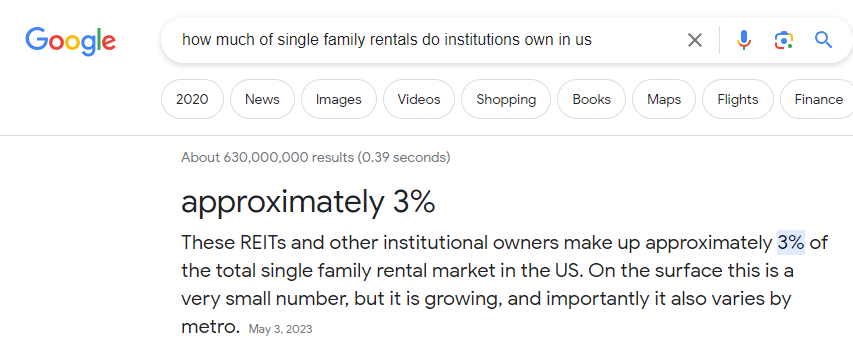
i actually don't know what the impact is on prices - do you? i don't have any data sources to say "institutional investors are responsible for 17% of the increase in prices in the last 3 years." but my point is - they still own only a small fraction of all SF rentals.
K S, I think we're agreeing. As requested, I was providing a data source (Vox). You provided another one (Zillow.)
Lol, uhm, lol, what you start with here actually kind-of IS the point. You did a search, in "A" zip code, at what "A" entity had for listings..... You just defined Selective Data Bias.
And funny how you put your theory for a "monopoly" on rent control. Funny because, are you aware I am a Broker with, I believe we are now #2 in USA for the size of our SFR portfolio. In my personal home market, we have under management about the same/similar # of units as ALL the other SFR PMC's in market, combined. And we have 0 "monopoly" on rent control.
By the #'s, in general 74% of ALL SFR's in the USA are owned by small investors holding 1-7 total units. Yes, the industry is vastly controlled by Mom-and-pop operators. And I love that fact. I love small business. But the unique thing about Mom-and-pop Landlords is a very large % Self-manage, self-administrate. And than the next big chunk are transient in their operations, meaning the transition who and how they are administrating their Tenant Placement and PM operations. And that makes it near to impossible for anyone to get any foot-hold of "monopoly" in any manner beyond hyper-local.
BlackRock has been long at acquiring SFR's, is still at it today, and despite there gargantuan acquisition capital and now holdings, they are but a speck of market share.
All these fund level investors, COMBINED, make up less than 25% of market share. COMBINED.
The amount of trillions needed for any 1 entity to obtain a market monopoly is just bizonkers, and mathematically impossible. BlackRock, the king of them all, would have to buy, them ALL. Than, would have to DOUBLE in size, and than, maybe, MAYBE would start entering territory of monopolistic controls in some market areas.
the article says that - that the impact in certain neighborhoods is much higher.
i actually don't know what the impact is on prices - do you? i don't have any data sources to say "institutional investors are responsible for 17% of the increase in prices in the last 3 years." but my point is - they still own only a small fraction of all SF rentals.
All one has to do is google it:
higher. Most people doing this have residual income and access to better deals
"The reason why bread has become unaffordable for the middle class is because we have too many nutritionists and life coaches espousing the ability of bread to improve your life. It'll defeat cancer (bread's intense healing powers give you the best chance to overcome cancer*), give you energy (you'll feel like tiger after eating a slice of bread*) and help you get laid (an elegant slice of bread with wine is the perfect way to a potential lover's heart*)."
*Results compare eating bread vs. eating nothing.
Unlike bread, real estate has limited supply (especially good real estate). So if you are creating more demand by convincing people it's the best investment vehicle, it'll drive prices higher.
This argument that the promotion of Real Estate Investing is the "villain" in making, FORCING real estate prices UP, is just ridiculously infantile in it's nauseating reasoning.
Let's start with the simple obvious; your talking about INVESTMENT real estate actions. That means it holds an analysis basis of what it can monetize at. If there were some "PUMP" as declaring, that means NO TRUE DEMAND. If there were no demand, that monetization would NOT be there. That would be a SURPLUS of supply. Do we have a surplus of rental supply? Bueler.... Bueler.... Bueler....?
NO! We have a net-SHORTAGE. It is the net-SHORTAGE, and or the BALANCED supply-demand that is EMPOWERING the operational finances of, which is MONITIZATION, and that "profit" is what intones the VALUE for investors.
Saying home prices are too high for owner occupant buyers is childish, it just is. Any amount of actual data CLEARLY destroys that ridiculous notion, because it's simply NOT true. It's a Socialist talking point to say such and that's all that it is.
Fact is investors are MEETING demand.
You want villains for home prices, talk to your Comrade-in-Chief throwing out $ like it's confetti. Every dollar borrowed into existence, which is EXACTLY what happens when you spend more than you have and borrow it into existence better known as "The National Debt", cut's the "pie" into ever smaller and smaller pieces, because there is ONLY 1 pie! How do you get more slices? You make every slice a bit SMALLER. That's your purchasing power, getting SMALLER, which is reflected in items requiring MORE "slices of pie" to acquire them.
It's called inflation, maybe you heard of it?
Seriously kid's: "I can't buy the home I want because.... because.... because that nasty rich person is paying more than I have for it! Why can't everyone STOP buying what I want, it's MINE, I want it, make it LESS!", that's all I hear from this ridiculous argument. You blame everyone EXCEPT the actual people who are at fault for the way things are.
In "Rule Book For Radicals" they had a term for you: "useful idiots".
People this confident in their convictions aren't this obnoxious explaining them.
You can't just say data shows that our argument is false without providing this data. The onus would be on you to provide the data for your counter argument. You understand that it's not an argument to say "it's not true"
You said "saying home prices are too high for owner occupant buyers is childish because demand is being met" then I have to ask if you considered the fact that the only people buying the low inventory are top 5% of earners, small investors, institutions and cash buyers. I'd say the middle class family is the minority of buyers in every transaction if not nearly non existent. Have you also considered that data on the amount of denied mortgages due to not meeting the 40% DTI limit?. The fact that real estate was 3x income decades ago and now it's 12x income. Or the fact that investors meeting the demands as you stated is just investors accepting lower returns. Accepting lower returns is not proof that prices aren't too high nor does it mean we are childish for thinking so.
James, you have more important things to do than this.
I do. The accusation's just drive me crazy, that we are to blame for house prices being what they are.
I had it out with a city last year on this point, who had same moronic argument, and instituted a "fix" of a moratorium on any new rental license's for anything other than large apartment complex's for a year. under the guise it was to "protect consumers". And I told them, they were going to severely HURT not help people, namely renters. That they'd sent rent's through the roof, and it will do nothing to SFH prices. They did it anyways.
They lifted that moratorium a short while ago, after driving rents through the roof, and with 0 impact on SFH prices. Median rents went up 22.5% after that idiotic move they did.
Maybe I shouldn't care so much about impact on complete strangers, but when I am there, informed, see the stupidity in it, know how it's going to hurt people, it just incenses me. I feel a requirement to speak out, to at least try.
And getting vilified, for something we have 0 to do with, when we are actually working to provide SOLUTIONS, to help in dealing with this inflation, it's frustrating to say the least. There is no cabal, were not working against people. We see a market demand, were working to help meet that demand. We are housing providers, we HELP people, for profit. I don't understand why some need to run away with conspiracy theories on such vs the simple reality.
I have sat at the table with some wildly wealthy and powerful people in this segment of things and ironically know what we talk about, what they say, how can we better help these people out. Yeah, it's not just all how do we make $ off this situation, it's how can we help people, and how can we make that help make financial sense, to also be financially rewarding for us doing such. These people are still humans, they have kid's, mothers, brothers, neighbors, employees. They do actually give a squat about humanity.
Not saying all, without doubt there is some slimy soulless creeps out there. But many are actually decent human beings. No motive for monopoly, no motive to bleed people dry. Just seeing a need and working to help in it, and for it to be profitable to do so.