How do most new investors fund their first deal?

How do most new investors fund their first deal?

Member since 2025 · 111 posts · 56 votes

I see a lot of first-time investors struggling to find capital for their first property. Some go the hard money route, others partner up, and some use creative financing.

Curious — what funding strategies worked for you when you started? Any lessons learned or mistakes to avoid?

1Reply
162 views

Most Popular Reply

Specialist · Member since 2025 · 483 posts · 270 votes
11mo

I started with private money paired with small chunks of my own cash, then used BRRRR to pay lenders back and recycle capital. Hard money works, but it's pricey for new investors, so I led with credibility: a simple one‑page deal story, conservative numbers, my skin in the game, clear exit, and consistent updates. Big lessons: always protect your lender, over‑document the appraisal and comps, and line up two funding lanes before you offer. Quick next step: make a 60‑second pitch plus a one‑pager, share it with 10 people this week, and ask each, "Who else should see this?

See this reply in the discussion

3 Replies

Jump to latestLatest
  • Investor · Get yourself trained before doing something inadvisable. · Member since 2024 · 3k+ posts · 1k+ votes
    11mo
    Quote from @Michael Santeusanio:

    I see a lot of first-time investors struggling to find capital for their first property. Some go the hard money route, others partner up, and some use creative financing.

    Curious — what funding strategies worked for you when you started? Any lessons learned or mistakes to avoid?

    Well, I started by using creative finance because lenders weren't lending to new guys like I was. I've been doing so for 30 years now and I don't see a reason to use a bank. Here's one I did that shows what I mean.

    Are you new? Buying an "Off Market" property with "Subject To" and "Wraps" & Selling "Lease / Option"

    When buying a property to cash flow, you need to know what your expenses are. The following is one I actually purchased in Phoenix that was a pre-foreclosure. The seller and I negotiated the terms. I did not offer a number to him, he told me what he needed. This first portion is the end result. The following portions are how we got there. Click on images to enlarge.
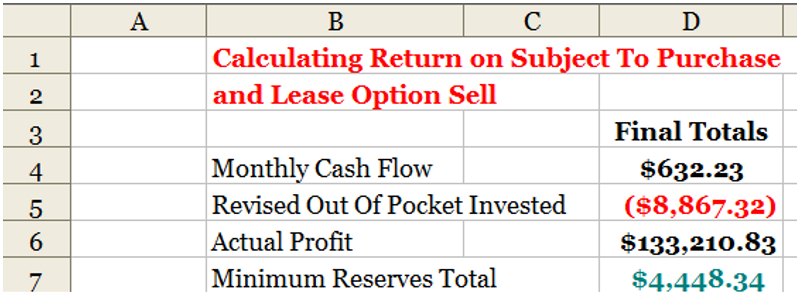
    The house was not suitable for the MLS. The seller had waited too long to fix the problem and just wanted out. He said he needed $10,000 so he could move back to his home state. So, this is how we put the deal together.

    First, you determine ARV (After Repair Value) so you can see if this one is actually worth buying. In this case it’s worth $245,00 fixed up.,(ARV).

    You enter the Blue Numbers only, the rest are calculated. Enter the ARV (it's MLS value after it's all fixed up) on line 23, you get that number from looking at "comps". On line 24 you enter the payoff amount. We’ll take care of the arrears in a minute.
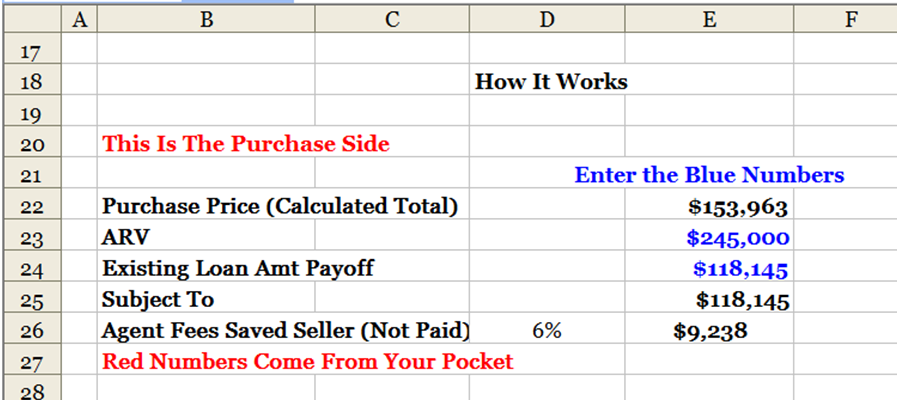
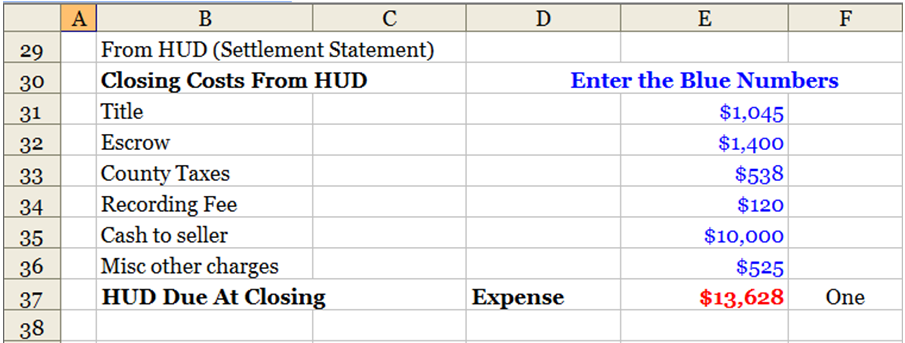
    We always go through Escrow and Record, so we need to account for those costs. We Record because it’s the right thing to do and we want to know about any actions that come up against the property. Some people say don’t Record because of the Due On Sale clause, or to use a Land Trust to defeat the DOS which is bad information. If a lender wants to enforce a Due On Sale, a Land Trust violates the DOS anyway so it is ineffective in stopping the Due On Sale call.

    Line 35 is always negotiable, but the seller needs enough to rent an apartment and move their belongs or they will become squatters which causes serious problems. There will be closing costs.
    And of course, since this is a pre-foreclosure, the arrears have to be brought current.

    Sometimes, a property will have a second loan or lien. Usually those can stay in place, but sometimes you have to pay those to buy the property. You can get the payoff amount from the lender. There is a specific process for doing that properly. If you are new, I would have someone help you with the process.

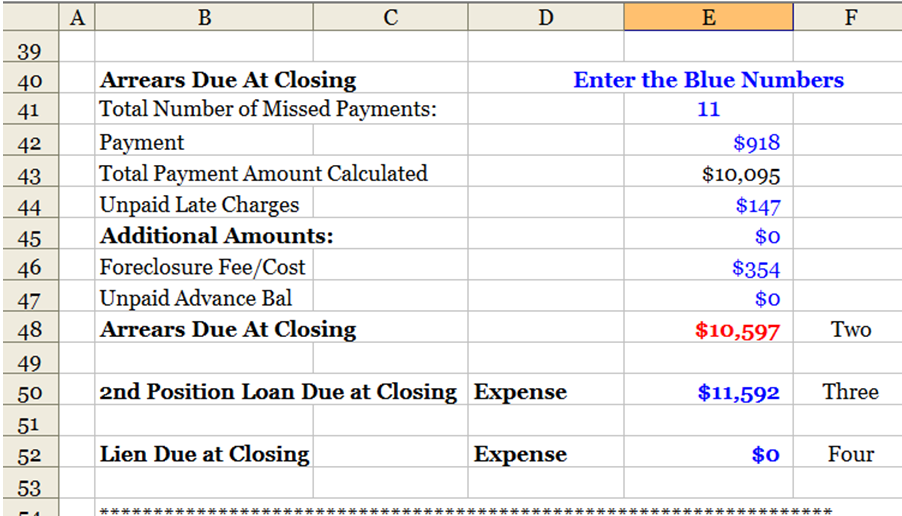
    So, on this property, I paid line 37 $13,628 (which included $10,000 to the seller & closing costs $3,628), brought the loan current $10,597 line 48, took over the 2nd loan of $11,592 and took over the main mortgage of $118,145. I paid $153,862 and got a $245,000 property. But, I didn't need all $153,862, I only needed $24,225 to do so.

    When you are new, looking for lenders & considering Fix & Flip, BRRRR, or rental, as a buyer, learn to ask the owner/seller to be one of your private lenders with creative financing. This works in Southern California (CA), AZ, WA, and GA & TX. Slight variations work elsewhere.


  • Specialist · Member since 2025 · 483 posts · 270 votes
    11mo

    I started with private money paired with small chunks of my own cash, then used BRRRR to pay lenders back and recycle capital. Hard money works, but it's pricey for new investors, so I led with credibility: a simple one‑page deal story, conservative numbers, my skin in the game, clear exit, and consistent updates. Big lessons: always protect your lender, over‑document the appraisal and comps, and line up two funding lanes before you offer. Quick next step: make a 60‑second pitch plus a one‑pager, share it with 10 people this week, and ask each, "Who else should see this?

  • Alyssa MarquezBusiness Member
    Real Estate Agent · San Antonio TX / Fort Lauderdale, FL · Member since 2023 · 120 posts · 29 votes
    1mo

    You know that really depends on the deal, but for partnerships I can see value if you are in need of capital upfront. Hard money could be a way to finance flips and rehab projects, but the interest rates and holding costs can chew you up real fast in terms of profitability. One lesson from hard money; know the real cost of money and you need adequate cash reserves and don’t do a deal just because you have a loan source.

Join the conversationCreate a free account to reply, vote on answers and follow this thread.
