A 50-year mortgage sounds like affordability, really?
Adam MaciasPro Member
Real Estate Consultant · Fort Collins, CO · Member since 2022 · 291 posts · 178 votesA 50-year mortgage sounds like affordability — but it’s really it'll be debt that never ends. lol
On paper, stretching a mortgage from 30 years to 50 lowers the monthly payment, yes.
But in reality, you’re paying far more in interest while barely building equity for decades.
If you buy a house at 25 years old if you're lucky, you'll be 75 when the mortgage term ends...
It’s housing that feels like ownership but functions more like renting — just with a longer contract and a higher total cost.
The real problem isn’t the length of the loan.
It’s the affordability crisis that’s forcing people to consider lifetime debt as a solution.
Until we address prices, wages, and supply, extending loan terms only delays the inevitable...
The further elimination of the middle class chasing the American Dream of owning a home.
A 50-year mortgage sounds like affordability — but it’s really it'll be debt that never ends. lol
On paper, stretching a mortgage from 30 years to 50 lowers the monthly payment, yes.
But in reality, you’re paying far more in interest while barely building equity for decades.
If you buy a house at 25 years old if you're lucky, you'll be 75 when the mortgage term ends...
It’s housing that feels like ownership but functions more like renting — just with a longer contract and a higher total cost.
The real problem isn’t the length of the loan.
It’s the affordability crisis that’s forcing people to consider lifetime debt as a solution.
Until we address prices, wages, and supply, extending loan terms only delays the inevitable...
The further elimination of the middle class chasing the American Dream of owning a home.
Seems like this might benefit some RE investors, seeing that they can lower their current payment and increase rental cashflow. Some of them might not even care to pay the current mortgage off, especially if they have an active business.
I don't really see how this will benefit any first time buyers. If anything the shared appreciation program seems more of a benefit for a lower payment and lower barrier to entry.
Seems like the 50yr "could " be a useful tool for a few (disciplined) 1st time buyers? No prepayment penalty & paying down principle plus sweat equity (valu add) may be good for some?
given that strategy wouldn't shared equity be worse if the buyer did heavy forced equity? Adding bd/ba....pop top etc. Especially here in CA?
School me.
A lot of the shared appreciation mortgages, at least here in CA are basically a lottery..
Many first time homebuyers struggle to have any skin in the game in the first place. This loan pretty much gives them the best of both worlds. Low/no downpayment and a lower mortgage payment. Since it is a lottery based system, and whoever applies must follow certain first time buyer requirements, it actually helps the people that need it the most while also controlling the buyer demand (luck of the draw).
I think the 50 year mortgage is just going to increase RE prices significantly. The lower payment and the few buyer restrictions for it is going to increase buyer demand significantly, and we'll arrive to the same issue. I am pretty sure the rates on these will be high on these as well, unless it is an FHA loan.
Who really knows, but just based on my conversations with buyers in CA, the main issue is skin in the game and mortgage payments being triple the rent. The shared appreciation mortgage helps solve both of those issues, while somewhat controlling buyer demand with the lottery system.

You're ignoring the equity that's built over decades from appreciation. Very few individuals keep their loan for the duration of a 30 year mortgage, much less a 50 year. They'll refi or sell before 50 years is up. IF they keep it for the full 50 year terms, the property should be worth way more than the interest they paid.
Paying down more principal would be ideal, and I like your solutions better, but a 50 year mortgage is still better than renting.
But as we can see with the current affordability turmoil, how high does a property have to go up in price before you price out an entire generation? It's sounds nice to say the house always goes up, but it's not guaranteed. Depending on appreciation is not as valuable as just being able to create equity by actually paying off the principle of the loan.
No guarantees in life except death and taxes. But if I was a betting man, I'd bet prices will be higher in 50 years than they are today.
The best thing about the 50 year mortgage is that no one has to get one if they don't want to. If paying down principal is the main goal, then a 15 year mortgage is the way to go.
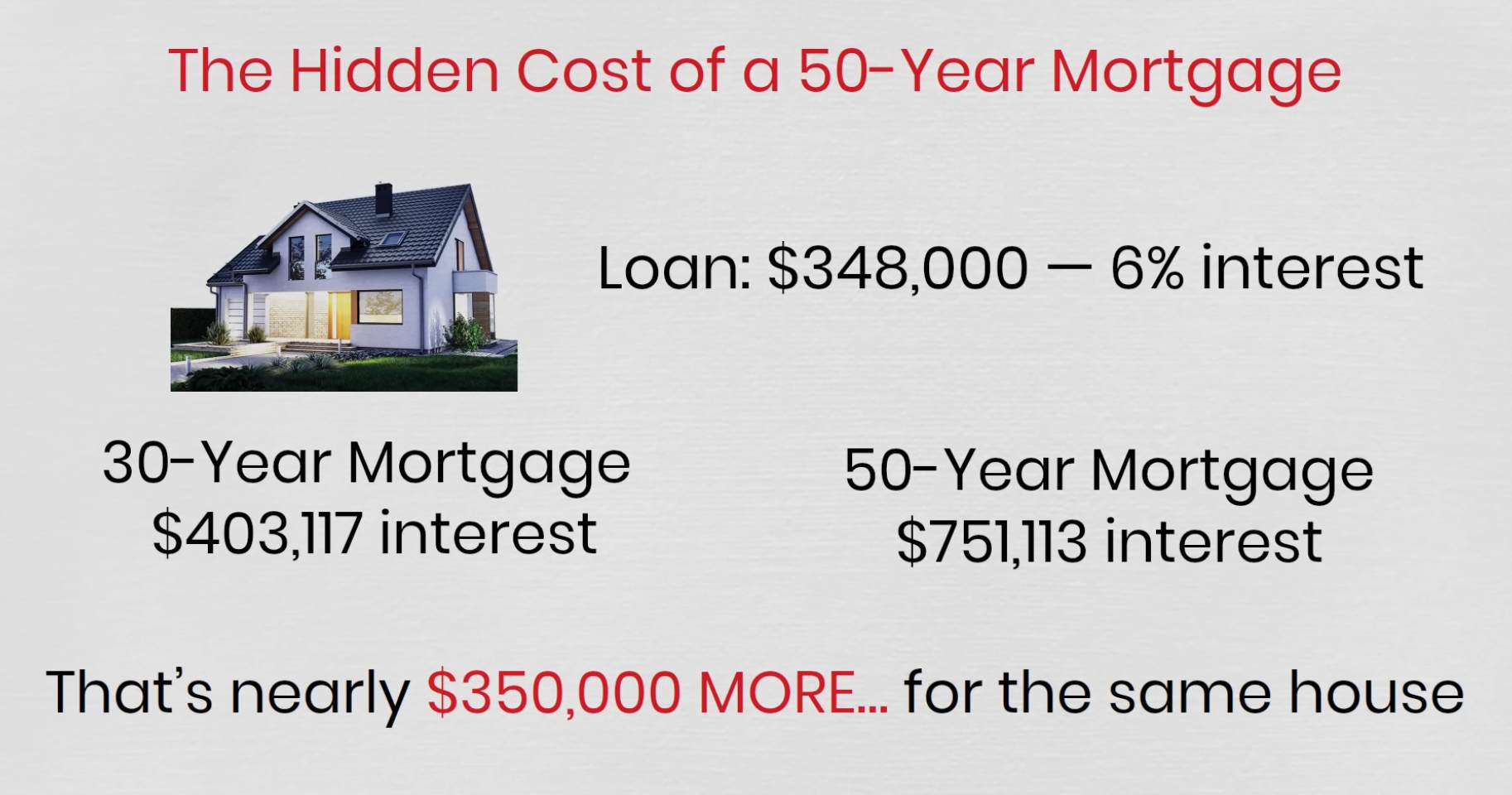
A 50-year mortgage sounds like affordability — but it’s really it'll be debt that never ends. lol
On paper, stretching a mortgage from 30 years to 50 lowers the monthly payment, yes.
But in reality, you’re paying far more in interest while barely building equity for decades.
If you buy a house at 25 years old if you're lucky, you'll be 75 when the mortgage term ends...
It’s housing that feels like ownership but functions more like renting — just with a longer contract and a higher total cost.
The real problem isn’t the length of the loan.
It’s the affordability crisis that’s forcing people to consider lifetime debt as a solution.
Until we address prices, wages, and supply, extending loan terms only delays the inevitable...
The further elimination of the middle class chasing the American Dream of owning a home.
Seems like this might benefit some RE investors, seeing that they can lower their current payment and increase rental cashflow. Some of them might not even care to pay the current mortgage off, especially if they have an active business.
I don't really see how this will benefit any first time buyers. If anything the shared appreciation program seems more of a benefit for a lower payment and lower barrier to entry.
Seems like the 50yr "could " be a useful tool for a few (disciplined) 1st time buyers? No prepayment penalty & paying down principle plus sweat equity (valu add) may be good for some?
given that strategy wouldn't shared equity be worse if the buyer did heavy forced equity? Adding bd/ba....pop top etc. Especially here in CA?
School me.
A lot of the shared appreciation mortgages, at least here in CA are basically a lottery..
Many first time homebuyers struggle to have any skin in the game in the first place. This loan pretty much gives them the best of both worlds. Low/no downpayment and a lower mortgage payment. Since it is a lottery based system, and whoever applies must follow certain first time buyer requirements, it actually helps the people that need it the most while also controlling the buyer demand (luck of the draw).
I think the 50 year mortgage is just going to increase RE prices significantly. The lower payment and the few buyer restrictions for it is going to increase buyer demand significantly, and we'll arrive to the same issue. I am pretty sure the rates on these will be high on these as well, unless it is an FHA loan.
Who really knows, but just based on my conversations with buyers in CA, the main issue is skin in the game and mortgage payments being triple the rent. The shared appreciation mortgage helps solve both of those issues, while somewhat controlling buyer demand with the lottery system.
Thanks a bunch Erik, im thinking of my 24 yo & we're brainstorming strategy to buy in San Jose. He's a tech bro, 2yrs job vested in January, got 100k for down, 790 FICO heavy stock investor. Im a contractor.. He wants outright ownership ASAP...saddled to 16k in prop taxes is a big enough burden lol.
Any reading material on this LOTO program? Of course I'll search to for DD.
Thanks again & BTW your humorous zingers on the forum rock!
Totally agree. Sweetening the deal with a seemingly lower monthly payment disguises the actual price. For me, the question is whether the buyer truly gets to create substantial equity, all while still staying within budget, and a long loan term might open a door but does not solve the core problem of affordability.
Stretching to 50 years to save $283 a month isn't affordability. It's a math trick that costs you roughly $460,000 more in interest and keeps you in debt until you're 75.
The actual problem is the rate, not the term. At 6.8%, a $400k loan runs $2,615/month and you'll pay over $540k in interest on a standard 30-year. Extend that to 50 years and the payment drops to about $2,330. But total interest blows past $1 million. You saved $283/month and spent an extra $460k to do it.
The better affordability tool already exists and most people have never heard of it. Every FHA and VA loan is assumable by law. I do these full-time in Colorado Springs. Right now there's inventory at 2.7%, 3.25%, even sub-3% rates sitting out there. Assuming a $400k balance at 3.25% is $1,740/month. That's $875 less than a new 30-year loan, you build equity at a normal pace, and you're done in 30 years, not 50.
The equity gap (purchase price minus remaining loan balance) takes some structuring. But for a buyer who can handle that gap through a second, seller credit, or cash, you're getting a dramatically lower rate with a normal payoff timeline.
50-year mortgages treat the symptom. The rate is the disease. DM me if you want to run numbers on a specific property.
