For the first time in a decade, builders—not everyday sellers—are the ones with properties on sale.
For the first time in more than a decade, new construction isn’t the “expensive” option.
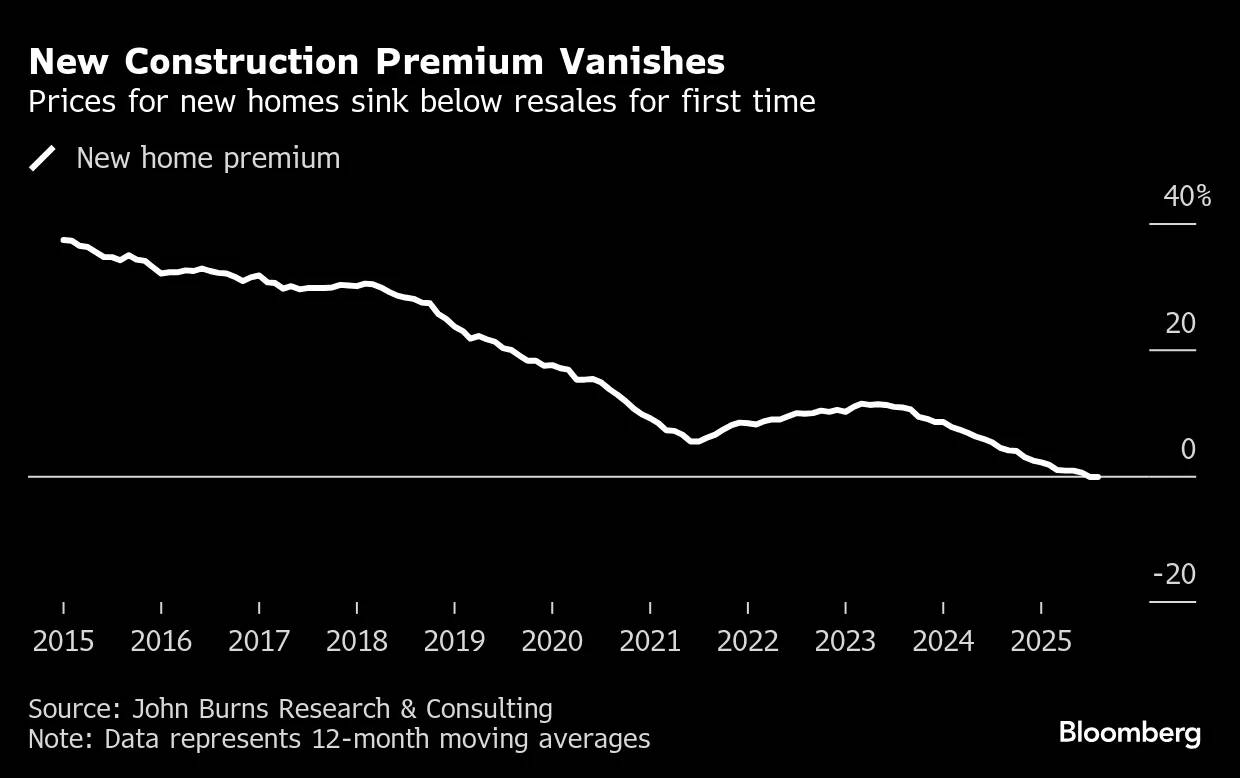
It’s often the better value.John Burns Research shows the new-build premium has flipped negative for the first time in modern tracking. In many markets, new homes are now trading below existing homes on a price-per-square-foot basis.
Why?
Builders have levers individual sellers don’t:
- They can buy down rates into the mid-5s (I've seen as low as 3.875% recently in Reno, NV...) while resales sit at 6.5%+/-
- They offer closing cost credits without blowing up appraisals
- They price off absorption and carry costs, not emotions
- They HAVE to push product, no matter the market conditions
A good number of resale sellers are still anchored to 2021–2022 pricing, and DON'T have to sell. Builders are not. That gap is where the opportunity sits.
Are you guys seeing similar opportunities in your market?

Bought new builds this year at 4.25%, 4.25% and 4.75% interest All are positive cash flow
Yeah, this trend is showing up all over. Builders are basically rewriting the affordability math right now, and it’s not because their base prices crashed, it’s because the incentives are doing all the heavy lifting. A resale seller just can’t compete with a 5% (or lower) rate buydown, tens of thousands in credits, and a builder who has to move product by quarter-end.
Meanwhile a lot of resale owners are still mentally stuck in 2021 and don’t have any urgency, so their prices stay sticky. That gap is where the deals are popping up.
Yeah, this trend is showing up all over. Builders are basically rewriting the affordability math right now, and it’s not because their base prices crashed, it’s because the incentives are doing all the heavy lifting. A resale seller just can’t compete with a 5% (or lower) rate buydown, tens of thousands in credits, and a builder who has to move product by quarter-end.
Meanwhile a lot of resale owners are still mentally stuck in 2021 and don’t have any urgency, so their prices stay sticky. That gap is where the deals are popping up.
Hello @Jake Andronico,
I don’t know the Reno market, but here’s how new builds perform in Las Vegas.
Many investors prefer new homes because of lower maintenance during the first few years. That’s true—but it’s the only advantage. To understand why, start with the goal of real estate investing: reliable rental income. Income reliability comes from the tenant, not the property. The property is simply the container the tenant pays to occupy.
For over 17 years, we’ve focused on tenants who can afford $1,800–$2,300/month in rent. Today, these single-family homes cost $350,000–$475,000 and attract exceptionally reliable renters:
Desirable Las Vegas land costs exceed $1M/acre, so new single family homes start around $550,000. The break-even rent on a $550,000 home (25% down, 6.5% interest) is $3,100+/month—far above what our stable tenant segment can afford. Tenants who can pay that much typically stay only 1–2 years and then buy a home.
Vacancy cost depends on three factors: how long the tenant stays, carrying costs until a new tenant moves in, and the cost to restore the property to rent-ready condition. To compare vacancy costs between the two tenant segments, below is an estimate of the 10-year vacancy cost for a $550,000 new build versus a $400,000 property.
Due to higher costs, shorter tenant stays, and longer time to place a tenant, the additional vacancy cost difference over ten years is $49,920. This is a huge cost to reduce maintenance costs for a few years.
Do the maintenance cost savings of new homes actually result in overall cost savings? No. For example, I will assume the $550,000 new home has no maintenance cost for the first 5 years, and the average maintenance cost of a $400,000 home is $400/Yr (our typical). If both properties are financed with 30% down, 30-year, 6.5% rate, the five year debt service is:
The difference in five-year debt service cost is $38,580. The assumed base maintenance cost for the $400,000 home is $400/Yr x 5 Yrs = $2,000. So the incremental cost for the new property is $38,580 - $2,000 = $36,580. This equates to:
New builds are taxed at ~1% of the sold price versus 0.55% for the property segment we target. What is the property tax difference per year?
The annual property tax difference is $3,300. This covers a lot of repairs each year.
New builds save a few hundred dollars per year in maintenance but cost tens of thousands more in vacancy, debt service, and taxes. For long-term, reliable rental income, existing homes in the $350K–$475K range dramatically outperform new construction (for Las Vegas).
Hello @Jake Andronico,
I don’t know the Reno market, but here’s how new builds perform in Las Vegas.
Many investors prefer new homes because of lower maintenance during the first few years. That’s true—but it’s the only advantage. To understand why, start with the goal of real estate investing: reliable rental income. Income reliability comes from the tenant, not the property. The property is simply the container the tenant pays to occupy.
For over 17 years, we’ve focused on tenants who can afford $1,800–$2,300/month in rent. Today, these single-family homes cost $350,000–$475,000 and attract exceptionally reliable renters:
Desirable Las Vegas land costs exceed $1M/acre, so new single family homes start around $550,000. The break-even rent on a $550,000 home (25% down, 6.5% interest) is $3,100+/month—far above what our stable tenant segment can afford. Tenants who can pay that much typically stay only 1–2 years and then buy a home.
Vacancy cost depends on three factors: how long the tenant stays, carrying costs until a new tenant moves in, and the cost to restore the property to rent-ready condition. To compare vacancy costs between the two tenant segments, below is an estimate of the 10-year vacancy cost for a $550,000 new build versus a $400,000 property.
Due to higher costs, shorter tenant stays, and longer time to place a tenant, the additional vacancy cost difference over ten years is $49,920. This is a huge cost to reduce maintenance costs for a few years.
Do the maintenance cost savings of new homes actually result in overall cost savings? No. For example, I will assume the $550,000 new home has no maintenance cost for the first 5 years, and the average maintenance cost of a $400,000 home is $400/Yr (our typical). If both properties are financed with 30% down, 30-year, 6.5% rate, the five year debt service is:
The difference in five-year debt service cost is $38,580. The assumed base maintenance cost for the $400,000 home is $400/Yr x 5 Yrs = $2,000. So the incremental cost for the new property is $38,580 - $2,000 = $36,580. This equates to:
New builds are taxed at ~1% of the sold price versus 0.55% for the property segment we target. What is the property tax difference per year?
The annual property tax difference is $3,300. This covers a lot of repairs each year.
New builds save a few hundred dollars per year in maintenance but cost tens of thousands more in vacancy, debt service, and taxes. For long-term, reliable rental income, existing homes in the $350K–$475K range dramatically outperform new construction (for Las Vegas).
Hello @Jake Andronico,
I wish the properties I owned in other states came close to our $400 annual average maintenance cost.
Note that the $400 includes minor repairs such as running toilets, dripping faucets, and appliance malfunctions. Big-ticket items like a water heater or air-conditioning compressor increase the maintenance cost in that year, but successive years will be less than $400, so it averages out.
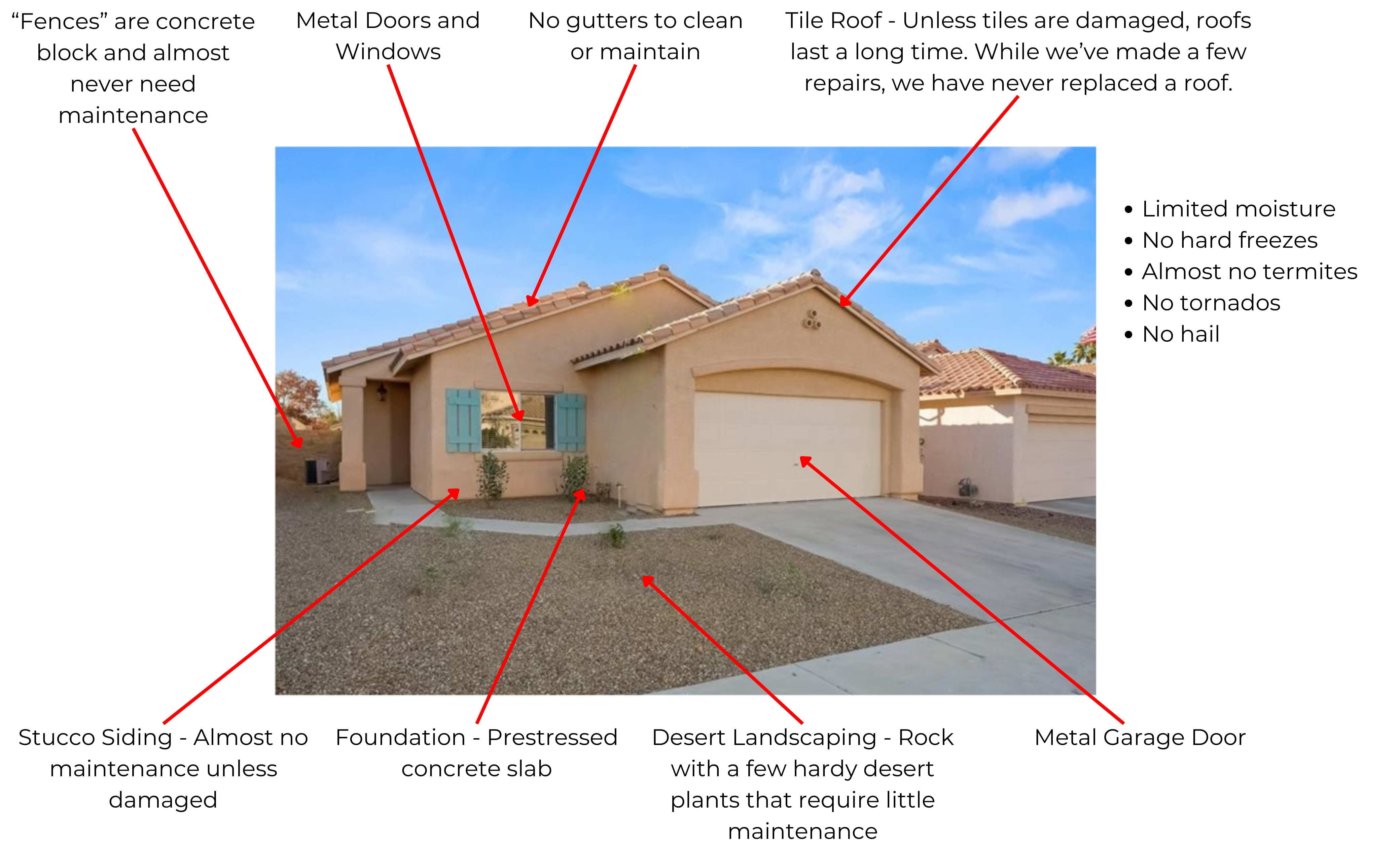
The properties we recommend have low maintenance costs partly because of construction practices in Las Vegas—which is in the Mojave Desert. Below is a typical property we would recommend to our clients.
Only tile roofs, stucco siding, metal doors and windows, concrete slab foundations, and concrete block fences can survive the climate. There is no exposed wood—exposed wood disintegrates in the heat. Almost all of our properties also have desert landscaping. We remove any grass or high-maintenance vegetation during renovation and then install rock. We do add a few desert-hardy plants like lantana or rosemary.
Moisture also isn't a problem because we average less than 4 inches of rain per year. The water table is typically >90 ft down from the surface.
We have no termites except for a ground-dwelling species. In over 17 years, I haven't seen any termites in the properties we target. Termites are so rare in Las Vegas that lenders don't require a termite inspection.
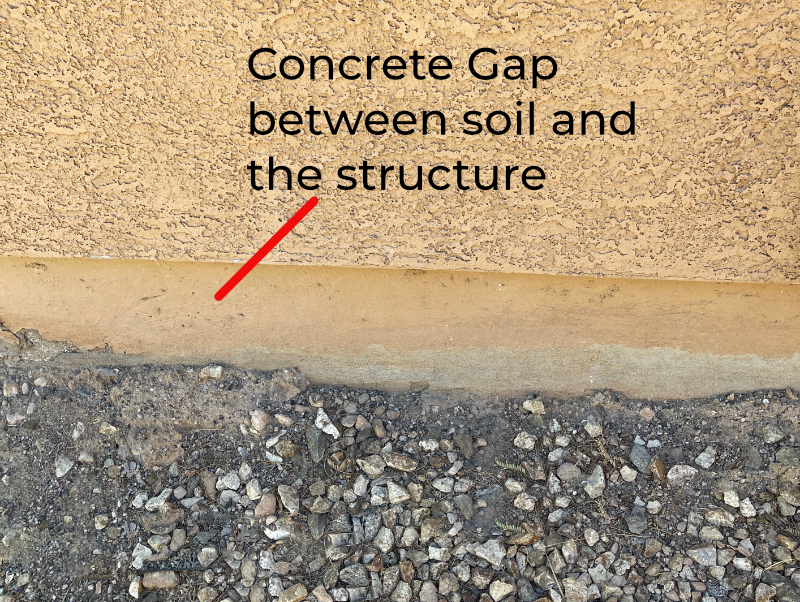
If a property did have termites, they would be easy to spot. To reach the structure, termites build visible dirt tunnels from the soil up. There's a gap between the soil and the bottom of the structure—as you can see below—making any termites easy to detect.
We cherry picked subdivisions and properties for low maintenance. I am an engineer and I've personally evaluated multiple properties in each subdivision we recommend. We eliminated many subdivisions due to poor engineering practices or issues like soil settlement. In most cases, we only consider properties built in 1990 or later.
Another big advantage is our renovation approach. I standardized all major renovation components in 2017. For example, we use commercial-grade LVP flooring from a single manufacturer in one color. This allows our vendors to buy truckloads and keep inventory on hand whenever we need to install or replace planks—keeping costs low.
We also target a demographic that takes care of our properties. Las Vegas is a pro-landlord city, so tenants know that if they cause damage, they'll pay for it. This motivates them to take care of the properties.
Summary
Multiple factors combine to keep our maintenance costs low. In contrast, the properties I owned in Houston and Atlanta required constant attention—wood rot, termites, siding issues, and roof replacements. It was a major pain and expense.
Hello @Jake Andronico,
I wish the properties I owned in other states came close to our $400 annual average maintenance cost.
Note that the $400 includes minor repairs such as running toilets, dripping faucets, and appliance malfunctions. Big-ticket items like a water heater or air-conditioning compressor increase the maintenance cost in that year, but successive years will be less than $400, so it averages out.
The properties we recommend have low maintenance costs partly because of construction practices in Las Vegas—which is in the Mojave Desert. Below is a typical property we would recommend to our clients.
Only tile roofs, stucco siding, metal doors and windows, concrete slab foundations, and concrete block fences can survive the climate. There is no exposed wood—exposed wood disintegrates in the heat. Almost all of our properties also have desert landscaping. We remove any grass or high-maintenance vegetation during renovation and then install rock. We do add a few desert-hardy plants like lantana or rosemary.
Moisture also isn't a problem because we average less than 4 inches of rain per year. The water table is typically >90 ft down from the surface.
We have no termites except for a ground-dwelling species. In over 17 years, I haven't seen any termites in the properties we target. Termites are so rare in Las Vegas that lenders don't require a termite inspection.
If a property did have termites, they would be easy to spot. To reach the structure, termites build visible dirt tunnels from the soil up. There's a gap between the soil and the bottom of the structure—as you can see below—making any termites easy to detect.
We cherry picked subdivisions and properties for low maintenance. I am an engineer and I've personally evaluated multiple properties in each subdivision we recommend. We eliminated many subdivisions due to poor engineering practices or issues like soil settlement. In most cases, we only consider properties built in 1990 or later.
Another big advantage is our renovation approach. I standardized all major renovation components in 2017. For example, we use commercial-grade LVP flooring from a single manufacturer in one color. This allows our vendors to buy truckloads and keep inventory on hand whenever we need to install or replace planks—keeping costs low.
We also target a demographic that takes care of our properties. Las Vegas is a pro-landlord city, so tenants know that if they cause damage, they'll pay for it. This motivates them to take care of the properties.
Summary
Multiple factors combine to keep our maintenance costs low. In contrast, the properties I owned in Houston and Atlanta required constant attention—wood rot, termites, siding issues, and roof replacements. It was a major pain and expense.