I am wondering what would be the best scenario to get the best rates in a mortgage:
Either contact as many banks as possible before starting to make offers or contact them after your offer has been accepted and you have a specific properties and the bank/lender can lock their rates for some time.
I worry that with few days and many other deadlines shopping around after might not be enough.
Would you also recommend contacting a mortgage broker?
Thank you in advance!
@Victor Vela
Here is my thought,
If you're going to buy a house, what you should do is if you have a good broker you should go in and you should get your financing all worked out for you to start looking at homes. So you need to go to the bank. You have to prepare your financial paperwork to get a prequalification to know how much you can afford. Then once you know how much you can afford. Then you can start making offers based on the fact that Chevy bank approved behind you on the transaction. Obviously, your credit makes a difference. So, if you have a credit score that's above 800 there to
give you maybe a lower rate. But ideally, at the end of the day, most of these people to get loans are all brokers and they are feeding their loans into the same product which is a
Fannie Mae, Freddie Mac product. So, one lender over it. Once it is not really
a lender, the broker, the mortgage broker that's gonna find you the money to lend you on
your home is pretty much getting the same deal. So if Fannie Mae's rate is 3.35% for 30 years fixed at this date, they all gonna sell you the same loan. What you really look at is their fee structure. Because where the mortgage broker makes the money, sometimes they make it a kickback on the backside from the lender over there to make their money is on the points in the fees they charge you to close that loan. So it's really want to be looking at is more along the lines of what the points and fees are with the loan more than what the interest rates can be at the end of the day.
Thanks
I am wondering what would be the best scenario to get the best rates in a mortgage:
Either contact as many banks as possible before starting to make offers or contact them after your offer has been accepted and you have a specific properties and the bank/lender can lock their rates for some time.
I worry that with few days and many other deadlines shopping around after might not be enough.
Would you also recommend contacting a mortgage broker?
Thank you in advance!
Rates are only a portion of the equation. Your best bet is to talk to a wide variety of lenders and give them your scenario. Tell them EVERYTHING and let them decide what matters and what doesn't. Ask questions to see where their heads are at and then choose which one is the best one to put on your team.
I spoke to a guy this morning that was rate conscious and after discussions about his deals, I was about 1 point higher than everyone else (he wasn't shy about telling me I was higher either). Then i asked him if the other lenders asked him as many questions as I did, if they understood he was going for a no income verification loan and whether they bothered to ask if he was putting the loan in an LLC. For the most part, they did not ask one or more of those questions which directly affected the rate and where those loans were going.
Rates are close to the same from lender to lender, especially for conventional financing, depending on the schedule they set up with the eventual servicer. Your lender is going to be the one that makes or breaks your deal. Find one that you feel comfortable with and that understands your situation and go with it.
Stephanie
Of course you should shop around, and it saves you money. According to a research from Freddie Mac, the average borrower could save $1,500 just by getting one extra rate quote when applying for their mortgage. With five quotes, they could save $3,000 or more.
So how to do it? The first step would be estimating your mortgage rate yourself.
There is an old Chinese saying from The Art of War that “If you know your enemies and know yourself, you will not be imperiled in a hundred battles.” That’s exactly why this step matters. Having a rough idea of what interest rate you can expect is crucial for you to play well in this game.
There are many factors that determined your interest rates including base rate (update daily), loan amount, location, LTV (loan to value ratio), credit score, house type (single family vs condo) etc.
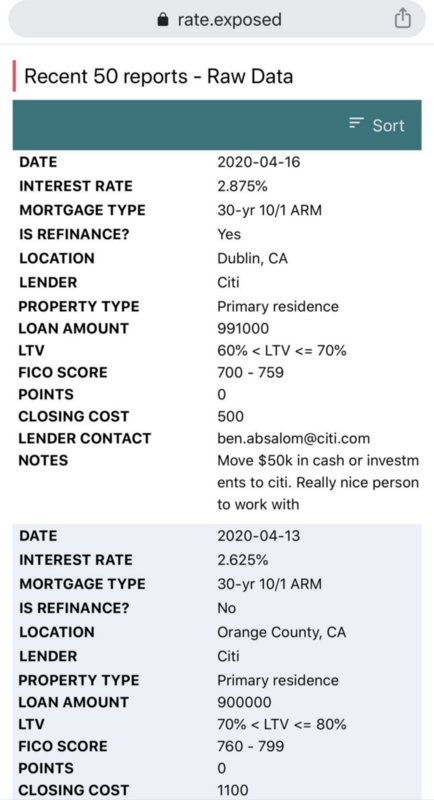
So to help yourself estimate, you can talk to your friends who have done mortgage recently and ask about their rates and how they get them. There are also some anonymous mortgage reporting site (such as rate.exposed) out there if you need more data.
The best way to estimate your rates is comparing with people with similar cases.
Now, let’s pick up the phone and start dialing
You can follow the steps here:
1. Call 5 lenders, ask them to quote and write the numbers down
2. Find the best quote from the 5 lenders, let’s call it lender A
3. Call the rest 4 lenders again asking them to match (or even beat) the quote from lender A.
4. If you get a quote better than lender A, go back to step 2 and step 3 to call the rest to match
5. Until the number can’t go lower and the rate is within your expectation.

Extra Tips 1: Ask for special program
Different lenders have different promotional program. For example, Wells Fargo has relationship discount where for every $250k asset you move to WF bank account, you get your rate reduced by 0.125%.
You might just save yourself $10k but just a simple ask
Extra Tip 2: Credit Hard Pull
Many people are worried about hurting the credit scores by having too many lenders hard pull your credits. In fact, if you do them within a short period of time, multiple credit inquiries will combine to count as only one.
Also, if you know your credit score in advance, you can simply just ask them not to pull and tell the lender the number. That should be more than enough for lenders to come up with a quote for you.
Extra Tip 3: Pay attention to fees
Some lenders do the trick to lower your interest by increasing some less obvious fees including closing costs, points, etc. So whenever you get a mortgage quote, always look at the full picture before making any decision.
@Victor Vela
Contact before trying to make offer. Normally, you can’t make an offer without Proof of Funds (PoF). If you are buying in cash, it’s bank and/or brokerage statements. If you are financing, it’s a pre-approval letter.
Don’t focus on solely rates at first. Focus on the lender fees, service (eg does the loan officer work “banker” hours or “realtor” hours), and loan products. Mortgage lenders are more flexible nowadays due to the increased regulations afte the 2008 crash. I think mortgage brokers can be a good choice to get the best deal. While tough to find out, how well they process your mortgage is key. Wells Fargo has been excellent to making a smooth transaction for me and those I’ve heard who have used them. Everybody else I’ve used I’ve always had to keep pushing and it was so frustrating...
Assumingly, you are going to be making more deals so will need more financing. This is how you start that relationship. When it comes time to make an offer, you’ll get an updated letter to match the offer (when the rep is working can be key), and off you go.
Good luck
@Victor Vela
Here is my thought,
If you're going to buy a house, what you should do is if you have a good broker you should go in and you should get your financing all worked out for you to start looking at homes. So you need to go to the bank. You have to prepare your financial paperwork to get a prequalification to know how much you can afford. Then once you know how much you can afford. Then you can start making offers based on the fact that Chevy bank approved behind you on the transaction. Obviously, your credit makes a difference. So, if you have a credit score that's above 800 there to
give you maybe a lower rate. But ideally, at the end of the day, most of these people to get loans are all brokers and they are feeding their loans into the same product which is a
Fannie Mae, Freddie Mac product. So, one lender over it. Once it is not really
a lender, the broker, the mortgage broker that's gonna find you the money to lend you on
your home is pretty much getting the same deal. So if Fannie Mae's rate is 3.35% for 30 years fixed at this date, they all gonna sell you the same loan. What you really look at is their fee structure. Because where the mortgage broker makes the money, sometimes they make it a kickback on the backside from the lender over there to make their money is on the points in the fees they charge you to close that loan. So it's really want to be looking at is more along the lines of what the points and fees are with the loan more than what the interest rates can be at the end of the day.
Thanks