Should I be doing something with reserve cash I get from rent?

Should I be doing something with reserve cash I get from rent?

Member since 2018 · 24 posts · 25 votes

This might also be a bit of a personal finance question as well but wanted advice. Is there a set amount I should have in reserves to feel comfortable in case something catastrophic happens? I'm a bit paranoid so right now, I'm putting away everything I receive from rent I receive and have enough for lets say, a total roof replacement, if necessary. 

Should I just keep putting this money away or are there smarter things to do with it? I guess I'm also putting it away in case a tenant moves out but that's my mind also going crazy. Any advice would be appreciated. 

6Reply
83 views

Most Popular Reply

Investor · Fall River, MA · Member since 2014 · 399 posts · 300 votes
6y

@David Czech I love that you are storing cash away in a reserve account.

The only thing that scares me about this post is that sentence about saving for a catastrophic event.

What we think about we bring about and what we focus on expands. I know that sounds crazy, but let's just pretend that is how the universe works.

You should instead be storing your reserves away so the banks and private lenders will feel much better about lending you money on your next deal.

I hope you can see the subtlety there and how shifting from savings for fear to savings for abundance will dramatically change your business.

We don't use our own money in our deals. Instead we use our reserves as proof and collateral for our lenders to trust us with more money on bigger purchases.

You can always make an insurance claim or take out a small loan if something catastrophic ever happens.

I hope this helps you.

Cheers to your success!

See this reply in the discussion

26 Replies

Jump to latestLatest
  • Rental Property Investor · Ankeny, IA · Member since 2017 · 2k+ posts · 3k+ votes
    6y

    @David Czech

    You’ll get advice all over the spectrum here. Some will insist it never leaves your savings account. Some will state online savings to get that magical 2%. Some, like me, invest most of it. I have plenty of reserves, so I keep a few thousand cash on hand for each unit, and then invest in Vanguard VTSAX. The stock market would have to drop 80% before I had to worry about not having enough reserves.

    So, you’ll have to decide for yourself, based upon age of major expenses like roof and hvac, and what you’re comfortable with for risk.

  • Member since 2020 · 9 posts · 5 votes
    6y

    Good question! I personally invest the rental income in high dividend stocks (6%+). I have enough in my emergency fund, but I also have stable income and no other debt. As far as roof or other high cost replacement, I can always finance. However, I do think this is a personal finance question, it all depends on how much risks you are willing to take and what's your financial situation. I am curious what others do. 

  • Rental Property Investor · Oklahoma City, OK · Member since 2017 · 1k+ posts · 694 votes
    6y

    I don't think there's a right or wrong on this one. Like anything with investing, know the pros and cons of different solutions and make decisions based on your risk tolerance and financial position. 

    I have a ton of equity in almost everything I own, so I am fine with my reserves being low. In the event of a catastrophic event my worst case scenario is a refinance or selling the property. I also work in sales/real estate full time so it's pretty "easy" for me to grind out some extra hours and come up with cash. 

    If I didn't have equity and/or if I had a set income I'd likely be much more concerned with having a higher amount of reserved. 

    Hope this helps!

  • Member since 2019 · 144 posts · 93 votes
    6y

    If you are on the defensive side, you can use velocity banking and speed up paying the mortgage down. 

    If you don't know what velocity banking is.... 

    Use your credit card to pay principal only. Example if you have a 10K credit card limit, use it to pay principal only. Than use your saving to pay the creditcard over 5-7 months, than repeat it. You should be able to pay the house of in 5-7 years. Depending on your credit and saving limits. Especially at the beginning of each house mortgage, all you pay is interest and little principal but with this method you can pay of a lot of principal and reduce the interest you are paying. The interest on your credit card with 20% on 10k for 5-7 months are way less, than they interest on a 30 years term with 3-4% on a way higher amount. 

  • Rental Property Investor · Member since 2020 · 1k+ posts · 1k+ votes
    6y
    Originally posted by @Michael Thach:

    If you are on the defensive side, you can use velocity banking and speed up paying the mortgage down. 

    If you don't know what velocity banking is.... 

    Use your credit card to pay principal only. Example if you have a 10K credit card limit, use it to pay principal only. Than use your saving to pay the creditcard over 5-7 months, than repeat it. You should be able to pay the house of in 5-7 years. Depending on your credit and saving limits. Especially at the beginning of each house mortgage, all you pay is interest and little principal but with this method you can pay of a lot of principal and reduce the interest you are paying. The interest on your credit card with 20% on 10k for 5-7 months are way less, than they interest on a 30 years term with 3-4% on a way higher amount. 

    Can you explain this a little more, I'm a bit confused.  From my understanding you are taking money off your credit card to pay down your home and then paying off the card in a continuing cycle.  If you have interest at all on a credit card it is most likely much higher than what you are paying on your home.  Sure when you look at the interest you would pay on that money over the amortization on the loan it will be more but you would be better off just paying extra per month I would think on the house vs. periodic paydown using your credit card.  A way to look at it is for those specific funds you are paying probably around 5% on that money while it is in the loan and 15%+ on the credit card.  Now if you are getting promotional offers with 0% interest this may make sense but then you would get a credit hit I would think constantly opening new cards.  I am genuinely interested in this though and plan on looking more into this idea but would appreciate your clarification as well.  

  • Kenneth GarrettPro Member
    Investor · Florida Panhandle/Illinois · Member since 2016 · 4k+ posts · 3k+ votes
    6y

    @David Czech

    The rule of thumb is 6 months of expenses, but after you accumulate a number of rentals that would be a lot money that your not using.  I keep about 20K in the bank for emergencies, vacancies, etc.  I take the excess and bank it for my next investment.

  • Member since 2019 · 144 posts · 93 votes
    6y
    Originally posted by @Adam Martin:
    Originally posted by @Michael Thach:

    If you are on the defensive side, you can use velocity banking and speed up paying the mortgage down. 

    If you don't know what velocity banking is.... 

    Use your credit card to pay principal only. Example if you have a 10K credit card limit, use it to pay principal only. Than use your saving to pay the creditcard over 5-7 months, than repeat it. You should be able to pay the house of in 5-7 years. Depending on your credit and saving limits. Especially at the beginning of each house mortgage, all you pay is interest and little principal but with this method you can pay of a lot of principal and reduce the interest you are paying. The interest on your credit card with 20% on 10k for 5-7 months are way less, than they interest on a 30 years term with 3-4% on a way higher amount. 

    Can you explain this a little more, I'm a bit confused.  From my understanding you are taking money off your credit card to pay down your home and then paying off the card in a continuing cycle.  If you have interest at all on a credit card it is most likely much higher than what you are paying on your home.  Sure when you look at the interest you would pay on that money over the amortization on the loan it will be more but you would be better off just paying extra per month I would think on the house vs. periodic paydown using your credit card.  A way to look at it is for those specific funds you are paying probably around 5% on that money while it is in the loan and 15%+ on the credit card.  Now if you are getting promotional offers with 0% interest this may make sense but then you would get a credit hit I would think constantly opening new cards.  I am genuinely interested in this though and plan on looking more into this idea but would appreciate your clarification as well.  

    Let me explain this further. If my explantion is not good enough have a research on youtube. They might explain it better. 

    If you use 5k out of your creditcard with a interest rate of 20% annually and put it on a 190k mortgage with 4% on the principal with 30 years than this is what happen. 

    You pay a little over $400 for the 5k creditcard cash in advance. Look at my screenshot. You pay it off with $700 per month, if you can do more the better. You have it paid off in about 8 months. 
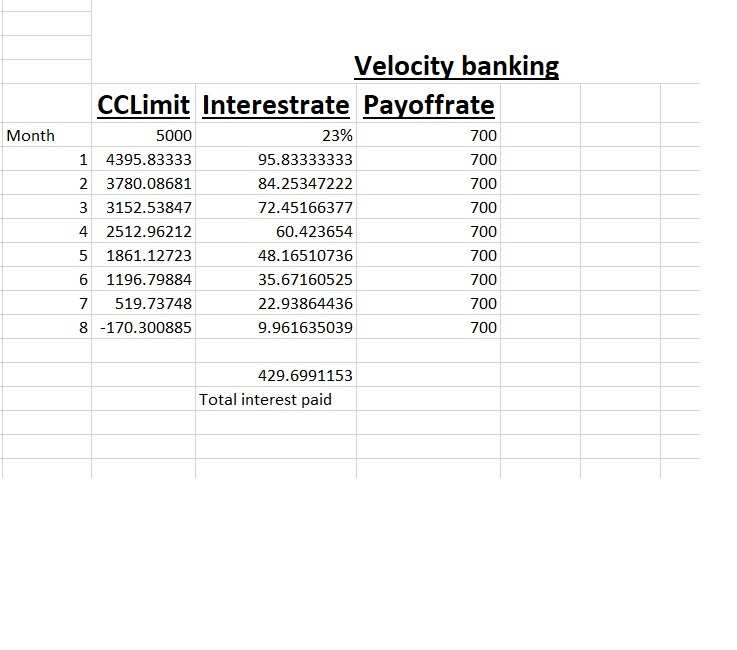
    With 190k Mortgage you are paying over 7,5K in interest the first year and in the second year you still pay 7,4k just in interest. But look at the right side, when you are using your 5K of your credit card and pay it towards the principal you are saving around 10K in interest or 1.5 years. It just cost you little over $400 and monthly savings. 

    Please watch the velocity banking video if you like this strategy it also explain you in detail how you can come up with extra saving. 
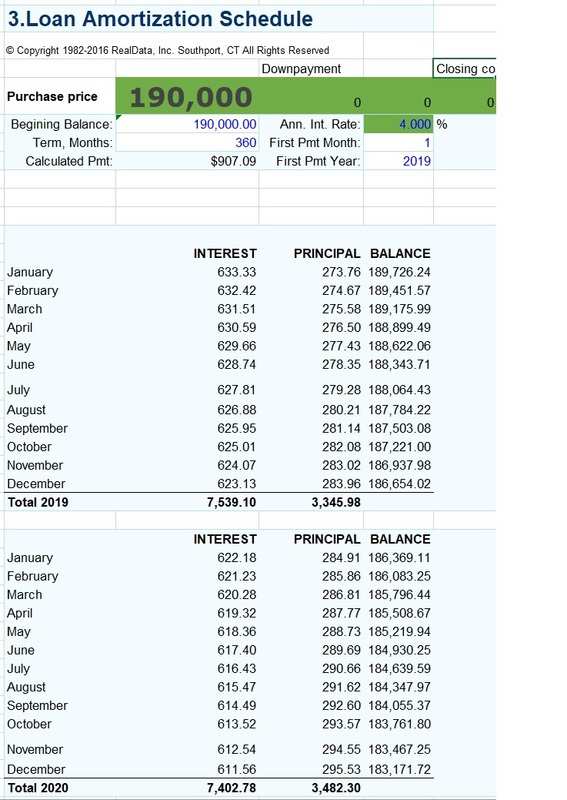

     All in all it will reduce your mortgage lifetime dramatically. 

  • Property Manager · Raleigh, NC · Member since 2014 · 729 posts · 596 votes
    6y

    @David Czech

    I keep a certain balance in my cash account that can almost cover all my annual expenses. As i spend money over the year, i replenish rhe account to the same balance. Anything else is either saved for more houses, or my wife finds a use for it.

  • Rental Property Investor · Member since 2020 · 1k+ posts · 1k+ votes
    6y

    I have been looking into this and on most accounts it has people doing this with a heloc which will have a dramatically lower interest rate but I'm not completely sold on all of the concepts while others I have been using for years.  Based on your scenario there is no doubt that you are saving money on interest for your mortgage however I feel to get an apples to apples comparison you would need to run another scenario making it 3 vs. 2.  Scenario 1, what you will pay in interest over the amortization schedule, option 2 velocity banking strategy, and option 3, simply pay the money you would be paying through velocity as principal payments to your loan.  I'm still working on the tools to calculate it out however I feel confident option 3 will result in the least amount of interest as you are not paying it to the cc over and over.  A high amount of your credit card payment will be interest which is a higher rate than your mortgage which feels like wasted money that could be going to your house to get it paid off even faster.  

    On the other hand I have been using parts of the strategy for years. I took out a HELOC to buy my first rental and use that to buy a home. I have put all the profits from that house into my HELOC to pay it down and once I have enough of a line of credit I take it out and purchase another and the cycle repeats itself. I have bought 3 that way and just had another HELOC I initiated in February to buy another but with Covid felt the stock market had a lot of areas of opportunity and I would be better investing for a while to try to help it grow to make the process work even faster almost like a form of margin but without calls in a volatile market.

  • Investor · St Petersburg, FL · Member since 2014 · 231 posts · 221 votes
    6y

    I keep it all in savings. I kept a years worth of expenses for each property for a long time. Anything above that was earmarked for the next down payment. Now I'm up to 5 doors, and I don't keep that much in reserve anymore. I don't want that much money sitting on the sidelines, so I keep enough to cover some major expenses, but not ALL of them. I've already done a lot of capex on my properties, so I don't need $5k for a new furnace in house 3, for instance.

  • Rental Property Investor · Santa Rosa CA · Member since 2014 · 56 posts · 48 votes
    6y

    I think the key point in your question is how much is enough to make you "feel comfortable". I would suggest that the "right" amount to have in reserves is solely dependant upon what makes you sleep better at night and avoid worry. I would not be concerned about what the "smart" financial thing to do is. That is how I approach it. 

  • Investor · Broward County, FL · Member since 2018 · 1k+ posts · 938 votes
    6y

    @David Czech

    I funnel all my excess cash through a life insurance policy that I use as a high interest savings account. I can then borrow from it to pay expenses or reinvest somewhere else and gain additional returns while the policy is still growing. On top of it I get a life insurance for my family if something happens.

    There are multiple marketing names for this strategy: bank on yourself, infinite banking, ...

  • Investor · Pittsburgh PA · Member since 2018 · 102 posts · 76 votes
    6y

    I also am asking myself the same question as I acquire more properties. Once all the cappex are done I guess I would be comfortable with a lower amount than initially projected 

  • Rental Property Investor · Atlanta, GA · Member since 2019 · 80 posts · 33 votes
    6y

    @Thomas Burnett Have you looked at BlockFI? Seems like a safer option and pays 8.6% while being US based.

  • Investor · Fall River, MA · Member since 2014 · 399 posts · 300 votes
    6y

    @David Czech I love that you are storing cash away in a reserve account.

    The only thing that scares me about this post is that sentence about saving for a catastrophic event.

    What we think about we bring about and what we focus on expands. I know that sounds crazy, but let's just pretend that is how the universe works.

    You should instead be storing your reserves away so the banks and private lenders will feel much better about lending you money on your next deal.

    I hope you can see the subtlety there and how shifting from savings for fear to savings for abundance will dramatically change your business.

    We don't use our own money in our deals. Instead we use our reserves as proof and collateral for our lenders to trust us with more money on bigger purchases.

    You can always make an insurance claim or take out a small loan if something catastrophic ever happens.

    I hope this helps you.

    Cheers to your success!

  • Rental Property Investor · Seattle, WA · Member since 2020 · 43 posts · 21 votes
    6y

    @Gualter Amarelo

    Great answer! I’ll take your advice! Thank you Gualter.

    Randy

  • Folsom, CA · Member since 2018 · 134 posts · 100 votes
    6y

    @Gualter Amarelo I like the mindset shift 👌🏻

  • Fallon, NV · Member since 2020 · 10 posts · 2 votes
    6y

    @Michael Thach my mind is blown! Thank you so much for this information. I've been working so hard to get my CC debt paid, and then never use again. That has been my mindset. I was looking at the breakdown for a $230,000/30 and 15 yr loans, 3% int. And this idea was completely unknown to me. Thank you!

  • Fallon, NV · Member since 2020 · 10 posts · 2 votes
    6y

    @Adam Martin take the $700 you're paying a month to the 5k CC and apply to the principal? I would like to see a the numbers on this, if you can figure it out, please. Im very interested in the Velocity and HELOC options to pay down faster. I can see where paying the immediate 5k to a $230k loan would dramatically cut down the interest. But, also saving the much higher interest rate on a CC. Thank you so much for your insight, as well.

  • Wholesaler · Portland, OR · Member since 2017 · 40 posts · 96 votes
    6y
    Originally posted by @David New:

    @Thomas Burnett Have you looked at BlockFI? Seems like a safer option and pays 8.6% while being US based.

    I'm just hearing about BlockFI and I haven't gotten a chance to look into it yet. Are you familiar with both, or did you switch for an important reason?

    Without knowing the differences, I feel like they have similar products along with benefits and concerns. It's def on my radar

  • Rental Property Investor · Atlanta, GA · Member since 2019 · 80 posts · 33 votes
    6y

    @Thomas Burnett I have only used BlockFi for about 3 months and it has been great. I was referred by another member on here who has used it for close to a year and had high praise for it.

  • Member since 2019 · 25 posts · 18 votes
    6y

    @Thomas Burnett @David New  

    Hi Thomas, Let me know if you have any questions about Blockfi or Decentralized Finance (DeFi) in general. I've been involved in Crypto for 4 years now and have been using BlockFi for almost a year to store my profits from sale and to park cash while waiting for new investments.  I'd gladly give you a summary.  I've helped a few others on here get into it and it has worked well for them.  It's not difficult and not a scam or anything like that.  Crypto gets some bad headlines, but there are really two sides, Investment (Bitcoin, etc) and Decentralized Finance.  DeFi is able to pay good returns while still being pegged to US dollar.  They call them 'Stable coins.'  Stable coins do not suffer the wild swings that investment coins like Bitcoin, Ether and others do.  

  • Rental Property Investor · Member since 2020 · 1k+ posts · 1k+ votes
    6y
    Originally posted by @Racquel Welch:

    @Adam Martin take the $700 you're paying a month to the 5k CC and apply to the principal? I would like to see a the numbers on this, if you can figure it out, please. Im very interested in the Velocity and HELOC options to pay down faster. I can see where paying the immediate 5k to a $230k loan would dramatically cut down the interest. But, also saving the much higher interest rate on a CC. Thank you so much for your insight, as well.

    Doing so can be done using time value of money calculations.  I have a financial calculator I can do this on for work but if you google early mortgage payoff calculator you can get them as well, I like the one on calculator.net but there are plenty out there.  The limitation on these calculators though is you assume you are paying off the same amount each month or year extra.  I could technically look towards different payments on my calculator but it would be a nightmare.  

    For the example above I have calculated a 190k loan over 30 years with a 4% interest rate.  If you put the 700/month towards principal on the loan you would be saving $84,194.24 in interest and pay off the loan in 12 years and 7 months.  

    If You Know the Remaining Loan Term

    Use this calculator if the term length of the remaining loan is known and there is information on the original loan – good for new loans or preexisting loans that have never been supplemented with any external payments.

    Original Loan Amount
    Original Loan Termyears
    Interest Rate
    Remaining Termyears
    months
    Repayment Options:Payback altogether
    Repayment with extra payments per month
    per year
    one timeBiweekly repayment
    Normal repayment

    Payoff in 12 years and 7 months

    The remaining balance is $190,000.00. By paying extra $700.00 per month, the loan will be paid off in 12 years and 7 months. It is 17 years and 5 months earlier. This results in savings of $84,594.24 in interest.

    If Pay Extra $700.00 per month
    Monthly Pay$1,607.09
    Total Payments$241,957.82
    Total Interest$51,957.82

    The Original Payoff Schedule
    Monthly Pay$907.09
    Total Payments$326,552.06
    Total Interest$136,552.06

    View Amortization Table

    I have no doubt that velocity will pay off your mortgage earlier than sticking to the amortization schedule but I still can't understand why you would agree to pay that much interest to the cc vs making consistent payments to your loan if your goal is to pay off the home faster. Unless there is something I am missing I feel that once you are out of your growth stage and trying to lower your debt paying towards the principal seems to be the better option.  
  • Fallon, NV · Member since 2020 · 10 posts · 2 votes
    6y

    @Adam Martin thank you. I did download a couple different amortization calculators. I also watched some of the YouTube videos on Velocity banking as well. Thank you so much for your insight, much appreciated

  • Chandler, AZ · Member since 2017 · 174 posts · 269 votes
    6y

    As @Kenneth Garrett mentioned previously, the "standard" advice is to hold back 6 months worth of operating expenses in reserve.

    I would add that most of us, as we acquire more doors, feel that 6 months is too much.  It's the "acquire more doors" part that is key here.  As you get more doors you begin to notice that "problem$$$" usually only occur on one or two properties at a time.  And that very often the income from the other properties covers the cost of the issues on the few problematic ones.

    I deal with a a fair number of property managers, and they will generally estimate 3-5% of rent as being needed for maintenance.  This number is WAY to low (for most of us).  The way these PMs come up with that number is by cost averaging maintenance costs over the hundreds (sometimes thousands) of properties they manage.  I've tried to explain why standard deviation is an important consideration in this calculation but, as you might imagine, it ends up being too mathy for most PMs and they tune out.  :D  The problem is that of their hundreds of homes they manage, the average cost is 3-5%, but some poor owner is stuck buying a new AC each month. 

    But the cost averaging principal still applies.  As you get more homes, you will find that you don't need to hold back quite as much.

    So how much do you hold back?  Ultimately it's a personal decision.  It does seem to me that there is an upper limit.  Questions like:  What is my insurance deductable?  What is the longest period my PM has needed to rent a unit?  What is the largest repair expense my PM has seen?  Those types of questions would likely help you find a reasonable upper limit on how much you should reserve.

    I would love to a large PM share their data with a mathematician, and probably a professional poker player :), and see if they could come up with some guidelines.

Join the conversationCreate a free account to reply, vote on answers and follow this thread.